
Occultations / Tools and Techniques
(Last updated: 2026 Aug 28. by T Haymes)
[ Original Web Page ]
Helpful reading:
Introduction to Observing and recording by the Assistant Director (external page).~
An Occultation Primer written by G .Viscome (IOTA-US). Pdf download.
New! Asteroid Occultations Explained by Michael O’Connell : YouTube
The International Occultation Timing Association (IOTA) website
International Occultation Timing Association/European Section (IOTA/ES) website
Occultation studies
We are observing stars occulted by asteroids and remote planets.
During the course of its orbit around the Sun, an asteroid will appear to pass in front of a star or another solar-system body as seen from Earth. Such a passage is referred to as an occultation. As the asteroid passes in front of the star, the latter will appear to dim or disappear altogether. We make careful timings of these event by video.
This is an area of amateur and professional collaboration which reveals shape and position of asteroids and more distant bodies (Trojans, TNOs…). When a prediction is observed by us, we are in essence probing the space around the asteroid by recording changes in the combined light of the asteroid and star. Some asteroids have peculiar shapes, with lobes or in contact with a secondary body; so called contact binaries. By observing we are helping to identify these candidates for follow-up observation.
This is an exciting time to become involved.
The Section will provide all the advice necessary to make and report video observations of occultations. You will need only typical astronomical equipment to make the observations, with emphasis on video recording and timing in a standardised format.
Reports in the Journal (BAA Login may be required)
(350) Ornamenta Vol 135, 1 , p 14 (Feb 2025 )
(319) Leona Vol 134, 3, p 168 (Jun 2024 )
(156) Zanthippe Vol 129, 1, p 6 (Feb 2019 )
(130) Elektra Vol 128, 3, p 132 (Jun 2018 )
P8M01 Triton Vol 127, 6, p 366 (Dec 2017 )
(241) Germania Vol 124, 3, p 166 (Apr 2014 )
(42) Isis Vol 121, 4, p 194 (Aug 2011 )
Table-1 Notable observations by ARPS members:
Observer(s) Date Object Description
R Miles 1996 Nov 09 (892) Seeligeria First UK observation reported in TA (NASA ADS)
Haymes/Tickner 2018 Sep 23 (2875) Largerkvist An Unexplained occultation
P Denyer 2021 Nov 23 TYC 1857-01108-1 New double star, occulted by (212) Media
W Stewart 2022 Jan 11 (934) Thuringia Graze or some other effect.
M Jennings 2023 May 07 Comet 29P First observation by a comet nucleus from UK
A R Pratt et al 2023 Dec 12 Betelgeuse Occulted by (319) Leona from Spain
Deborah Smith * 2025 Apr 22 (31736) 1999 JR73 moon discovered from Gergal S. Spain CBET 5552
T Haymes * 2025 Aug 13 (3704) Gaoshiqi Double occultation. A contact binary ?
Jennings/Kidd 2025 Sep 06 UCAC4 424-073382 New double star, occulted by (183) Istria
S D Kidd 2025 Dec 03 (50142) 2000 AY129 Confirmed moon discovered CBET 5656
S D Kidd 2026 June 18 (59195) 1999 BG2 a second moon discovery CBET 5714
M O’Connell 2026 July 27.02 (8007) 1988 RU6 Confirmed moon discovery CBET 5730
( * Two stations reported)
Tools and Techniques:
1. Introduction
Our observations record the times when a star disappears (D) and reappears (R). The occulting object is not general seen except in longer exposures. It is the star light we are observing and recording by video.
2. Predictions
Occultations require a prediction that provides the position and identity of the star being occulted, the predicted mid- time and duration, and how far the observer is from the shadow path. Predictions of interest are available weeks or months in advance from a cloud server: Occult Watcher Cloud (OWC). Here, an observer can filter predictions and list what is available on a nightly basis at their location. E.g. display occulted stars brighter than 11th magnitude.
Figure-1 OWC. Events predicted for this observer on the night of June 13/14, 2026.
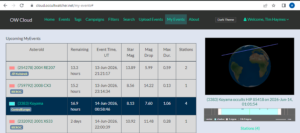
Explanation: The highlighted event is show on the World Map to the right. The pale-blue strip (shadow) indicated the relative positions of 4 planned observations. The observers may be separated in longitude by many 100s of km. It is their position across the track that is important for established the approximate shape of the asteroid and its position. These events will be available in Occult Watcher desk top app when installed.
Figure-2 OWC World Map expanded: prediction for (3383) Koyama
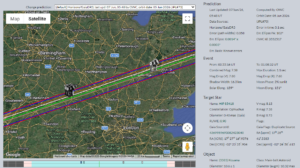
Explanation: Predictions indicate the shadow path as far as is known. We don’t know where the shadow will pass exactly. We observe from our back gardens. More experienced observers have used a mobile telescope to get nearer to, or in the path. In this example one station has a fixed and a mobile telescope not far away.
Data table to the right shows: Combined magnitude (Gaia-G), Mag. drop, Maximum duration, coordinates, RUWE. etc.
RUWE: This is a unit-less number indicating errors in the Gaia star position. If the value is >1.4, this might effect the path or suggest the star has a companion. Observers should check the value and continue with observation. The resolution of Gaia is about 0.1 arcsec. This seems incongruous when astrometry is to 1/1000 arcsec !
Map Colour Code: (lines):
Green: Mid-line where the maximum duration can be expected.
Blue: Shadow edges. Significant uncertainties arise here. We don’t know the shapes. The width is based on a circular diameter.
Red: Indicates overall errors in the path. There is still a 68% probability of an occultation in this region.
White: The chord occupied by the observer.
Orange: Chords occupied by other observers.
3. Prediction Sources:
Source On-line resource Author Notes
IOTA https://asteroidoccultation.com/ S Preston Predictions as Occelmnt (*)
IOTA-ES https://call4obs.iota-es.de/ O.Kloes Favourable European events
OWC https://cloud.occultwatcher.net/ H. Pavlov Prediction to 15th mag
OW https://www.occultwatcher.net/ H. Pavlov Windows Desktop App.
BAAH https://britastro.org/wp-content/uploads/2025/12/BAAHandbook2026_Digital.pdf~
GOFFIN https://www.bedekkingen.vvs.be/predictions/ E. Goffin Comprehensive Maps
CORA https://astro.kretlow.de/cora/occultations/ M.Kretlow Predictions+observations.
(*) The Occelmnt file is displayed in Occult4. Events may be filtered by region and brightness, and then displayed as a World Map.
4. ARPS Occultation Observing Program
Observers taking part in our program are invited to contribute to one or more activities to further the aims of the occultation group, by:
1) recording and reporting the time of disappearances and reappearances (Main Aim)
2) be alert to the possible detection of double stars and any unexpected phenomena
3) specialisation in e.g.: small objects, those with suspect moons, or unusual shapes
4) contributing to PRO-AM projects (e.g.: Lucky-Star, GaiaMoons, NASA/ESA )
5) helping with non-observing actives such as checking reports, and analysis.
6) Becoming part of an informal team of nearby observes, who record the same predictions with the aid of Occult Watcher software.
Figure-3. (657) Gunlod. Two observers (London and Reading) record a positive, while a third (at Oxford) recorded a Miss.
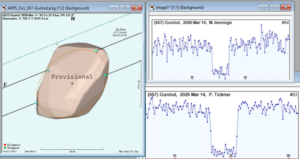
Explanation: While many predictions are recorded by just one observer (a single chord), this event was observed at three locations. A provisional outline model is included by Occult software, while the Miss forms a constraint on the overall shape.
The right hand panel shows the the light curves recorded by the observers. Durations were: 3.20 sec and 4.77 sec.
5. Familiarisation work-flow.
These notes are intended to guide new or more seasoned observers towards making successful observations of occultations:
- Set up and test a telescope with a CMOS camera recording system.
( a SCT may need a focal reducer to F/6). Obtain your Long/Lat from Google Earth. - Estimate the camera’s magnitude limits at various exposures (0.5s, 0.1s, 0.05s)
Use a familiar star cluster where you can judge the magnitudes, or use a variable star field. - Use Occult Watcher Cloud (OWC) to select predictions to observe. Stars brighter than 12.5 with maximum duration longer than 1sec, would be a good starting point. See also the BAAH.
- Use Tangra software to get a light curve of the recorded target star. Was there an occultation?
- Report initial observations to the Section via email, or use Zoom to discuss.
- Report observations to the European Database SODIS (Section will advise)
6. Planning to observe.
The OWC map [Figure-2] can be used to announce a station by right click on the map and adding a few details. This is an important step in the collaboration process and will allow an observer to make a preliminary report. A site name is usually the home of the observer, or possibly a society observatory.
An intention to observe is a “planned observation”. We can report: “No Occultation”, or “Positive”. This give feedback to other observers in the path after the event time has passed. There is free text to describe a “no observation”. Eg Clouded out !
7. Occult Watcher on your desktop (OWD)
The information displayed by OWC is also available through OccultWatcher Desktop (OWD) app. This is very handy for the keen observer using Windows (7, 10, 11). OWC and OWD work together. (same password.)
Google AI says: “ OccultWatcher is a tool for astronomers to track, coordinate, and observe stellar occultations. It allows users to browse event predictions, determine optimal observation locations on a global scale, and communicate with other researchers.”
The OccultWatcher application is also the starting point for preparation of the European report.
8. Which Telescope?
A medium size telescopes ( C8 to C9.25 or Newtonian) would be ideal. ( SCTs should be used with a focal reducer). The writer has used a 6”F/4 on some occasions. A 3 or 4” objective can be used for brighter stars. It will become apparent, that recordings with an exposure of 0.1 sec, require a lot of light (see Table-2). Some have asked if Smart Telescopes are a possible occultation devices.
An investigation with S50 was conducted by Dr. C. Weber (IOTA-ES). The paper is <here>. We are grateful to Dr. Weber for this evaluation.
Table-2 GUIDE to DETECTION LIMITS
Aperture and limiting magnitude for a mono CMOS camera exposure 80ms (approx’ data)
Ap./mm Vmag* number of observable predictions**
80 9.9 3
150 11.2 10
200 11.9 15
280 12.7 30
(*) Magnitude of star giving a usable detection limit (Signal/noise > 5) with a short exposure (80ms)
Exposures up to 200ms are usable.
(**) sample of predictions over a 3 month period ( Will vary during the year )
Table-3 Cameras
Use whatever camera you have. Most observers have USB3 CMOS. Mono is preferred over colour. If you plan to upgrade your camera specificity for occultation work, here are manufactures who offer GPS timing build into the camera.
QHY: QHY174mGPS Cooled (TEC) Global shutter. Requires SharpCap software
DVTI+Cam IMX174 and 430. Passive cooling. Global shutter. Software developed by the company.
Many users across Europe. Optimised for fast frame rates.
Other non-GSP cameras: Mono preferred, e.g Touptek 585 and similar. Requires external time sync.
WATEC: WAT910-HX/RC integrating camera with exp 0.04 /0.08 /0.16/ 0.32s up to 5 sec.
Analogue video requires a GPS video Time Inserter: BlackBoxCamera Sprite-3
9. Exposure
A general rule is to expose at one tenth of the maximum occultation duration. For a 1 sec duration event, use 0.1sec. (10 fps). There are situations where the optimum exposure will be different or difficult to obtain. The aim is for a clear recording. This will take a little practice. Sometimes we may be forced to increase exposure if it goes cloudy or foggy and use say 4 to 5 frames across the diameter.
The light curve analysis requires at least a 3 frame evident duration to be a “definite” occultation. One or two frame events are classed as “probable or possible.”
Advice here is to make the observation (and not loose the opportunity) and decide later if it recorded anything. A great number of observations are lost to the weather. This is expected, not to mention annoying technical problems that get in the way.
10. Timing
Accurate UT is necessary for a reliable observation so that country and world-wide results can be aligned correctly. We ensure our computer clock is managed by GPS or NTP to minimise any time drift. A PC clock is erratic, and can gain or lose seconds in as many days. Moreover image frames may not appear in chronological order. This is not a concern for long exposure imaging.
GPS and Network Time Protocol (NTP) can be used to synchronise our computer clocks to UTC. The recording software then uses the PC clock and a time stamp is added to the CMOS frames recorded as SER, FITS or ADV.
Time stamps are inserted by the recording software.
The GPS cameras in Table-3 don’t require time corrections. This simplifies analysis of the video with Tangra,
There will be a separate page on the subject of “Timing”. Some of the fore going will be moved.
11. Delay times and offsets –
The observer should be aware that there is an operating system delay when writing the files to disk. (This does not apply to dedicated GPS-cameras ). The system delays need to be assessed to establish correct UT on the recording. The correction depends of the computer system in use. W10 and 11 are preferred. We are talking about a delay in the range 10-50 ms for NTP.
If PC time corrections are made via a USB port, the delay can be longer. The corrections can usually be applied with the analysis software.
Table-4 Software and Hardware for recording and time calibration
SharpCap 4.1 – many cameras usable. Frame time added. Designed for QHY174mGPS
Firecapture. Used by Planetary imagers. Also asteroids ?
Time sychronistion software for PCs
Dimension4. (free) Rapid synchronisation, but should not be used during the observation.
Meinberg NTP (free) Well controlled clock sync to time servers. Can be recommended.
NMEATime2. (license?) Uses a GPS/GLONAS usb receiver. Usable if no internet. Can be used in combination with a flash timing method where the GPS 1sec LED pulse (100ms) is directed into the OTA and recorded. Time offsets can be corrected this way.
https://occultations.org.nz/meetings/TTSO18/Camilleri%20-%20Flash%20Timing.pdf
Table-5 Hardware
Raspberry Pi Build your own GPS system to discipline the clock. (Internet search)
TIMEBOX I https://www.shelyak.com/timebox-to-accurately-measure-an-occultation/?lang=en
TIMEBOX II https://www.shelyak.com/wp-content/uploads/TimeBoxII-User-Manual.pdf
A minuturisedver of TIMEBOX 1. Note section 4.2.2 that describe how to find the OS time lag.
Flash Timing A 1pps GPS flash can be inserted in the optical path to calibrate the displayed time. This requires that the PC time is already not-more-than say 300ms from UT. The GPS flash Dongle is a cheap buy on Amazon
https://occultations.org.nz/meetings/TTSO18/Camilleri%20-%20Flash%20Timing.pdf
12. Analysis of occultation recordings.
Advice is available from the Section or Uses Group (document, or video). There is standard software to do this. (Tangra, Occult4, PyMovie, PyOTE). New observers can send their recordings to the Occultation Coordinator for analysis, where it will be processed on the observers’ behalf.
The first step in the analysis is to create the light curve using Tangra, It is a simple operation to load the video and select the target star.
Table-6 Data reduction and Analysis software
Tangra: Written by Hristo Pavlov. Measures the occulted star and displays a light curve.
Occult4 Tools by D. Herald. Requires installation of Occult 4 to use the AOTA tool. Not needed immediately by the new observer.
C2a planetarium – Is used to display a star map and can be integrated with OccultWatcher.
UCAC4 catalogue – Can be downloaded (8 GB). Used by C2a. (The Section has a copy – send a 16G SDXC card and sae.)
Occult Watcher – Provides the input file to the SODIS database
More software available on the IOTA web site https://occultations.org/observing/software/
13. Reporting asteroid occultations
Reports are uploaded by the observer to a database named SODIS. Details and advice on how this is done is available from the Section Coordinator and through the UKoccultation user group, or on the IOTA-ES web pages https://iota-es.de/
By joining the PLANOCCULT mailing list observers can see the better occultation reports submitted by other observers. The ARPS Director, Richard Miles, and ARPS Occultation Coordinator, Tim Haymes, are members of PLANOCCULT and can advise on reporting. Reports are now submitted to SODIS.
14. Results
Euraster archived data 1996 to 2022 https://euraster.ericfrappa.com/
Mike Kretlow’s CORA https://astro.kretlow.de/cora/observations/
SODIS observer login. Contact SODIS https://sodis.iota-es.de/
UK report summary can be seen here: Log File (external page)
Figure-4 (426) Hipp0 observed on 2025 Sept 13, when it occulted UCAC4 579-000308, a 12.1 mag star in Pegasus.
One of the best result of 2025. The profile is well defined. The longest chord was 8.5 sec duration
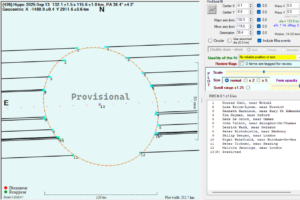
Explanation: A best-fit ellipse is drawn through the points, D-phase is on the right side, an R-phase on the left. The blue dots contain the timing errors, but they are two small to see at this scale. The dotted pink line is the predicted mid-line and the spot marked in the middle of the plot is the mid-time. The observations indicate a very close agreement between observation and prediction in this example.
15 Conclusion
You have to be fairly dedicated to do this stuff. There used to be the ‘Rule of Ten’ i.e. for every 10 occultations you prepare for, the weather will wash out 9 of them and for every 10 you actually observe you may get one ‘Positive’. Now that predictions are much more accurate, the chances of observing a positive occultation are substantially higher (1 in 3), but of course the weather still prevents observations in a lot of cases–! Remember for those observing close to the edge of the predicted track, ‘Negatives’ are just as important as ‘Positives’. With predictions continuing to improve, the ratio of ‘Positives’ to ‘Negatives’ is steadily increasing. So please do get involved as the more observers there are, the more clearly we can derive the shape and size of these distant objects. And you have a good chance of discovering something new.
Hopefully the foregoing will motivate you to give it a try. Just remember that the greater the effort put in, the more rewarding is the actual success when it comes – Good luck.
Tim Haymes and Richard Miles.
==================================================================
Download OWD: https://www.occultwatcher.net/
Seek advice on UKOccultations User Group: https://ukoccultations.groups.io/g/main
===================================================================
Return to the Tools and Techniques Section
Return to the Asteroids & Remote Planets home page
| The British Astronomical Association supports amateur astronomers around the UK and the rest of the world. Find out more about the BAA or join us. |