
2025 December 3
Deep Sky Update – November 2025
November has not been a great observing month – a couple of clearish nights, but not very transparent. And no ‘big’ auroral displays, just low altitude glows with occasional rays. Hopefully December when we get to the dark of the Moon conditions will be better.
Section Meeting – 2026 March 28
I have made progress with arrangements for the section meeting on 28th March. Speakers confirmed are:
Mike Greenhill-Cooper – My Astro-imaging Obsession
Jonathon Elliott – A Gloucester Observatory
Bryan Lawrence – Adventures in Auriga
Owen Brazell – TBA
Andrew Stephens – The Andromeda Galaxy
Prof. Albert Zylstra – Planetary Nebulae
Tickets are now available for purchase. £20 for non-members and £15 for members using the discount code.
The discount code for BAA members is shown here if you are logged in or you can access the BAA Discount Codes document.
And for more details as they become available keep an eye on the event page.
Papers
I noticed a couple of interesting papers in November.
The first concerns using Type 1a Supernovae as standard candles, which might not be so ‘standard’ as previously thought depending on the progenitor star. The implications on the recession velocity of distant galaxies, the Hubble Constant, and the Hubble Tension could be significant.
Here is the full paper: https://academic.oup.com/mnras/article/544/1/975/8281988
Another interesting paper concerns the Pleiades open cluster. Research using TESS and Gaia data have found tidal tails and connections to associated clusters that form the Pleiades Complex which comprises over 3000 stars. I suppose it might be ‘fun’ to try and track some of these down, but most are very faint, and the tabular data provided lists absolute rather than apparent magnitudes, so some work would be needed to determine which might be visible.
The paper can be found at: https://iopscience.iop.org/article/10.3847/1538-4357/ae0724
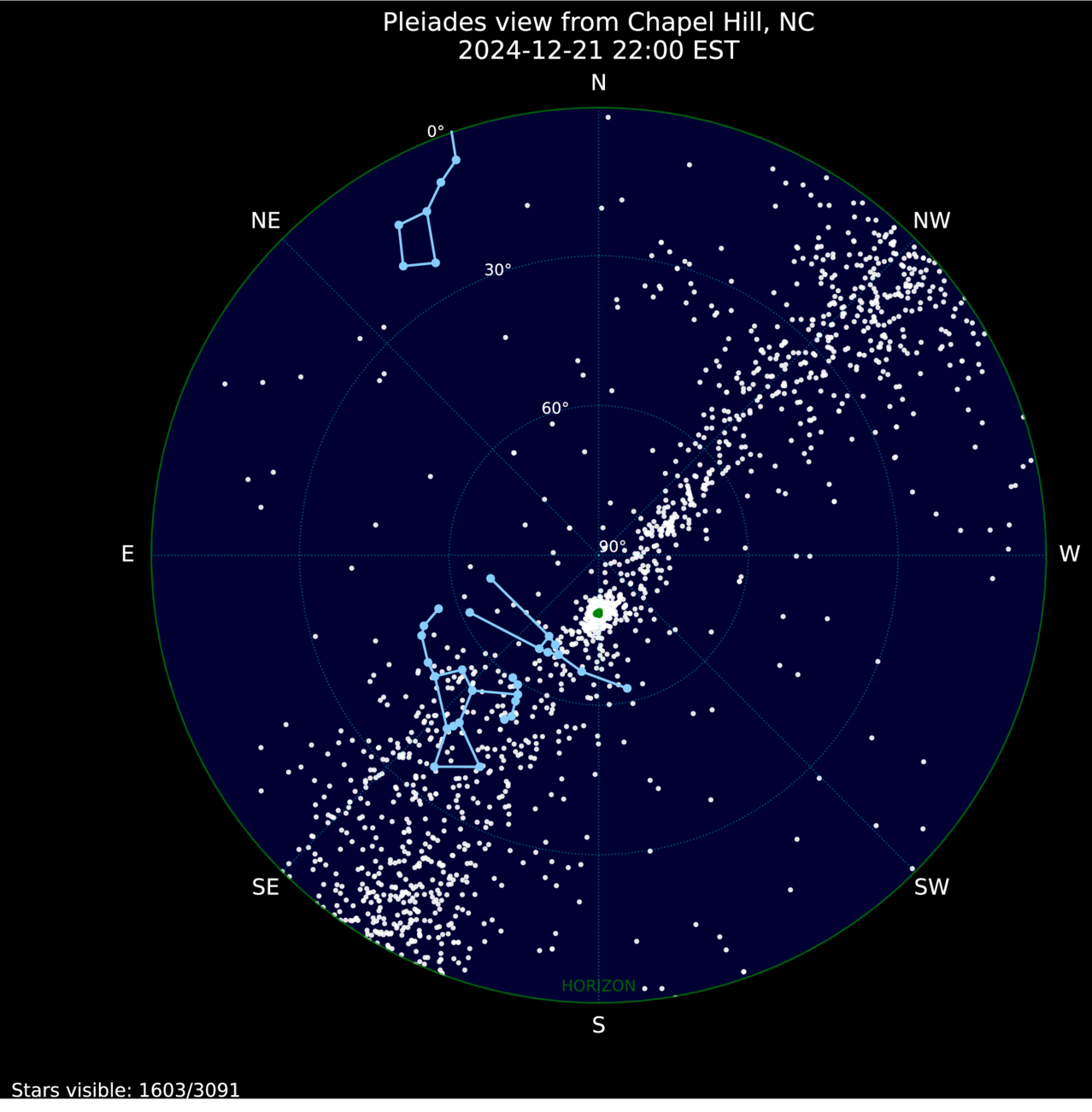
Fig 15. The full extent of the Greater Pleiades Complex as it would appear on the night sky if all stars from our membership list were visible to the naked eye. The seven brightest stars in the Pleiades are shown in green, while the stars from our membership list are shown in white. The Big Dipper, Orion, and Taurus are overlaid in blue. Of the 3091 stars in our membership catalog, 1603 are above the horizon at the selected observing conditions. The plot is oriented to match what an observer looking to the South would see.
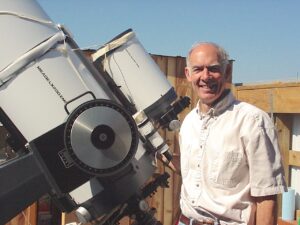 Jack Newton 1942-2025
I was sad to hear that pioneering astrophotographer Jack Newton passed away on 11th November. I remember meeting Jack in the 1990’s when he gave a talk to Macclesfield AS and I think he was doing a ‘tour’ of the UK. He may also have talked to the BAA/TA He co-founded the Arizona Sky Village and had summers on Anarchist Mountain in British Columbia and winters in the USA. His astrophotography on film was ground breaking, but he also kept up to date with CCD technologies.
Double Stars for December – Peter Morris
This month I leave the Zodiac and move down to Eridanus. The best double star in this southern constellation is 32 Eridani (STF 470). The primary is magnitude 4.8 and the secondary is 5.9; the position angle is 348.9°. Their spectral types are G and A, and they are usually seen as yellow and blue, although some observers see the secondary as green. With a separation of 6.9 arcseconds, they are fairly close together and benefit from a fairly high magnification, but they should be easily split with a small to medium telescope. Although the separation has increased since the double was first recorded by William Herschel in October 1781 (H II 36), the position angle has hardly changed and unusually for a double star nowadays, it is still uncertain if it is a binary star or not. 32 Eridani is a triple star, but the purely optical companion C is very dim (mag. 10.5) and will require at least a medium sized telescope. With a position angle of 4.5° it is much further out at 164.7 arcseconds.
Below 32 Eridani is the interesting binary 40 Eridani (STF 518), also known as Keid or Omicron2 Eridani which is only 16 light years away from us. The main star is magnitude 4.4 and the secondary is a dim 9.3; the position angle is 101.7°. While it may be dim, the secondary is very interesting as it is the easiest white dwarf to observe. Sirius B is both dimmer (9.9) and difficult to make out in the glare of Sirius. The nearest solitary white dwarf, van Maanen’s Star in Pisces, is very faint at magnitude 12.4. But it gets even better. The secondary can be split into the white dwarf (B) and a red dwarf (C) which orbits it with a period of 233 years. The red dwarf is magnitude 11.2 and the separation is currently 7.8 arcseconds (and narrowing); the position angle is 328.6°. It is easiest red dwarf to see in the northern sky as the brightest solitary red dwarf, AX Microscopii (mag. 6.7), is invisible from the UK (but is visible from the southern USA or Portugal). While it is challenging in smaller telescopes, I have seen it in a 5-inch Mak-Cas. The main star is spectral type K and the colours are usually seen as being yellow, dark blue and dark blue, but it has been said that the two companions are white and pale red in a large telescope.
Moving south-east from 40 Eridani, we reach our last target, 55 Eridani (STF 590) which is a nice easy double as the two stars are practically the same brightness (their magnitudes are 6.74 and 6.78) and the separation is 9.3 arcseconds; the position angle is 317.8°. Again, it is uncertain if it is a binary or not. There have only been slight changes in both the separation and the position angle since it was first recorded by Herschel (H III 99) in January 1783. The spectral types are G and F, and they are both usually seen as pale yellow.
Object of Interest for November
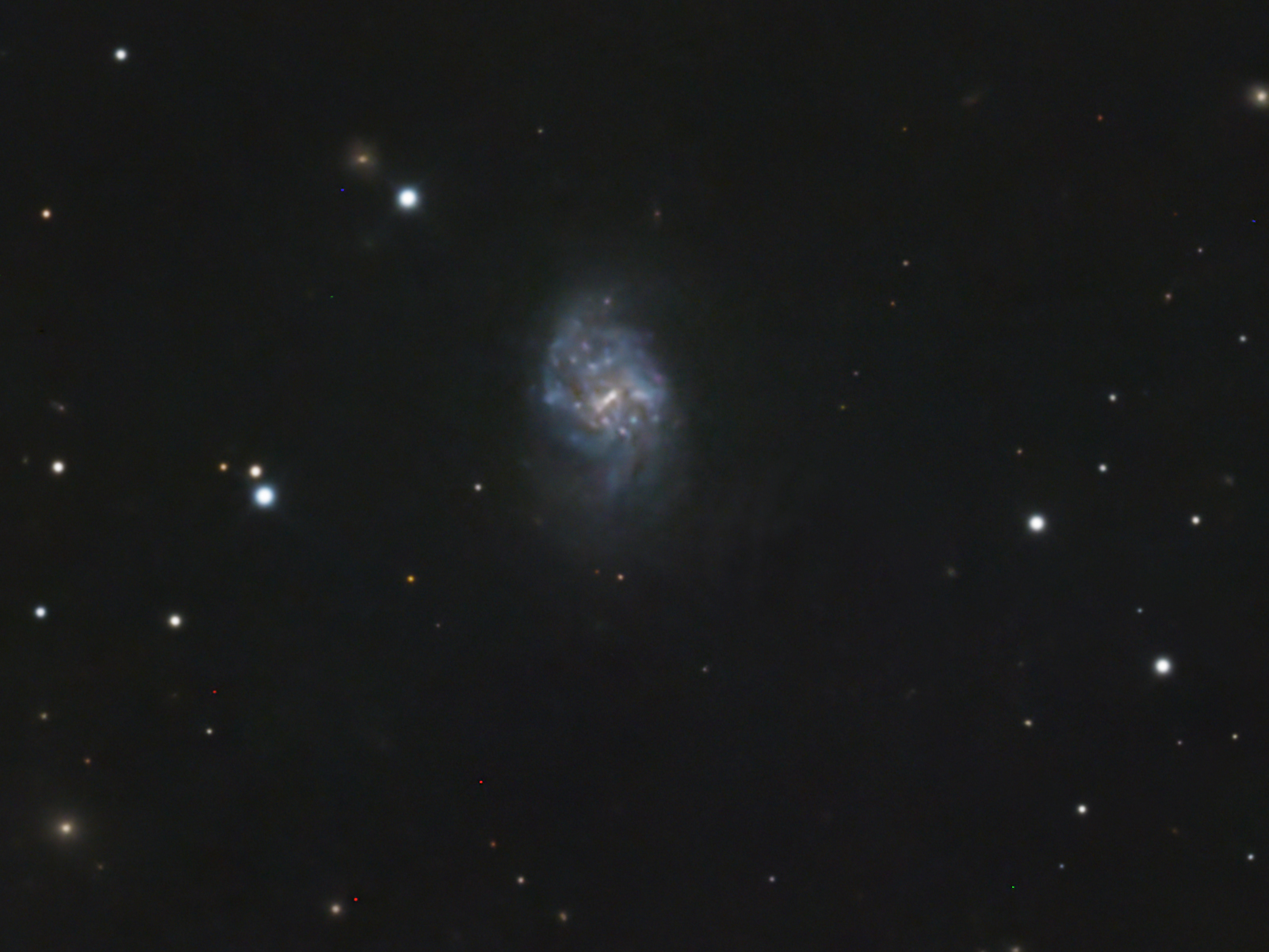
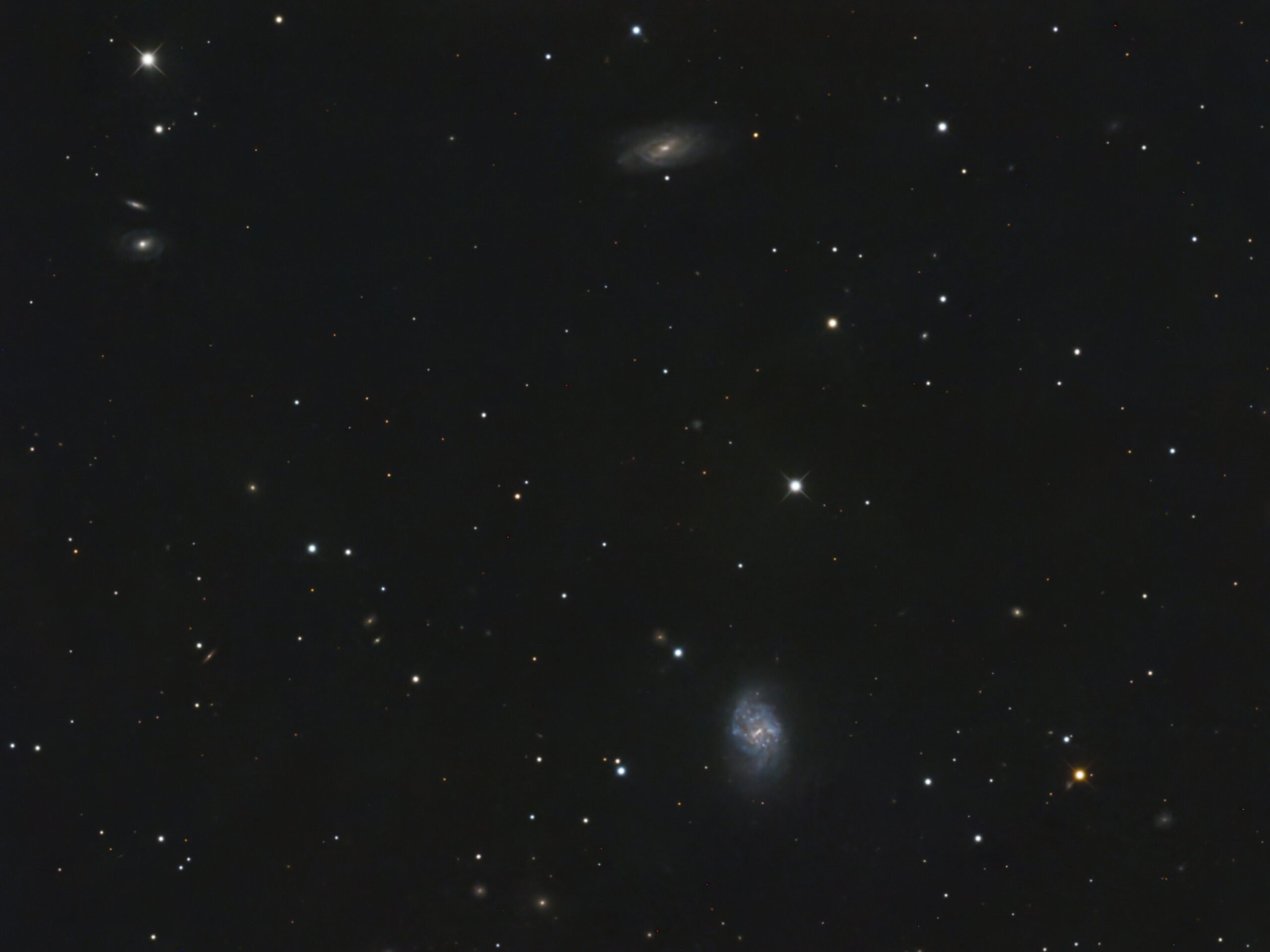
The November target was NGC 1087, an interesting galaxy in Cetus. Nice observations received from; David Davies, Paul Whitmarsh, David Strange, Mark Fairfax, Iain Cartwright, Tim Haymes, and Jonathon Elliott. Many thanks to all.
This crop of an image by David Davies shows the structure of the galaxy well. And below is David’s wide-field view.
December Object of Interest
For December Jim Latham has picked NGC 1501 a planetary nebula in Camelopardalis. Known alternatively as the ‘Camel’s Eye’ or ‘Oyster’ nebula or ‘Blue Oyster’ (if you have a cultish taste in music). It lies at the end of Kembles Cascade so fairly easy to find, and also a chance to look at the open cluster NGC 1502. It’s about 1 arc-minute on the sky, so a challenge for imaging but I am sure many will have a go.
Deep Sky Picture of the Month
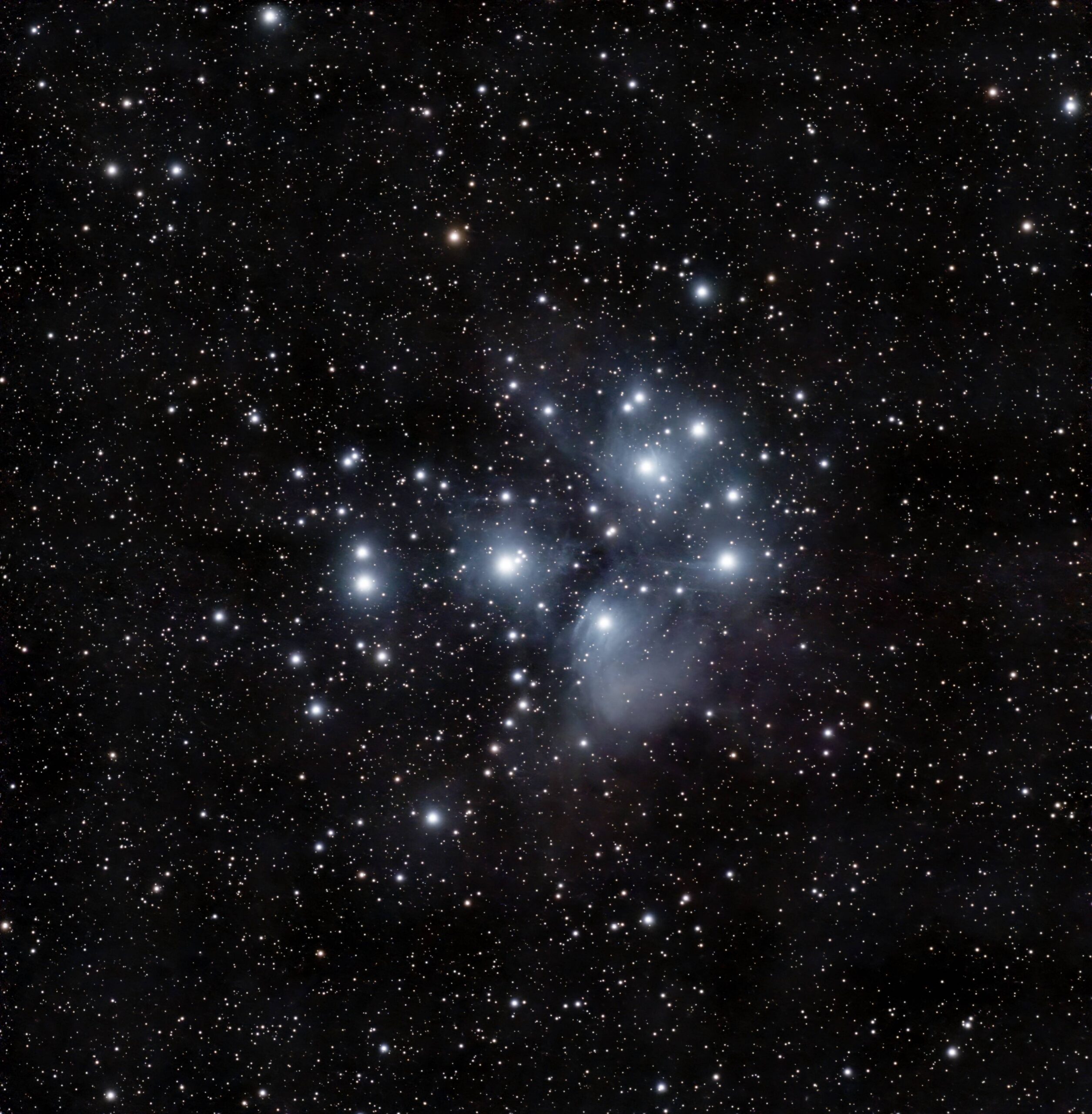
Observers made 195 observations of deep sky objects in November alone, so a lot to go through. It is amazing the quality of imaging we have in the BAA, and what can be done with basic kit. As I have been thinking about the wider Pleiades in the paper mentioned above, I thought it would be nice to pick this image of M45 by Andrew Wilson, a two pane mosaic made using a Dwarf 3 smartscope.
And Finally
I was looking back at the Deep Sky Notes part of the section website, and saw it has been a while since we have had a new note. It would be great to have a few more Notes – so please send me some material. These could be on observing projects, notable images or observations, your astronomical journey,or anything vaguely connected to Deep Sky Observing will be of interest. If you have any ideas for an article and want to discuss, please get in contact. Editing will be very light-touch!
And finally, it is now December and the next Update will be out in 2026, so I hope in the meantime you have a Good Christmas and a Very Merry New Year!
Clear, dark skies,
Callum
| The British Astronomical Association supports amateur astronomers around the UK and the rest of the world. Find out more about the BAA or join us. |