
› Forums › Spacecraft › Artemis II mission
Tagged: Artemis II Orion Moon
- This topic has 16 replies, 6 voices, and was last updated 6 months, 1 week ago by
 Alex Pratt.
-
AuthorPosts
-
26 March 2026 at 10:37 pm #636793
 Alex PrattParticipant
NASA is getting into gear to have lots of coverage of this mission:
https://www.nasa.gov/news-release/nasa-sets-coverage-for-first-artemis-crewed-mission-around-moon/
You can also register as a ‘virtual attendee’ and receive mission updates, resource material, etc to your e-mail Inbox:
https://www.eventbrite.com/e/nasas-artemis-ii-mission-launch-registration-1074571685839?aff=vgotsite
(Link takes you to Eventbrite for a free ‘launch ticket’)
There’s also a link to track the Orion craft in space:
https://www.nasa.gov/missions/artemis-ii/arow/
although I guess this will be a graphic of the mission’s progress rather than astrometric-quality coordinates such as:
https://ssd.jpl.nasa.gov/horizons/
or Bill Gray’s Project Pluto:
which will publish ephemerides after the spacecraft has left Earth orbit.
Alex.
28 March 2026 at 8:56 pm #636800 Nick JamesParticipant
If the launch takes place as currently planned (April 1, 22:24 UTC) we may be able to see the Trans-Lunar Injection Burn from the UK 25 hours 37 minutes later so around 2026-04-03 00:01 UTC although the spacecraft will be low above the SW horizon. An ephemeris is available from JPL Horizons.
From Chelmsford the spacecraft rises around 23:49 on April 2 and at the time of TLI it will be 10 deg up at an azimuth of 209 deg.
Almost 60 years ago, on 1968 December 21, Chris Taylor saw the Apollo 8 TLI from Chelmsford. There is a really good S&T write-up here:
https://skyandtelescope.org/stargazing-and-observing/stargazers-corner/apollo-8-view/
I would like to reproduce that observation!
30 March 2026 at 8:45 am #636806Alex PrattParticipantGood luck with that project, Nick. (Looks like more clouds and rain for me).
Yes, JPL Horizons now have ephemeris details for the mission:
https://ssd.jpl.nasa.gov/horizons/app.html#/
Edit Target Body to be Artemis II
Select a Location or MPC observatory code
Select a Start Time after 2026-04-02 01:47:08
Select a Stop Time and Step interval
(Times are UTC)
Click Generate EphemerisAlex.
31 March 2026 at 10:28 pm #636823 Nick QuinnParticipant
Unfortunately this post on Seesat-L: http://satobs.org/seesat/Mar-2026/0111.html highlights a change to the mission timeline as posted on JPL Horizons. The TLI burn is now scheduled from MET 1d 01:08 for 8 minutes, i.e. April 2 23:32 – 23:40 with the spacecraft still below the UK horizon (based on a launch at April 1 22:24hrs.
Earth shadow entry is at 23:54hrs with the spacecraft at 7 degs elevation from the Sussex coast, so even an observation of a propellant dump is going to be just about impossible. A launch later in the window won’t change the visibility of the TLI burn for the UK and probably moves it into the Earth’s shadow – although perhaps a 1.5/2 hour delay moves any fuel dump back into sunlight?
1 April 2026 at 6:22 am #636824Nick JamesParticipantThat’s a shame, but it was going to be a difficult observation anyway. Still worth keeping an eye on the launch time and ephemeris for interesting opportunities from the UK.
2 April 2026 at 5:25 pm #636842 Steve KnightParticipant
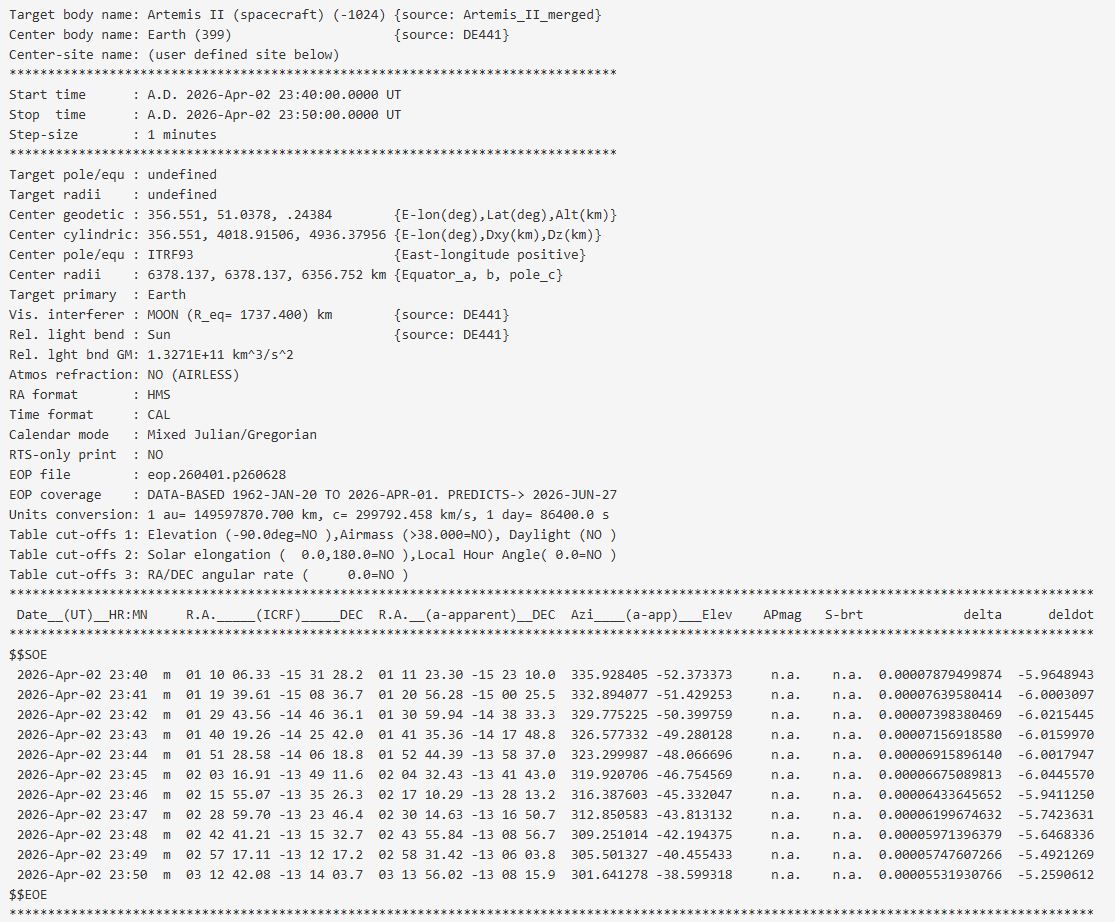
Help required. When I use Horizons to generate RA and Dec for the 23.43 UT TLI burn RA and Dec are 49 degrees below horizon with it rising 10 hours later. I am obviously doing something stupid. I just don’t know what!
Attachments:
2 April 2026 at 5:40 pm #636844Nick QuinnParticipantThe table is correct: the burn takes place well below our horizon. If you run the predictions past 23:50hrs. you should see it rise at about 00:07hrs (on the 3rd). I’m not sure where you got the 10 hours from!
2 April 2026 at 6:01 pm #636845Steve KnightParticipantCopy that Nick! Situation now nominalish, duhh, I was looking at rise time of RA and Dec when burn started and finished. Can you pull out of the Ephemeris when Artemis in Earths shadow?
-
This reply was modified 6 months, 2 weeks ago by
 Steve Knight.
2 April 2026 at 6:05 pm #636846 Grant PrivettParticipant
That is entirely my mistake I fear – see other Artemis thread.
JPL Horizons currently gives:
Rises above 10 degs 00:17 UTC
Culminates (15.07) 00:52 UTC
Drops below 10 degs 03:42 UTCJPL says launch was at 22:35:12UTC
It further says “Launch + 1/01:08 – Star Translunar Injection Burn”
I read that as 1day + 1hour+8min or 23:43 UTC but somehow converted it to 00:43 BST – a dumb BST/UTC mess up on my part.
Apologies to all.
We will miss the burn, but it will reach 15 degrees from the south coast!
Lets hope it stays clear.
-
This reply was modified 6 months, 2 weeks ago by
 Grant Privett.
3 April 2026 at 3:58 pm #636889Nick QuinnParticipantCan you pull out of the Ephemeris when Artemis in Earths shadow?
I don’t think you can; unless somebody knows otherwise!
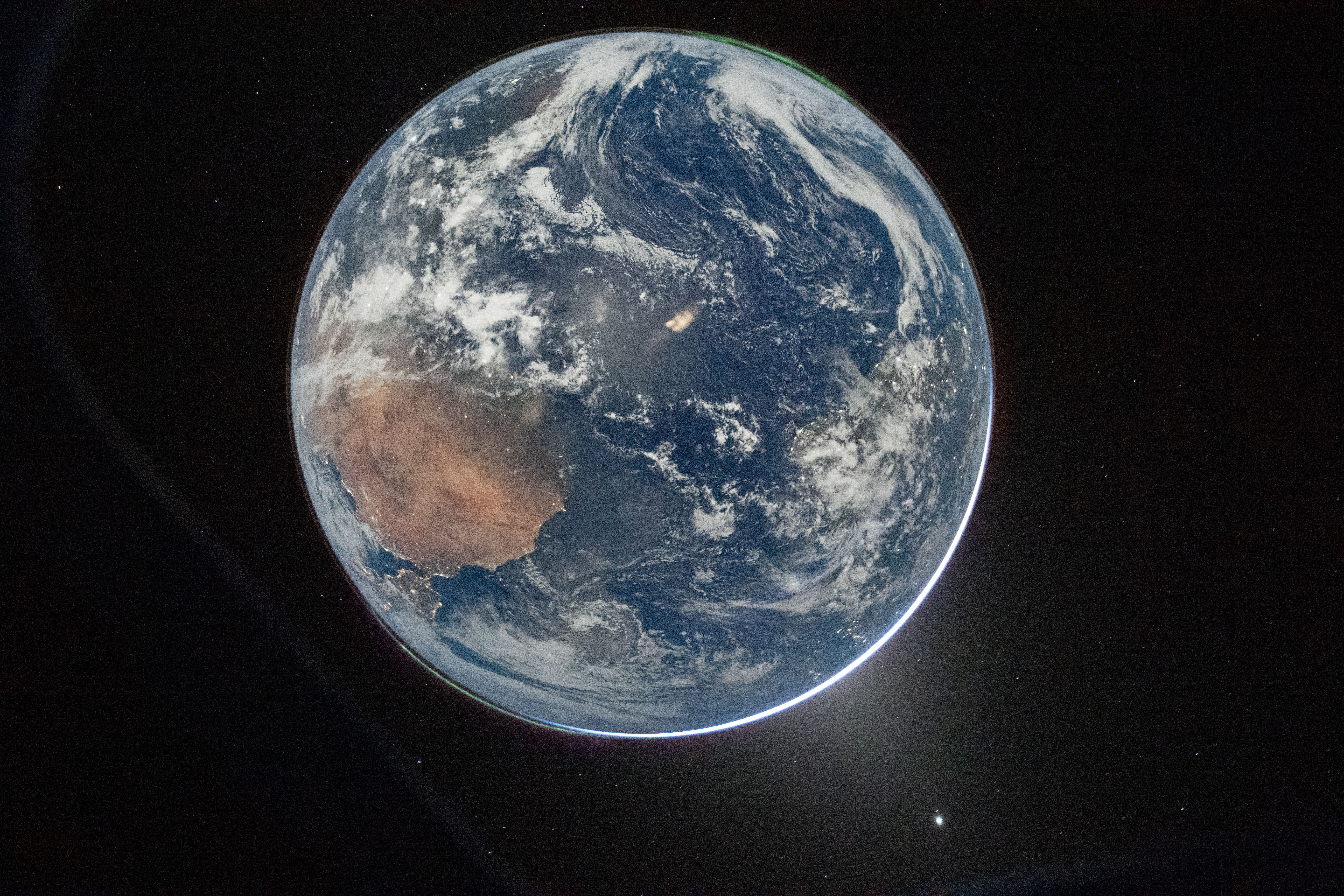
3 April 2026 at 4:34 pm #636892Steve KnightParticipantIncredible image by Reid Wiseman of moonlit Earth after TLI burn. South at top (of course). Aurora and Zodiacal light visible. Is that Venus bottom right?
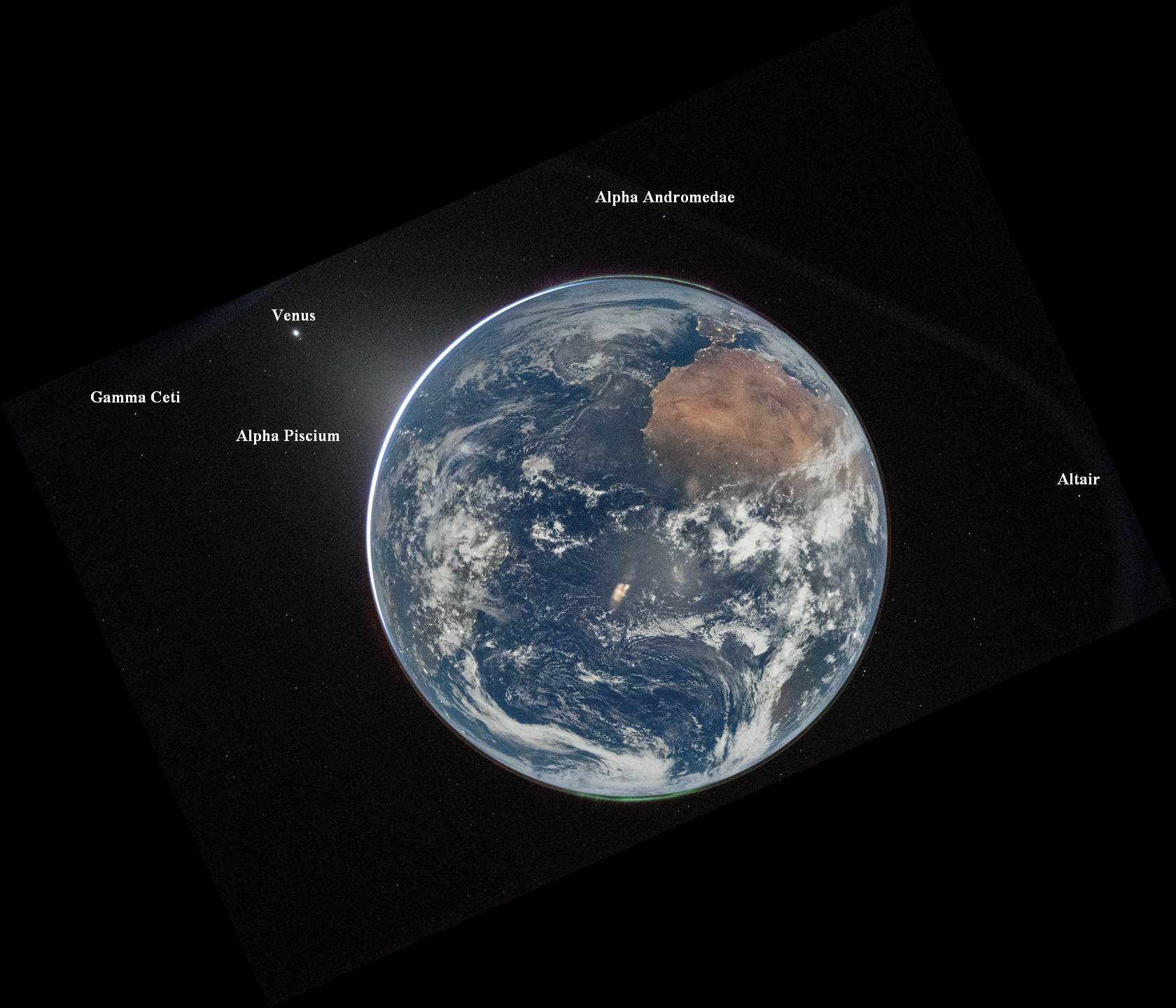
3 April 2026 at 5:10 pm #636893Steve KnightParticipantI think that is Venus. Rotated image so north is at top and tried matching objects. Alas Mercury seems to be behind our planet.
Attachments:
3 April 2026 at 5:54 pm #636895 Dr Paul LeylandParticipant
I think that is Venus. Rotated image so north is at top and tried matching objects. Alas Mercury seems to be behind our planet.
Hey, you can see my house from there!
Well, La Palma anyway. Tenerife and Gran Canaria show up particularly well, likely because the former still has snow on Teide which fell from storm Therese whereas the latter, as the name suggests, is the biggest of the Canary Islands. El Roque, on La Palma, also has snow on it which is why La Palma is easily visible despite it being relatively small.
Incidentally, that storm dumped 419mm of rain on me which is about nine months typical rainfall. A significant amount came through the roof and ceiling. 8-(
4 April 2026 at 3:26 pm #636901Nick JamesParticipantThat really is a beautiful image. The full-sized image is here:
https://images-assets.nasa.gov/image/art002e000192/art002e000192~orig.jpg
the EXIF suggests that this was taken using a Nikon D5, 22mm, f/4, 1/4s, ISO 51200. Apollo 8 had the famous Earthrise photo. I think this is better.
4 April 2026 at 6:16 pm #636903Alex PrattParticipantHi all,
There’s interesting astrometry, images and discussion threads on MPML (Minor Planet Mailing List, archive visible to anyone)
https://groups.io/g/mpml/topic/astrometry_for_artemis_ii_and/118627349
https://groups.io/g/mpml/topic/artemis_movie/118648043
Caveat emptor – I never follow links to so-called ‘social media’ especially requiring logins, passwords, tracking me etc, so I can’t comment on those.
Alex.
6 April 2026 at 7:31 pm #636926Alex PrattParticipantThe Moon certainly looks strange and unfamiliar as viewed by Artemis II as we see more of the ‘far side’ features.
Alex.
9 April 2026 at 10:36 pm #636961 -
AuthorPosts
- You must be logged in to reply to this topic.