
› Forums › General Discussion › Astronomy communities
- This topic has 19 replies, 11 voices, and was last updated 2 days, 10 hours ago by
 Robin Leadbeater.
-
AuthorPosts
-
20 August 2026 at 9:50 pm #642543
 Grant PrivettParticipant
Recently, I went to Spain for the eclipse and stayed in some shared accomodation with a bunch of people who regularly photograph the sky and who have taken some very, very impressive pictures.
But while chatting with them over the couple of days I realised that their astronomical worlds and mine had remarkably little crossover. None appeared to be BAA members and one didn’t even appear to be aware of it – which I found kind of shocking. Yes, we all liked clear dark skies and getting outside under the stars, and were happy to chat telescopes, but there seemed to be a community of observers with no interest in, nor reason to associate with us – which is a shame, though hardly the end of the world.
Even so, I have been trying to fathom out how this comes about. Is it the case that many are solely centred on the aesthetics of the imagery rather than what is represented and so can find all the community and advice they need in Stargazers Lounge/Cloudy Nights/Astrobin/youtube? Is it that the internet is now so dominant as a force that the BAA is marginalised by search algorithms for reducing advert clicks or is it that I am just a stupid old man shouting at clouds?
This had me thinking and I wondered what others think.
However, I do see one possible ray of hope. In this world, with AI on the rise and Cory Doctrow’s graphic description of what is happening to the web becoming so apposite (some image processing suites now use techniques that employ prior knowledge of the target to “enhance” the image), I wonder how long it will be before some of these sites become so burdened and polluted by AI agents that some are rendered nearly unusable by company generated “characters” slyly promoting their equipment and no longer something you can rely on as sources of personal “hands on” experience.
Will the BAA end up seeing a resurgence as other sites become increasingly untrustworthy?
21 August 2026 at 12:47 pm #642548 Robin LeadbeaterParticipant
Hi Grant,
I think to engage people interested in the science side of astronomy you have to be where the largest numbers who might be interested can be found which is in the astro forums and the profile of the BAA is very low there.
I spend a lot of time out there in various groups engaging with people interested in spectroscopy, promoting spectroscopy, showing examples and helping them. While most of it is in the science sections of general astro groups or special interest groups (If you look at what is going on in the Cloudy Nights Scientific Amateur Astronomy subforum for example, there is some interesting stuff going on there), I also drop in on the “pretty picture” imagers from time to time to give a science view of what is in their images, show them a spectrum, explain why light leaks in their filters is turning the red stars in their narrow band filtered images into planetary nebulae etc which generates quite a bit of interest. As part of that I also try to raise the profile of the BAA where I can, linking to the gallery, video talks, spectra in the BAA database, section content etc which at least brings them to the BAA website. Jeremy is on Stargazers Lounge and there are a couple of others but generally I don’t often see other BAA members.
Concerning AI, it can only find the good stuff if it is out there. In Cloudy Nights there is someone building an impressive “point an click” application which can take an image full of slitless spectra taken using a Star Analyser and identify objects in it, generate fully calibrated spectra and roughly classify them. He is using AI a lot and commented that most of the queries about using the Star Analyser lead back to stuff I put out there.
-
This reply was modified 2 months ago by Robin Leadbeater.
-
This reply was modified 2 months ago by Robin Leadbeater.
21 August 2026 at 4:20 pm #642552 Dr Paul LeylandParticipant
Robin: I had enormous trouble getting CN’s Scientific Amateur Astronomy section created. Some moderators (mentioning no names in order to protect the guilty) were very antagonistic but a few were equally enthusiastic. The enthusiasts won out in the end, after what one moderator described as a “💩-storm” in the moderator’s community. The descriptive text:
A forum where amateurs can discuss their contributions to fields such as spectroscopy, photometry, astrometry, interferometry, and radio astronomy. Astronomical objects of interest may include variable and carbon stars, pulsars, supernovae, AGNs, exoplanets, asteroids, and short-lived energetic phenomena such as GRBs. The presentation of quantitative observational measurements, techniques used for acquisition, and relevant ensuing discussion are especially welcome.
is entirely mine, apart from the later addition of “and carbon stars”.
Your work promoting spectroscopy there has paid dividends. Kudos!
Other areas, especially photometry but including astrometry and radio astronomy also have a productive community.
FWIW, I am also a member of SGL. Amongst my other efforts, I annotate the plentiful images of M31 and M33 to show the locations of globular clusters, LBVs and Cepheids; explain workflow in photometry, and post an annual image showing the proper motion of Barnard’s star. Each of these have had a positive response. A few “pretty pictures” afficionados have asked for, and received, catalogues of globular clusters in Local Group galaxies so that they can track down more examples in their images.
I also plug the BAA, especially the ARPS and its asteroidal photometry programme in both CN and SGL.
The lesson, I suggest, that other BAA members should follow Robin’s and my lead in creating mass-audience sub-fora and in encouraging their readers to contribute material of scientific value. Beware: it may prove to be hard work.
Paul
-
This reply was modified 2 months ago by
 Dr Paul Leyland. Reason: Add SGL material
21 August 2026 at 6:40 pm #642555 Jeremy ShearsParticipant
I think Robin and Paul are right. Engaging via online fora is one of the best ways to show people the science side of astronomy. All 3 of us spend quite a bit of time on SGL. Robin is often posting about spectroscopy and Paul if often pointing out to imagers the interesting objects that are in the images of well known objects they post, like globulars in M31.I sometimes post about variable stars. It’s a matter of gently encouraging others to do more.
22 August 2026 at 12:54 am #642557Grant PrivettParticipantHi Paul,
I’m curious, what was it that some of the moderators objected to in scientifc amateur astronomy? Seems fairly innocuous.
I’m struggling to see how it causes offence.
Grant
22 August 2026 at 10:53 am #642561Dr Paul LeylandParticipantGrant: I really don’t know, not being privy to the detailed discussions. All I can report is what a couple of the supporting moderators passed on in private messages.
I don’t understand why the proposal was controversial either.
Paul
22 August 2026 at 10:54 am #642562Dr Paul LeylandParticipantI think Robin and Paul are right. Engaging via online fora is one of the best ways to show people the science side of astronomy. All 3 of us spend quite a bit of time on SGL. Robin is often posting about spectroscopy and Paul if often pointing out to imagers the interesting objects that are in the images of well known objects they post, like globulars in M31.I sometimes post about variable stars. It’s a matter of gently encouraging others to do more.
Sounds like a call to arms to me.
OK, so what is everyone waiting for? 🙂
12 October 2026 at 3:57 pm #643341iantaylor2uk
ParticipantI think the issue may be that many astronomers (and I count myself amongst them) do not like the term “amateur”.
If you look in the dictionary, one definition of an astronomer is “A person who is skilled in astronomy or who makes observations of celestial phenomena”.
This would include all of us.Since many “professional astronomers” carry out reseach on data, and never look through a telescope, the distinction between “amateur” and “professional” seems somewhat arbitrary – apart from the fact the “professional astronomers” are presumably being paid!
13 October 2026 at 9:53 am #643362Grant PrivettParticipantI remember my consternation when I first encountered a professional astronomer who had not been an amateur observer when a teenager. It seemed shocking.
However, with the advent of blind plate solving and smart scopes I think we are about to encounter an influx of amateurs in the same position.
In fairness, eyeballing an object through a 2m scope wouldn’t yield much beyond a subjective drawing and you would still miss the really faint stuff.
-
This reply was modified 1 week, 2 days ago by
 Grant Privett.
13 October 2026 at 3:53 pm #643364 Andy WilsonKeymaster
There is a perception problem with “amateur” as it is casually used to describe someone who is not very good at a task. Whereas the distinction between amateur and professional astronomers is about whether or not you are paid. Each can be a skilled observer or theorist.
I straddle both camps as I am currently a professional astronomer, though I have been an ‘amateur’ for 40 years and I still do ‘amateur’ astronomy (things for fun that I am not paid to do). While not all professional astronomers are aware of the BAA, I know of professional astronomers who are or were members and the Association has an excellent reputation.
I would add that most professional astronomers do it because they are interested in the subject and enjoy it. You can usually earn more by going into industry rather than staying in astronomy and the work tends to be more reliable.
I agree it is rare for a professional astronomer to look through a telescope. However, to get time on a telescope detailed proposals have to be written which may be approved or rejected. Writing these proposals involves detailed knowledge of the object being studied along with the physics of how the observation will be made. While there is a real buzz when observations you have requested arrive, and occasionally you may visit the observatory, it is not quite the same as looking through an eyepiece or casually deciding what to image that night.
13 October 2026 at 5:38 pm #643376Jeremy ShearsParticipantI am actually OK with the term amateur astronomer and that is how I describe myself. “An amateur is a person who engages in an activity, sport, or art for pleasure, passion, or personal interest rather than for financial gain or as a profession” sums it up for me.
But whilst we are on the subject of terminology, one term I dislike is “citizen science”.
13 October 2026 at 6:02 pm #643377 Gary PoynerParticipant
I switch off whenever I hear or read the term ‘Citizen Science’. It’s dreadful, and completely winds me up. Where did this originate? Can we send it back?
Gary
14 October 2026 at 9:36 am #643384 Melvyn JoslinParticipant
Amateur astronomer or professional astronomer, Why not astronomer. In my young and reckless years l took part in cycle races and still cycle today and will do as long as l can get my leg over the crossbar. I was classed as an amateur cyclist but we had professional cyclists as well. Now we are just cyclists. Athletes had the same terminology but now they are also just athletes
19 October 2026 at 11:51 am #643477 Ms Janice McCleanParticipant
I have to agree with the chat here. Enjoying astronomy is more than astrophotography, and certainly more than sitting in front of a computer processing or reading blogs etc. I agree also however that the BAA does need to raise its profile amongst some of these groups but that is hard when it involves yet more hours in front of a screen, which people keen to go out and look up are less likely to have the time to do. Social media has become a beast requiring constant feeding. The BAA’s strength is its breadth of interests and ability to accommodate all tastes, and to help people improve and increase their knowledge.
I have also been surprised at how some clubs push BAA membership as almost a rite of passage and others have hardly heard of us.
Grant – I think you hit the nail on the head with the dominance of dreaded algorithms that seek to control what we read and hear. But I think that increasingly users are becoming more aware of that influence and starting to push against it. Times are always changing.19 October 2026 at 4:53 pm #643478 Alex PrattParticipant
Why join the BAA? Some members of local astro societies enjoy the social aspect and doing casual observing and imaging but aren’t interested in what they consider ‘serious observing’ and having to submit reports.
There’s an increasing number of Smartscope owners out there. If they’re looking for other targets the BAA could offer them new projects. As per the discussion about Photometry with a Seestar
https://britastro.org/forums/topic/photometry-with-a-seestar
in the field of occultation astronomy there’s a great worldwide pro-am community. We quip that we’re a mix of ‘paid’ and ‘unpaid’ astronomers, united in a common goal. We’re working on how Smartscopes could be used to record asteroidal occultations. An inexpensive GPS flasher in the FoV can provide the required timing accuracy.
In due course I hope the BAA website can offer Tutorials on ‘Observe Variable Stars with your Smartscope’, etc.
Alex.
19 October 2026 at 6:30 pm #643479 Sonia TurkingtonParticipant
Alex, this is such an exciting direction. The growing community of Smartscope users is hungry for meaningful projects, and the BAA stepping in with structured pathways, especially in areas like occultation work and variable star observing—would be a game changer. The pro‑am occultation network is a brilliant example: Smartscopes already have the sensitivity and automation, and pairing them with a simple GPS flasher makes accurate timing genuinely accessible. That’s exactly the kind of “small upgrade, big science” story that inspires newcomer. I’m not familiar with this myself, but I’ll definitely be taking a look, being an owner of all the seestar smartscopes. Will just need to get my head around of how I do it!
19 October 2026 at 8:56 pm #643481Grant PrivettParticipantSo, what you are saying is that theres two populations of Smart Scope users:
1, those who don’t want the hassle of planning observations, carrying them out, reducing the data and then generating products and sending them to the BAA VSS or ARPS or similar
2, those that are willing to go beyond taking rather attractive images of DS objects by just putting out the scope and typing a name into a phone.
Realistically, I suspect the second group will always be considerably smaller than the former.
Sorry, dumb question – because I don’t own such an instrument – are they ASCOM compliant? If they are then someone could have lots of fun writing some Python code (under Alpyca) to say, service a list of variables or monitor stars for predicted occultations (I suspect they wouldn’t be good enough for exoplanets) but wouldn’t you then need to connect from a computer rather than a phone? Also, if you hand out free software for something like that then the next day you will have lots of users requesting changes, mods etc and grumbling on SGL or Cloudy Nights. Suddenly, its not fun anymore, but an unpaid and probably thankless, job.
19 October 2026 at 11:07 pm #643491Alex PrattParticipantGrant, re automating an observing run, look at Ian Sharp’s impressive image of the Pleiades taken using a remotely-controlled Seestar in Andalucia.
https://britastro.org/observations/observation.php?id=20261011_091307_e4c33487dd734611
Alex.
19 October 2026 at 11:34 pm #643492Alex PrattParticipantSonia,
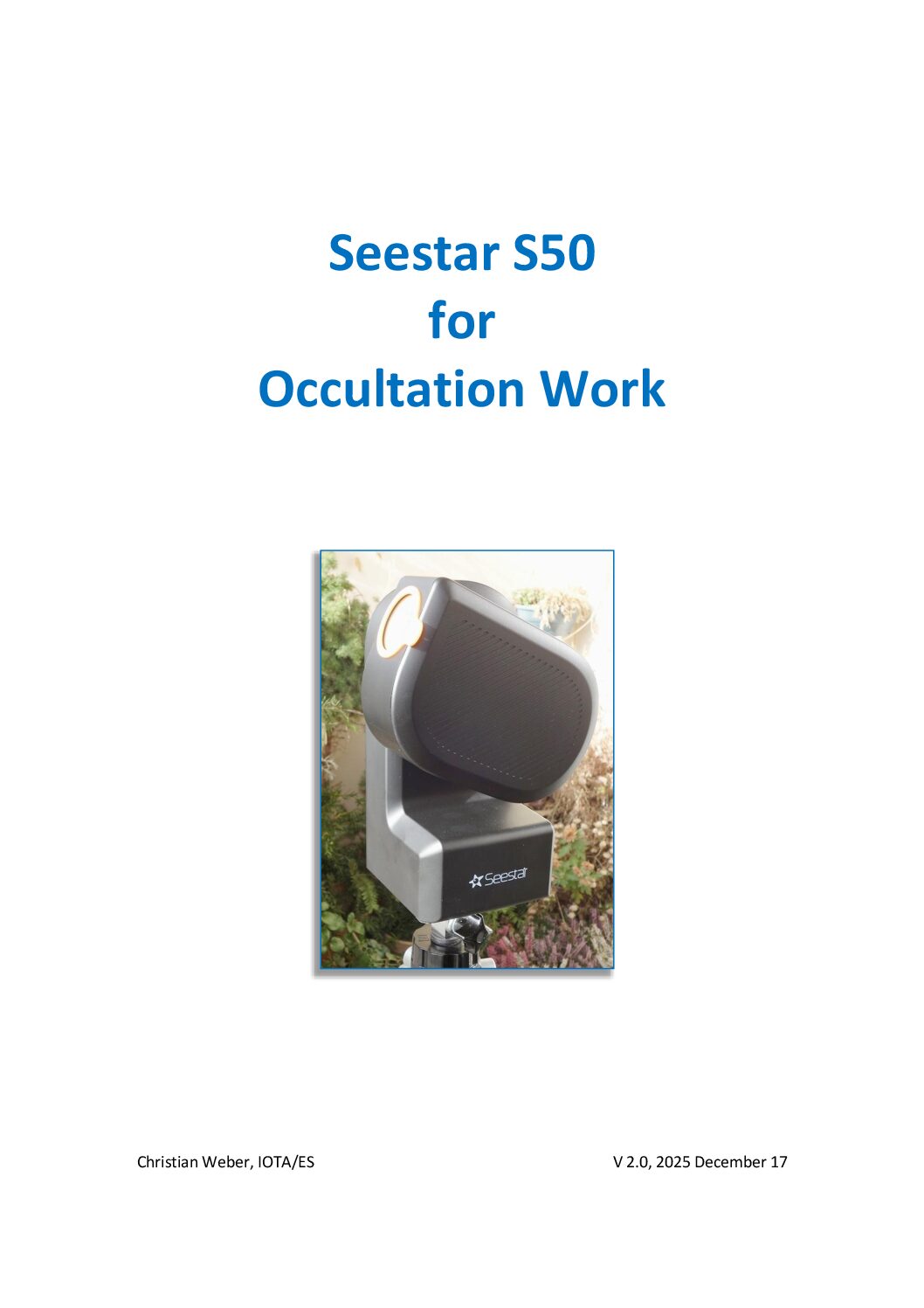
Re occultations with a Smartscope – I’ve attached an article by Dr Christian Weber (DE) – a feasibility study on using a Seestar S50 to record asteroidal occultations. It was written a year ago and there’s rapid developments in Smartscope design, their firmware and phone app software, but it explains that accurate timing is the key to observations of scientific value.
Since then, observers have had success with the addition of a GPS flash timer – there’s also phone apps such as Occult Flash Tag, AstroFlashTimer, etc.
Other articles/papers on this subject are in preparation and should be available soon.
We use Occultwatcher (Desktop, Cloud and ‘phone App versions) to obtain predictions for our home location.
Alex.
Attachments:
20 October 2026 at 2:11 pm #643501Robin LeadbeaterParticipantEngaging with the “pretty picture” astrophotographers on their home turf today 🙂
https://stargazerslounge.com/topic/449402-the-star-that-makes-the-north-america-nebula-visibleIt tend to put my more unusual/interesting observations in my BAA gallery and often point people to them in posts like this in various forums. I would be interested to know whether these do draw people to the BAA website. Does the BAA collect these kinds of statistics ?
Cheers
Robin -
This reply was modified 2 months ago by
-
AuthorPosts
- You must be logged in to reply to this topic.