
- This topic has 7 replies, 6 voices, and was last updated 9 months, 2 weeks ago by
 Bill Barton.
-
AuthorPosts
-
31 December 2025 at 6:09 pm #632891
 DawsonParticipant
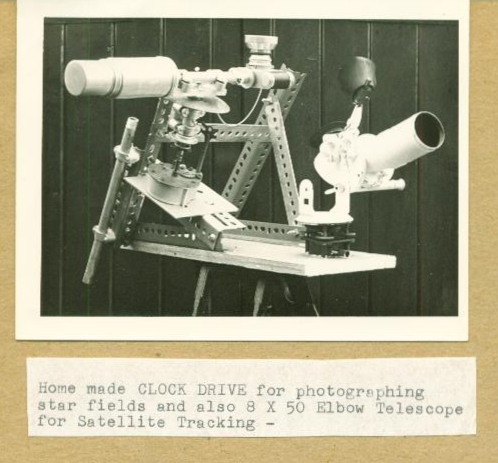
I am still sorting through some pamphlets and paperwork from Alan Heath’s house. I found this fascinating photo from about 1961 of a clock drive he had built and an 8×50 Elbow Telescope… I have to confess I’d not heard of an Elbow Telescope before.
I just thought this may be something other may be interested to see, and to save the image for prosperity.
James Dawson
NottinghamAttachments:
1 January 2026 at 11:00 am #632894 Bill BartonParticipant
Elbow telescopes were salvaged from World War II artillary guns. Back in the day amateur astronomers would use anything they could lay their hads on to observe the skies.
1 January 2026 at 1:32 pm #632896DawsonParticipant1 January 2026 at 6:29 pm #632900 Nick JamesParticipant
That is an impressive Scotch mount.
I think that the Scotch mount (aka barn-door mount) was first described by G.Y. Haig in JBAA Vol 85, No 5. I’d only just joined the BAA in 1975 and this was the first paper that I found really interesting. I built a basic copy and used it for many years to take night-sky photos using a manually driven screw and a stop watch (things were hard back then). In the 1980s I built an advanced one which had a crystal controlled stepper motor drive and took this to Tenerife to photograph C/1996 B2 (Hyakutake).
1 January 2026 at 8:16 pm #632902 Jeremy ShearsParticipant
I too built a Scotch mount in the 1970s, Nick. I was surprised how well it worked for time exposure photography. Mine was always “fully manual” with its hand-turned screw.
This was more successful than another project from the JBAA: to build a small planetarium (I think the inspiration was a paper by Harry Ford). I used Meccano for the equatorial support which held an electric motor to which was attached a ballcock. The ballcock contained a lightbulb and there were holes to project the constellations. It never really worked and heaven help anyone who tried to recognise the constellations.
A slightly more successful project was to build a lunar photometer, using a photocell, from a design by Chris Watkis. Chris lived not too far away from me, in Sevenoaks, and was a great help. I can’t remember if this was in JBAA, the Lunar Section Circular, or elswhere.
2 January 2026 at 12:30 am #632903 Denis BuczynskiParticipant
Seem to remember that the lunar photometer using a photocell was used extensively by a Lunar section member Lawrence Fitton to measure albedo changes in local lunar topography. I think there was an interesting “discussion” in the LCC about the validity of the method with a member (David Jewitt) who became very famous as the first astronomer to recover Comet Halley at its 1986 apparition. Old days old memories!
Denis Buczynski2 January 2026 at 4:25 pm #632910Mr Giovanni Di Giovanni
ParticipantYour notes are beautiful. They remind me of my enthusiasm and excitement when I built my first telescope half a century ago. A Newtonian D200 f1400, worked on in my garage, the mount entirely homemade using mechanisms from old cars being scrapped and gears from a rotisserie, with manual tracking. The photometer was a photodiode at the focus of a microscope used to examine photographic plates. Reading your notes, memories emerge unchallenged and presumptuous.
Happy New Year 2026 (and following) to all of you.4 January 2026 at 4:57 pm #632943Bill BartonParticipantIt looks like Alan used Dexion to construct his mounts.
-
AuthorPosts

- You must be logged in to reply to this topic.