
- This topic has 2 replies, 2 voices, and was last updated 10 months ago by
 Robin Leadbeater.
-
AuthorPosts
-
26 December 2025 at 11:17 am #632818
 Robin LeadbeaterParticipant
I was interested in how far from the sun 3I would have passed in the absence of gravity (the impact parameter) so decided to ask Google AI. (full interaction attached)
It correctly gave the comet 3I perihelion distance or 1.36AU. (a good start) It then claimed that it would pass closer to the sun in absence of gravity. (1.05AU compared with 1.36AU). This seemed pretty unlikely so…
I asked directly how gravity would affect the perihelion distance. It then correctly stated that gravity would reduce the perihelion distance.
When asked if 1.36AU is closer than 1.05 AU it realised it had made a mistake but failed to volunteer the correct answer.
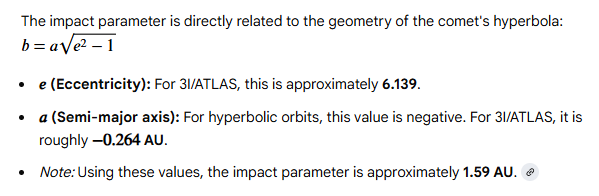
Only when asked directly why it gave the incorrect answer did it actually do the calculation and then made a lame excuse as to why it might have given the wrong answer ! (claiming confusion with a completely different parameter which had roughly the same numerical value)
When asked how many times it had given the wrong answer to other people previously it did not know !Perhaps AI will dominate next Christmas sky notes bloopers
BTW Does anyone know that the value of the impact parameter it came up with (1.60AU) is actually correct ?
Seasons Greetings !
Robin-
This topic was modified 10 months ago by Robin Leadbeater.
Attachments:
28 December 2025 at 11:05 am #632824 Nick JamesParticipant
Indeed. LLMs like Chat GPT are pretty hopeless at logic and arithmetic since they can only regurgitate stuff that they have seen in their training. Their natural language abilities are pretty amazing though.
You can work out the miss distance of 3I assuming no gravitational accelerations by linearly extrapolating the “infinity” state vector to closest approach. JPL Horizons will give you the barycentric position and velocity vectors at any past time if you select “vector table” as the ephemeris type. The state vector for 1900-01-01 is:
2415020.500000000 = A.D. 1900-Jan-01 00:00:00.0000 TDB
X = 6.146692847218195E+02 Y =-1.410989916978468E+03 Z = 6.302147691517926E+01
VX=-1.339387085953456E-02 VY= 3.065893078363736E-02 VZ=-1.367393155520660E-03(position in au, velocity in au/day). The position at any future time (if you ignore gravity) is just P + Vt where P and V are the initial position and velocity vectors. Differentiate the magnitude of that and find the minimum to get the closest approach time (JD 2461021) and you get a miss distance of 1.60au so you did eventually get the correct answer! You should ask it how it knew this? It will have found it on a website somewhere. I’ll be more impressed when these “AI” sites can actually calculate stuff from first principles.
28 December 2025 at 12:39 pm #632825Robin LeadbeaterParticipantTheir natural language abilities are pretty amazing though
Yes they can be pretty good at weaving a convincing (though false) argument. I found it interesting that it recognised the inconsistency when pressed and owned up to this in its response. It did finally calculate the answer (or appeared to do so, though perhaps it just lifted it from somewhere) using the orbital elements and geometry.
Attachments:
-
This topic was modified 10 months ago by
-
AuthorPosts
- You must be logged in to reply to this topic.