
› Forums › Variable Stars › Preparing for the next eruption of T CrB
Tagged: T CrB recurrent nova CV
- This topic has 157 replies, 30 voices, and was last updated 3 hours, 17 minutes ago by
 Hugh Allen.
-
AuthorPosts
-
11 May 2026 at 1:23 pm #639332
 Robin LeadbeaterParticipant
Here is the latest “prediction”
https://www.astronomerstelegram.org/?read=17784
Though given it appears to be based on the same premise as Brad Schaefer’s original (failed) prediction, I don’t think will be rushing down to the bookies !Cheers
Robin11 May 2026 at 2:59 pm #639333 Dr Paul LeylandParticipant
They note: “While T CrB clearly appears to be in the final stages before its next nova eruption, our analysis of its historical recurrence pattern suggests a significant scatter of at least 10 years around the mean ∼80-year period. Therefore, while an eruption is anticipated, the existing data do not allow for a precise prediction of its timing”.
Another NR which shows a scatter of about 10% of its mean period is M31N-2008-12a. The period is about one year with variability of about a month. The period so short that several eruptions have been observed.
The sample size is so small, IMO, that it is impossible to say whether this is typical behaviour.
Paul
12 May 2026 at 7:35 am #639335 Mike HarlowParticipant
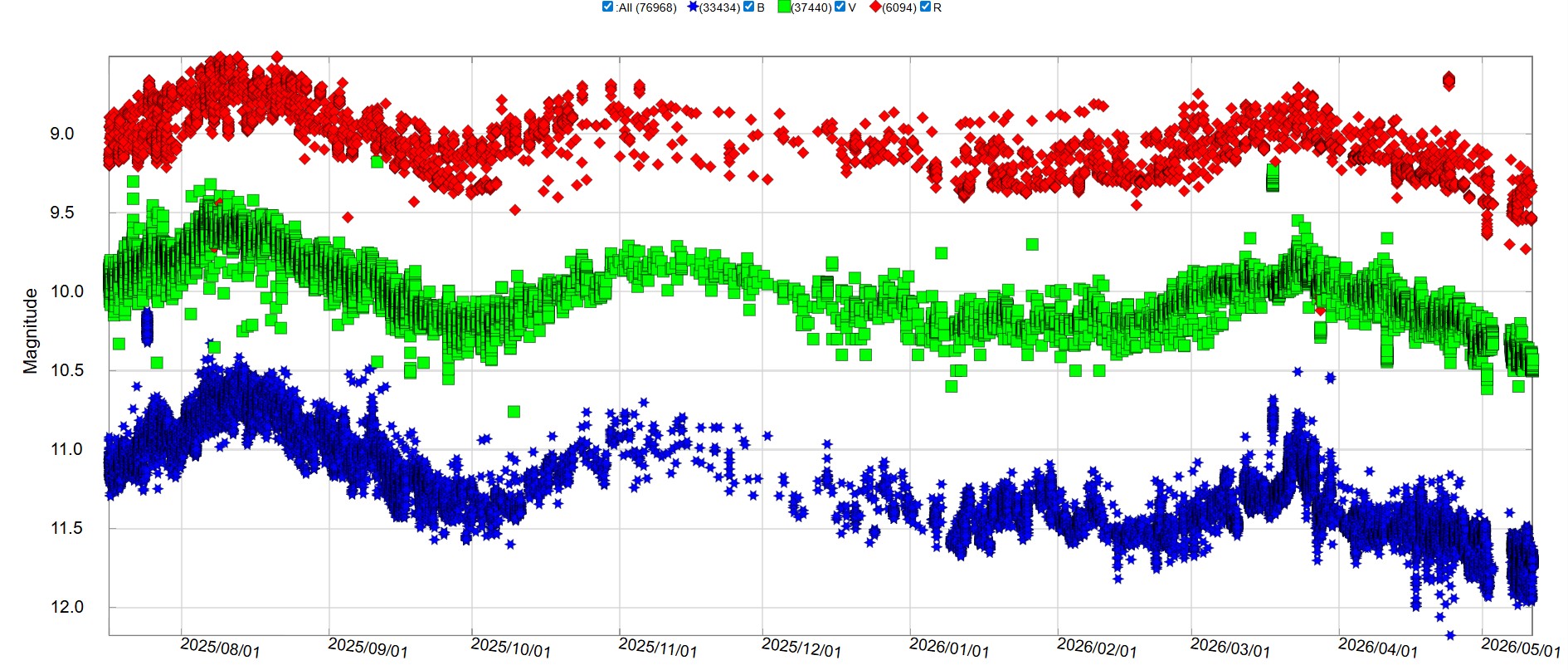
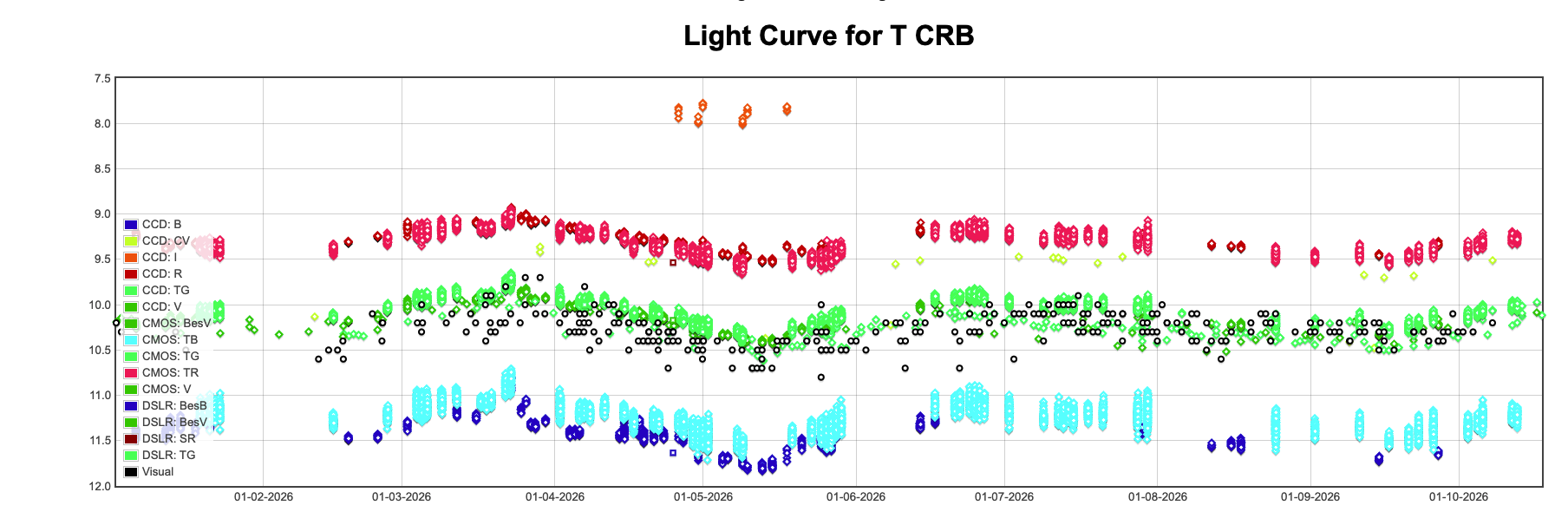
Don’t know if this helps but this is the light curve for the last 300 days taken from the AAVSO ‘Light Curve Generator’: https://www.aavso.org/LCGv2/ .
Any thoughts???
MikeAttachments:
12 May 2026 at 12:00 pm #639337Robin LeadbeaterParticipantIt does shows that predictions based on the kind of spot measurements taken a year apart quoted in the latest aATel are likely to be misleading. The latest minimum in the orbital cycle is deep though. Here is Chris Peterson’s plot on Cloudy Nights which shows it very clearly
https://www.cloudynights.com/forums/topic/932002-blaze-star-t-coronae-borealis-starting-to-blow/page/15/#findComment-14658109Cheers
Robin12 May 2026 at 12:03 pm #639338 Hugh AllenParticipant
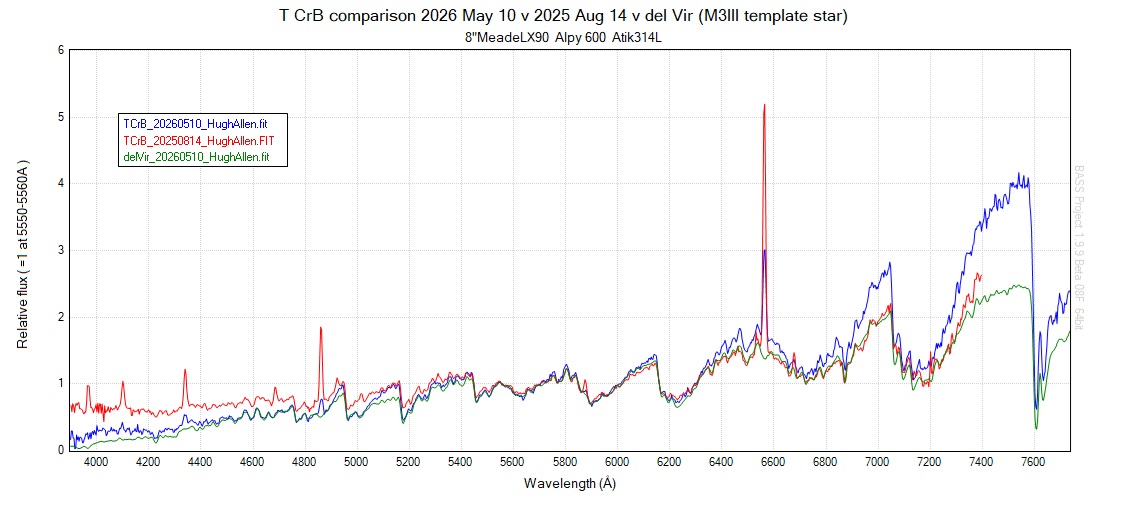
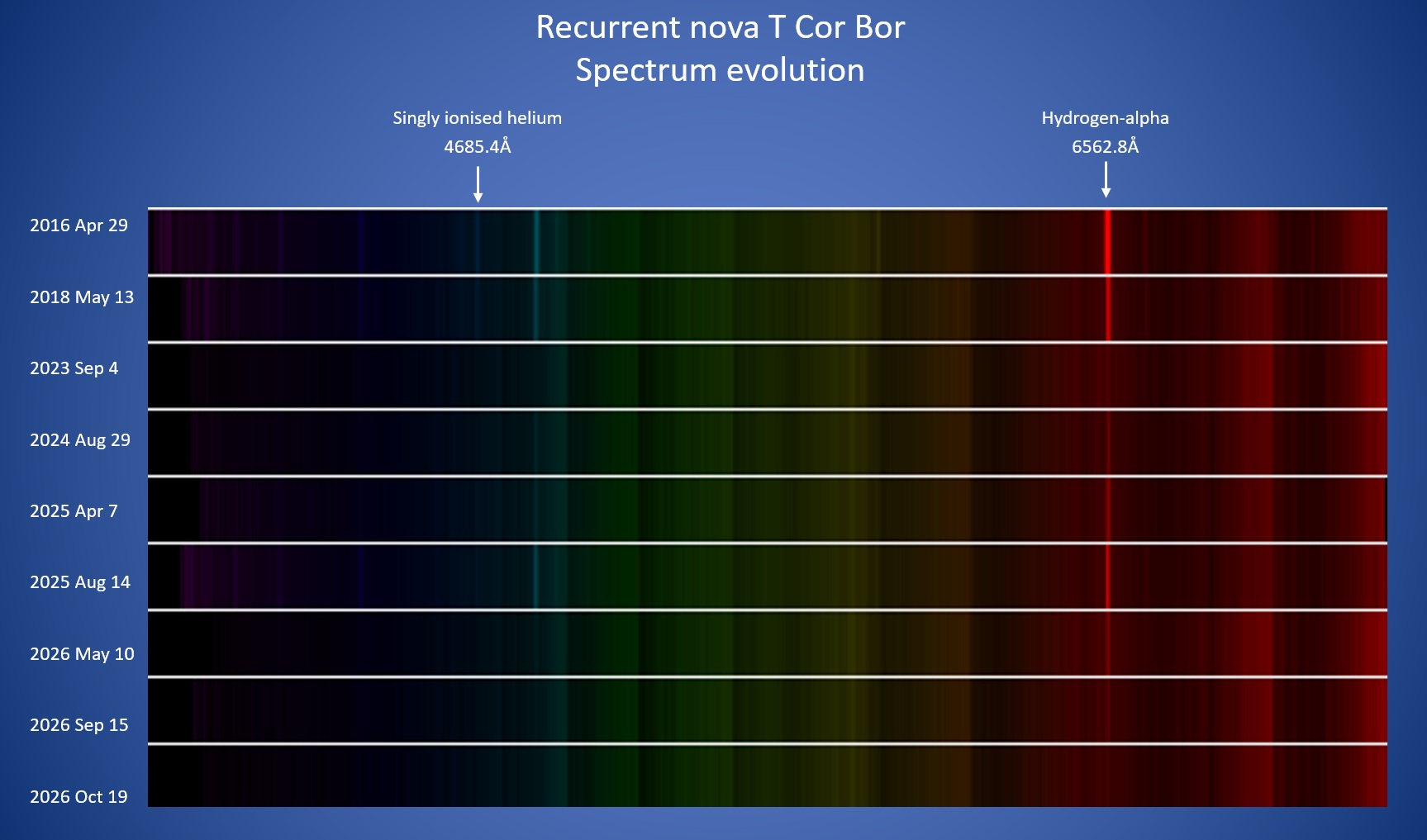
Thanks Mike for preparing this light curve comparison. The spectrum has shown interesting changes too over this date range (see attached comparison 2025 Aug 14 v 2026 May 10). The emission line changes have been much discussed. But in agreement with the light curves you have compiled from AAVSO data, the spectrum seems to have reddened significantly. It now diverges signifcantly from the shape of the spectrum of del Vir which I think is considered a template M3III type star, the spectral type of the red giant in the T CrB system. I wonder too what is occurring?
12 May 2026 at 12:37 pm #639340Robin LeadbeaterParticipantHi Hugh,
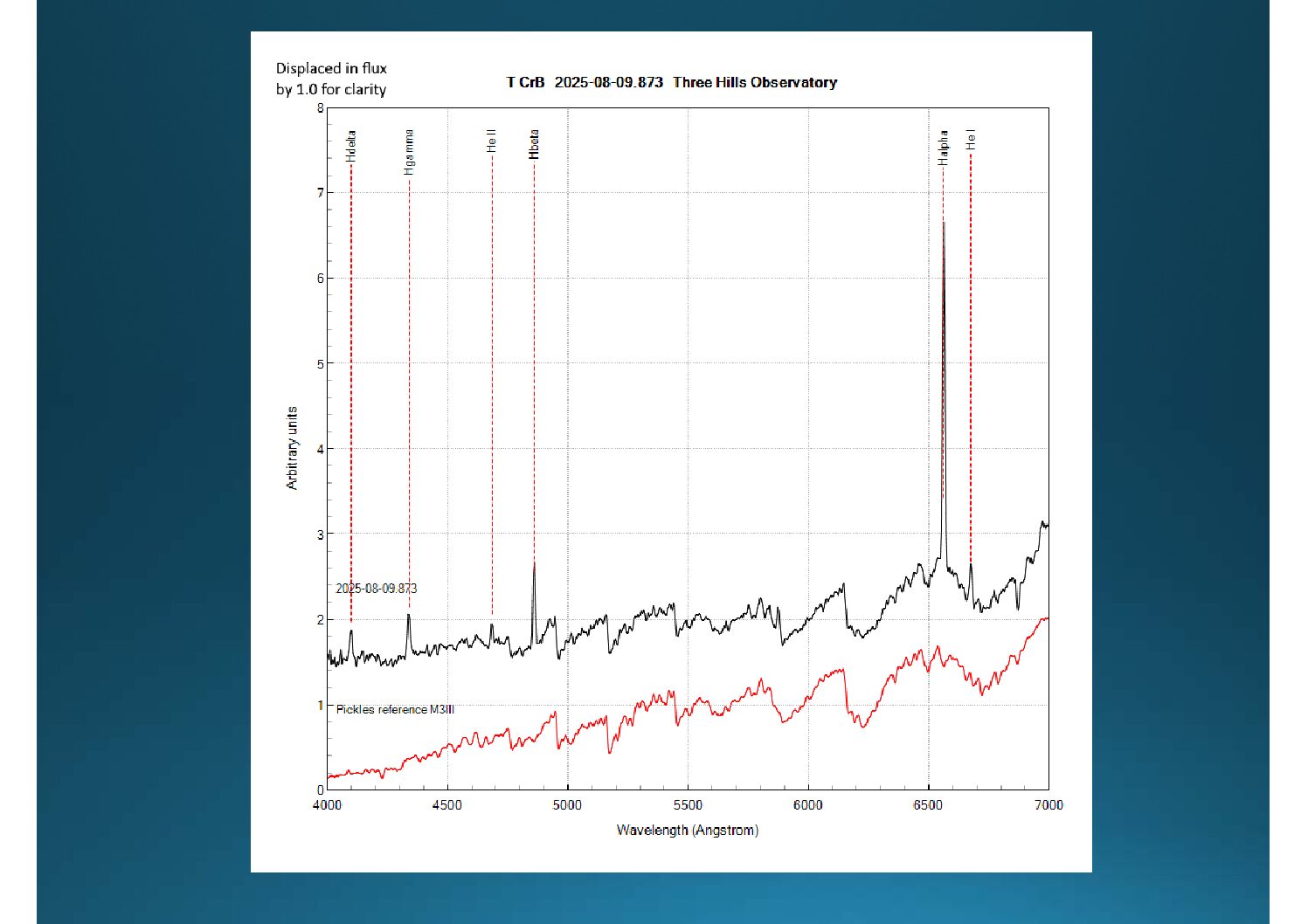
It is complicated by the fact that the hot continuum spectrum of the accreting material is superimposed on the cool star spectrum but I have seen signs that the best fit cool star spectral type once the hot component continuum is removed may vary from M3III in high activity to M4III in low activity based on TiO band depths. See attached slides. (Here I was removing the cool star component to try to see the underlying spectrum of the accreting material)
Cheers
Robin-
This reply was modified 5 months, 1 week ago by
 Robin Leadbeater.
Attachments:
17 June 2026 at 3:27 pm #640759 Jeremy ShearsParticipant
An ApJL paper on ArXiv today, ‘Pre-nova Observations of T CrB: A view from the CHARA Array’, reports measurement of the red giant’s pre-eruption diameter as 0.64–0.74 mas.
https://arxiv.org/abs/2606.172729 September 2026 at 9:50 am #642843Jeremy ShearsParticipantThis MNRAS submission on The First Multi-Messenger Nova: External Shocks, TeV Photons, and Neutrinos in the Next Eruption of T CrB takes another look at timescales for its eruption recurrence.
Taking various factors into consideration, the authors come up with a recurrence time-scale of Trec ≃ 80±12 yr.
However, they note that if substantial weight is instead assigned to the proposed historical eruptions of T CrB, and the 1217–1787 interval between eruptions is assumed to contain seven recurrence cycles, the resulting recurrence history implies a much narrower characteristic time-scale of ≃ 79–80 yr with a dispersion of only ∼ 1–2 yr. The latter is in line with Schaefer’s predictions.
We are now at T(last eruption) + 0.6 years and we keep looking…..
14 September 2026 at 10:58 pm #642875 Steve KnightParticipant
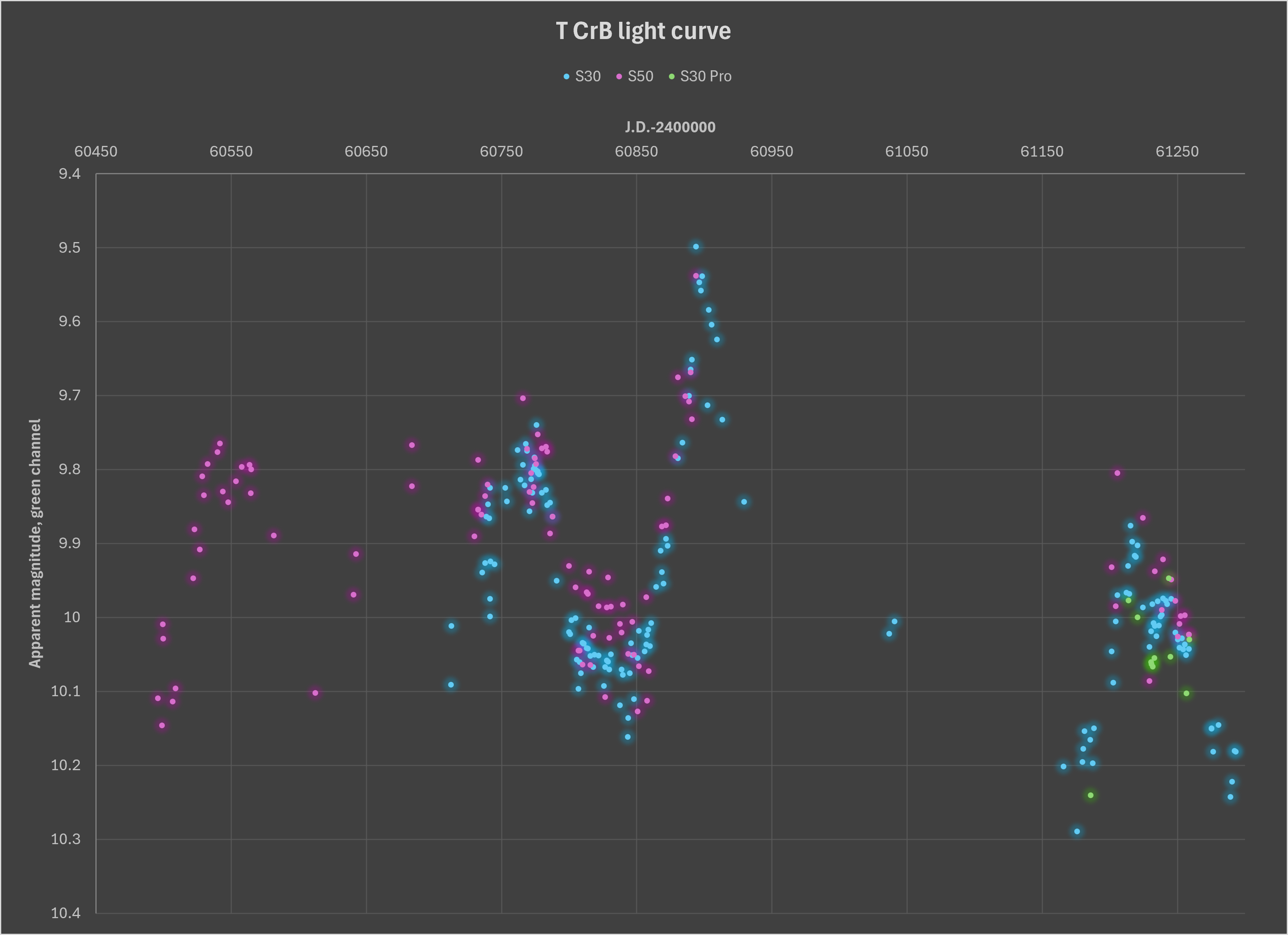
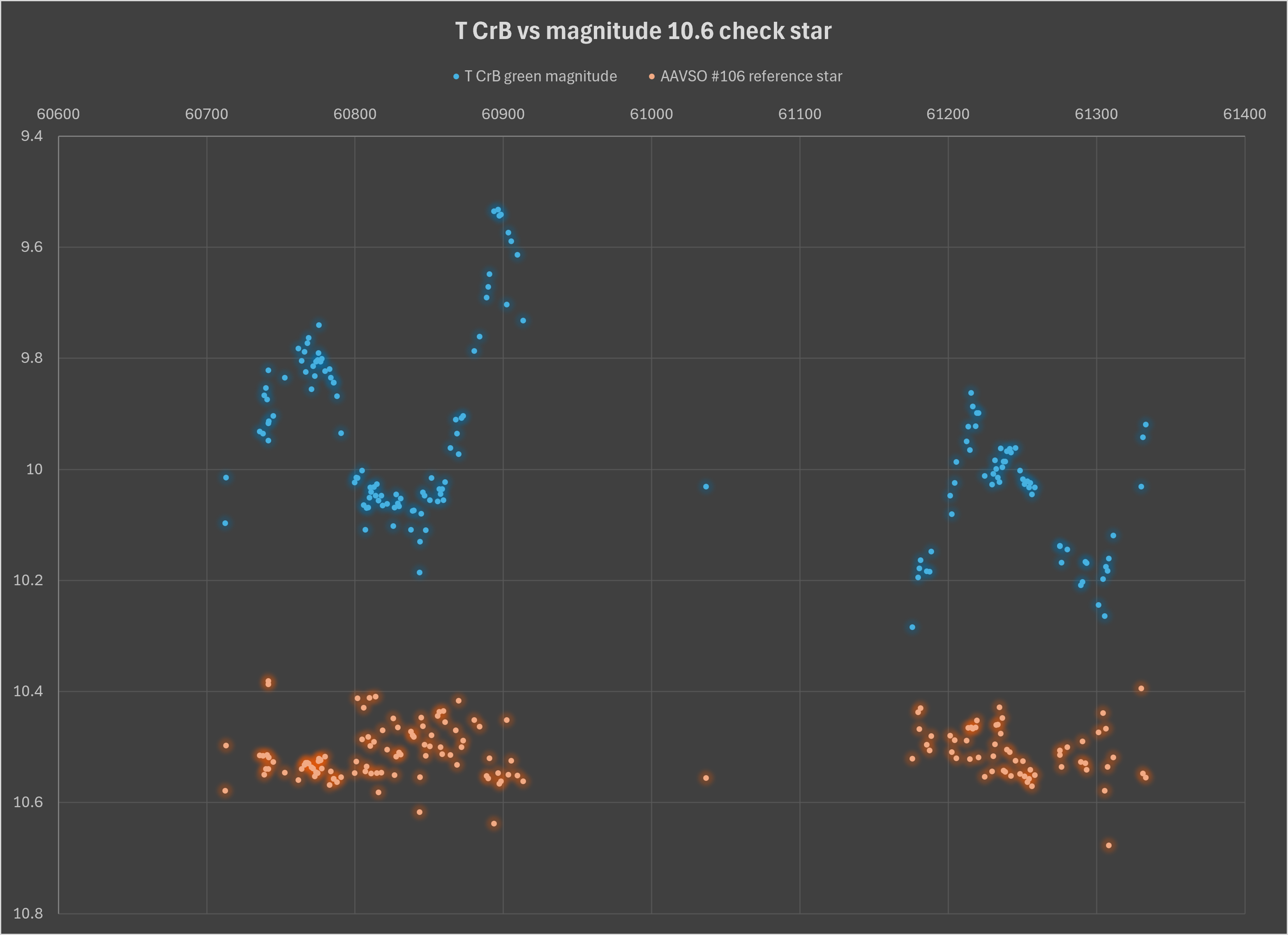
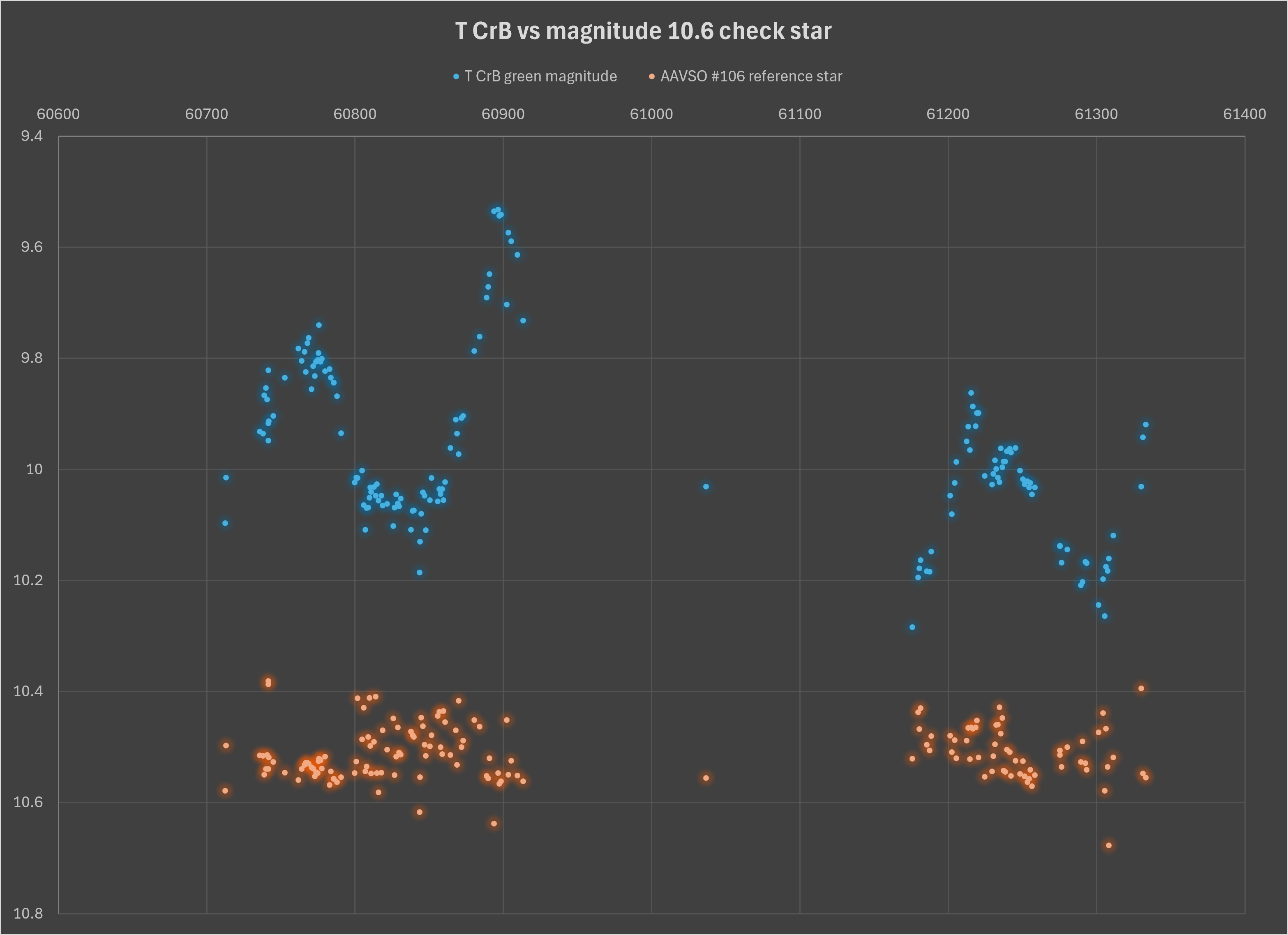
Multiple Seestar T CrB light curve beginning July 4th 2024. This curve is derived from 397,667 (ish) exposures up to September 9th 2026. There are 264 data points here each derived from a stack of as much of the night as I can manage. Processed with Pixinsight and differential photometry with AstroImageJ. Exposures are 2-30 sec. Now investigating how my green channel magnitude matches V magnitude.
Attachments:
15 September 2026 at 6:51 pm #642895Jeremy ShearsParticipantMultiple Seestar T CrB light curve beginning July 4th 2024. This curve is derived from 397,667 (ish) exposures up to September 9th 2026. There are 264 data points here each derived from a stack of as much of the night as I can manage. Processed with Pixinsight and differential photometry with AstroImageJ. Exposures are 2-30 sec. Now investigating how my green channel magnitude matches V magnitude.
Good to see you persevering with this, Steve. Keep going!
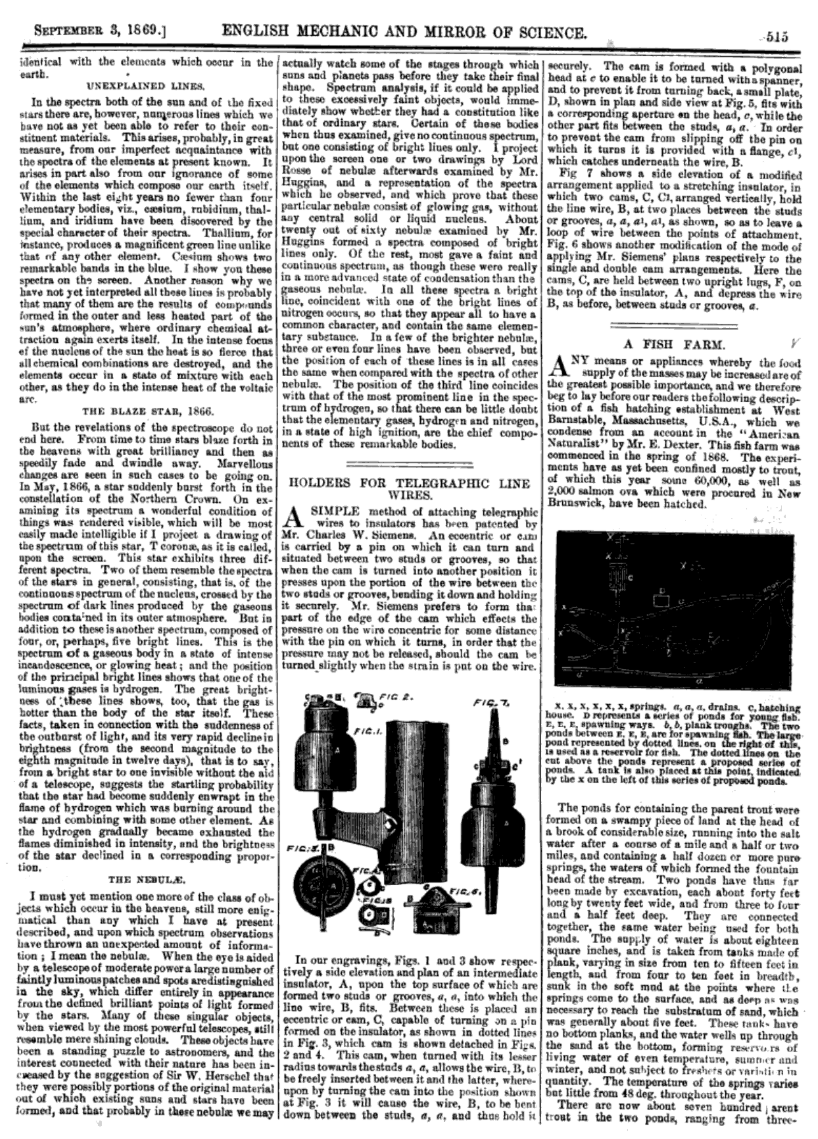
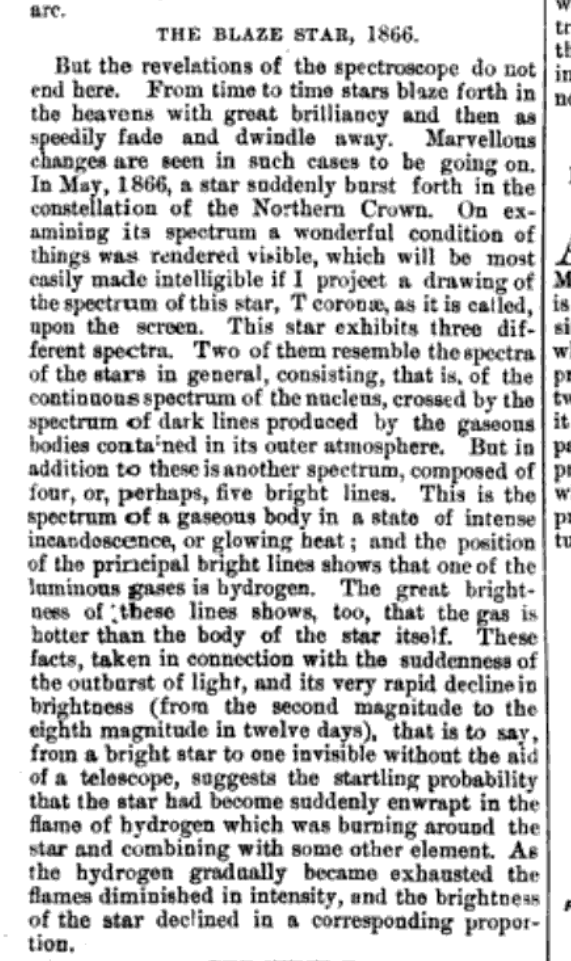
24 September 2026 at 2:35 pm #643053Steve KnightParticipantI’ve always been slightly irritated by calling T CrB “The Blaze Star” and had assumed it was a comparitively recent Americanism. Apologies to all Americans for my prejudice. It turns out I was wrong, it was first used in the Sept 15th 1869 edition of English Mechanic & Mirror of Science. I will now be using the term at every opportunity!
24 September 2026 at 5:32 pm #643056Jeremy ShearsParticipantI’ve always been slightly irritated by calling T CrB “The Blaze Star” and had assumed it was a comparitively recent Americanism. Apologies to all Americans for my prejudice. It turns out I was wrong, it was first used in the Sept 15th 1869 edition of English Mechanic & Mirror of Science. I will now be using the term at every opportunity!
Many older atlases have it identified as Blaze Star.
But not to be confused with Blaze Starr: https://en.wikipedia.org/wiki/Blaze_Starr
25 September 2026 at 9:38 am #643060 Paul G. AbelParticipant
Well it has now passed into the trees into the NW for me, and then will be lost for winter. So it’s bound to erupt then!
21 October 2026 at 11:12 pm #643528Steve KnightParticipantAnyone else noticed that T CrB has been brightening over the last month? Of course it could be just down to my lamentable skill at coding in Python. Awaiting a V filter so I can calibrate the magnitude. Observed with Seestar S30 using stacks of 10 sec exposures. Timescale is JD-2400000.
-
This reply was modified 16 hours, 38 minutes ago by
 Steve Knight.
Attachments:
22 October 2026 at 9:41 am #643532Jeremy ShearsParticipantHello Steve,
Looking at both the BAA VSS and AAVSO data it has been brightenin g over the last 25-ish days, but it looks like part of the normal 226 day period modulation.
VSS LC from 1 Jan 26 attached.
Keep looking though – you are doing great work. I have lost it from my site.
Go well!
Jeremy-
This reply was modified 6 hours, 12 minutes ago by
 Jeremy Shears.
Attachments:
22 October 2026 at 11:17 am #643537Steve KnightParticipantThanks Jeremy. Getting to grips with this now as T CrB photometry is my dissertation subject this year. I should be able to keep on monitoring it through solar conjunction if I travel a mile into Exmoor for evening view. Morning view should be possible from my garden. Luckily Seestars are not exactly large and heavy.
22 October 2026 at 12:09 pm #643538Jeremy ShearsParticipantGreat stuff, Steve.
There are people doing daytime imaging of the field of T CrB. Though I am not aware of anyone using a Seestar for that, ARne Henden is using a Newtonian stopped down to 50mm, a long focal length Seestar 50 🙂
Here is a discussion on daytime imaging: https://britastro.org/forums/topic/24-hour-monitoring-of-t-crb
22 October 2026 at 12:36 pm #643539Hugh AllenParticipantEmission lines in the T CrB spectrum seem to be falling quiet again. Here’s a visual comparison of my fairly sporadic monitoring with my Alpy 600 spectrograph. The intensity of the hydrogen-alpha emission on 2026 October 19 is even lower than on 2023 September 4 (1.52 compared to 1.63 x 10¯¹² erg/cm²/s/Å). Also, I think the singly ionised helium emission line is considered a good proxy for the accretion rate onto the white dwarf.
-
This reply was modified 3 hours, 12 minutes ago by Hugh Allen.
Attachments:
-
AuthorPosts
- You must be logged in to reply to this topic.