
Forum Replies Created
-
AuthorPosts
-
 Denis BuczynskiParticipant
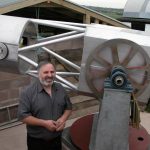
Image taken at Tarbatness Observatory Highland Scotland
 Denis BuczynskiParticipant
Hello all, Very interesting to read everyone’s selections. I am sure the same books will come up time and time again. Here is my rather long list ( not that I am well read)
Hutchinsons Splendour of the Heavens
The Larousse Encyclopedia of Astronomy
Celestial Objects for Common Telescopes(2 vols)
Amateur Telescope Making (3 vols)
100 years of Astronomy ( Waterfield)
The Amateur Astronomer (Moore)
Constellations (Rukl)
Nortons Star Atlas (1950 and 2000)
The Planet Saturn History of Observations etc( Alexander)
History of the Harvard College Observatory (Jones and Boyd)
Starlight Nights (Peltier)
History of the Telescope (King)
Analysis of Starlight (Hearnshaw)
Planet X and Pluto (Hoyt)
Cometography (Kronk 5 vols)
Burhams Celestial Handbooks ( 3 vols)
The Messier Album (Mallas and Kreimer)
Astronomical Scrapbook (Ashbrook)
Sorry it is so long, there are many more!
Denis BuczynskiDenis BuczynskiParticipantI enjoyed watching the sky notes and look forward to seeing the rest of the meeting talks on video. I really appreciate this service as part of my BAA membership.Living so far away from London I cannot attend meetings. However I do want to hear the talks and lectures given by the excellent speakers that the BAA ( Hazel Collett) persuades to participate at our meetings. I was worried that this video service would go by the wayside due to the large effort required by the compiler to complete the task. I am very happy to see it continue and would like to personally thank Dominic for posting themfor us to see.
Denis buczynski
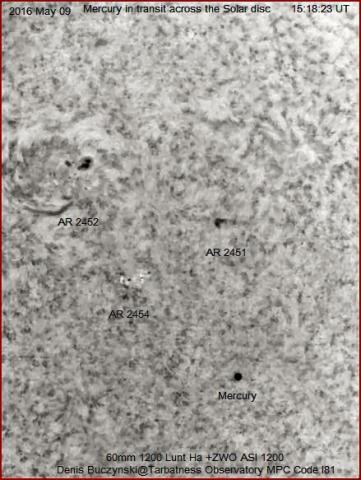
Denis BuczynskiParticipantHello all, Attached is an Ha image of the transit just after mid transit.
Apologies the AR numbers should be 25 etc not 24 etc
Denis Buczynski Tarbatness
 Denis BuczynskiParticipant
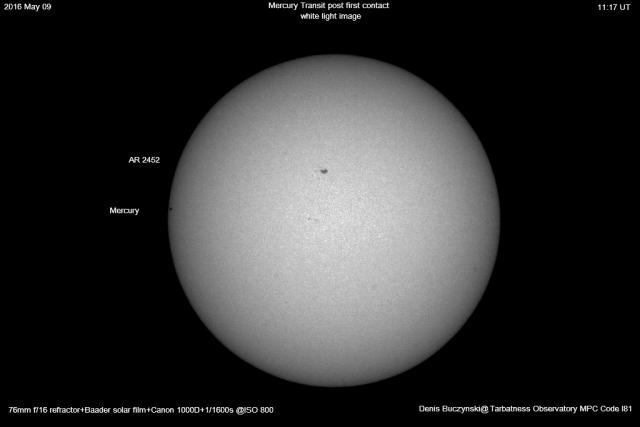 Hello all, Attached is an image I took of the transit just after first contact. Conditions here at Tarbatness are clear with a cold easterly wind , temperature 10d C. Seeing was fair. Mecury looks a very inky black dot in the Ha view, some small prominences also on view.Denis BuczynskiParticipant
Hello James, Donati’s comet has been described by many of the 19th Century observers who saw it as the most beautiful comet. Both in scale in the sky, in form with the curved dust tail and the thin straight gas tail. It was painted by many artists, whose paintings can be seen by searching for images of this comet on Google.It was an important comet as it was the first comet to be photographed. This feat was achieved intially by an English Portrait Photographer William Usherwood then by G.P.Bond at Harvard Observatory in the USA. My particular favourite painting of this comet is by James Poole and is held at Sheffield Museum

Denis Buczynski
Denis BuczynskiParticipantHi Roger,
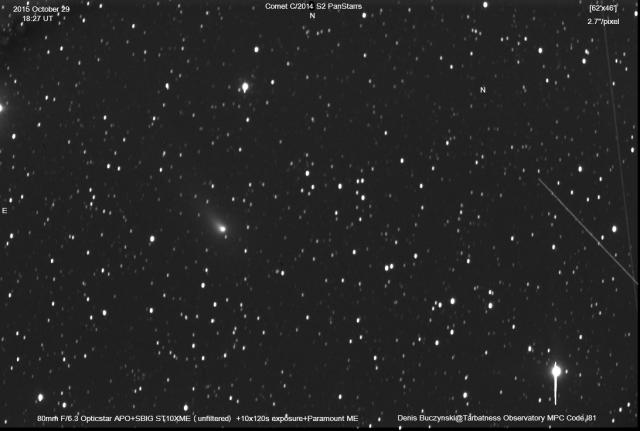
I am happy with my Opticstar 80mm F/6.3 APO forwide field imaging with CCD and DSLR. Here an image of C/2014S2 taken with this budget OTA. The DSLR needs a field corrector to cover the bigger chip than the CCD.
Denis Buczynski
 Denis BuczynskiParticipant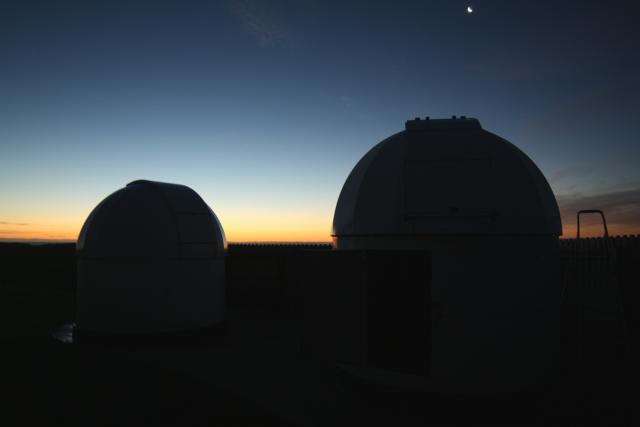
My observing stats at Tarbatness Observatory MPC Code I81 in Highland Scotland for 2014 are as follows:
JAN5 FEB17 MAR12 APR12 MAY4 JUN0 JUL0 AUG13 SEPT7 OCT 9 NOV13 DEC 10 total 94 nights = 1 night in 4 (1 in 3 nights if the summer 3 months are excluded)
These are defined as nights when I undertook CCD images for Comets or VS or TOCP confirmations . The summer months at 58d N lat are unusable due to all night twillight when observing is halted in MAY, June and July. These stats do not include nights when aurora and NLC observations were made. Rainfall here for the year was 855mm, this was slightly higher than the 18 year average of 796mm, so a bit wetter this year and substantially wetter than last year at 673mm.
Denis BuczynskiParticipantKevin Hills has also mad a video of this event, he writes:
I managed to get 160 frames, 45 seconds each with a 0.4m Ritchey-Chretien telescope and SBIG 1001E in Moorook, Australia. At the dropbox link below you will find an animation made in Maxim DL, but beware, the file is large (18mb zipped, 167mb raw) so will take a while to load. Maybe there is a way to reduce the file size, but it’s my first animation…https://dl.dropboxusercontent.com/u/53940961/CK13A010%20and%20NGC362.zip
Denis BuczynskiParticipantHello Mike,I presume that you have looked at the information about this comet (discovery circumstances and subsequent development) in Gary Kronk’s Vol 1 pages 369-373 Cometography. This is the “bible” when it comes to researching past comets. If you have not got these pages let me know.It was an extrordinary comet with a description (from Cometography) from an observer in Sussex on 1680 Dec 20 afterthe comet had emerged form the sun’s glare in the southwest that the tail extended to the zenith and was broader than a rainbow. On the same day John Flamsteed said the comet appeared as a beam of light about the width of the moon extending stright up from the horizon. It had become visible before daylight had ended.
Denis Buczynski Secretary Comet Section
BAA
Denis BuczynskiParticipantNice image of this comet showing that dust trail edge on. With ccd imaging we are seeing more of these cometary features which were only rarley imaged when photography was the main detector. The number of comets imaged recently with “antitails” is another aspect of this more sensitive means of recording comets.
Your comment about seeing the comet in the NW when it gets dark made me smile. It does not get dark here in Tarbatness again until mid August at 58d North latitude! I look forward to seeing other images of this and other comets by those who do have dark skies.
Denis Buczynski
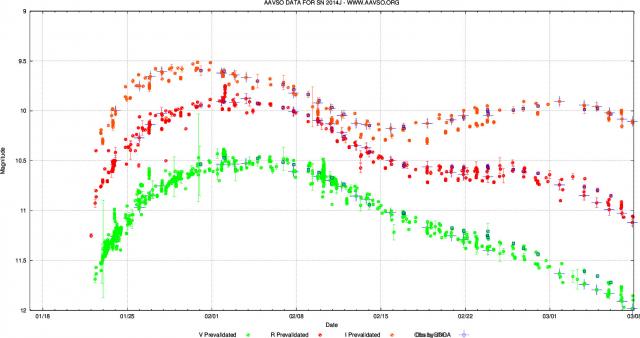
Denis BuczynskiParticipantSince posting this discovery announcement at the end of January, both Nick James and myself have been observing this bright Supernova using multicolour photometry. We have been pleasantly surprised by the number of observing opportunities that we have had during these winter months at opposite ends of the east coast. The weather has been very mobile and clear spells have been frequent, but sometimes fleeting. We hope other observers have had similar experiences over the last few months. Our observations are shown an the attached lightcurve which is from the AAVSO database (the crosses are NDJ observations and the squares are DGB). The SN is currently very red and we have not transformed our measurements to exactly match V and R hence the bias between our two sets of observations. This supernova is at an interesting stage of its development and we would encourage more observations from BAA observers.
-
AuthorPosts