
Forum Replies Created
-
AuthorPosts
-
 Dr Paul LeylandParticipant
I was thinking about this problem overnight. There are several metrics which could be considered (and the considerer not to be considered to be too silly).
One is that which minimizes the person-kilometres traveled. A few people who have to travel a long distance balance a larger number who need only travel a short distance.
Another is that which minimizes the person-expenditure outlay. A few people who must take expensive routes, for example on a ferry or over a toll bridge, balance a larger number who do not need to pay for the infrastructure such as public highways over which they travel.
I have very little idea about the locations which minimize the above metrics. If forced to guess I suspect that the location would be somewhere fairly near Nottingham.
Dr Paul LeylandParticipant“If you stick a pin in the centre of the UK?”
https://en.wikipedia.org/wiki/Centre_points_of_the_United_Kingdom gives a point in Lancashire.
Dr Paul LeylandParticipantFair point.
I was more thinking that having a price list here would be helpful to all concerned.
P.M. already sent.
Dr Paul LeylandParticipantWhy not list your stuff here? Some of us may be interested in it.
Dr Paul LeylandParticipant“Problem sorted I think!”
Excellent, I’m happy to have been of help.
Dr Paul LeylandParticipant“something weird associated with frame stacking”. Ah, I wonder if perhaps some frames have become rotated with respect to the others? If your stacking performs only rectilinear shifts then those near the center of rotation will be stacked perfectly but those further away will be smeared into short arcs. Removing a circularly symmetric synthetic star from the center of an arc will result in wings.
Could you try stacking, say, half the images and see if the result changes? Repeat with a differently chosen half, and again.
Dr Paul LeylandParticipantNot entirely sure what to make of this …
I took your FITS image and fed it through IRAF’s DAOPHOT pipeline because I knew that it could compute PSFs and subtract them from images. The image below shows an 8x enlarged view of the region of the transient after computed stars had been removed. With the exception of saturated stars and a scattering of doubles, all the bright stars were invisible, meaning that they had been successfully modeled and removed from the image. A good number of faint stars (one is very obvious in the snapshot) had not been removed because they were too faint for accurate photometry with the parameters I chose.
The double next to the transient is very clearly marked as such: the PSF of a single star has been removed from the mid-point. The transient has been removed nicely but two wings remain. I’d say that was fairly conclusive reason for your astrometric result but for the fact that the other two bright stars also show wings.
As I said, I’m not sure what to make of this but post it for your interpretation which may well be better than mine.
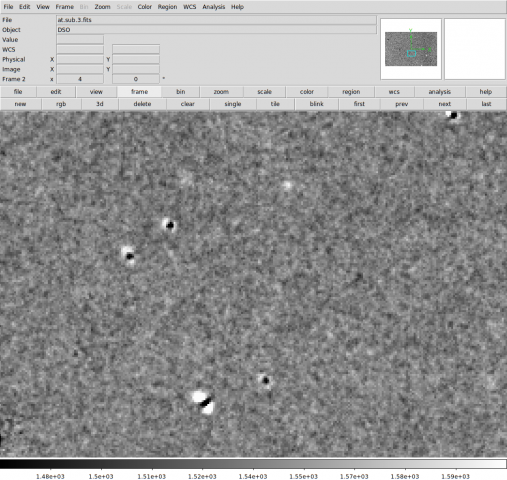
BTW, the image below is inverted N/S with respect to your because IRAF counts pixels from the bottom up. Causes no end of confusion …
Paul
Dr Paul LeylandParticipantCould it be a blend?
The residuals plot after the (presumably) Gaussian profile has been subtracted appears asymmetrical to me, with the left hump being somewhat larger than the right.
https://arxiv.org/abs/1809.00018 came to my attention a few days ago which is what made me think of this possible explanation.
Paul
Dr Paul LeylandParticipantThanks! If it is an early G, which looks very likely, then the known distance (from GAIA) and reasonably well-characterized interstellar absorption in that part of the sky will let me estimate its expected apparent magnitude. Comparing that with the known magnitude (again from GAIA) lets us estimate the brightness of the secondary and, hence, its absolute magnitude, leading to a plausible guess for the latter’s spectral type.
Later …
Paul
Dr Paul LeylandParticipantIt certainly looks like it. Typing the coordinates into https://www.aavso.org/apps/vsp/ produces a nice finder chart. It was found while investigating the X-ray transient MAXI_J1820+070 fpr which it is an AAVSO comparison star labeled “120”. The field is crowded which has led to issues with photometry too.
Thanks and good luck!
Paul
Dr Paul LeylandParticipantWhat happens if you put one shutter in front of the other and look through both …
27 July 2018 at 12:06 pm in reply to: Updated, and hopefully final, proposal to the BAA Council #579753Dr Paul LeylandParticipantI also give my whole-hearted support for this proposal. After all, exoplanets are about as remote planets as we’re likely to study!
In a somewhat related matter, I discovered what I thought might have been a transiting exoplanet recently. In the end it transpired to be an EA variable with minima of 0.025 pm 0.005 and 0.010 pm 0.002 magnitudes. Also known as TYC 444-2670-1. Close, but no cigar, yet demonstrates that discoveries are well within the amateurs grasp.
Dr Paul LeylandParticipantI have a great deal of sympathy with this view. Just keep any XP systems off the net because XP is fuller of bugs than a tramp’s undies and none of them have been fixed and never will be.
Dr Paul LeylandParticipantThis will likely evolve to include extreme spectroscopy if any desire to detect an exoplanetary atmosphere is to be taken seriously, but that‘s possibly decades away even for professionals.
Professionals have been characterizing exoplanetary atmospheres for a number of years already! I’ve been doing voluntary work with the ExoMol team at University College London for the last couple of years specifically to help astronomers characterize the atmospheres of exoplanets and very cool stars.
I agree that current amateur equipment would find spectroscopy of atmospheres extremely challenging to say the least. On the other hand, radial velocity measurements may well be feasible, given that relatively inexpensive (circa 10,000 pounds/euros/dollars) spectrographs fitted to 0.5m class telescopes have already shown to be capable of measuring RVs to within 50 m/s — that typical of hot Jupiters orbiting close to the star, especially so if the star is a late M-type with a mass of around 0.3 M_sun.
Added in edit: @stellarplanet has Tweeted only today about the detection of CO, H20 and CH4 in exoplanetary atmospheres. Several posters at the conference were on the subject of exoplanetary atmospheres.
Dr Paul LeylandParticipantLet me stick my head above the parapet and apologize for not contributing earlier. Fortunately (!) I have been very busy of late.
The reason I was busy last week is that I purchased a house and observatory on La Palma on Wednesday. It has a 0.4m Cassegrain, of excellent optical camera, tip/filt adaptive optics which keeps a star image on a single pixel (the plate scale is 0.75 arcsec/pixel) and a SBIG-8 CCD. I’ve not had chance to use it seriously yet but the previous owner managed 2 millimag photometry. La Palma is famous for having clear skies and superb seeing. Incidentally, Kevin Hills has comparable equipment on the same site and I have been working with him and Phil Charles performing ~2mmag photometry on the optical counterpart of an X-ray black-hole transient.
I’ve been busy all day today attending the Exoplanet-II conference in Cambridge — https://www.exoplanetscience2.org/programme . After only 1 day of presentations (out of 4.5) several indicated that amateurs can do bleeding-edge research on exoplanets. Although most spectroscopy is done with 2-10 metre-class telescopes, professionals often use 0.4 — 0.6m scopes for photometry because it is so much easier to get time on them. One speaker presented results from a 0.2m telescope.
I very much intend to work on exoplanets, whether or not a section is created. Needless to say, I strongly recommend an exoplanet section be created.
Dr Paul LeylandParticipantCould you post a brief report on how this proposal was received please?
Dr Paul LeylandParticipant“Next thing is to determine the rpm and chop rate….”
If you have access to a sillyscope it is very easy to determine chop rate to an accuracy of a few percent. Shine a laser pointer through the chopper at a photodiode and measure the voltage across the latter.
Dr Paul LeylandParticipantAndy, arcsecs are indeed a useful size for some objects but so are degrees. For some objects, the milliarcsec and microarcsec are the appropriate measures, especially in astrometry and VLBI radio.
This leads me to the proposal that degrees, millidegrees, microdegrees, nanodegrees, … would be the appropriate way of proceeding. Alternatively, and this I find rather more attractive myself, radians and their SI sub-divisions must be the natural units. You may claim that a radian is a rather large angle but the size of the farad has never seriously worried the electronics engineers who are quite happy working with pF capacitors.
Dr Paul LeylandParticipantPerhaps. IMAO you should check my assessment. I could well be wrong and have been many times in the past.
Dr Paul LeylandParticipantThat one looks like 2MASS 11112757+554027 with J=14.822
-
AuthorPosts