

Forum Replies Created
-
AuthorPosts
-
 Alex PrattParticipant
Hi Bill,
A single station result gives good pointing direction but the distance vector is approximate, estimated from its likely ablation altitude.
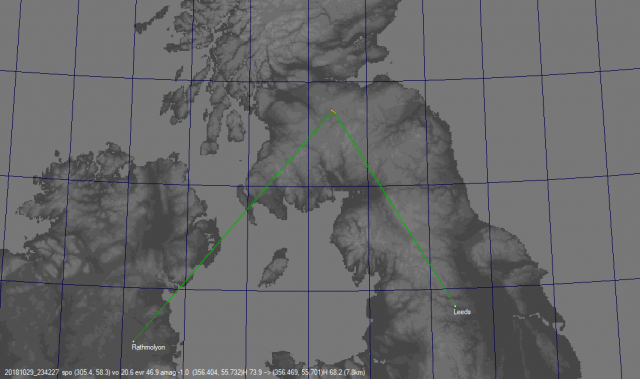
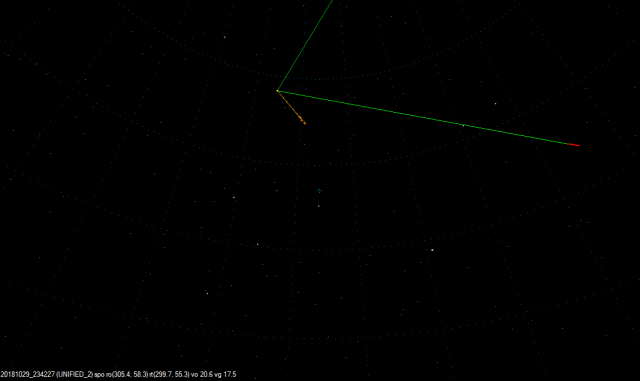
NEMETODE members are submitting their October data and we can now combine my observation with that of Mike Foylan (Rathmolyon, Ireland). Two-station analysis suggests it was a slow sporadic meteor of absolute mag -1. Do the following updated ground map and radiant plot match your meteor?
Alex.
 Alex PrattParticipant
Hi Bill,
Another nice one for the archive of spectra.
It looks like I recorded this meteor on my Leeds_N camera. Apparent mag 2, this far distant from the event. Ground plot and composite image attached. Is this your meteor?
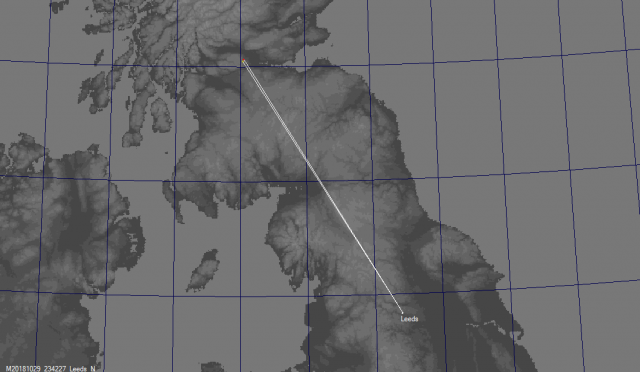
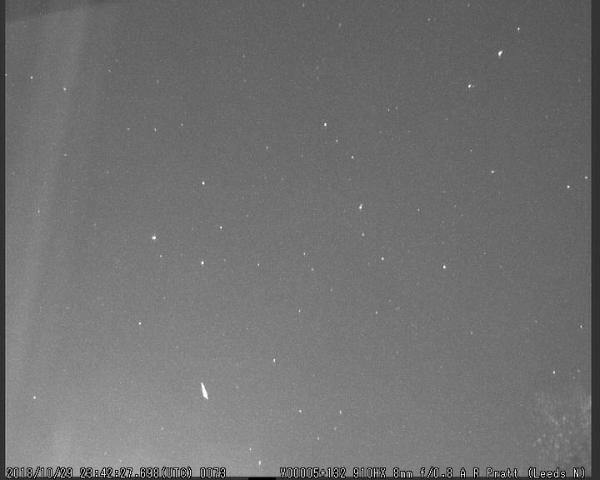
Single-station analysis suggests it was an Andromedid. If so, it is useful data on debris from comet Biela.
Clear skies,
Alex.
2 October 2018 at 5:50 pm in reply to: NEMETODE Workshop, Dunsink Observatory Dublin – Sat 15th Sept #580038Alex PrattParticipantCongratulations Michael in linking the audio tracks (thanks to Nick’s recording gizmos) with the speakers’ PPT slides to produce the YouTube videos. They are a much appreciated permanent record of the formal talks at the workshop.
Your hard work makes them available to anyone who couldn’t attend.
Clear skies,
Alex.
Alex PrattParticipantHi Michael,
I enjoyed reading your radio data report. I often wonder why there aren’t large numbers of amateur radio astronomers in these misty isles! We got some good video meteor data this August, although many of us had cloudy skies during the Perseid maximum, so let’s see if we can marry up the video data with the radio counts.
I hope your work is on display at Dunsink on Saturday.
See you there,
Alex.
Alex PrattParticipantHi Bill,
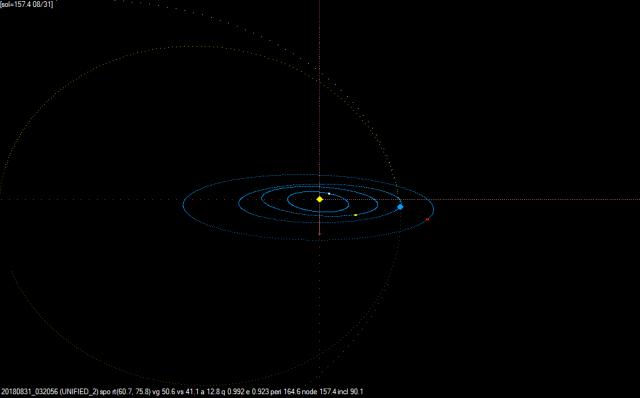
The meteor was also recorded by Andy McCrea (Bangor, NI). He and Michael O’Connell analysed his video clip. My single-station analysis was a good match for a Perseid, but our 2-station result suggests it was a sporadic of absolute mag -2.5 from a radiant in northern Cam with a Vg of 50.6 km/s.
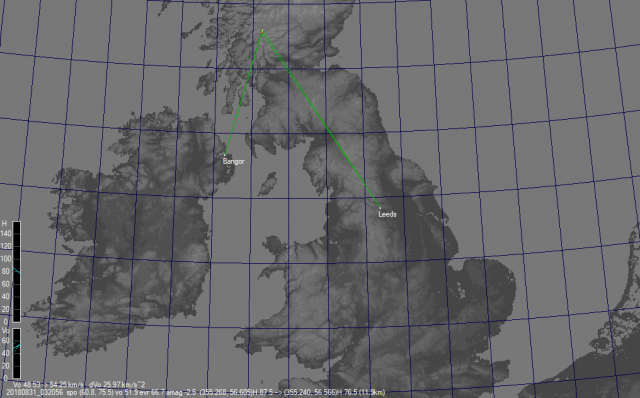
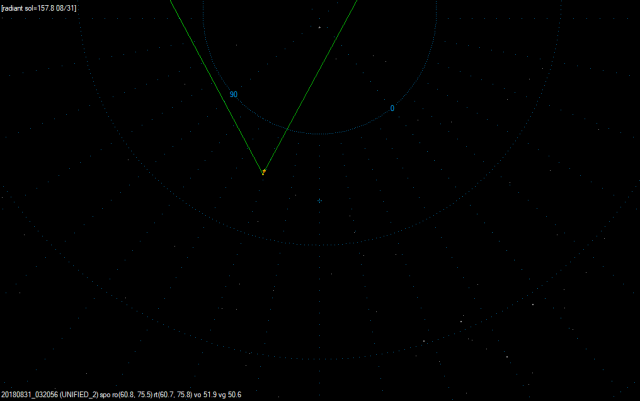
Its short path length of 12 km and our non-optimal viewing geometry only give a Q1-quality solution, so there’s some uncertainty in its computed orbit. I’ll let you know if more data are forthcoming.
Clear skies,
Alex.
Alex PrattParticipantHi Bill,
My Leeds_N camera recorded a mag 1 Perseid matching the time of your spectrum. I’ve attached the composite image from the video capture and its ground plot. Does this alignment agree with your general azimuth?
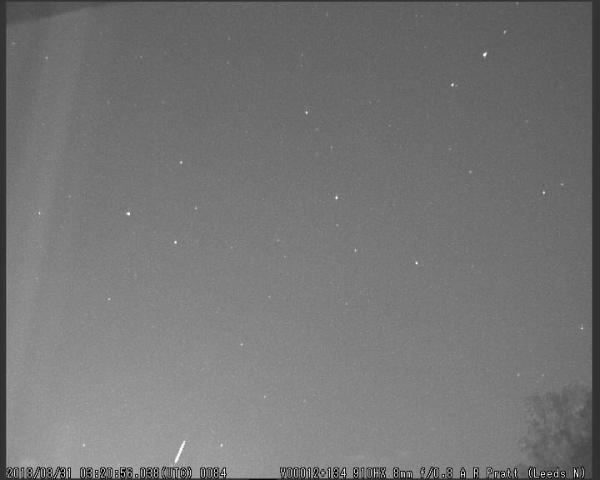
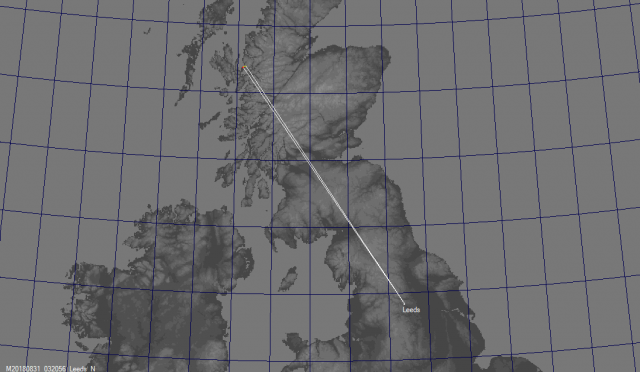
This is a single station result, so if other cameras recorded it we should be able to confirm its shower membership and orbit, etc. I’ll let you know.
Cheers,
Alex.
Alex PrattParticipantThat’s a great idea for an exhibition, Denis. Let’s hope comet 21P puts on a good show in late August / September for young (and old) astronomers alike. If it brightens sufficiently they might not need a special yellow telescope to see it.
Clear skies,
Alex.
Alex PrattParticipantHi Andrew,
Meteor cameras occasionally record long duration, long pathed meteors that exhibit interesting variations in brightness. At the Winchester Weekend I showed an extreme example that was visible for 10 seconds with a ground track of nearly 500 km, recorded by several video cameras.
Such objects are usually in Earth-grazing paths, skimming the atmosphere and their solar system orbit is such that they are catching up with the Earth, rather than a head-on collision.
I’ll ask the NEMETODE video meteor network if anyone recorded your object. Multi-station captures can give us a ground track and solar system orbit, then we can evaluate the event.
Clear skies,
Alex.
Alex PrattParticipantThey are good quality recordings of these impressive events.
Yes, as well as Russians never leaving their driveway without a dashcam they are becoming increasingly popular in the UK because of ‘crash for cash’ scams and irresponsible drivers scarpering from incidents, such as low-speed shunts.
It could be a while though before the BAA Meteor Section needs to appoint a Dashcam Fireball Coordinator…
Clear skies,
Alex.
Alex PrattParticipantHi Bill,
It will be quite a bit of work to replicate Steve’s meteor analysis techniques from 20 years ago, but you should have a lot of fun in the process.
I’m considering changing my Leeds_N lens from a 12mm to an 8mm, to increase my coverage of the Borders and southern Scotland. This will increase our chances of recording more dual- and multi-station events.
Heavy snow put paid to my attendance at the ASE meeting in March so it’s been rearranged for October 5th. I’ll be in Edinburgh for a couple of days. I’ll keep you updated.
Cheers,
Alex.
Alex PrattParticipantHi Bill,
The longest focal length lenses in the NEMETODE network (12mm) can achieve reference star O-Cs of 0.5 arcmin, very similar to the CAMS and SonotaCo networks. HD video systems should surpass this, but they need beefy PCs to cope with the data bandwidth and data processing requirements.
Both SD and HD video systems have their uses in estimating meteor rates, radiants and solar system orbits. Let’s see what your DSLRs can do this summer.
Cheers,
Alex.
Alex PrattParticipantHi Bill,
Have a look at this JBAA paper by Steve Evans -1998 Aug Vol 108 No 4 pp. 204-206
and other references to stepper motor rotating shutter systems
1999 Dec Vol 109 No 6 p.3002001 Feb Vol 111 No 1 p.332001 Dec Vol 111 No 6 pp.337-3382002 Apr Vol 112 No 2 p.63 & p.94Cheers,Alex.Alex PrattParticipantHi Bill,
Great to meet up at Stirling!
As discussed offline, I’m really pleased that you’ve got Steve Evans’ rotating shutter system up and running for long-duration operation. All members who knew Steve will be delighted to see any results you obtain with this kit.
Perhaps we can locate a paper or report by him documenting its chop rate etc., although I fully agree with the need to check and confirm its current performance.
Have fun!
Alex.
Alex PrattParticipantHi Bill,
I have one of the late Steve Evans’ stepper motor-driven rotating shutters from AWR Technology. He used this system with Canon T70 cameras – and in conjunction with video timings from Andrew Elliott and Tim Haymes et al – determined the solar system orbits of Geminids and other major showers. It’s much easier these days using video cameras and the latest software!
I’ve just tested the control box, stepper motor and cutaway shutter and it burst into life. The AWR Technology website describes this equipment, which might differ slightly from the items in my care.
You are welcome to have them for your ‘olde fashioned’ meteor work. I can bring the items to Stirling this weekend.
Cheers,
Alex.
Alex PrattParticipantTo add to the fun I once saw a ‘correction’ made by an editor (non-BAA) who changed all references to Angstrom to Armstrong. 🙂
Clear skies,
Alex.
Alex PrattParticipantHi Bill,
I must add this to my library. Any chance of it being available from the BAA Shop?
Clear skies,
Alex.
Alex PrattParticipantDavid,
thanks for posting about this brief opportunity to see this NEO from the UK.
I find it frustrating and amusing in equal measure that the MPC’s ‘Daily Minor Planet’ often tells us about NEO flybys the day after they’ve been and gone. 🙂
I had to smile this teatime as I checked my e-mails and ESA’s 2010 WC9 Close-Approach Fact Sheet arrived in my Inbox at 16:09. Informative but no use for planning a UK observing session.
Thankfully other resources such as the Minor Planet Mailing List and some astro magazines tell us in advance. I recorded 2010 WC9 last night and will add something to my Member Page this evening.
Clear skies,
Alex.
Alex PrattParticipantHi,
It looks like my NW camera recorded the same event, although the meteor was near the edge of my FoV, so unfortunately I only recorded one of the trails.
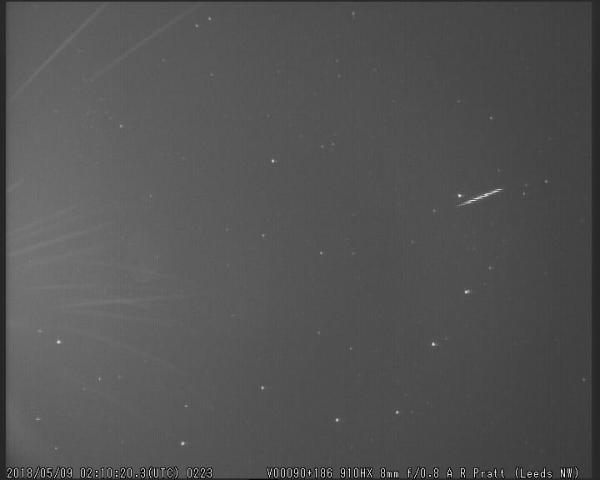
Cheers,
Alex.
Alex PrattParticipantWe’re all likely to produce unintentional typos after a long observing session!
I used my Watec video camera and 50mm f/1.7 Vivitar SLR lens to record the field of V392 Per. I’ll add a pic to my Member Page later this weekend.
Come along to Newcastle tomorrow. My talk won’t be flawless but I hope there’s something in there of interest. 🙂
Alex.
Alex PrattParticipantOn Denis’ Member Page entry for May 2 a typo describes V 392 Per as a ‘comet’, so keep observing! 🙂
Clear skies,
Alex.
-
AuthorPosts