
Forum Replies Created
-
AuthorPosts
-
 Stewart John BeanParticipant
I make it 11.8 mag through V filter this morning, Aug 5th at 01 :43. (T18, Nerpio, Spain.)
I make it 11.1 mag through the R filter.
For both measurements the reference star was 11.2 on the AAVSO chart. I’ll try to get these uploaded via Muniwin once I get the hang of it.
Stewart John BeanParticipantI find the following from this morning using T5 (250 mm) in New Mexico at JD 2459062.902. I used AstroimageJ
With V filter, nova was 12.9 using 11.2 ,14.3, and 12.6, reference stars in AAVSO chart
With R filter, nova was 12.4 using 12.6 in AAVSO chart
With B filter, nova was 13.3 using 12.6 and 13.7 in AAVSO chart
Seems quite bright through the red filter. Stewart
Stewart John BeanParticipantI was not able to resolve the nova from its adjacent star in images taken overnight with the T18 scope in defocus mode for photometry. Not sure how to proceed. Stewart
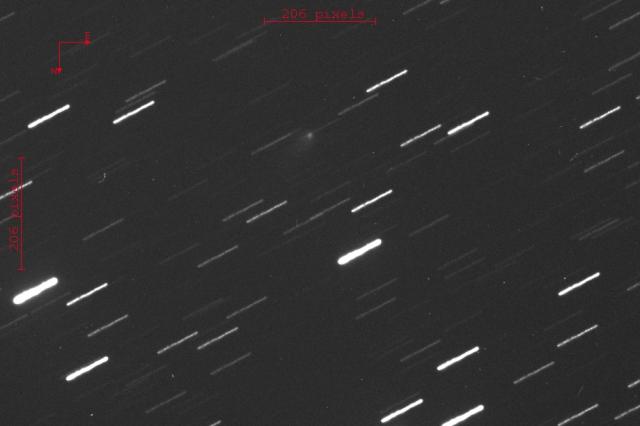
Stewart John BeanParticipantI obtained this image using the T30 500 mm telescope at Siding Spring Observatory . It is the average of three 600 s exposures with a luminance filter.
 Stewart John BeanParticipant
Hi,Here is a link to the arXiv website posting an abstract a paper on a Saturn sized planet discovered , in part, though citizen scientists. https://arxiv.org/abs/1909.09094
The first line of the abstract is reproduced below:
We report on the discovery and validation of TOI-813b (TIC 55525572 b), a transiting exoplanet identified by citizen scientists in data from NASA’s Transiting Exoplanet Survey Satellite (TESS) and the first planet discovered by the Planet Hunters TESS project.
I am one of many volunteers, probably including other BAA members, who found the light curve dip last winter. It is interesting that for transits that are infrequent ( this planet has an orbital period of about 80 days) , the automated searches are less able to detect the dip as they depend upon reoccurring events. So transits from hot Jupiters with short periods are easily found but cold Jupiters with long orbital periods are more difficult. So there is a role for volunteers even if you do not possess a telescope.
Regards
Stewart
Stewart John BeanParticipantHaving looked at the front page of the August journal , I am also struck by how coarse the material seems to be. Could the absence of fine dust be linked to the accumulation of charge on particles under the influence of the solar wind or deep UV? Electrostatic repulsion between individual particles and Bennu itself will be larger than the gravitational force for all but the larger particles assuming they both charge with the same polarity. So only big pieces can grow into something like Bennu.
In the outer solar system far from the solar wind charging will be much less significant and smaller particles can clump into a comet precursor.
Stewart
Stewart John BeanParticipantI obtained the following three results with the T5 telescope ( 250mm reflector) in New Mexico on 26 May. Using a 14.29 mag star as reference, AstroImageJ gives 15.55(V), 15.96(Red) and 15.48(Blue).
Stewart
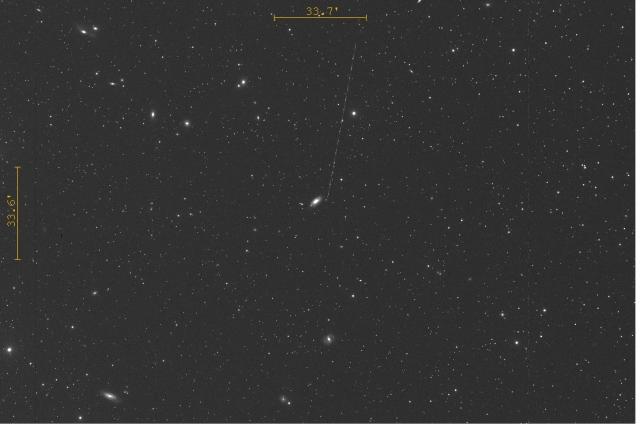
Stewart John BeanParticipantAn image from New Mexico (T14) showing AL Com at the limit of detectability for 106 mm refractor with V filter. Still easily detected with a Luminance filter. Something for every section here with galaxies, a variable star, and a tumbling object crossing the 300s exposure field. A second image also captured this object suggesting it was not a CCD defect or other anomaly.
stewart
 Stewart John BeanParticipant
Mike, How did you get to use this telescope? Stewart Bean
Stewart John BeanParticipantRepeating this field on May 5th ( following my first observation on 28 April), Al Com is only just detectable with itelescope’s T14 106 mm refractor with a V filter. AstroImageJ gives an magnitude estimate of 15.0 but the S/N and S/B are poor and the reference star is magnitude 11.9 – perhaps too bright to be the best choice.
However, using a Luminance filter it is still easily visible.
Stewart John BeanParticipant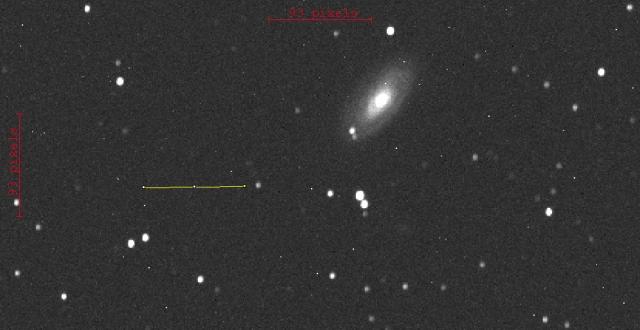
AL Com now at 14.34 as of 28 April. I used the T14 telescope in USA ( 100 mm refractor and cooled CCD) with a 300 s exposure , V filter, defocussed. AstroImageJ produced the estimate of magnitude. There are also a large number of galaxies close to M88/AL Com.
Stewart
-
AuthorPosts