
2026 April 8
Comet C/2025 R3 (PanSTARRS) is worth observing in the morning sky
After the recent disappointment with C/2026 A1 (MAPS) we have another interesting comet to get excited about. C/2025 R3 (PANSTARRS) was discovered by Yudish Ramanjooloo using the Pan-STARRS2 1.8-m RC reflector at Haleakala, Hawaii. Images taken on 2025 September 8 showed a 20th magnitude object in Andromeda (CBET 5607). At the time of its discovery the comet was 3.6 au from the Sun.
Initial astrometry showed that the comet would come to perihelion on 2026 April 20 at a distance, q, of 0.50 au. It is an intrinsically faint object so it was not expected to do very much, and initially it didn’t attract much attention as it moved slowly through Andromeda and Pegasus. In any case the geometry around perihelion was poor although northern hemisphere observers would have a reasonable view before perihelion.
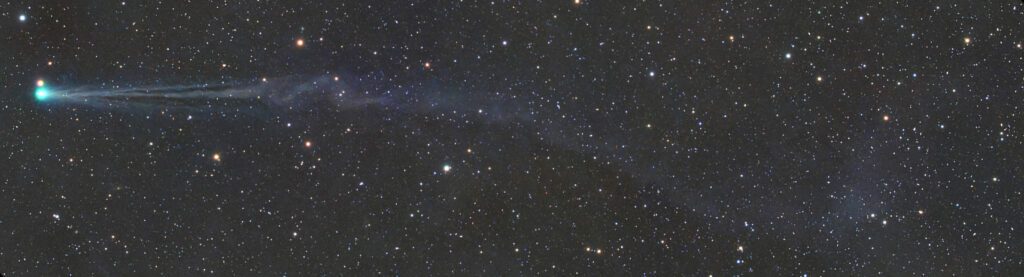
At the start of 2026 the comet was around 17th magnitude but amateur images were showing a small gas coma and tail and these appeared to be developing rapidly. The BAA archive for this comet is here. Through February the comet was badly placed but it started to rise out of the morning twilight in March and, by then, it had brightened substantially reaching around 10th magnitude in mid-March. About this time the first signs of an ion tail appeared. Since then the comet has been brightening strongly and it is now (April 8) around 6th magnitude and the ion tail can be traced for at least 7 degrees in wide angle images. At the current rate of brightening the comet could reach 3rd magnitude at perihelion although the small elongation will then make observations in a dark sky impossible. Forward scattering may even enhance that magnitude to some extent so it is definitely worth observing the comet as far into the morning twilight as possible. Please submit any magnitude estimates to COBS. At present the comet does not have much of a dust tail so it might not look very impressive to visual observers but it is a great target for imagers.
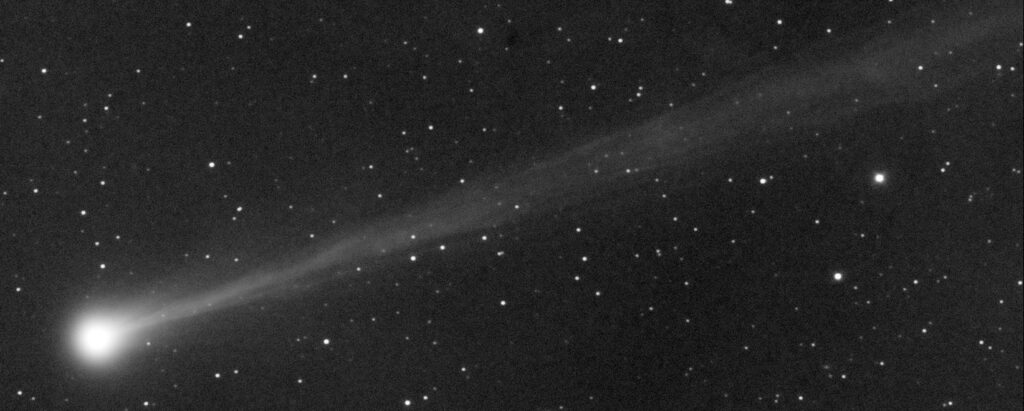
If you want to catch the comet your best chance is over the next week or so as the comet brightens but it remains observable in a relatively dark sky. You will need to get up early, a couple of hours before sunrise, and have a good, low, eastern horizon. At the time of writing (April 8) the comet is moving fairly slowly eastwards between the two western stars of the Square of Pegasus (alpha and beta Peg). Over the next two weeks its motion will accelerate as its elongation decreases. From 52N the comet’s altitude when the Sun is 15 degrees down is 13 degrees on April 8, 11 degrees on April 13, 8 degrees on April 15 and 4 degrees on April 18. After that the comet will only be observable in bright twilight as the elongation drops to 20 degrees on the day of perihelion as the comet moves from Pegasus to Pisces. The waning moon is currently in the morning sky, approaching last quarter, but it will become less of a problem as time passes, reaching New on April 17.
After perihelion the comet will be best seen from the southern hemisphere as it emerges from the evening twilight in early May. By then it will have faded back to 5th magnitude or so.
| The British Astronomical Association supports amateur astronomers around the UK and the rest of the world. Find out more about the BAA or join us. |