-
AuthorSearch Results
-
8 November 2026 at 7:20 pm #643907
In reply to: Rev T.E.Espin’s Calver telescope :action needed
 Dr Paul LeylandParticipant
Hello David. Great news to hear that the telescope is now on the move to the Beamish Open Air Museum. One thing that is puzzling me though is why is the Ash Dome not being used in the construction of the new observatory. Unless there are two Ash Domes. Mel
Beamish have said they would prefer to build a replica of Espin’s original Tow Law Observatory. The Ash Dome was a later addition to the Close House observatory by the University and was the home of a rather good 14″ Meade SCT.
If the locals get their act together in time, please ensure that the dome goes to them.
Otherwise I will pay a (fairly) nominal sum for the dome and arrange for transport to La Palma. Assuming your dome is in reasonably good condition. shipping will be noticeably cheaper than buying a new dome for the 0.4m R-C which is currently lying on a floor at Tacande Observatory. An EQ-8 mount is already ready for it.
From experience, I know that Ash domes are of very good quality but, being made of galvanized steel, require regular maintenance to stop rust. Another round of treatment is required on my Ash dome when I return to Tacande next year.
Feel free to continue further correspondence to email — or continue here if you wish.
Paul
8 November 2026 at 7:35 am #643903In reply to: Rev T.E.Espin’s Calver telescope :action needed
 David HughesParticipant
Hello David. Great news to hear that the telescope is now on the move to the Beamish Open Air Museum. One thing that is puzzling me though is why is the Ash Dome not being used in the construction of the new observatory. Unless there are two Ash Domes. Mel
Beamish have said they would prefer to build a replica of Espin’s original Tow Law Observatory. The Ash Dome was a later addition to the Close House observatory by the University and was the home of a rather good 14″ Meade SCT.
8 November 2026 at 7:31 am #643902In reply to: Rev T.E.Espin’s Calver telescope :action needed
David HughesParticipantFrom the team…
“The Ash observatory and dome, internal wall diameter is 138″ (3.505m). The Ash dome sits approximately 8″ in from the wall which makes the dome appropriately 154″ (3.91m). To get it more accurate I would need someone to hold the tape.”
There is some local interest in the dome as a possible housing for a community telescope.
Happy to let the thing go for free but time is running short as demolition work will start in December.
6 November 2026 at 1:37 pm #643889In reply to: Rev T.E.Espin’s Calver telescope :action needed
 Melvyn JoslinParticipant
Hello David. Great news to hear that the telescope is now on the move to the Beamish Open Air Museum. One thing that is puzzling me though is why is the Ash Dome not being used in the construction of the new observatory. Unless there are two Ash Domes. Mel
5 November 2026 at 2:32 pm #643860In reply to: Rev T.E.Espin’s Calver telescope :action needed
Dr Paul LeylandParticipantHow big is the dome? I have a 0.4m (~16″) Ritchey-Chretien which needs housing. My other 0.4m, a Dilworth, is already inside an Ash dome.
Unfortunately your dome is in the UK and my telescope is in La Palma. Depending on size, weight, and price it may be worth shipping.
Paul
5 November 2026 at 11:58 am #643857In reply to: Rev T.E.Espin’s Calver telescope :action needed
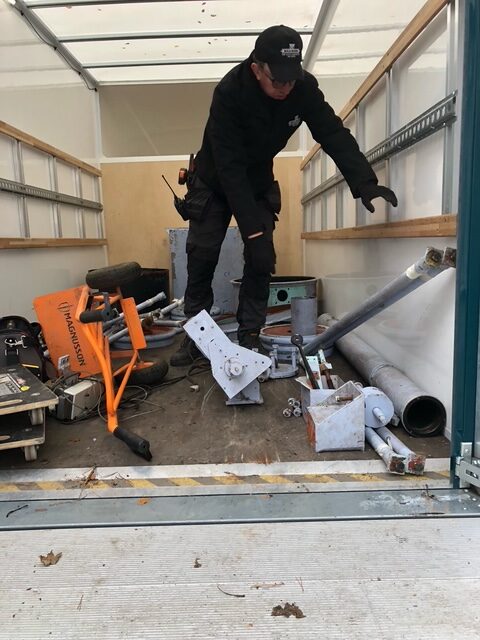
David HughesParticipantBeamish Open Air Museum collected the Optical Tube Assembly and related hardware earlier this week.
We still have the right ascension and declination axes to recover, and then the uprights. Once we have those then the telescope can be considered ‘rescued’.
Stage Two is the difficult one – We have to build a replacement observatory.
That’s when the hard work starts!
Attachments:
4 November 2026 at 10:13 am #643836In reply to: Observations of ZZ Psc in support of a JWST campaign
 Jeremy ShearsParticipant
Tim Cunningham of the Center for Astrophysics at Harvard has asked for further assistance from VSS observers to monitor ZZ Psc. Target is 13th mag.
Tim’s next scheduled JWST observing periods is 3-9 Nov 2026. He would also like to obtain optical light curves with ≤40 sec cadence Oct 23–Nov 20 2026.This is a variable white dwarf of the ZZ Ceti type, whose variability is associated with large-amplitude, non-radial pulsations caused by gravity waves. What is particularly interesting is that ZZ Psc is surrounded by a debris disc, which may have been created through tidal disruption of an exo-comet or exo-asteroid passing close to the white dwarf. The white dwarf is now accreting the debris. Tim has requested time series photometry in support of his James Webb Space Telescope (JWST) programme to observe the star. Long ground-based photometric runs will allow him to keep track of the system’s pulsations which have periods from 100 to 1000 secs.
His top priority is for amateur observers to obtain ground-based photometry within this window. A week either side of that is the next highest priority. Beyond that, any long-baseline observations taken this year will also be extremely valuable. The object has a declination of +05 degrees, making it a favourable target from both hemispheres.
3 November 2026 at 10:12 am #643821In reply to: ER Uma stars: ER Uma itself update
 Stewart John BeanParticipant
Call for assistance with observing ER Uma.
The AAVSOnet telescope in New Mexico has been out of action for a long time now. It was a regular source of results for ER Uma and RZ Lmi. The light curve for ER Uma is a bit sparse as a result with only two contributions (from a VSNET member) for the current observing season. ER UMa is not the easiest of objects to observe currently being best placed just before dawn.
ER Uma gives its name to the small group of active CVs that show superoutbursts around every 20 to 100 days and which are one of the VSS’s observing programmes. See my note in VSSC 188 for some background.
If you can help out these are the key details: J2000.0 09 47 11.89 +51 54 08.7 (146.79954 +51.90242). It usually falls between Mag 13 and 15 .
Thanks in advance
Stewart Bean
2 November 2026 at 8:39 pm #643820In reply to: Variable stars
Dr Paul LeylandParticipantHi Connor,
Not necessarily binaries, but some variables which are good to start doing photometry on with the default S50 settings (i.e. 10s exposures) are:
T CrB
RY Leo
TX CVn
V UMa
U Boo
OO Aql
SW Cyg
BR CygThese all fall in a useful magnitued range to analyse each of the 10s exposures, and a good starting place I feel as no stacking should be necessary under reasonable conditions. If there is concern around the photometry mode in the S50 these are all easy enough export from the scope and analyse using other software.
Please beware that unless you calibrate your detector carefully and apply the transformation coefficients so produced, your magnitude measurements are unlikely to be close to those reported by other observers.
For time-resolved photometry, such as determining the time of minima of eclipsing variables, this doesn’t much matter. It is the times of the observations which is important, not the magnitude measurements on any particular scale per se.
Don’t let this discourage you from doing useful work. Especially don’t let it discourage you from learning how to calibrate your telescope and so go on to work on the full range of fields available. The BAA-VSS people are very willing to help you take this step.
Paul
2 November 2026 at 10:45 am #643750In reply to: Variable stars
 Mr Ian David SharpParticipant
Hi Connor,
I too am using my Seestar S50 Pro to do photometry but I’m not using the in-built feature because I want full control in the same way as I would with any telescope/camera setup. Also, as Jeremy says, there are unknowns in the in-built process at the moment.
I’m currently trying to work out a process that I’m happy with and I’m finding that the ASTAP software is the most useful at the moment. My process at the moment is:
In the Seestar (SS) app:
– Make sure you are storing RAW files in the SS app.
– Add the variable to my custom objects in the Seestar app.
– Set the exposure in the SS app depending on the brightness of the target to ensure no saturation (I’ve used 10, 20 and 30 seconds so far)
– Centre the SS on the target and autofocus. Then adjust the focus point up or down about 20 steps to defocus slightly
– The defocus step is important to prevent saturation and to smear the stars over enough pixels to help when we extract the green channel
– Now you can add the target to a Plan in the SS app and set it runningIn the morning:
– Download the FIT files (you can ignore the jpeg files)
– Load the FIT files into ASTAP – extract the green channel (TG) and optionally average the files into groups (I use 3 or 4 – depending)
– Perform the photometry in ASTAP choose the comparison stars and and plot the results (I can’t explain all that here!)There are videos out there on using ASTAP on Seestar data.
One important tip – After turning off Autofocus the SS app, make sure you also turn off autofocus on switching target in your plan. If you don’t do this, the SS will autofocus and lose your manual de-focus.
Lots more to say!
Cheers
Ian.-
This reply was modified 1 week, 3 days ago by
 Mr Ian David Sharp.
28 October 2026 at 11:54 am #643616Joel Silber
Participantwas not aware that this technique was piccy about what telescope was used
Yeah. The main reason for NV requiring a fast focal ratio for extended objects — f/15 or potentially even slower is viable with globs and open clusters — is that NV produces an image in real time. Imaging and EAA stacking don’t have this specific constraint.
27 October 2026 at 3:18 pm #643602In reply to: Photometry with a Seestar
 Robin LeadbeaterParticipant
Concerning the Seestar photometry feature, there is a bit of feedback from the AAVSO smart telescope working group on what they have determined so far
https://forums.aavso.org/t/status-update-from-the-aavso-smart-telescope-working-group/3073/111
Uses (the effectively unfiltered) gaia G as the reference and just the Seestar G channel apparently, (no colour corrections) and does not check for saturation of comp stars.
D- needs to improve ?
Robin
-
This reply was modified 2 weeks, 1 day ago by
 Robin Leadbeater.
26 October 2026 at 2:29 pm #643585Barry Fitz-Gerald
ParticipantThanks for the detailed reply – was not aware that this technique was piccy about what telescope was used, that is useful information. I did get to use a GenIII unit on an auroral display some time ago – quite mesmerising!
23 October 2026 at 11:26 am #643558Topic: Easy asteroid occultation Oct-25 at 0240UT
in forum Asteroids Tim HaymesParticipant
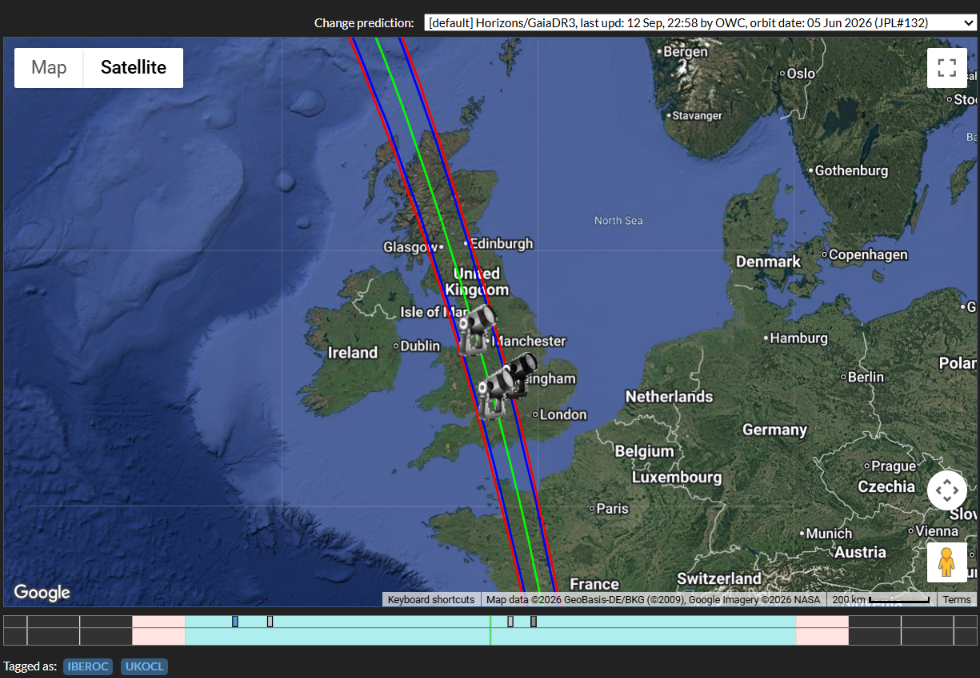
On the night Oct 24/25 (Sunday morning) there is a rare opportunity (weather permitting !) to see a 10th magnitude star occulted by the asteroid (635)Vundtia.
The star TYC 0720-00339-1 is in northern Orion. Only a smallish telescope could be used, or big binoculars to see the star vanish for up to 17 seconds.To make a visual observation, watch carefully from 0239 to 0241 UT and time the duration of the disappearance. The prediction is on page 54/55 of the Handbook. With enough observations and knowing the location of an observer, an approximate outline to the asteroid could be constructed.
Video observation with NTP timing would be best, but i see this as possible visual observation “experience”.
Full prediction details here: https://cloud.occultwatcher.net/event/2123-635-318591-360562-T00339-1
Best of luck – Tim
(Asteroids and Remote Planets Section)Attachments:
20 October 2026 at 10:19 am #643498In reply to: Photometry with a Seestar
Melvyn JoslinParticipantI have been a visual variable star observer and added my observations to the BAA database over a period of several years. I have now unfortunately have failing eyesight and this is only going to get worse, not better. So I thought it would be a great idea if I turned my attention to photometry instead. So over the past two years l have been trying to get to grips with the whole process. I have even attended a workshop on the subject but I left in a very confused state of mind and I have still not recovered from the experience. I have persevered since to no avail and have not added one observation to date to anything. So perhaps photometry is not for me. I admire the members who contribute their photometry observations to the BAA data list who have the skills to do so. Unfortunately the variable star membership is in decline so if there is a way of encouraging new membership to the section that must be great news. Now a telescope that not only finds an object but processes all the information and allows me to post my results to a database at the push a button is just fantastic news for me. Now should I get one or not that is the big question
13 October 2026 at 3:53 pm #643364In reply to: Astronomy communities
 Andy WilsonKeymaster
There is a perception problem with “amateur” as it is casually used to describe someone who is not very good at a task. Whereas the distinction between amateur and professional astronomers is about whether or not you are paid. Each can be a skilled observer or theorist.
I straddle both camps as I am currently a professional astronomer, though I have been an ‘amateur’ for 40 years and I still do ‘amateur’ astronomy (things for fun that I am not paid to do). While not all professional astronomers are aware of the BAA, I know of professional astronomers who are or were members and the Association has an excellent reputation.
I would add that most professional astronomers do it because they are interested in the subject and enjoy it. You can usually earn more by going into industry rather than staying in astronomy and the work tends to be more reliable.
I agree it is rare for a professional astronomer to look through a telescope. However, to get time on a telescope detailed proposals have to be written which may be approved or rejected. Writing these proposals involves detailed knowledge of the object being studied along with the physics of how the observation will be made. While there is a real buzz when observations you have requested arrive, and occasionally you may visit the observatory, it is not quite the same as looking through an eyepiece or casually deciding what to image that night.
12 October 2026 at 3:57 pm #643341In reply to: Astronomy communities
iantaylor2uk
ParticipantI think the issue may be that many astronomers (and I count myself amongst them) do not like the term “amateur”.
If you look in the dictionary, one definition of an astronomer is “A person who is skilled in astronomy or who makes observations of celestial phenomena”.
This would include all of us.Since many “professional astronomers” carry out reseach on data, and never look through a telescope, the distinction between “amateur” and “professional” seems somewhat arbitrary – apart from the fact the “professional astronomers” are presumably being paid!
7 October 2026 at 8:27 pm #643281In reply to: Paramount ME – help needed to set up and align
 Martin MobberleyParticipant
Hello Sheridan,
Can the scope have an imaging camera attached? One way of checking rough polar alignment with an ME is to note the precise time (to, say, a few seconds GMT) when homing completes and the sidereal tracking starts. Then, immediately take an exposure of, say, 60 seconds. If there are plenty of stars on the image upload it to Astrometry.net and it will calculate the precise field centre. For an ME it should home at 0 dec and 2 hours past the meridian at the time you homed it. Of course this is somewhat dependent on nothing going wrong with the homing process (you get the bongs, so that is encouraging) and also the telescope being mounted parallel to the Versaplate…… It also assumes there are no trees or buildings from your site that are over 30 degrees high at an azimuth to the SSW…. Astrometry.net will instantly tell you if the field centre is far from zero degrees Dec. The sidereal time from the observatory at the time tracking started, minus two hours, should tie up with the R.A. calculated by Astrometry.net.
It’s a simple test that should give you a rough idea how far off the polar alignment of the mount might be.
Martin
30 September 2026 at 3:55 pm #643138Topic: Paramount ME – help needed to set up and align
in forum Telescopes SheridanParticipant
Despite trying for over a year we have been unable to get our telescope’s Paramount ME set up accurately.
If anyone is willing to come and assist we would be eternally grateful. We are based in Milton Keynes.
Sheridan WilliamsSheridan Williams
Andy WilsonKeymasterHi Connor,
Supernova are too distant for any change in their distance or location to be measured. Though monitoring the changing brightness and spectra of brighter supernova is frequently done by members of the BAA Variable Star Section.
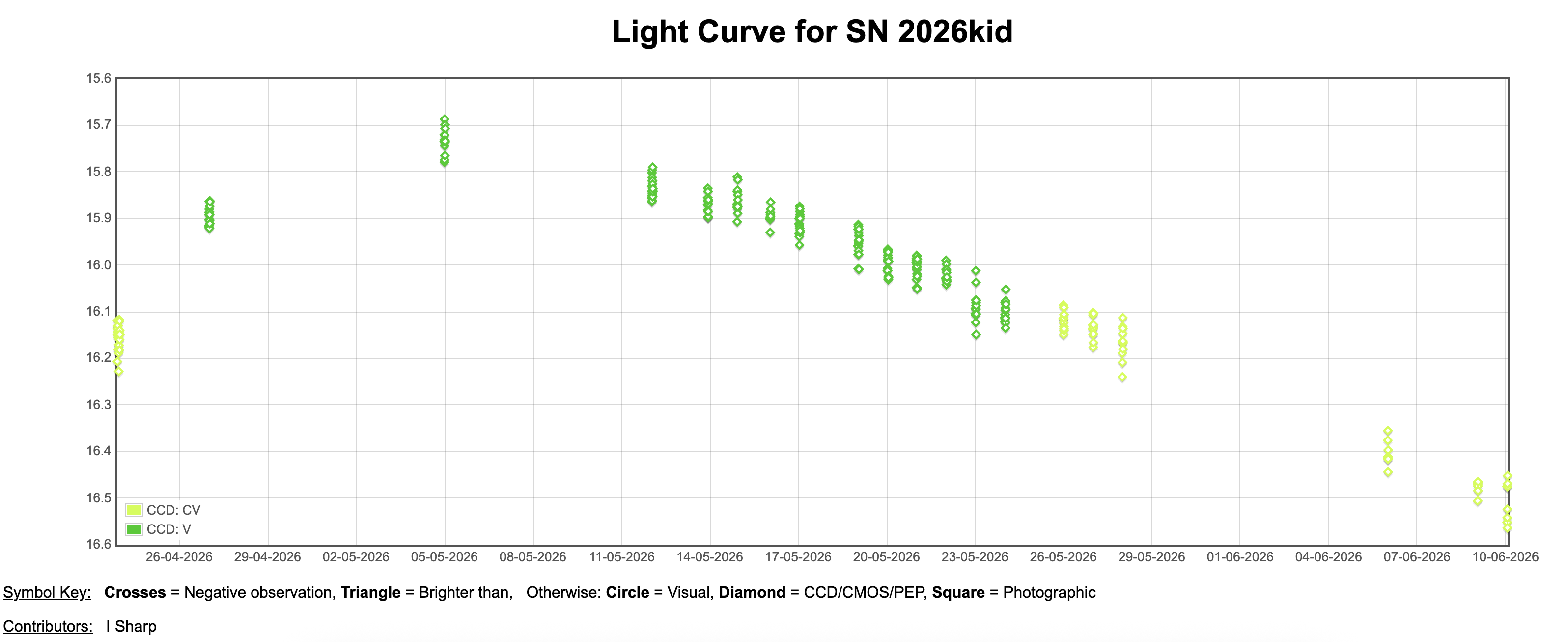
I attach a plot from the BAA Photometry Database of SN 2026kid, photometry again by Ian Sharp.
Robin Leadbeater is an expert at obtaining spectra of supernova. This is tough for amateurs as supernova are faint and typically require large telescope to obtain usable spectra. Here are a couple of spectra from the BAA Spectroscopy Database of SN 2026kid by Robin.
https://britastro.org/specdb/data_graph.php?obs_id=20917%2C20670&multi=yes&mix_flux=no&plot=Plot+up+to+20+SpectraCheers,
Andy-
This reply was modified 1 month, 3 weeks ago by
 Andy Wilson.
-
This reply was modified 1 month, 3 weeks ago by Andy Wilson.
Attachments:
-
AuthorSearch Results
Search Results for 'espin telescope'
-
Search Results
-
On the night Oct 24/25 (Sunday morning) there is a rare opportunity (weather permitting !) to see a 10th magnitude star occulted by the asteroid (635)Vundtia.
The star TYC 0720-00339-1 is in northern Orion. Only a smallish telescope could be used, or big binoculars to see the star vanish for up to 17 seconds.To make a visual observation, watch carefully from 0239 to 0241 UT and time the duration of the disappearance. The prediction is on page 54/55 of the Handbook. With enough observations and knowing the location of an observer, an approximate outline to the asteroid could be constructed.
Video observation with NTP timing would be best, but i see this as possible visual observation “experience”.
Full prediction details here: https://cloud.occultwatcher.net/event/2123-635-318591-360562-T00339-1
Best of luck – Tim
(Asteroids and Remote Planets Section)Attachments: