
- This topic has 9 replies, 5 voices, and was last updated 7 months, 2 weeks ago by
 Denis Buczynski.
-
AuthorPosts
-
5 March 2026 at 12:11 pm #635201
 David StrangeParticipant
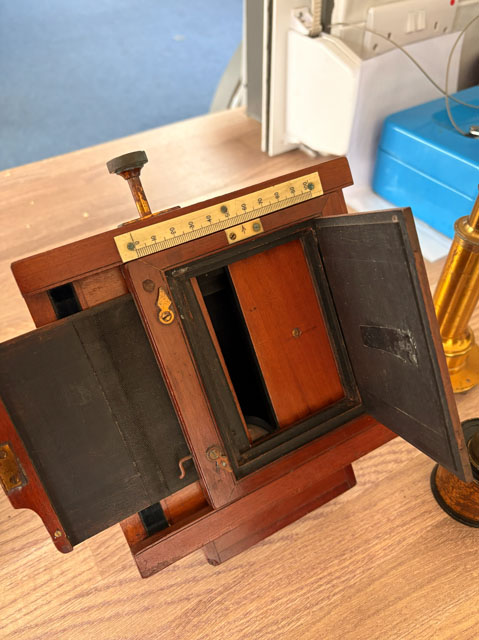
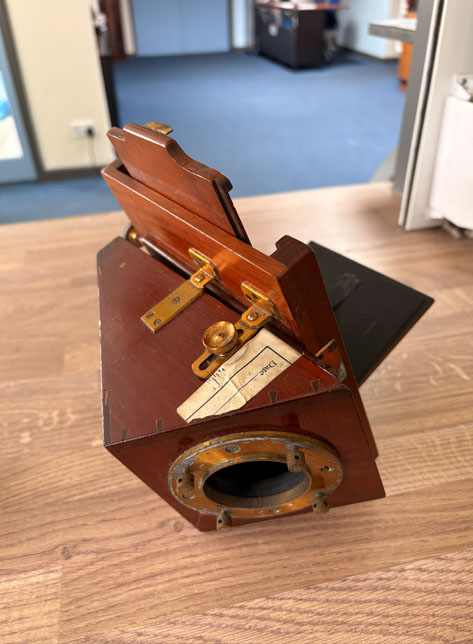
Can anyone expalin the resaon behind the design of this camera? It is a beautifully made hardwood (mahogany) plate camera with precision brass fittings.
The focal plane of the camera is highly inclined and not perpendicular to the optical axis if it was attached to a telescope. There is a shutter mechanism which
allows different parts of the plate to be exposed. I realise that the blue and red end of the spectrum have different foci, but would not have thought it would be this extreme? But maybe with a long focus refractor that may be so?David
Attachments:
5 March 2026 at 1:56 pm #635245 Roy HughesParticipant
This looks to be the back end of a spectrograph.
See Spectrograph for comparison5 March 2026 at 2:23 pm #635246 Denis BuczynskiParticipant
Hi David,
Maybe it is a camera that is used for meteor spectroscopy with objective prism and lens attached. Observatories had camera bodies made like that by a firm called Gandolfi.
Denis Buczynski6 March 2026 at 12:41 am #635249 Robin LeadbeaterParticipant
A 45 degree (erecting) diagonal perhaps ? Is there any sign that there was a prism in there ? Not sure why though unless it added some needed optical length for some reason.
Cheers
Robin6 March 2026 at 11:10 am #635252Denis BuczynskiParticipantHello all,
Here some comments from John Briggs and Richard Berry in the Antiqur Telescope Forum:Hi Denis,
I’m pretty sure it’s a plate holder from a spectrograph. Some old instruments that I have seen had very inclined focal planes like this hardware suggests. One example is the setup used for early Raman spectroscopy. But I think some other types I have seen, but did not have time or circumstances to study, had similarly included plate holders.
All the 2×10-inch plate holders on the old Mount Wilson solar telescope Littrow spectrographs are tiltable to allow for varying focal lengths of the different wavelengths recorded in a given exposure (given that the camera used a lens with some inevitable chromatic aberration). But the maximum angle allowed was not nearly as great as what has been built into the unit you show.
I’ll see if I can find pictures of spectrographs with similar big-angle plate holders to give us a better clue!
–JWB.
And a bit more: These highly inclined plate holders were used on quartz spectrographs for violet and UV light, where the prism and the camera lens, etc., where made of quartz for good UV transmission. In this case, the camera lens might not have been more than a single element, given that the goal was transmission and focusing of UV. Only quartz was possible! Thus, the camera’s focal length was a function of wavelength. And from the appearance of how these things were made (with a big tilt), it was a strong function!Google “Adam Hilger quartz spectrograph.”
I recently learned that Adam Hilger had been an employee of John Browning in Hilger’s youth. (I’m a big fan of all things Browning!)
–JWB.
Hi all–I agree. There were similar plateholders on the spectrographs at C.R.E.S.S. at York University (Toronto) where I worked many years ago. The focal surface is inclined if there are refractive optics in the instrument. They would take many spectra on each plate, moving the plate down for each spectrum. If you examine it carefully, you’ll probably find what were called “deckers” that allow the spectroscopist to shoot a 6 to 10mm slice on a 3-1/4 x 4-1/4 plate, or whatever size the plateholders take. I was sometimes able to snatch boxes of out-of-date 103a-E Kodak glass plates before they chucked them out.
–Richard
6 March 2026 at 11:17 am #635253David StrangeParticipantThanks Denis, yes that sounds exactly like the one we have.There is a wheel that slides a 10mm aperture over the plate to expose different parts of the spectrum. Many thanks for your research. Now we know what it is we will display it in our cabinet.
David6 March 2026 at 12:44 pm #635657 Mike HarlowParticipant
On a related issue, does anyone know what happened to the objective prisms at NLO?
There is a nice BAAJ article from 1982 [1] that mentions three prisms, two for the 300mm refractor and one for the 225mm refractor. They appear to have been used up till 1961 but then no mention of them.
If they were full aperture prisms they would be serious pieces of glass having angles of 15, 20 and 45 degrees. Not items that could be ‘lost’ easily, so they could still be at NLO or deliberately moved somewhere else.
Any historical background on these prisms would be interesting for my own objective prism project.
Thanks.
Mike.
Ref: BAAJ 1982, 93, 1, p25-28. “Sic Itur Ad Astra: A History of the Norman Lockyer Observatory“6 March 2026 at 4:50 pm #635664David StrangeParticipantMike, the full apertture prism is still attached to the Kensington telescope. Unfortunately this telescope is currently out of action awaiting repairs to the dome shutter. I also believe we have the objective prism for the McClean telescope in store but not aware of any others.
David
7 March 2026 at 8:52 am #635809Mike HarlowParticipantThanks for your reply David. Good to know the prisms are still there.
Mike.7 March 2026 at 5:18 pm #635812Denis BuczynskiParticipantMore info from Phillip Houston on ATS Forum
Yes, a spectrum camera seems very likely. This camera has a rather small range of tilt adjustment, perhaps 40 – 50* or less, and only in one direction, unlike ordinary view cameras. It would work with an objective prism, and perhaps a long focus singlet objective. No need for achromatism in a dedicated spectrophotography system. In fact, a singlet lens and prism of the same glass would perhaps give a more linear spectrum spacing than anything achromatic. As John pointed out, focal length of a singlet varies with wavelength, requiring a range of tilt. Quarts optics would be needed to reach very far into the ultraviolet, but other materials could be used for visible and infra-red.
It seems likely that this plate (or film?) holder was part of a spectroscopy dedicated optical tube that attached to a larger telescope. The scale and long stem knob in the top photo appear designed for shifting the back to allow multiple images on one plate. A dark slide is pulled out at left. Typical practice for stellar spectrophotos of the day would have been to orient the prism and camera back so that the telescope drive could be shut off and the light would trail perpendicular to the dispersion spread, giving nice neat spectral lines and great stability.
On the bottom photo, you can see some narrow dovetails. This is consistent with fine English carpentry. Looks like mahogany and very well made.
Sam
-
AuthorPosts
- You must be logged in to reply to this topic.