
Forum Replies Created
-
AuthorPosts
-
 David SwanParticipant
I’d be happy to submit my image and magnitude estimation (CCD, clear filter). I gather you have to go through VSnet to get your obs on the Rochester site, so I’ve sent a request to be added to the system. I’ve set a median stacking job going on my laptop during my lunchbreak – I can then use the Aperture Photometry Tool on that image to get a more accurate determination of the SN magnitude, using a couple of comparison stars.
David SwanParticipantI follow your spectroscopy with interest, Robin. I’ve just imaged the SN – the stacked image is on my observing page. Very bright – guesstimate mag 14, when compared with Gaia 1564852608241033472. The SN is clearly visible on individual frames; I will keep lights and darks in case anyone wants them for photometry. Best wishes – David
David SwanParticipantNothing is better than ‘space-walk’ viewing of globulars, open clusters and bright nebulae through a long focal length, wide AFOV, eyepiece. I think both the ease of acquiring images nowadays (cost, expertise required) and also of sharing them has led to the perception that visual observing and freezing to death at the telescope is over. I don’t think that is the case, in terms of absolute numbers of people. I just think there are many more different types of activity going on – and it’s all good as far as I am concerned! I do a lot of visual observing, and keep a log, but I don’t broadcast it. (My sketches are terrible; Paul Abel’s are amazing.) David
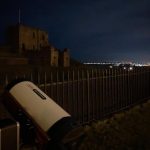
David SwanParticipantIt does indeed look like a low-lying castle on the right. I confess I was not familiar with the Crusader type, but I’ve now looked it up. Bamburgh is not too far from where I live, and to follow up from Andrew, that image could be north Northumberland on a poor summer day. LOL. David
David SwanParticipantWatching the BBC News footage from Kentucky, 1925 our time. Clear prominences visible at the 2 30, 4 and 6 o’clock positions on the solar disc.
David SwanParticipantI’ll be watching too!
David SwanParticipantThanks Lars. My Russian is rather flaky 😉 , so please find a Google translation attached.
David SwanParticipantI would guess this is an attachment to facilitate afocal photography? The two eyepiece clamps are placed differently with respect to the camera screw to allow different set-ups.
David SwanParticipantCheers James: good image stretching. And thanks all.
Let’s hope August gives us good astro weather, with a large high pressure area stuck over the UK affording clear skies and still air. LOL. David
David SwanParticipantThe link works. Thanks very much Jeremy – I had overlooked this option, which is very useful. And yes, the other stars are there. Great issue of the journal by the way. David
David SwanParticipantDavid SwanParticipantHello,
Yes, I’ve been looking at recent images taken by others that are publicly available – trying to find images at a similar scale is quite difficult! – and many of the ‘problem’ stars are in their images, so I’m more confident that there isn’t a major problem with my set-up. I’m planning to get more into deep sky imaging, hence the basic questions.
David
David SwanParticipantGrant, I have searched – in vain – for information about deployment of the reflective sheets. Where I am, it was completely overcast last night (18/19 Jul), so I made no observation. Lars, I have yet to see a report on a positive sighting. You may well be right.
David SwanParticipantThanks Damian. David
David SwanParticipantThanks Martin. Visually I could make out Titan easily, not so much the dimmer trio (it doesn’t help being so close to the summer solstice of course!). The camera makes light work of them. I’ll keep trying with Mimas: it’s a long wait till the rings are edge on! I’m pretty sure I’ve got a positive on Enceladus – there’s a definite concentration of signal (see my posted observation, and please give an honest opinion) where it is predicted to be by my planetarium application. I’ll have to be patient for a favourable elongation for Mimas – if there is such a thing!
David SwanParticipantIf my calculations are correct, the impact site should be nicely earth-facing at around 0115 UT on the morning of the 28th. Might it be worth staying out after the Io – Ganymede double shadow transit, to see if there is any scarring in the NPR?
-
AuthorPosts