
Forum Replies Created
-
AuthorPosts
-
 David SwanParticipant
Yes, with the frames I look last night: for some, a two point calibration with zero and hydrogen beta seemed to work very nicely, with the alpha, beta, gamma and delta Balmer lines superimposing precisely on target in RSpec. In other frames this wasn’t the case. I guess it is just an effect of seeing? I am looking forward to seeing the spectra of SN2018gj that will appear over the next few days. I note you are discussing the uncertainty around the SNII subtype on the ARAS forum. David
David SwanParticipantI’ll not do any sharpening. It was easy enough anyway to scan through the frames by eye and then select the best; no computer programme is required for that. The seeing yesterday was extremely bad – as unstable as I’ve ever seen it would not be an exaggeration.
David SwanParticipantI’ve posted a much better effort on my member’s page. With my first go, I thought stacking and sharpening a load of images (a la planetary imaging) would help things, but I think it actually blurred the spectrum – and the bit depth was 8 bit anyhow. This time I was careful with focusing and made sure the exposure wasn’t too high. I think the result is much better. Unfortunately the ADU of my camera is 14 rather than 16 bit, so there’s not quite as much data as there could be.
David SwanParticipantYes, I think overexposure is likely. I’ll look into the brightness values. Vega of course is low in the evening, and with this being early days (in spec) for me, I thought I’d go for a convenient target from my backyard. Thanks Hugh – David
David SwanParticipant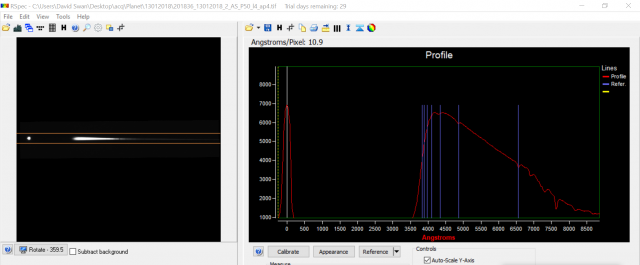 I’ve carried out my first capture. Not an ideal target I gather, but the weather isn’t cooperating! I’ve done the wavelength calibration – with the star image and hydrogen alpha line. Focus is definitely something I’ll work on; and exposure time too. DavidDavid SwanParticipant
I’ll keep you informed on how I get on. There was a 10min gap in the clouds yesterday… David
David SwanParticipantThanks Robin – David
David SwanParticipantThanks Andrew – I’ve had a quick look and indeed there’s lots there! David
David SwanParticipantThanks for pointing this out Denis. At the end of the Wiki article, Bopp is quoted as having said something I wholeheartedly agree with:
“I’ll never give up looking at the skies. There’s so many beautiful things there. And I love to share that with people.”
David SwanParticipantThanks Nick. According to the Beeb, the Hawaiian name for 1I/2017 U1 is pronounced oh MOO-uh MOO-uh.
David SwanParticipantI’ve just solved the image in Astrometrica. The software also dabbles in photometry: the estimate is 15.1 CV (unfiltered CCD with V mag zeropoint).
David SwanParticipant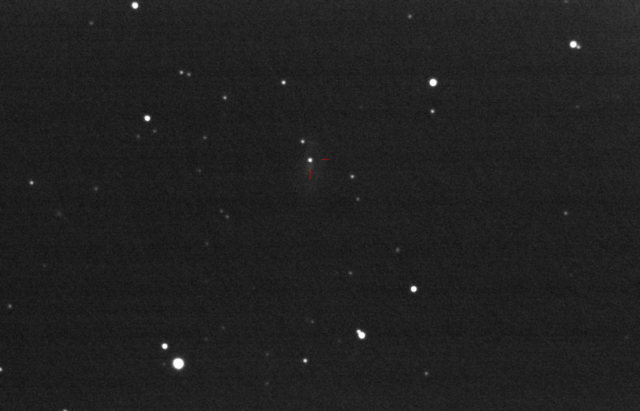 Hello,
I noticed a clear patch when putting the bin out and got 45 x 5s frames. Here’s an image. It does seem bright! Midpoint 21/11/2017 2015 UT.
David SwanParticipantYes, congrats Robin. The galaxy is nicely positioned, so – weather permitting – I’ll try and get some images over the next week for magnitude estimations. David
David SwanParticipantThanks Nick. The software looks really useful. I noted there was a long smudge just below as well, so it does make one a bit doubtful! I’ll try to get multiple stacks as you suggest, and then blink them. David
David SwanParticipantCertainly not a striking image, but I might just have picked up Heinze above the sky background. Please see the FITS here
https://1drv.ms/u/s!Agvxu8wNOxpAcJ2l_8CiGRTPXrc
and give me your opinion. The midpoint of the capture was 050649 UT on 8 Nov 2017.
David SwanParticipantQuite. Perhaps, Robin, you should reveal to Eric Watkins where in the UK this astro-friendly micro-climate exists. David
David SwanParticipantThanks for flagging this Robin. I can’t do spec, but I do have B, G and R CCD filters – so if the object is bright enough for my setup, I’ll take a set of images. David
David SwanParticipantWhat a fantastic image. Thanks for pointing this out.
David SwanParticipantHello everyone. I would like to second Martin Lewis’ question / request for this functionality. If it isn’t too much trouble – I don’t know what would be required ‘under the hood’ of the website. David
David SwanParticipantImage now visible via Rochester SNimages site. Carried out photometry and checked it – magnitude came out brighter than I judged by eye, at 13.6. Would be good to image this target again. Perhaps Thu. David
-
AuthorPosts