
- This topic has 24 replies, 7 voices, and was last updated 6 months, 1 week ago by
 Nick James.
-
AuthorPosts
-
25 February 2026 at 2:16 pm #634776
 Bill BartonParticipant
Could a mathematically skilled member use the solar constant (1360W/m2), the inverse square law (1/x2), and the perihelion distance of C/2026 A1 (MAPS) (0.0057AU) to tell us how much energy per square metre the comet will have to absorb on the afternoon of 2026 April 4?
26 February 2026 at 11:57 am #634783 Peter MeadowsParticipant
It will be 1360 * 1 / (0.0057*0.0057) = 41.8 MWm/2 assuming the Earth is at 1AU.
26 February 2026 at 6:20 pm #634789 Dr Paul LeylandParticipant
It will be 1360 * 1 / (0.0057*0.0057) = 41.8 MWm/2 assuming the Earth is at 1AU.
Strictly speaking (and one should always speak strictly, especially to animals and young children) the figure must be multiplied by the albedo as some of that power density will be reflected. I have little idea of the true albedo integrated over all wavelengths but a figure of 0.9 may be in the right ballpark. Still a fearsome figure.
26 February 2026 at 8:00 pm #634791 Nick JamesParticipant
Since we are getting picky here I need to point out the difference between power (measured in Watts) and energy (measured in Jules). 1W = 1 J/s. The power flux density (in W/m^2) is not the same as the energy absorbed (which will be in Jules).
The PFD at distance r is easy. It is simply the Sun’s total radiant flux (P=3.8E26 W) spread over an area which is the surface of a sphere of radius r so:
PFD = P / (4 pi r^2) [W/m^2]
If you put in 1 au (r = 1.5E11 m) you get a PFD of around 1.35 kW/m^2 which is our nice, familiar solar constant. If you put in the comet’s perihelion distance (8.55E8 m) you get the aforementioned 41 MW/m^2. That is indeed a lot!
As Paul points out the energy absorbed is much more complicated since it depends on the albedo. It also depends on how long you integrate over. Also, the comet’s nucleus will get very hot and so it will be radiating energy the other way. Depending on the thermal conductivity of the surface layer it might get close to thermal equilibrium with the photosphere. That is an exercise for the reader.
Whatever happens, it isn’t going to be nice. Add to that the tidal forces being that close to the Sun (they go as 1/r^3) and it is a big question whether it will survive. That will depend on how big and consolidated it is. We get a ringside seat since we’ll be able to see it as it passes through the field of view of space based coronagraphs.
What other Solar System objects do anything as exciting as this?
26 February 2026 at 8:36 pm #634792 Peter CarsonParticipant
The comet is currently absorbing energy without any ill effects. See my image taken a few days ago https://britastro.org/observations/observation.php?id=20260226_203305_fc0a5defdc192f57
26 February 2026 at 8:52 pm #634793Dr Paul LeylandParticipantWell …
If we are being really picky, the SI unit of energy is the Joule, and not the Jule. 😉
26 February 2026 at 9:29 pm #634794Nick JamesParticipantPeter – Nice image from Spain. I actually managed to get it from Chelmsford a couple of nights’ ago but the image is very grotty.
Paul – Yeek. You’re right! very embarrassing but spelling was never my strength! I do feel a right Fule.
26 February 2026 at 9:54 pm #634795 Jeremy ShearsParticipant
….and we haven’t even got onto the subject of the correct way to pronounce Joule
27 February 2026 at 8:10 am #634797Bill BartonParticipant41.8MW/m2 is approximately equivalent to……
120 London busses (340kW), or
16,000 electric domestic kitchen kettles (2.5kW) or
55,000 horsepower (746W), or
An unknown quantity of giraffe-power (the Internet is distinctly lacking in conversation factor for this unit).-
This reply was modified 7 months, 2 weeks ago by
 Bill Barton.
27 February 2026 at 9:01 am #634799Dr Paul LeylandParticipantInteresting that no-one has yet picked up my albedo error. The albedo is the fraction reflected, not the fraction absorbed. Multiplying by the WAG of 0.9 is OK, but the albedo is likely about 0.1.
27 February 2026 at 10:30 am #634804Peter MeadowsParticipantI should have clarified that the 41.8 MWm/2 is the power received at the comet (and not absorbed) and that the Sun is assumed to be a point source. In fact at a perihelion distance of 0.0057 AU (855,000 km), the comet will only be 155,000 km above the photosphere of the Sun (radius 700,000 km) and so the Sun will subtend an angle of about 70 deg – some sight.
28 February 2026 at 7:44 am #634821Bill BartonParticipantAt closest approach, is the comet going to be in the solar corona or chromosphere?
28 February 2026 at 9:14 am #634822Peter MeadowsParticipantIt will most likely be in the solar corona at closest approach – the chromosphere layer itself is only roughly 3,000 to 5,000 km thick above the photosphere. However, some prominences, that originate in the chromosphere, can reach heights above the photosphere of 100,000 km or more. So potentially this comet could pass through a high prominence but unlikely.
28 February 2026 at 10:32 am #634824Nick JamesParticipantA lot of the topics covered in this thread are dealt with in detail in the 2017 review paper I cited in my original news article on this comet:
https://link.springer.com/content/pdf/10.1007/s11214-017-0446-5.pdf
It is well worth a read. See, for example, section 6.2 which discusses the breakdown of the inverse square law in relation to, amongst other things, heat flux.
28 February 2026 at 5:40 pm #634828 Robin LeadbeaterParticipant
London busses (340kW)
That’s quite a difference from the Flanders and Swan conversion factor (1 bus = 97HP). We are in trouble if fundamental units like this are found to change with time. Is there a theory to explain this ?
28 February 2026 at 7:44 pm #634830Dr Paul LeylandParticipantAccording to units(1), 1HP = 745.7W and 340kW = 456HP. The discrepancy is a factor of 4.7.
I am prepared to believe that bus engines have become markedly more powerful since the last published measurement made quite a few decades ago. Car and motorbike engines certainly have.
1 March 2026 at 8:14 am #634831Bill BartonParticipantMy figure for the London bus was for an electric model, so is probably equivalent to the energy value of the fuel in the tank rather than the engine capacity. 340kW is also around 1/3 of a (Back to the Future) DeLorean.
-
This reply was modified 7 months, 1 week ago by Bill Barton.
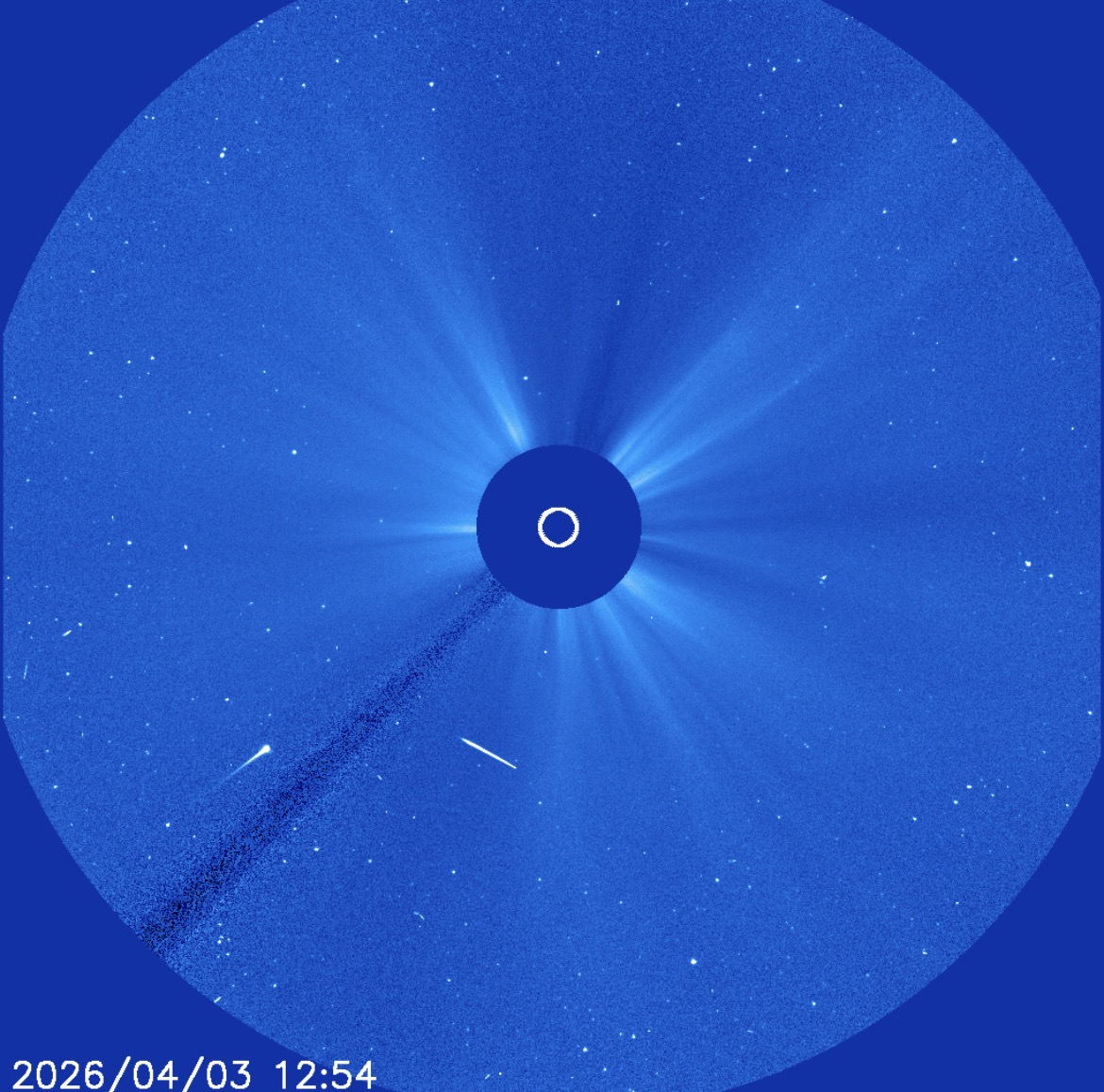
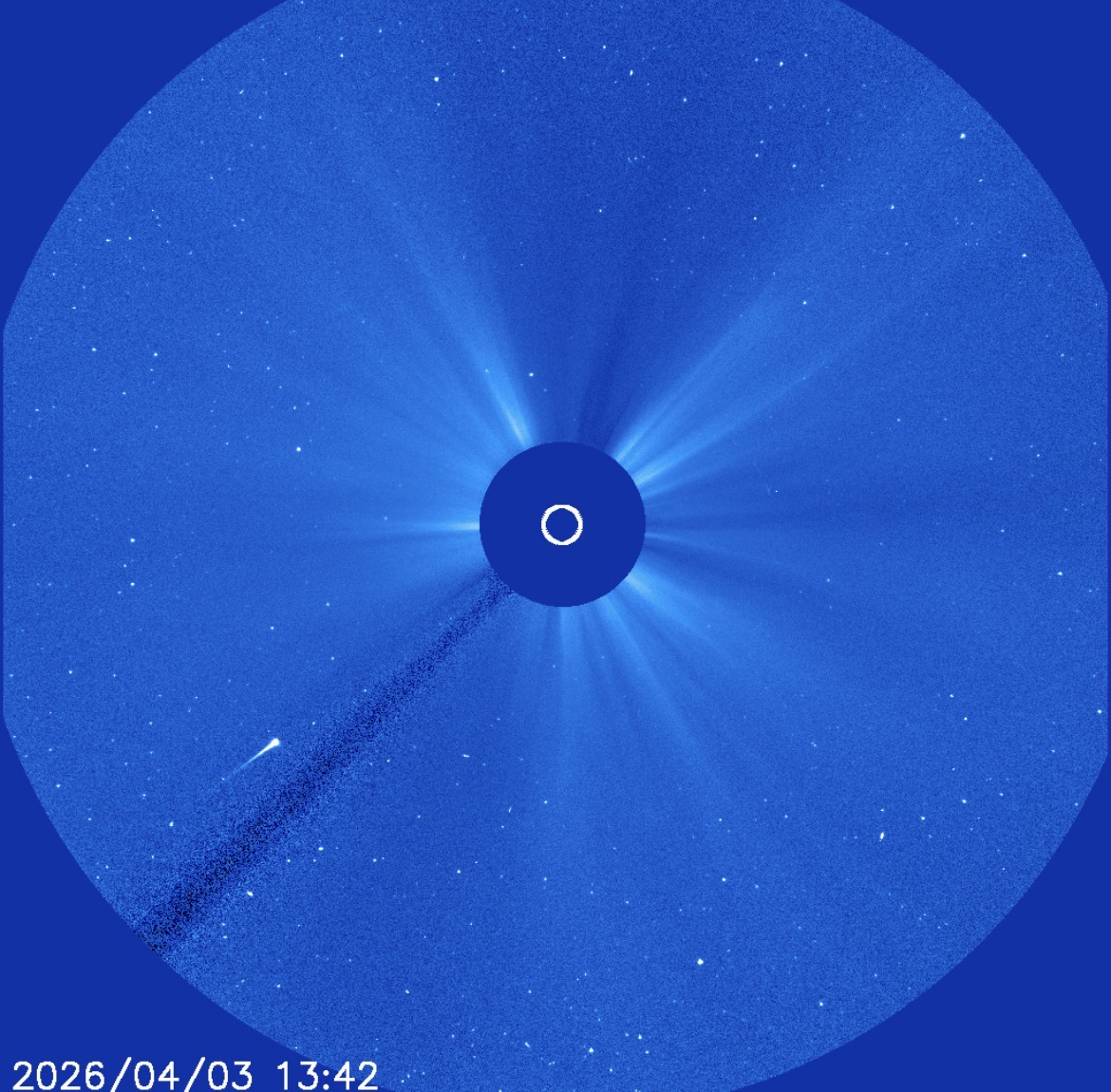
8 March 2026 at 7:31 pm #635828Bill BartonParticipantThe European Space Agency’s Solar and Heliospheric Observatory (SOHO) satellite has two coronagraphs known as C2 (narrow field) and C3 (wide field).
C2’s field of view is between 1.5 & 6 solar radii, C3 between 3.7 & 6 solar radii. When viewed from the Earth one solar radii is around 0.25 degrees. Therefore C2 can see objects in the background of solar corona images between 0.375 degrees and 1.5 degrees elongation. C3 0.925 and 7.5 degrees elongation.
When Comet MAPS’s elongation falls to less than 7.5 degrees it should become visible, first in C3 and then in C2. According to the ephemeris on Dominic Ford’s ‘in-the-sky’ website this will be from April 03 to April 06. Of course, Comet MAPS may be destroyed as it approaches, or leaves, perihelion meaning it may not actually be visible between the dates just given.
12 March 2026 at 2:25 pm #636495Bill BartonParticipantJust found this on the internet concerning comet MAPS, has some interesting graphics.
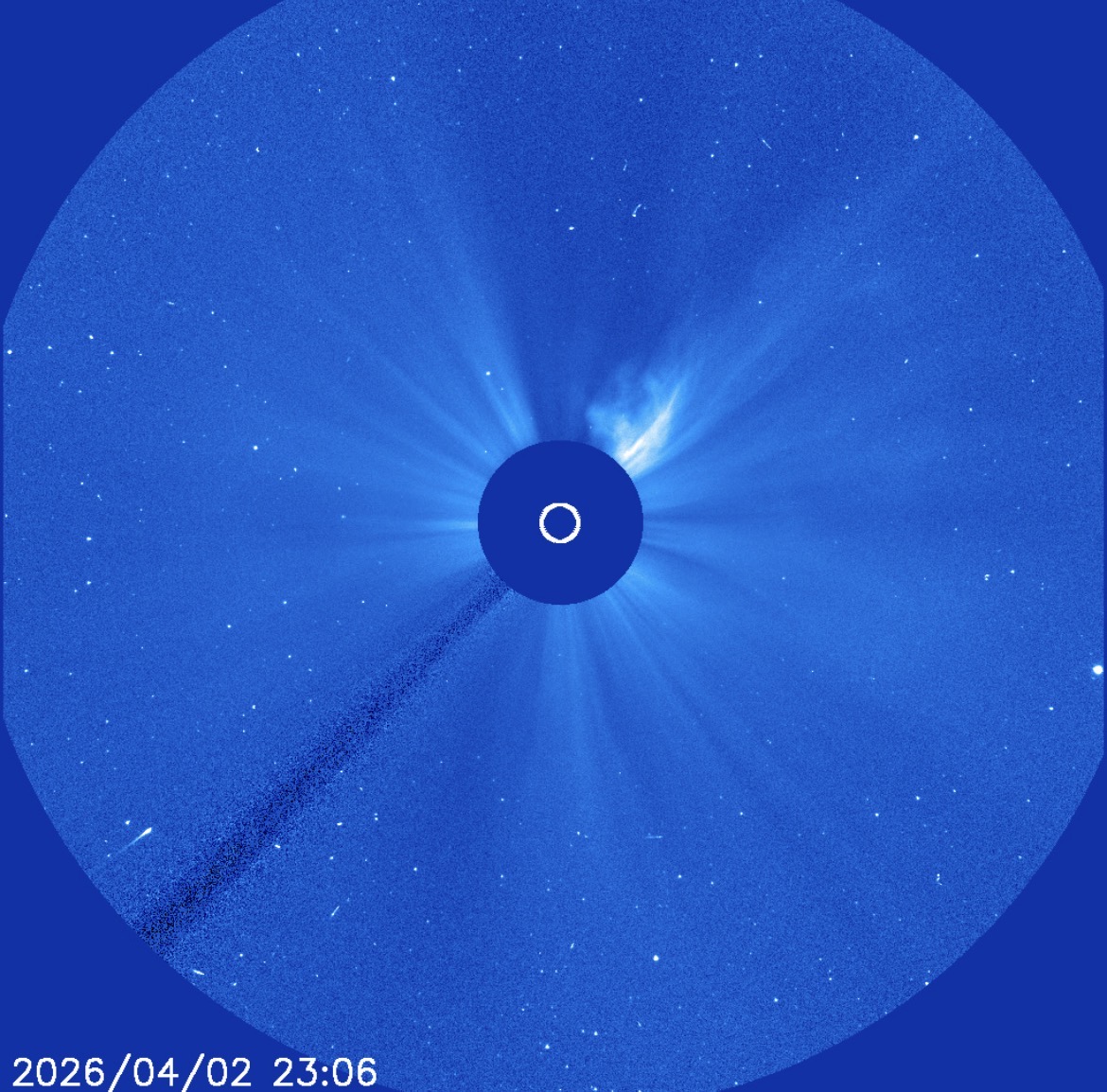
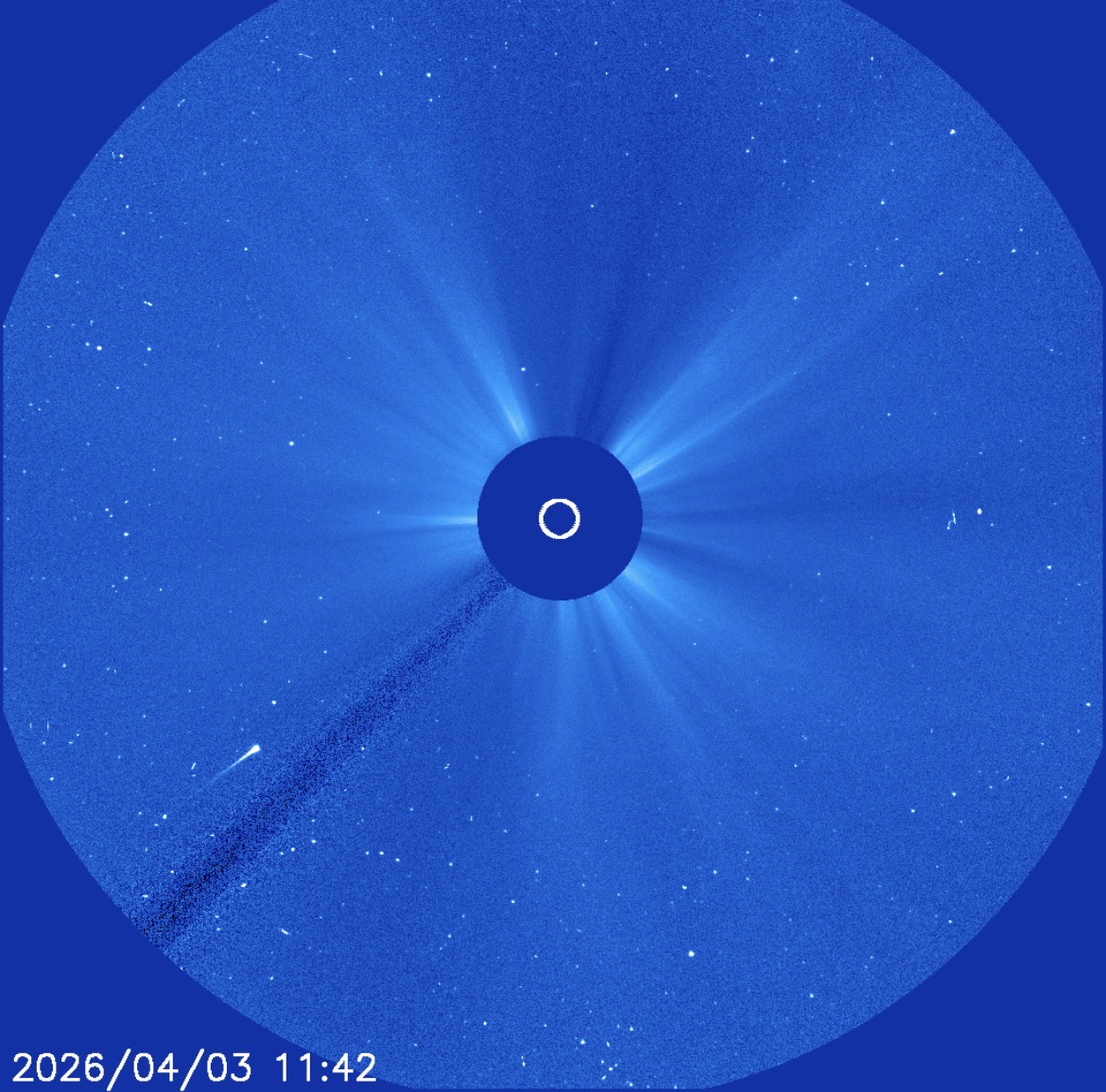
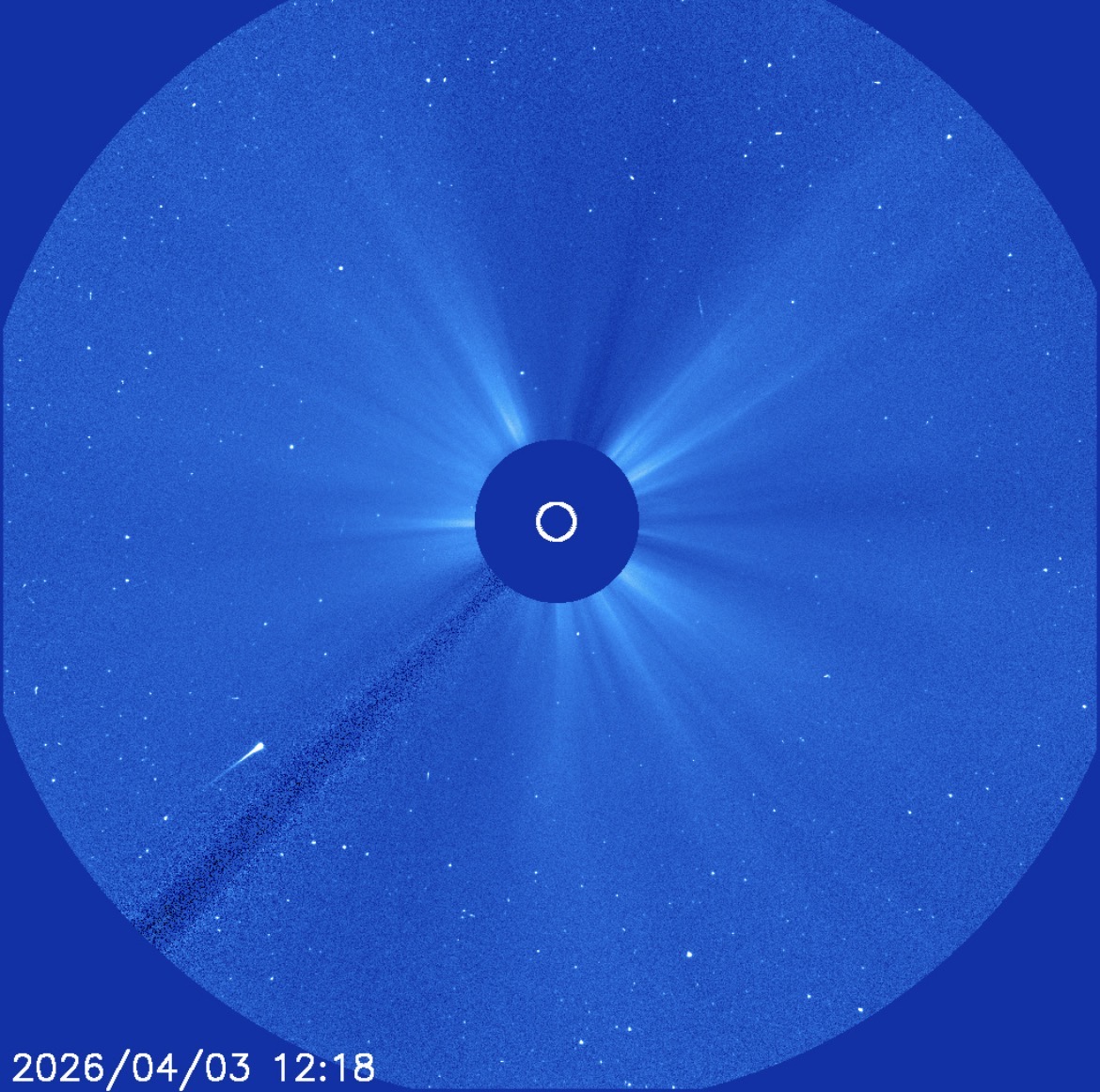
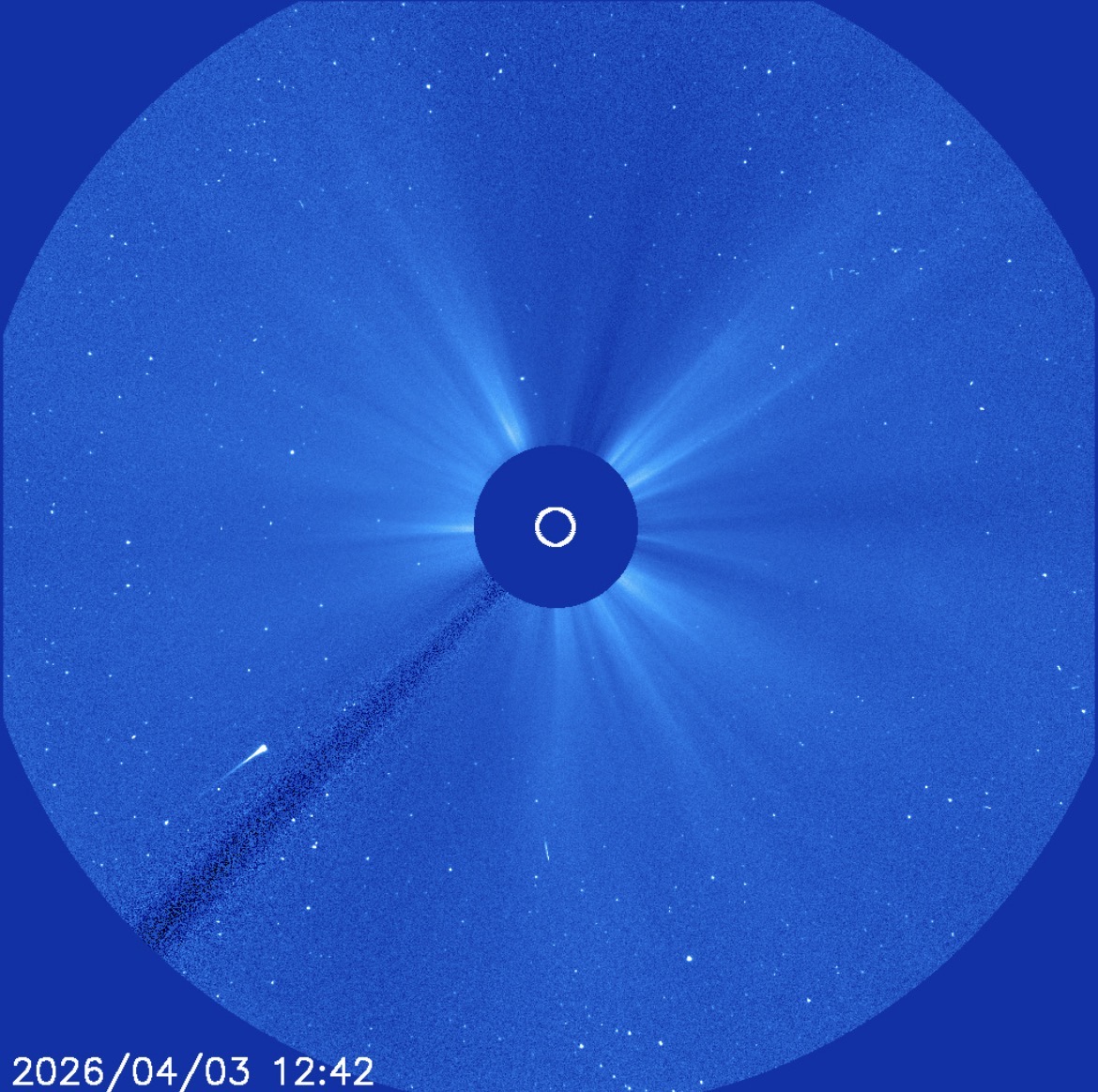
3 April 2026 at 3:31 pm #636880Bill BartonParticipantHere at last. Lower left of images from Soho LASCO C3 coronagraph.
-
This reply was modified 7 months, 2 weeks ago by
-
AuthorPosts
- You must be logged in to reply to this topic.