

Forum Replies Created
-
AuthorPosts
-
Dominic Ford (site admin)
ParticipantPosted by Gordon MacLeod at 18:31 on 2011 Oct 02
Thanks Paul and Graham.I have already placed an order for the BAA book on Astrophotography and have my eye on the Canon suggested.Many Thanks for all your advice.Best Wishes,Gordon
ParticipantPosted by Graham Relf at 17:52 on 2011 Oct 02
I am very keen to encourage others to start doing some astrophotography. DSLRs provide an easy way to start. My own site is aimed at explaining how to do it and shows many photos taken with Canon EOS cameras: http://www.grelf.net
ParticipantPosted by Paul A Brierley at 15:54 on 2011 Oct 02
The BAA publish a good beginners, guide book, on digtal slr imaging.As for cameras.I believe most, if not all Canon DSLR, are the camera of choice. The 1000D being a particularly good camera, used by many.But the more expensive Nikon cameras, are also proving popular.Below is a web link for Jerry Lodriguss website. Here I think you’ll find a fair bit of information.http://www.astropix.com/HTML/I_ASTROP/NIK_CAN.HTM
ParticipantPosted by Gordon MacLeod at 15:12 on 2011 Oct 02
It gets the thumbs up from me!Packed with all the details I want to know and have come to expect, and for me the colour enhances its presentation.
ParticipantPosted by Gordon MacLeod at 15:09 on 2011 Oct 02
Oh and particularly for capturing comets too, (how did I forget to mention probably the one thing I’d really love to capture on camera!)
ParticipantPosted by Graham Relf at 14:33 on 2011 Sep 29
I managed 2 comets last night: C/2009 P1 Garradd AND 78P Gehrels. The latter is much harder to see but here’s the result using Canon EOS 5DMkII at orime focus of 254mm f/4.8 (f=1200mm) Newtonian:
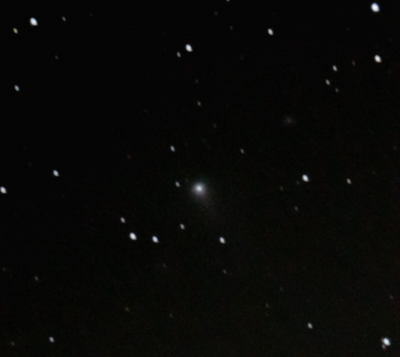 78P is in Pisces, directly under the square of Pegasus, so not very high up. I you want to know where exactly to find it use the Computing Section’s applet: http://britastro.org/computing/applets_planets.html Add the object, click on it to see details, click the button for drawing a chart.Participant
Posted by Tom Moran at 16:43 on 2011 Sep 28
HiThe GIf does’nt want to upload. You find the animation here (hopefully) http://www.tommoran1.webspace.virginmedia.com/page8.htmlTom Moran
ParticipantPosted by Graham Relf at 11:08 on 2011 Sep 27
At the risk of being thought an old fuddy-duddy, I have to disagree. It’s a bold try but I think the bleeding of colour to the page edges is a down-market move.
ParticipantPosted by Len Entwisle at 21:28 on 2011 Sep 26
Must concur with the two gentlemen above as to the excellence of the new JBAA format. Thanks.
ParticipantPosted by David Arditti at 18:46 on 2011 Sep 26
I agree. Much improved and more modern-looking, with more space for pictures.
ParticipantPosted by Paul A Brierley at 20:23 on 2011 Sep 18
I was able to look at our nearest star this morning.I counted five group’s visible at x25 through a Baader filtered 66mm William Optics "OG"You can read my report together with a drawing on my blog.I’ve mentioned to an observing colleague, jokingly. The Sun will probably wake up now. Now she’s heading South of the celestial equator. And thus making observing difficult from November.
ParticipantPosted by Paul A Brierley at 20:16 on 2011 Sep 18
What a shame you didn’t record this object visually.Looking back at its track. It must have appeared close to Sadalsuud (B Aqr) finally fading near Mirach (B And)I’ve estimated the magnitude, M-5?Had I not been clouded out. I might have seen it, as I had planned to go out observing.Such is life…
ParticipantPosted by Len Entwisle at 18:24 on 2011 Sep 15
A great set up for meteor video there !There has been a NASA Update today here Re-entry prediction time which takes us to 24 th September ( plus or minus a day ). The Heavens Above website gives some 11 passes (or so) over the UK during dark hours in that time 48 hr period . They are not pulled up as ‘visible passes’ so they must be in the earths shadow,however at re- entry there should be no need for reflected sunlight to make it visible! On the balance of probability it will be cloudy or happen somewhere else along the orbit but worth having a watch for. Murphy rules, OK
ParticipantPosted by Callum Potter at 15:43 on 2011 Sep 15
Hi Paul,as i mention in the October Journal Sky Notes, recent reports on Elenin suggest it is breaking up, is a lot fainter than expected, and may not survive perihelion.Of course, it is still worth checking it out – comets are notoriously unpredictable! It will be a couple of days into October before it will be high enough to see in the morning, before sunrise.Callum
ParticipantPosted by Graham Relf at 10:11 on 2011 Sep 15
C/2010 X1 Elenin is currently very near the Sun, as can be seen on the Computing Section’s site: http://britastro.org/computing/applets_planets.htmlYou can use our applet to see how it moves past the Sun and out to become observable. However, I believe there is still some doubt as to whether it will survive perihelion and be as bright as hoped.You can track many other comets on our applet, including all those currently at the top of the Comet Section’s list.I managed to photograph C/2009 P1 Garradd last night – the first proper clear night for many weeks here. Photo can be seen here (Flickr)
ParticipantPosted by Nick James at 18:41 on 2011 Sep 13
Len,Thanks for this. I now have a Watec 902h2 with Cosmicar 3.8mm, f/0.8 running permanently so it would be nice to pick up something interesting like that.Nick.
ParticipantPosted by Frank Bonner at 09:13 on 2011 Sep 08
SheridanThere does not appear to be a great choice. Google Sky works quite well but does not really provide much information. AstroTools is much better in what it can do but it is very, very slow but worth a try if your phone has a relatively fast processor.. Hope this helps.Frank Bonner
ParticipantPosted by Dave Adshead at 16:54 on 2011 Aug 30
Yes, I’ve been using a Lodestar with the OAG in my QSI 583 wsg CCD camera. Previously, I used a separate guide scope side by side on a Skywatcher EQ6 Pro. Moving to the OAG allowed me to remove 8 Kg of counterweight, the EQ6 Pro gave a sigh of relief.I can recommend an OAG, I’ve been using it now for about 16 months. I’ve not had any problems yet finding a star to guide by.RegardsDave
ParticipantPosted by Andrea Tasselli at 11:54 on 2011 Aug 30
Not directly but people that I know of use the combo quite effectively in conjunction with SX-AO.Reg’sAndrea T.
ParticipantPosted by Sheridan Williams at 21:58 on 2011 Aug 28
Can we get rid of the apostrophe in star’s (sic) please?
-
AuthorPosts