
Tagged: comet
- This topic has 30 replies, 9 voices, and was last updated 8 months ago by
 Jeremy Shears.
-
AuthorPosts
-
15 November 2025 at 6:43 pm #632087
 Nick JamesParticipant
This comet was reported to have fragmented on or about November 4 (ATEL 17482, 17487, 17488). There are several fragments but the two brightest are the main component and fragment B. Recent images are in the archive here:
https://britastro.org/cometobs/2025k1/thumbnails.html
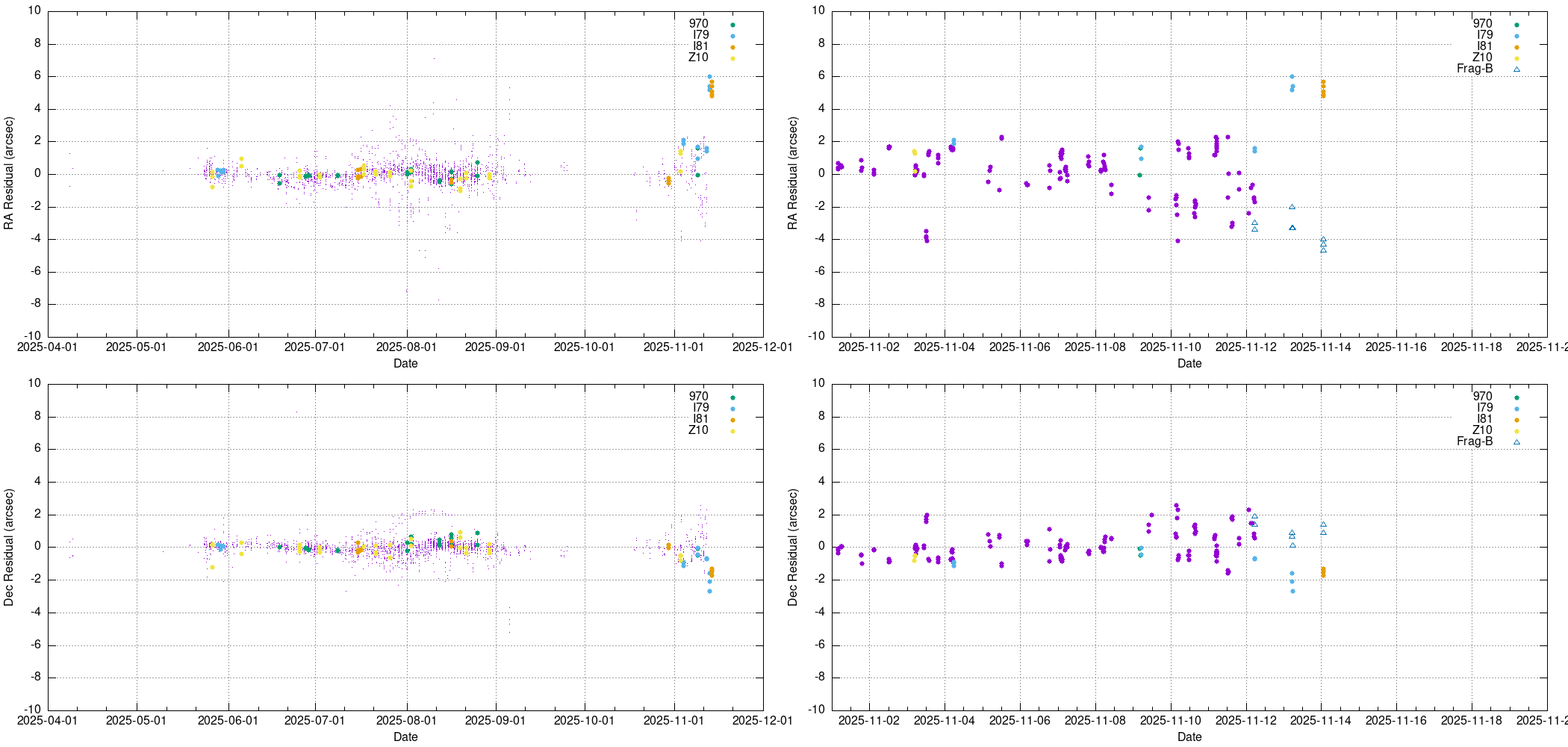
Attached is a plot of the all the astrometry that I have. The recent astrometry consists of my measures using the Alnitak telescope in Spain (I79) on Nov 12 and 13 and Denis Buczynski’s measures using his telescope in Tarbatness (I81) on Nov 14. The plot shows the residuals for the main component as filled circles and the residuals for component B as open triangles. These residuals are from the fitted orbit using all the available astrometry (from the MPC) prior to November 4.
The main component shows a large positive RA residual which is matched by a similarly large negative residual for fragment B. A simple-minded interpretation of this would be that both components have a similar mass but fragment B is much fainter so that doesn’t seem likely.
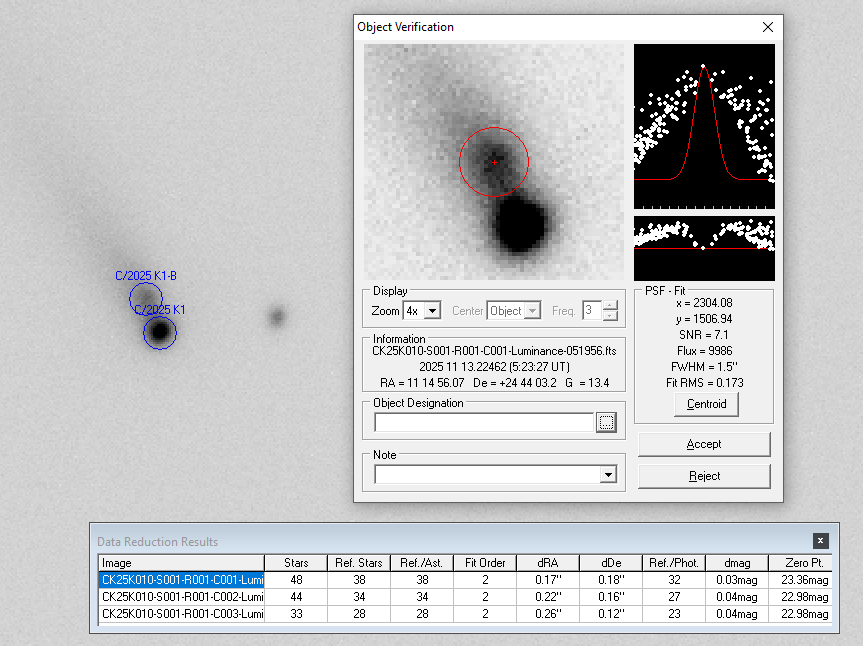
If anyone has any recent (post November 11) astrometry of this comet please forward it to me and the MPC. Astrometry of the main fragment (C/2025 K1-B) would also be very useful. It is now well separated from the main component.
-
This topic was modified 10 months, 4 weeks ago by
 Nick James.
16 November 2025 at 1:49 pm #632091 Robin LeadbeaterParticipant
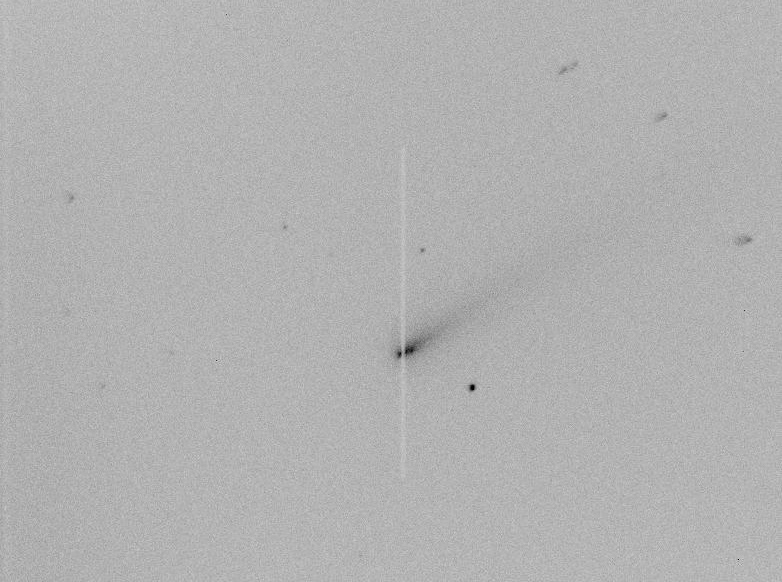
I was taking a spectrum last night. Here is a 15 sec exposure with the comet on the slit. It is difficult to be sure because of the slit but it looks like the brightest component is significantly elongated. Has there been further fragmentation ?
Cheers
RobinAttachments:
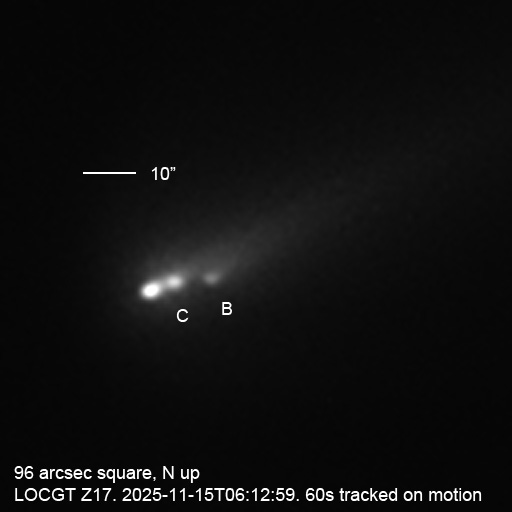
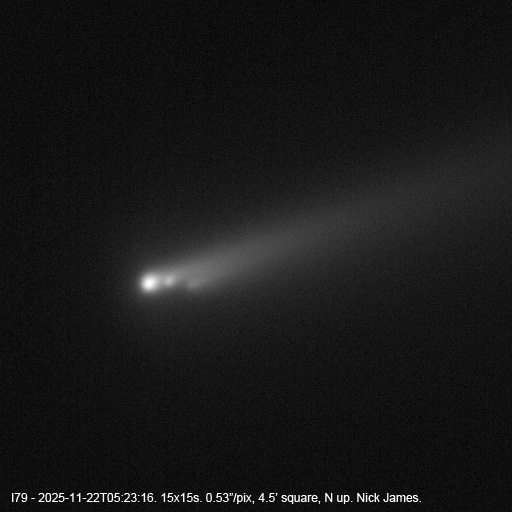
16 November 2025 at 3:55 pm #632093Nick JamesParticipantRobin. Yes. There are three components now. Attached is an image I processed from yesterday using data obtained by the Comet Chasers group. Component C is quite bright and would merge with the main component if seeing or resolution is poor. As of yesterday morning it was around 4 arcsec from the main component.
Z17 is a Planewave Deltarho 350 with an IMX455 sensor at 2300m Teide so a rather nice setup!
Attachments:
17 November 2025 at 5:36 am #632095Nick JamesParticipantAs of this morning fragment C is the brightest component.
https://britastro.org/observations/observation.php?id=20251117_052037_e18a08602a3cf34b
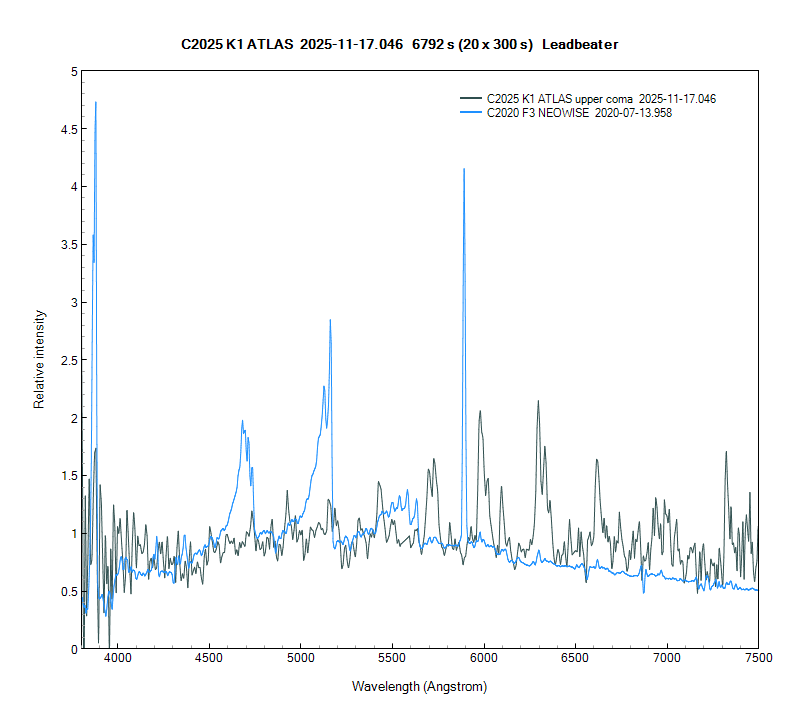
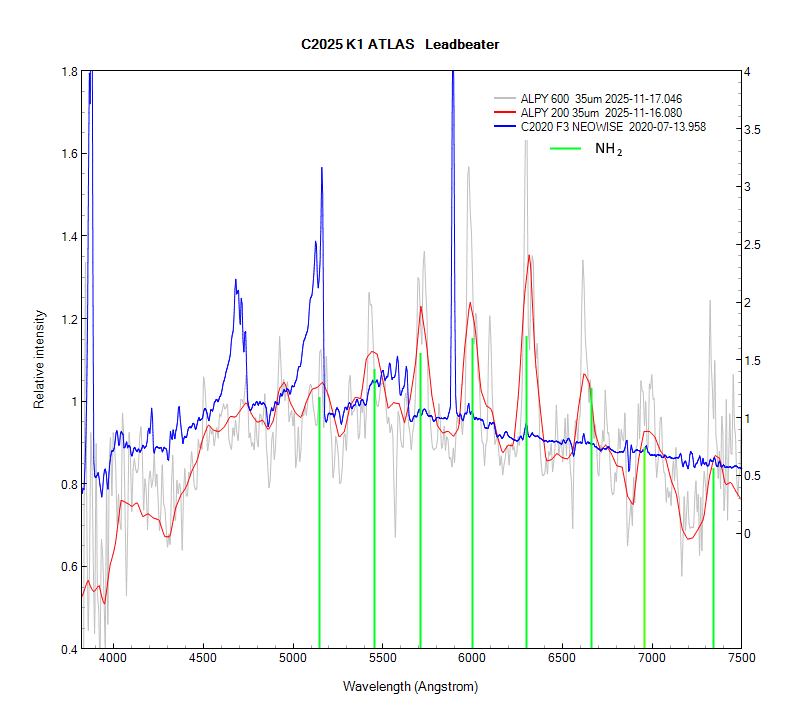
17 November 2025 at 5:51 pm #632096Robin LeadbeaterParticipantThe spectrum is quite different from other comets I have measured, with an apparent absence of CN, C2(swan) and instead a series of bands in the red which I need to check but I suspect are NH2. See attached comparison with 2020 F3 Is this known to be a carbon depleted comet or is it something to do with the fragmentation perhaps ? Are there any pre fragmentation colour images which might show a presence or lack of blue/green emission ?
Cheers
Robin18 November 2025 at 3:45 pm #632102Robin LeadbeaterParticipantYes it is reportedly very carbon depleted.
https://www.astronomerstelegram.org/?read=17351
The emission lines in the red are all from NH2 and are much stronger than in that spectrum taken in August marked here in green.Attachments:
18 November 2025 at 4:28 pm #632107Robin LeadbeaterParticipantThe emission lines in the red are all from NH2 and are much stronger
Now independently confirmed
“NH2 dominated spectra of Comet C/2025 K1 (ATLAS)”
https://www.astronomerstelegram.org/?read=1750022 November 2025 at 11:01 am #632147Nick JamesParticipantThis morning’s (Nov 22.22) image from the Alnitak telescope in Spain shows that component B has become very diffuse and it looks as if it is not long for this world. The astrometric residuals for B are now large and this reflects the fact that it doesn’t have a definite centroid any more.
The astrometric residuals for component A are generally small and they fit the previous orbit well, so we presume that this is the original nucleus, but the astrometry from this morning shows significant residuals. This component has also brightened significantly over the past few mornings. This may be a sign of further fragmentation so please keep observing this comet as frequently as possible.
This is why comets are so much fun. You never quite know what to expect when you observe them!
Attachments:
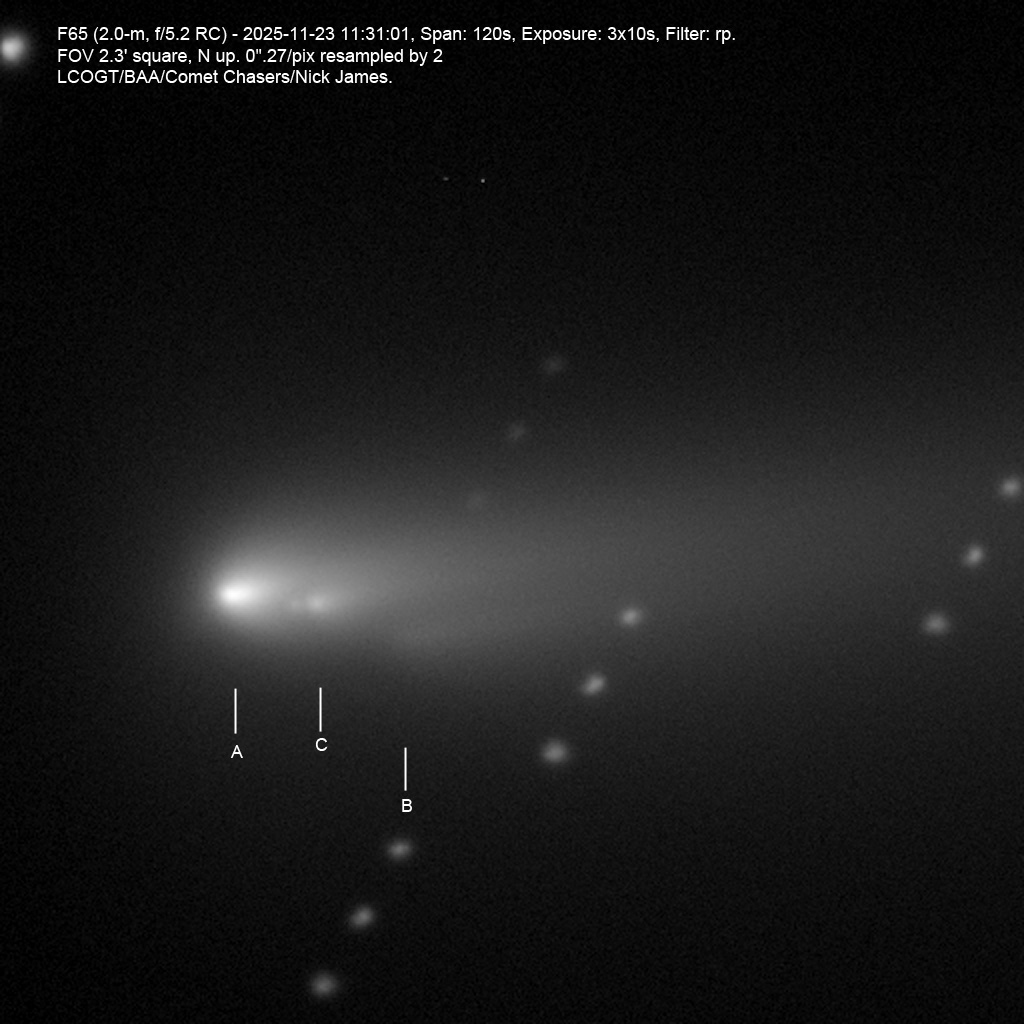
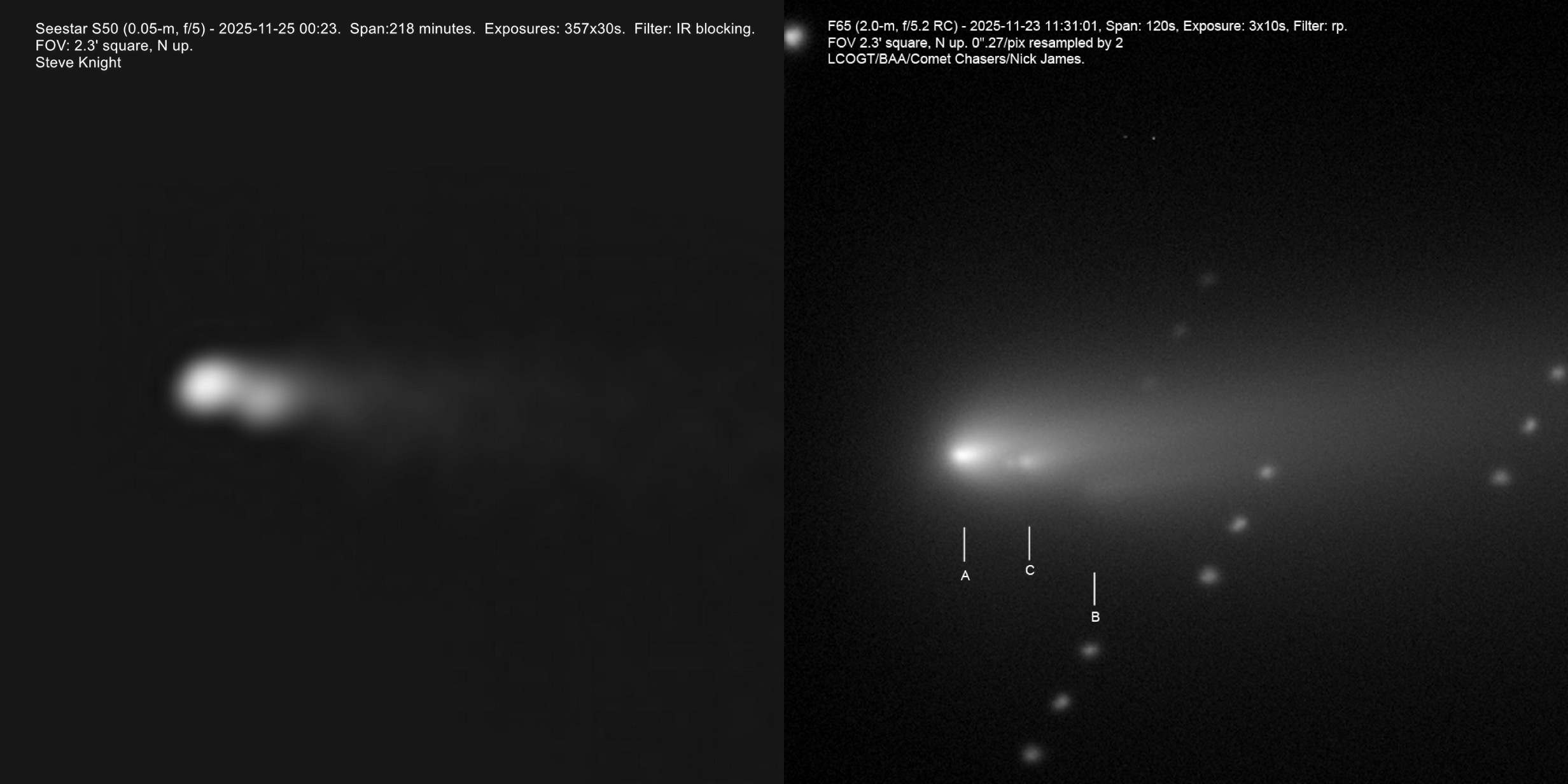
23 November 2025 at 8:48 pm #632178Nick JamesParticipantCourtesy of the BAA/Comet Chasers group I have processed some data obtained earlier today from the 2.0-m f/5.2 RC Foulkes Telescope North (F65). This has an image scale of 0.27″/pix. This image is resampled by a factor of 2 and is 2.3 arcmin square. It is a stack of 3x10s images taken at half the comet’s offset rate.
It shows a separate, faint apparent fragment just ahead of C and an elongated bright area behind A. It also confirms the demise of fragment B.
Attachments:
26 November 2025 at 12:27 pm #632201 Steve KnightParticipant
I think I may have captured fragments A & C with my humble Seestar. Here’s a comparison with Nick’s image taken about 35 hours earlier. Image scale is the same. The orientation of the tail is consistent with its motion. Thoughts or an artifact?
-
This reply was modified 10 months, 2 weeks ago by
 Steve Knight.
Attachments:
26 November 2025 at 6:31 pm #632205 Jeremy ShearsParticipant
Good to see some familiar names, including Helen Usher, on this paper on the Sequential Fragmentation of C/2025 K1 (ATLAS) After Its Near-Sun Passage on ArXiv today.
-
This reply was modified 10 months, 2 weeks ago by Jeremy Shears.
26 November 2025 at 10:25 pm #632208 Dr Paul LeylandParticipant
<p class=”wp-dark-mode-bg-image”>I think I may have captured fragments A & C with my humble Seestar. Here’s a comparison with Nick’s image taken about 35 hours earlier. Image scale is the same. The orientation of the tail is consistent with its motion. Thoughts or an artifact?
Well, I am impressed!
Though I may be an impressionable person.
27 November 2025 at 6:12 am #632209Nick JamesParticipantAs of this morning (Nov 27.2) the C fragment is no longer measurable in the I79 images.
Steve – certainly looks like you got A and C with the Seestar even though you needed 3 hours exposure to get a reasonable SNR. It is a 50mm aperture refractor after all!
The HST image in the paper with Helen as co-author mentioned above is very impressive too.
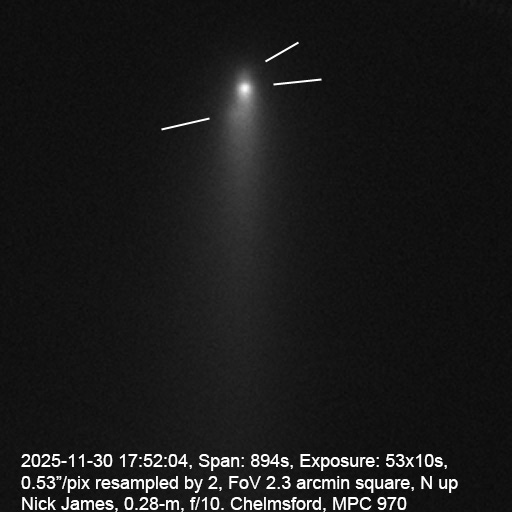
30 November 2025 at 6:21 pm #632247Nick JamesParticipantC/2025 K1 continues to change night after night. Tonight’s (Nov 30.7) image attached. Our viewing angle has been changing rapidly and the tail has now rotated so that it is almost pointing due south. The fragment we saw a few days ago south and a little east of the brightest component is still there but much fainter and there is a definite extension north of the bight component.
Attachments:
1 December 2025 at 2:53 pm #632260Robin LeadbeaterParticipantNo opportunity to get any follow up spectra but spectra posted on the French spectroscopy forum show a significant decrease in NH2 emission relative to dust between 17th and 25th November
http://www.astrosurf.com/topic/179978-une-com%C3%A8te-bizarre-c2025-k1-atlas/
Cheers
Robin1 December 2025 at 3:13 pm #632261Robin LeadbeaterParticipantThe HST image in the paper with Helen as co-author mentioned above is very impressive too.
Working with my old school ! Though it was just Coopers’ Company and in the East End back then
EDIT: I see ChatGP failed to spot the missing apostrophe in the paper
-
This reply was modified 10 months, 1 week ago by
 Robin Leadbeater.
-
This reply was modified 10 months, 1 week ago by Robin Leadbeater.
3 December 2025 at 4:06 pm #632325 Helen UsherParticipant
The HST image in the paper with Helen as co-author mentioned above is very impressive too.
Working with my old school ! Though it was just Coopers’ Company and in the East End back then
EDIT: I see ChatGP failed to spot the missing apostrophe in the paper
I’ll make sure we do better on the apostrophe next time Robin!
We did a remote Work Experience with the school (and one in Cardiff) in July. The students made observations of 3I during the week and those got used in 2 previous papers (we even managed to get them individually name-checked in one, which has proven quite useful for University applications!). And 4 of the 7 students at Coopers’ have continued working with me (and the Comet Chasers project) making comet observations. They have engaged really well, and I’m very much enjoying working with them and their Physics teacher. It is a change working with 17 year olds instead of 10 year olds!
If you want to read a bit more about the Work Experience then I did an article for the latest E&O section newsletter https://britastro.org/section_news_item/education-and-outreach-section-newsletter-edition-4-november-2025
Helen
4 December 2025 at 7:43 am #632396Nick JamesParticipantThe weather at the Alnitak telescope in Spain has not been too good the last few nights but I did get an image of the comet from Chelmsford yesterday morning. The comet is now moving away from the Earth so the physical scale is getting smaller but fragments are still visible. I’ll be preparing a report for the February Journal so many thanks to everyone who has submitted images.
The latest images in the section archive are here:
https://britastro.org/cometobs/2025k1/thumbnails.html
Most of these are north up so you can see how the tail has rotated rapidly over the past few weeks as our viewing angle has changed.
4 December 2025 at 10:09 pm #632410 David StrangeParticipant
Is it still there? I couldn’t locate it with my ASIair Pro tonight, or locate it using co-ordinates in Skylive, although I could identify the correct field stars?
Thanks
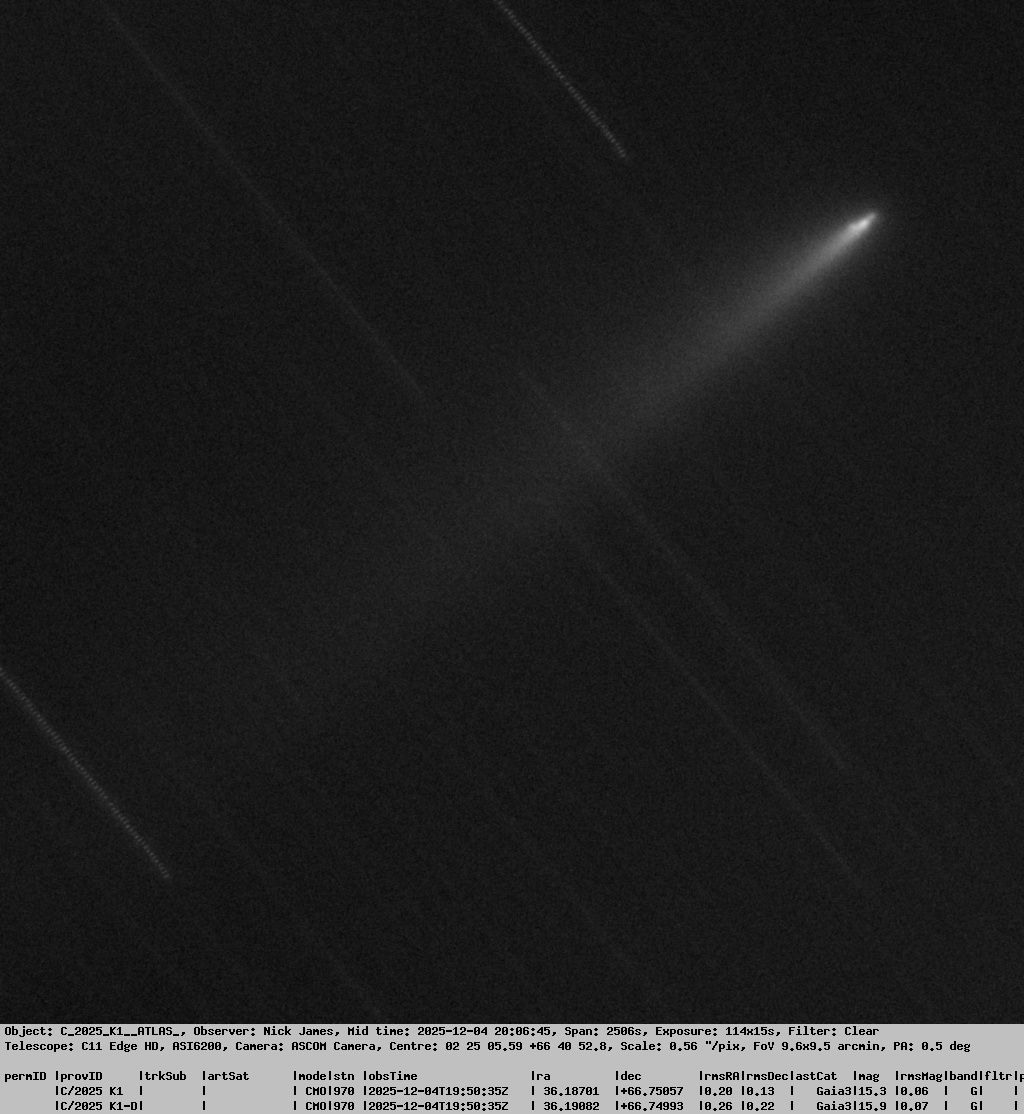
David4 December 2025 at 10:57 pm #632411Nick JamesParticipantYes, it is still there but it is getting a lot fainter and the sky tonight was very bright. My image from earlier attached. The fragments are still visible but the main component is around 3 mags fainter than it was a week ago.
Attachments:
-
This topic was modified 10 months, 4 weeks ago by
-
AuthorPosts
- You must be logged in to reply to this topic.