
Tagged: comet
- This topic has 30 replies, 9 voices, and was last updated 8 months ago by
 Jeremy Shears.
-
AuthorPosts
-
5 December 2025 at 10:44 am #632430
 David StrangeParticipant
Thanks Nick, I guess the presence of the full moon didn’t help.
David5 December 2025 at 4:13 pm #632438 Nick QuinnParticipant
Later on the comet was much higher and it was easier to image the fragments – although I have lost track of which ones are still extant.
https://britastro.org/observations/item.php?id=20251205_160939_9cad980d2d92.png
-
This reply was modified 10 months, 1 week ago by
 Nick Quinn.
-
This reply was modified 10 months, 1 week ago by Nick Quinn.
5 December 2025 at 8:24 pm #632462 Denis BuczynskiParticipant
Hi Nick,
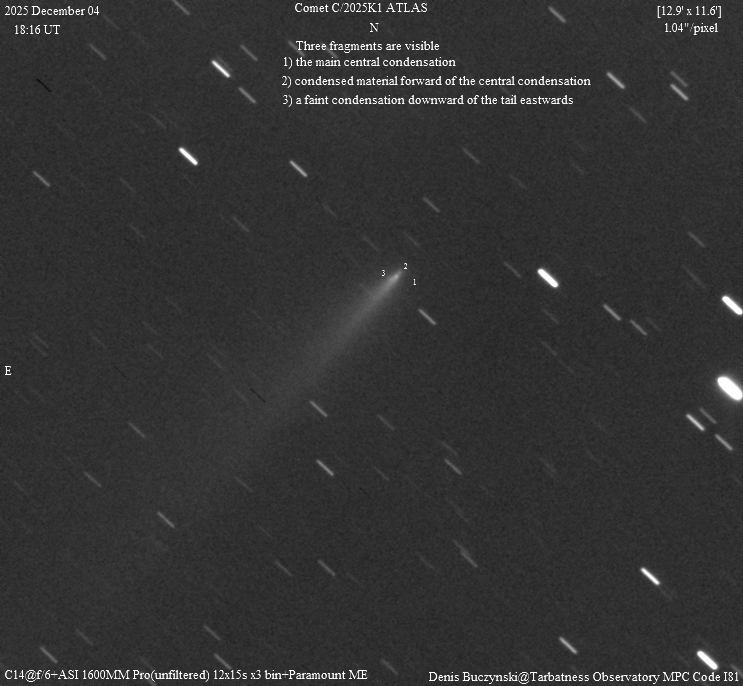
I imaged the comet yesterday evening 20251204 and recorded three fragments.I think only the main central condensation survives as one of the three original fragements. The other two I recorded are relatively new, appearing this last week after the two original secondary fragments faded.As I say “I THINK”
Denis Buczynski-
This reply was modified 10 months, 1 week ago by
 Denis Buczynski.
Attachments:
6 December 2025 at 11:17 pm #632488 Nick JamesParticipant
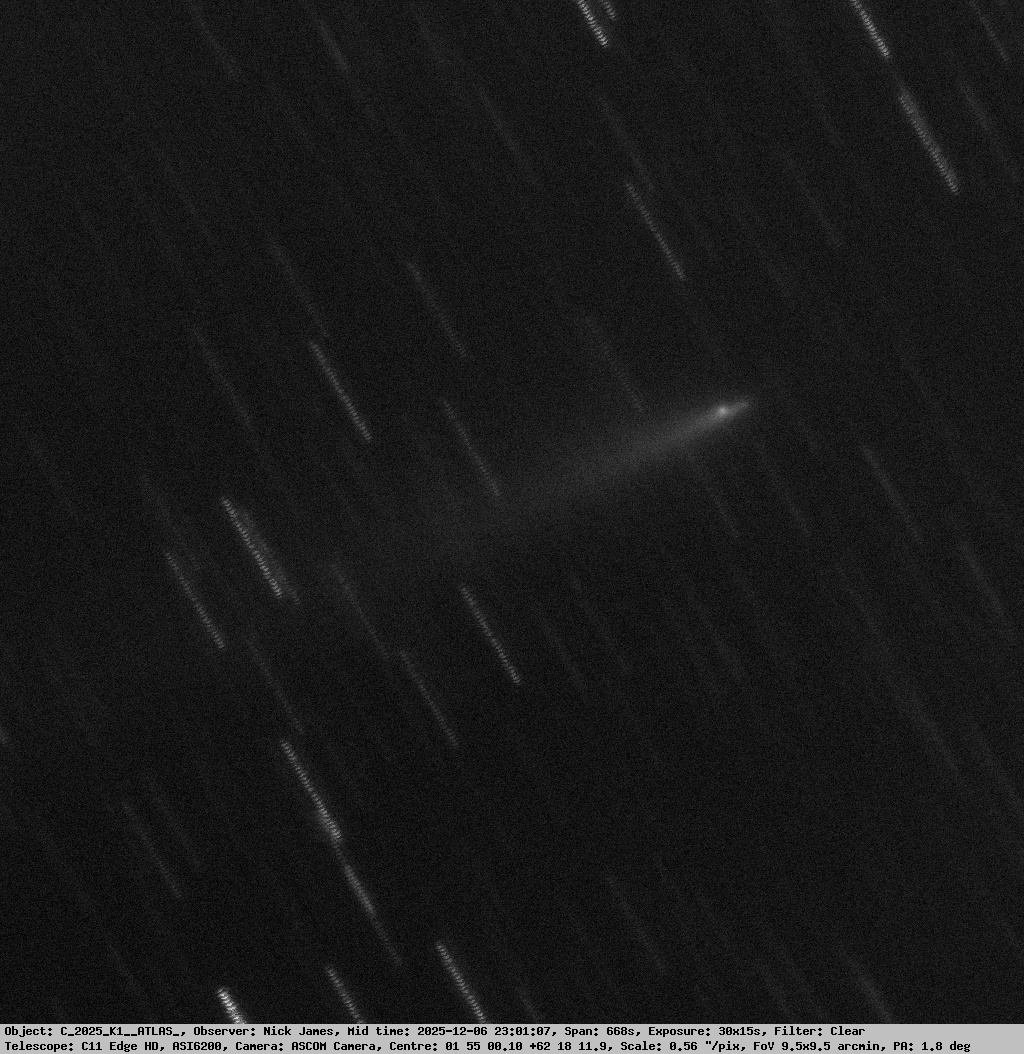
As of tonight there is not much left. The brightest fragment is the one furthest down the tail. It looks as if this comet doesn’t have much life left in it.
Attachments:
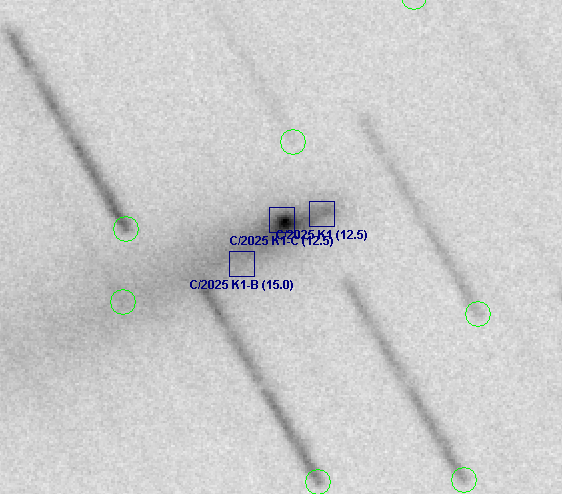
7 December 2025 at 9:34 am #632490Nick JamesParticipantThe brightest component as of last night (Dec 6.95) seems to be close to the predicted position of the C fragment.
Attachments:
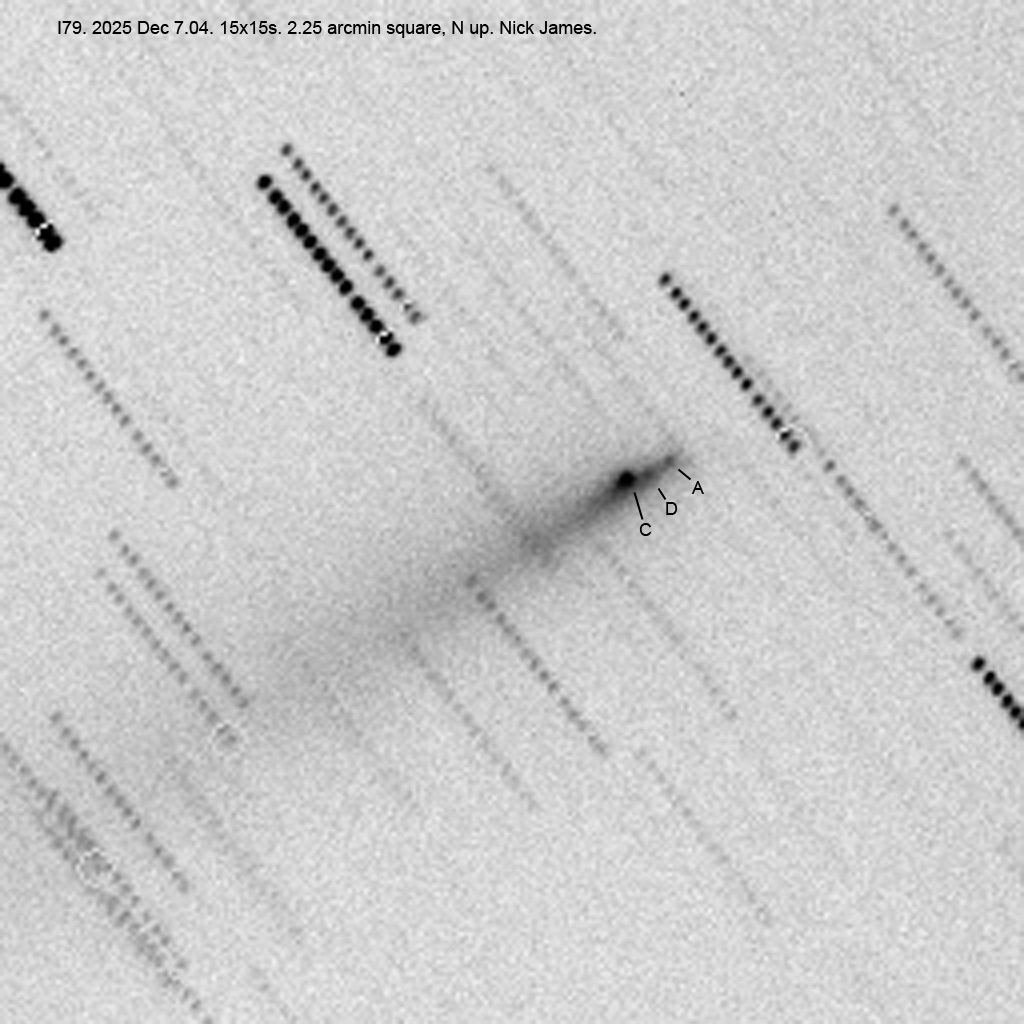
7 December 2025 at 8:21 pm #632521Nick JamesParticipantTaking the recent astrometry I think the attached image from I79 this morning has correct identification of the components.
It looks like the main component and component B have pretty much gone now. Component D appeared recently and is faint. Component C has been around for a while and has recently brightened to the point that it is the most prominent part.
The comet doesn’t look very healthy though and I doubt if there will be much remaining to measure soon.
Attachments:
8 December 2025 at 9:13 am #632547Nick QuinnParticipantThis ATel has a high-resolution image from December 6th taken with the 8.1 metre Gemini North telescope – a 3 second exposure!
8 December 2025 at 7:05 pm #632626Nick JamesParticipantIt is interesting to compare the Gemini image with our recent images here:
https://britastro.org/cometobs/2025k1/thumbnails.html
We have the advantage of a much better time resolution and so can see that the fragments have been changing rapidly over the last week. The Gemini image was taken on Dec 6.37 and it looks similar to the arrangement in this image from Dec 7.05:
https://britastro.org/cometobs/2025k1/2025k1_20251207_011026_ndj.html
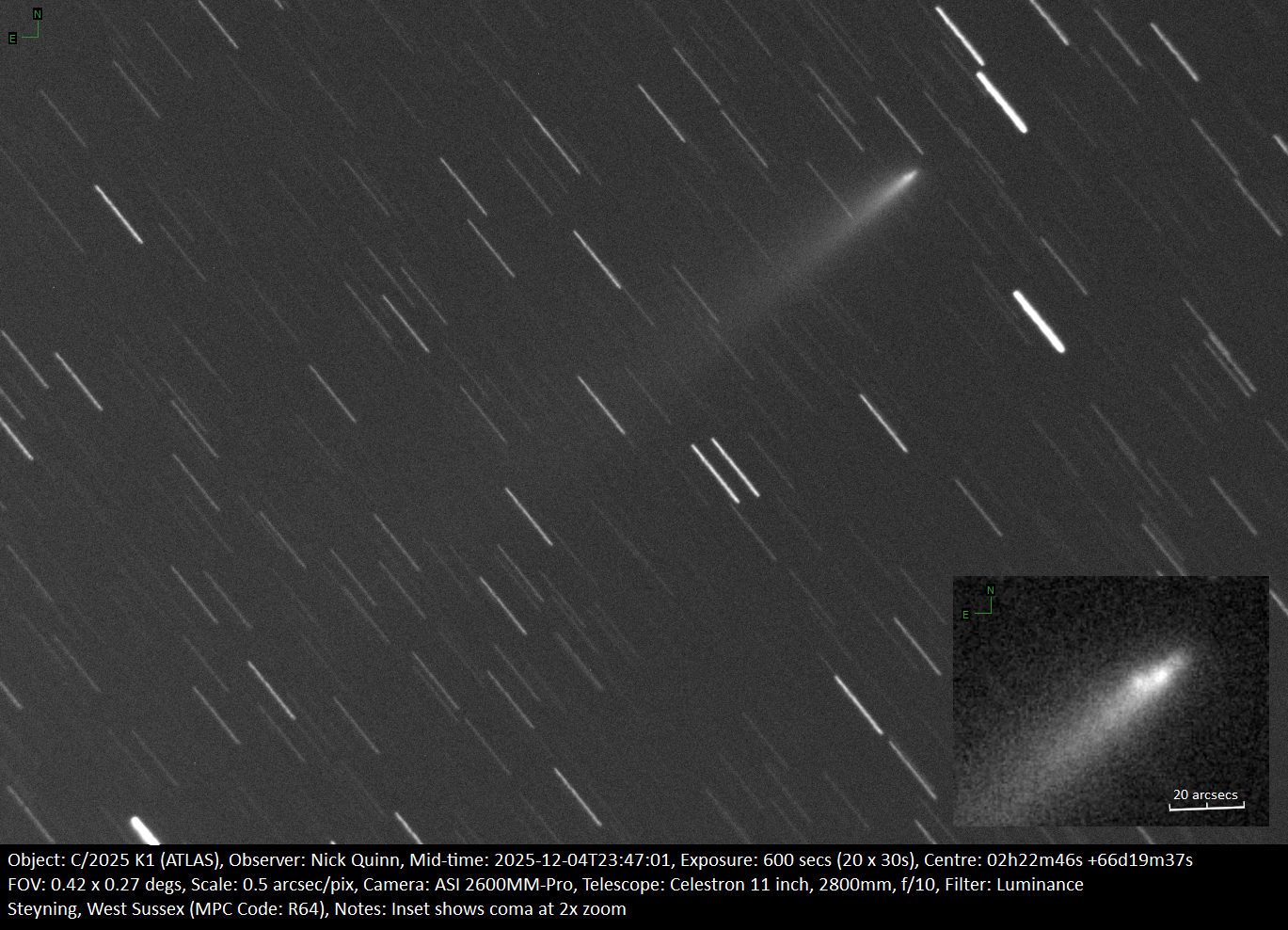
Gemini shows fragment A as being double and fragment D as very faint and diffuse. Fragment C is the brightest object. Only two days before (on Dec 4.99) fragment D was brighter than fragment C:
https://britastro.org/cometobs/2025k1/2025k1_20251204_234701_nquinn.html
I’m preparing a report for the February Journal and it has been fascinating tracking the daily variations in this comet over the last month.
24 December 2025 at 7:45 am #632812Nick JamesParticipantThanks to all of the observers who have sent in images and measurements of this comet we have almost daily coverage since the initial fragmentation in early November. The comet is now moving away from the Sun and Earth and seems fairly stable with two fragments visible (A & C). Astrometry from BAA observers indicates that fragment A is probably the original nucleus although it is now much fainter than fragment C. These two fragments are currently around 70,000 km apart and their slightly different orbits can be modelled quite well using a relative velocity change at separation of 30 m/s.
The comet is well placed in the evening sky so please keep imaging it in the highest resolution that you can manage.
9 February 2026 at 11:54 am #634562 Helen UsherParticipant
A quick update on this. The paper based on the Hubble observations and supplemented by ground-based observations has now been accepted and published. The revised paper incorporates some very interesting new analysis, so worth reading I think.
https://www.sciencedirect.com/science/article/abs/pii/S001910352600062X or
https://arxiv.org/abs/2511.19707v2
for open access9 February 2026 at 3:10 pm #634563 Jeremy ShearsParticipant
Thanks for the update, Helen. A good read.
-
This reply was modified 10 months, 1 week ago by
-
AuthorPosts
- You must be logged in to reply to this topic.