
Forum Replies Created
-
AuthorPosts
-
 Duncan Hale-SuttonParticipant
Thanks Peter I will take a look.
Duncan Hale-SuttonParticipantI have been giving some more thought to how the form of the equation that Peter used in his talk to describe solar differential rotation was arrived at. I think Peter used the equation ω = A + B sin²θ + C sin⁴θ where ω is angular velocity of the sun at the observable surface in degrees per day, θ is the solar latitude, A is the angular velocity at the equator and B and C are constants that control how the velocity decreases with increasing latitude (see this reference in wikipedia).
What I think is that the physics tells us that ω is a function of sin²θ, that is w = f(sin²θ). If that is the case then writing x = sin²θ we can expand w = f(x) using a Taylor series about x = 0, namely
f(x) = f(0) + f'(0)x + (f”(0)/2)x² + …
where f'(0) and f”(0) are the first and second derivatives of f with respect to x at x = 0. Replacing x by sin²θ we get
f(θ) = f(0) + f'(0)sin²θ + (f”(0)/2)sin⁴θ + …
Now x = 0 when θ = 0, so f(0) = A, the angular velocity at the equator. Also if x is small, which is true if θ is small then we can neglect higher order terms (those involving powers of x greater than 2) in the expansion. Equating constants B and C with constants f'(0) and (f”(0)/2) we get
w = f(θ) = A + B sin²θ + C sin⁴θ
as Peter quoted. I hope this makes sense.
-
This reply was modified 1 month, 2 weeks ago by
 Duncan Hale-Sutton.
-
This reply was modified 1 month, 2 weeks ago by Duncan Hale-Sutton.
Duncan Hale-SuttonParticipantThe aurora was very spectacular last night and there were some aspects that I hadn’t seen before. The most notable was right at the start when in fact I hadn’t been aware that an aurora was happening. I poked my head out to look at the sky about 21:15 UT to see if it was clear when I noticed that there was some puffy light cloud that was being lit up as if by a search light. It was so bright that I was convinced I was seeing something like the forward landing lights of an aircraft or perhaps something weird like a rocket fuel dump. Or, I thought, it might be the moon shining through a gap in the clouds. It gave me goosebumps because I just couldn’t explain it. The colour was sort of white to my eyes. It faded slowly over a minute or so and then grew brighter again a bit further south. It wasn’t until I went inside and saw the aurora alert that I reasoned what I saw was part of a very bright aurora.
21 November 2025 at 7:36 am in reply to: X-SHOOTER spectrum of 3I/ATLAS: Insights into a distant interstellar visitor #632129Duncan Hale-SuttonParticipantIt seems that the conspiracy theorists weren’t very happy with NASA’s conclusion that it is just a comet.
6 November 2025 at 12:59 pm in reply to: X-SHOOTER spectrum of 3I/ATLAS: Insights into a distant interstellar visitor #632021Duncan Hale-SuttonParticipantThank you Robin, that’s a good article.
6 November 2025 at 11:10 am in reply to: X-SHOOTER spectrum of 3I/ATLAS: Insights into a distant interstellar visitor #632012Duncan Hale-SuttonParticipantI know I am possibly opening Pandora’s Box but there seems to be a blizzard of speculation about this comet reported on social media and I thought that perhaps some sensible conversation here would be a good idea. If people can provide links to reputable sources of observations and reporting that would be a start. Obviously as an interstellar comet any observation that differs from the norm is going to be of great interest but needs to be viewed dispassionately. I have already had one person I know ask me in a serious way if I thought there was anything to worry about because his wife was concerned. I think not talking about this subject on this forum is perhaps the wrong thing to do.
Duncan Hale-SuttonParticipantThanks for the update Jeremy.
Duncan Hale-SuttonParticipantUnfortunately it looks like the livestream has been lost which is a real shame. I was watching at home because I couldn’t attend due to illness, but now we can’t see the rest of the meeting.
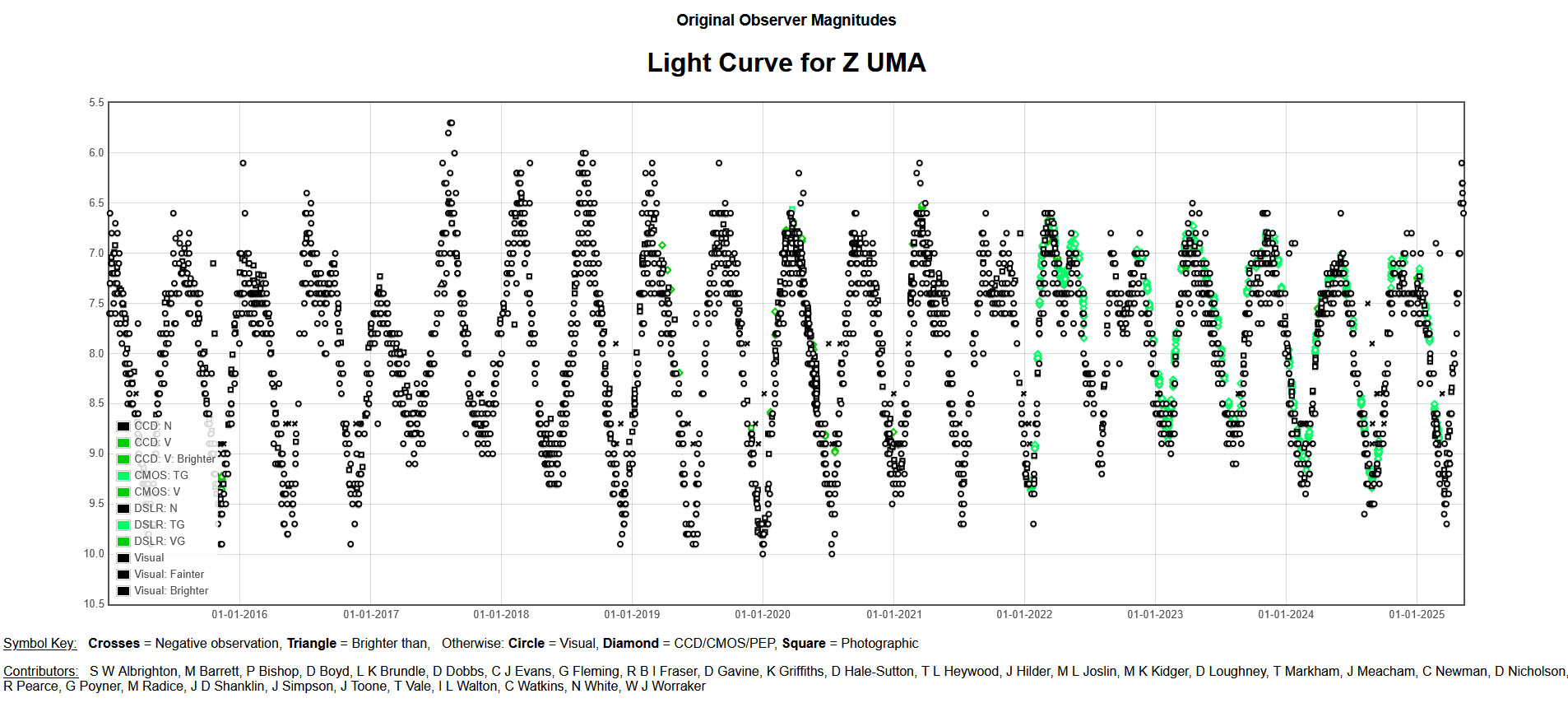
Duncan Hale-SuttonParticipantYou might have noticed that Z UMa has just recently reached a peak in its brightness and this peak was brighter than previous peaks for the last four years (see the attached screen shot from the BAAVSS database). I am going to stick my neck out here and make a bit of a prediction! I think we will see more of this in the next four years with more sharply defined peaks and troughs and a wider range in magnitudes. My reasoning is the interplay between the two periods of pulsation that this star shows. If you look back to 2016-2017 there was a period then when the amplitude of variation died away somewhat and there was evidence for double peaks in the pulsation prior to this. Then the variation recovered and there were more sharply defined peaks and troughs. I think we are now seeing a repeat of this behaviour.
Why do I think this? Well, I am not sure I believe that the second, less prominent, pulsation period in this star is dying away. I think that this modulation of the amplitude and the double peaks (see above) is evidence that the two pulsation periods in this star are still operating together and causing the modulations to the primary pulsation period that we see. Over the next four years we will probably see these sharply defined peaks because the two periods are acting in concert and then after this they will go out of phase and we will see the return of the double peaks and the lower amplitude range. We shall see! For more on this read my previous posts on this subject.
Attachments:
Duncan Hale-SuttonParticipantI picked up a small patch of purplish aurora in one of my frames at about the same time at 21.17 UT.
Duncan Hale-SuttonParticipantAccording to the handbook the moon won’t rise until 23:34 UT, so after midnight by our clocks. I have just been out to check my sky here in Norfolk but there appears to be too much haze/thin cloud. I have taken a few pictures but nothing is showing. Will try again later.
Duncan Hale-SuttonParticipantTwo things that I enjoyed about today’s eclipse was 1) the moon slowly eclipsing sunspot group 4043 2) looking closely at the edge of the Moon and seeing mountains and valleys. For 1) you could see the movement of the moon’s edge in real time as you had these sunspots nearby to compare distances with. For 2) I had never really looked that closely at the moon’s edge in eclipse before and was amazed at how much there are lumps and bumps. Obvious really but great to see. If you were clever enough you could probably identify which mountains and craters!
Duncan Hale-SuttonParticipantNot as good as the display that Premier Inn mounts
Excellent!
Duncan Hale-SuttonParticipantThanks for all your interesting comments and great pictures. One thing I wanted to comment on was how the display changed over perhaps 30 to 40 minutes. Initially I could see the usual green arc with some rays in it. Then it appeared to me that the arc swelled and moved southwards. This After this we began to see the larger and more colourful red/pink/purple rays and eventually Corona.
What are we seeing here? Is the auroral oval moving south as time progresses. Are the rays that we see overhead, the same rays seen in the green arc earlier? Is it because the oval has swept over our heads and the transition from green to red/pink/purple is just an effect of viewing angle? What do the experts say?
Duncan Hale-SuttonParticipantYes, definitely resurrect it. Brilliant!
Duncan Hale-SuttonParticipantGreat, thank you both. That makes sense. I will make the adjustment and resubmit. Duncan.
Duncan Hale-SuttonParticipantWe should indeed be making it more affordable for young people to join. In fact I wrote to the President at the time to suggestion a lower rate for young people, but it was many years before it came to pass. Which is why I proposed a motion at the 2023 SGM, seconded by Nick James, not to increase the young person’s membership rate (as reported in the current Journal).
I was present at 2023 SGM when we voted not to increase the young person’s membership rate and I thought that this was a good thing at the time. Now with the proposed changes to the by-laws we, as membership, will not be able to do this and it is something that also worries me. I know that often not many people turn up to vote at these SGMs but I am sure if a rate change was contentious enough people would attend.
As far as honorary memberships go it seem to me that it looks a bit like fiddling at the edges of a bigger problem to do with the future survival of the BAA. Unless it becomes a financial burden I don’t see that this should be changed out of hand just because it appears as low hanging fruit. Perhaps the BAA needs to face up to larger structural problems. What is the major issue at stake? Is it that it can’t survive longterm on the money it raises through membership? Is it that membership will eventually decline because of its age profile? Is it that it is becoming too large to manage all the things it currently does?
Duncan Hale-SuttonParticipantI went out at about 11.30pm last night as the fog had lifted but I can confirm that I didn’t see a single meteor during the 20 mins or so that I stood in the garden. The moon was well up by then which may have hidden fainter ones. I also went out Friday night for about half an hour around 7pm but I only saw one sporadic.
25 November 2023 at 8:09 pm in reply to: Look outside, there may be an aurora happening now (20:00 UT) #620299Duncan Hale-SuttonParticipantActually it looked like it peaked at 19:00 UT.
8 November 2023 at 6:55 pm in reply to: Fantastic auroral display happening now (19:00 UT 5th Nov) #620084Duncan Hale-SuttonParticipantI am slightly at a loss to understand why there hasn’t been much comment on here from the Aurora section about what we saw on Sunday night. From what I have read STEVEs are a relatively new phenomenon which haven’t been well observed and aren’t well understood. I have seen people say that they are difficult to see, but this one wasn’t. It was as clear as a bell and wasn’t limited to either the east or west horizon. It went in a clear arc from the eastern horizon to the western horizon in a continuous band. What is more, each termination at the horizon was associated with a red display of auroral (?) light both east and west. Added to this it appeared to flow from east to west (and never the reverse) with bands moving along its arc. I was surprised that my pictures on the gallery seemed to generate little interest. I uploaded them pretty much as they came out of the camera so the scientific value of them wouldn’t be lost by making alterations.
-
This reply was modified 1 month, 2 weeks ago by
-
AuthorPosts