

Forum Replies Created
-
AuthorPosts
-
 Hugh AllenParticipant
Hi Tony,
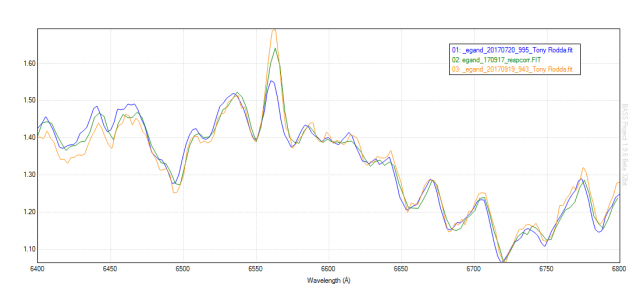
Very nice spectra as ever, the emission lines in AX Per are amazingly intense! I noticed from the EG And spectra that we’re both posting in the database that the H-alpha emission is brightening significantly. I downloaded your July 20th and September 19th spectra and added in my September 17th spectrum. There is a nice brightening trend even between 17th and 19th! The database is a great resource. Good luck with your new observatory
Cheers
Hugh
 Hugh AllenParticipant
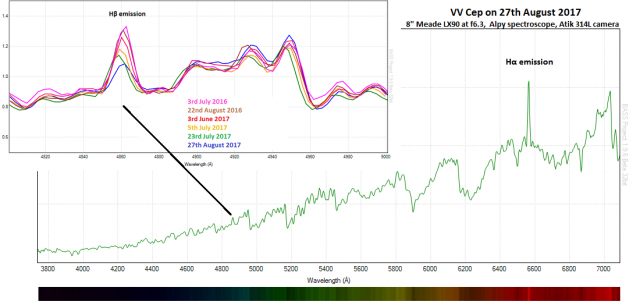
Great spectra Steve, are you adding the VV Cep to the BAA database? I captured a spectrum just the night before on the 27th August. I have seen a significant decline in the Balmer emissions since I began to take spectra last year….
 Hugh AllenParticipant
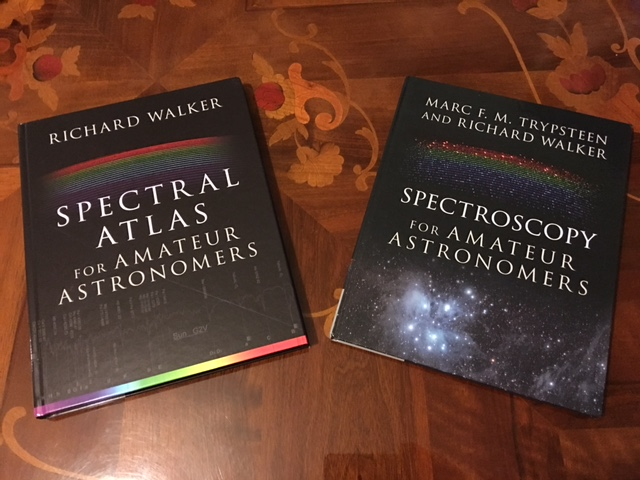
My copies arrived a couple of days ago. The spectra in the Atlas are beautifully reproduced. Thank you both!
Hugh
 30 July 2017 at 5:25 pm in reply to: Keeler’s seminal paper on the spectroscopic observation of nebulae #578407Hugh AllenParticipant
Thanks Paul, a fascinating link. I shall enjoy reading that 🙂
Cheers
Hugh
Hugh AllenParticipantHi Tony,
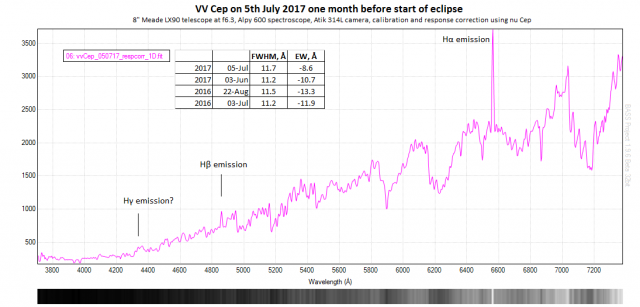
That’s a great looking spectrum. Would you upload it to the database? There are not many low resolution spectra on there – I attach the last one that I uploaded from 5th July. I agree that the most interesting science will come from high resolution spectra but I’m sure there’s a lot to be learnt from our low resolution Alpy spectra. Apart from the general evolution of the intensity of the hydrogen Balmer emission (I estimated the Equivalent Width EW of the H alpha emission from the baseline spectra that I’ve captured over the last year) I think it will be very interesting to see how the spectrum evolves down at the blue end – how visible is the spectrum of the Be star down at those wavelengths, I’ve read contradictory remarks on that. Anyway, it was great to see your result, let’s hope we get some clear skies soon!
Cheers
Hugh
-
AuthorPosts