
Forum Replies Created
-
AuthorPosts
-
 Jeremy ShearsParticipant
Impressively tight data, Max!
Jeremy ShearsParticipantWorth looking for quiescence eclipses, Max. Accretion disc might be smaller then and thus more easily eclipsed
Jeremy ShearsParticipantYes, mag is certainly consistent with an outburst Max
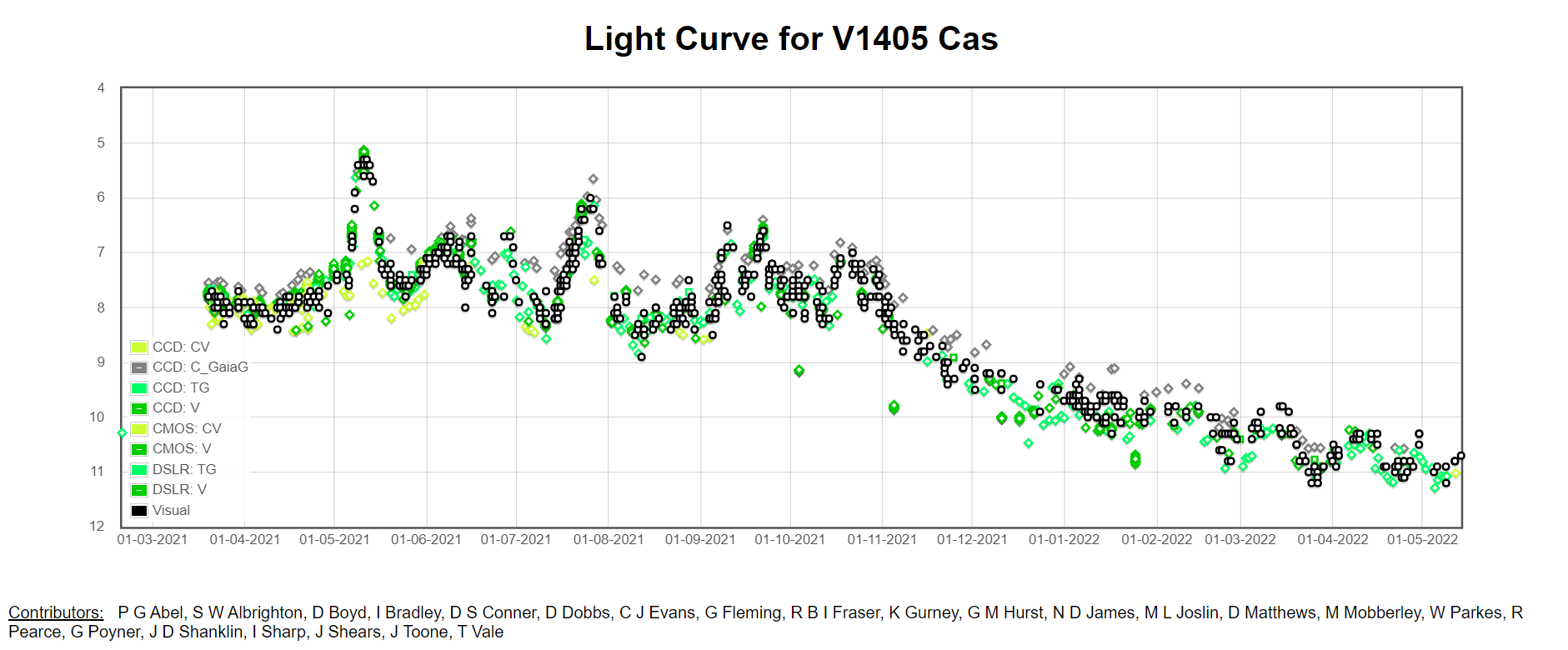
Jeremy ShearsParticipantThis nova is still being observed and still relatively bright at 11th mag. Worth following. What will it do next?
Light curve from the VSS database:Attachments:
Jeremy ShearsParticipantThanks Max. When I have a moment I’ll put it through Peranso to see if there are any signals.
Jeremy ShearsParticipantThanks Max. There’s a lot of variation there. Not sure it’s regular though. Time will tell.
Keep up the good work!Go well!
JeremyJeremy ShearsParticipantWonderful to see the video of this well deserved honour for Alan – thanks for sharing, James.
Jeremy ShearsParticipantStarlight Nights is available on Kindle, Daryl. Not the same as having the book, but at least you can enjoy it and be reminded why we love astronomy so much.
I think I was 14 when I first read it. Our Eng Lit master said we should read a book of our choice (“not a textbook on astronomy, Shears!”) and write about it afterwards. I found it in the village library. I must have renewed its loan many times. And fortunately it’s not textbook.
Jeremy ShearsParticipantThere was a meeting planned in 2020, but a global pandemic put paid to that.
These things needs a lot of planning and organising. Hopefully next year.
Jeremy ShearsParticipantThe nova, V1674 Her, is still 3-4 magnitudes above quiescence (latest entry in VSS database: Apr 2 at mag 16.7 by Nick James) as shown in the accompanying light curve. Well worth following now that Hercules is more readily accessible. As Prof Joe Patterson (Columbia U and Center for Backyard Astrophysics) noted: “We are just getting started on this amazing star… and I bet others are, too. In the history of novae, I think it will take a high place in the pantheon, alongside DQ Her, T Pyx, and V1500 Cyg”
A recent ATel (https://www.astronomerstelegram.org/?read=15312) said optical spectroscopy suggests it has returned to quiescence, which is curious since the progenitor was 20.5g. The final chapter on this neon nova is far from being written…..
Attachments:
Jeremy ShearsParticipantA fine tribute Nick. Thank you. It was lovely to see Pat at the Winchester weekend on the Saturday afternoon.
Jeremy ShearsParticipantWhile composing your rebuttal, Steve, you might like to munch a Jaffa biscuit: https://arxiv.org/abs/2103.16575
Jeremy ShearsParticipantA paper by Ulisse Munari and Paolo Valisa on “The 2021 outburst of RS Oph: a pictorial atlas of the spectroscopic evolution. II. From day 19 to 102 (solar conjunction)” has been posted on ArXix: https://arxiv.org/abs/2203.01378
Jeremy ShearsParticipantThanks Callum. And good that the recent Forum posts are back on the front page 👍🏻
Jeremy ShearsParticipantIs it possible to have more posts on a single page? We are now on page 4 of this thread, so to get here, I click the relevant Forum thread on the front page, then need to click a second time to get to page 4 (that’s when I don’t get to page 3 when my large finger applied to my tiny iPhone hits 3 instead of 4).
Or the ability to go straight to the most recent post from the main page.
Jeremy ShearsParticipantThanks Callum. Now booked
Jeremy ShearsParticipantI really like the fact that we see people’s proper names when they post now, rather than some pseudonym. Much more collegial!
Jeremy ShearsParticipantI would also like to see the recent Forum posts on the front page, please.
Jeremy ShearsParticipantAn A&A preprint on ArXiv today reports the first 3D imaging of Betelgeuse, revealing massive convection cells.
Frustratingly, especially for the authors, their equipment was being upgraded during the “great fade” at the end of 2019/early 2020, so this was missed!
Jeremy ShearsParticipantAnother paper (reprint from Nature) on ArXiv: A dusty veil shading Betelgeuse during its Great Dimming
-
AuthorPosts