
Archives
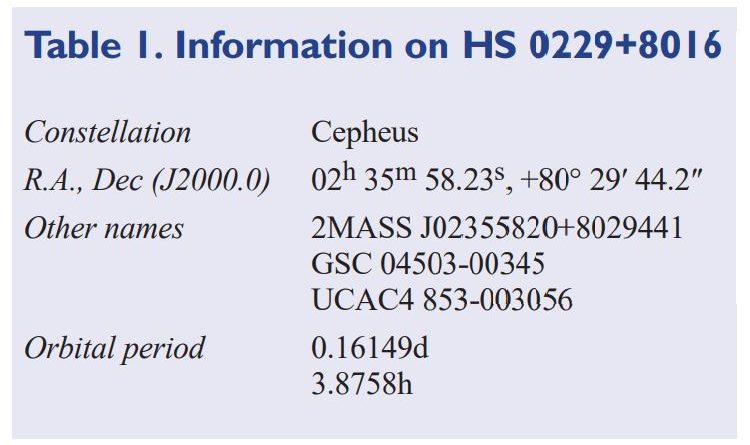
Unusual ‘stunted’ outbursts in the nova-like variable star HS 0229+8016
We present the light curve of HS 0229+8016 between 2006 and 2019, which shows that the star varies between magnitudes 13.4 and 15.1. There were episodes lasting up to hundreds of days during which distinctive 0.6mag cyclic variations were apparent, each lasting ~9.5 days. Observationally, these were very similar to the ‘stunted’ outbursts seen from time to time in several nova-like cataclysmic variables, such as UU Aqr. There were two intervals of up to 166 days when these stunted outbursts appeared to reduce or even stop. These coincided with the system being up to ~0.7mag fainter than usual. Previous workers have suggested that HS 0229+8016 might be a member of the Z Cam family of dwarf novae, but we can find no evidence of the characteristic dwarf nova outbursts and standstills at an intermediate brightness. Surveillance of HS 0229+8016 should be continued to understand more about the long-term behaviour of this system.
Read more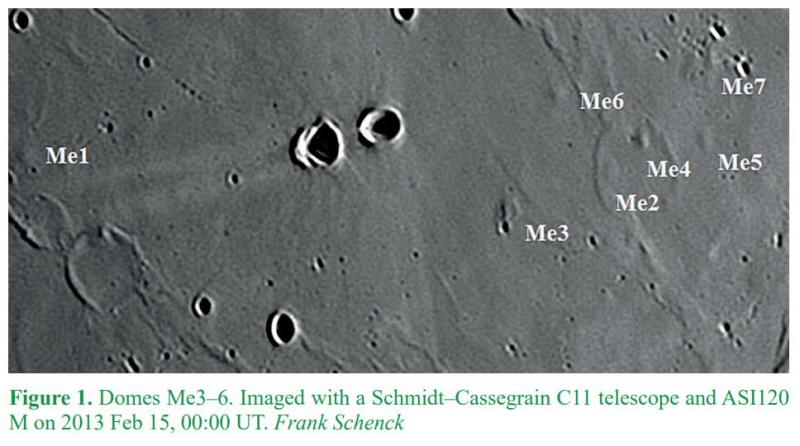
Remarkable waves observed in the atmosphere of Venus, 2015–2020
Observations at long infrared wavelengths by the Akatsuki spacecraft during 2015 December revealed the presence of a remarkable bow-shaped high-albedo atmospheric wave, elongated north–south and stretching over both hemispheres across a wide range of latitudes, up to 10,000km in length. Its velocity was nearly zero with respect to the surface, and its initial longitude placed it at the western side of one of the three highest regions of the planet. Amateur data at shorter infrared wavelengths recovered long, narrow N–S elongated waves or discontinuities in late 2016 and again during 2019–’20, but they showed typical velocities for that waveband, corresponding to synodic rotation periods of around five days. This short note reviews the Akatsuki data and more recent ground-based observations. Furthermore, it speculates whether waves could also have been generated by the possible surface volcanic activity first reported in BAA observations during 2017.
Read more
Lunar domes & volcanic constructs in Mare Fecunditatis
In this study we examine five lunar domes in Mare Fecunditatis. These domes, termed Messier 3–7, have moderate diameters between 5.6 and 15km, with slopes of between 3.2° (Messier 4), 1.5–1.6° (Messier 5–6) and 0.5–0.87° (Messier 7 & 3). Based on rheologic models, we infer the physical conditions under which the domes were formed (lava viscosity, effusion rate and magma rise speed) as well as the geometries of the feeder dikes, comparing them with the domes Messier 1–2 described previously by Lena et al. (127(6), 338–349, 2017). Furthermore, we have identified and characterised three lunar cones and several small ‘ring moat dome’ structures. These structures have recently been identified as widespread on the maria and are thought to be volcanic in nature, possibly involving the extrusion of magmatic foam.
Read more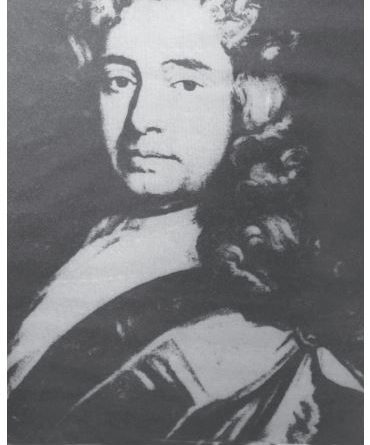
The astronomical observations & connections of Henry Prescott (1649–1719)
Henry Prescott lived during the second half of the seventeenth century and early part of the eighteenth century in Chester, Cheshire. Although not an astronomer, Henry was moved to record a number of astronomical observations in his diary after witnessing some spectacular celestial events. This fact was remarked on as an aside by a speaker at a local history lecture attended by the author, sparking his desire to research what these observations were. Finding out more about Henry and his observations has been an enjoyable journey, with some connections Henry had with well-known astronomers of the day identified along the way. This paper reviews these observations and connections, while also including side stories involving some of Henry’s associates. Brief references are made in some cases to other people’s observations of the events reported by Henry in his diary, to provide confirmation and supporting information.
Read more
From the Journal archive
This year the BAA has been highlighting the role of its women members. Many of us know that the BAA
Read more