Search Results for 'espin telescope'

› Forums › Search › Search Results for 'espin telescope'

Viewing 20 results - 21 through 40 (of 1,113 total)
  • Author
    Search Results
  • #642452
    Steve Knight
    Participant

    The view through my telescope of the eclipse. Best viewed with audio on.
    You can see the challenge of doing it on a windy day bobbing around on a rough Greenland sea.
    My apologies for poor manual tracking, I was also viewing it through binoculars.
    Canon 90D + Askar SQA55.

    Greenland eclipse video

    • This topic was modified 2 months, 1 week ago by Steve Knight.
    • This topic was modified 2 months, 1 week ago by Steve Knight.
    #642424
    Mike Harlow
    Participant

    The latest Astronomer’s Telegram, ATel #17960 details more spectroscopic observations. A bit better than mine….but they do have a 2.0 meter telescope on La Palma…!
    The narrow spectral lines don’t show well at the much lower resolution of my spectrum. But the atmospheric absorption (Telluric) bands are clearer…I’m looking through a lot more atmosphere than they are…(!)
    Mike.

    • This reply was modified 2 months, 1 week ago by Mike Harlow.
    • This reply was modified 2 months, 1 week ago by Mike Harlow.
    • This reply was modified 2 months, 1 week ago by Mike Harlow.
    • This reply was modified 2 months, 1 week ago by Mike Harlow.
    #642417
    Mike Harlow
    Participant

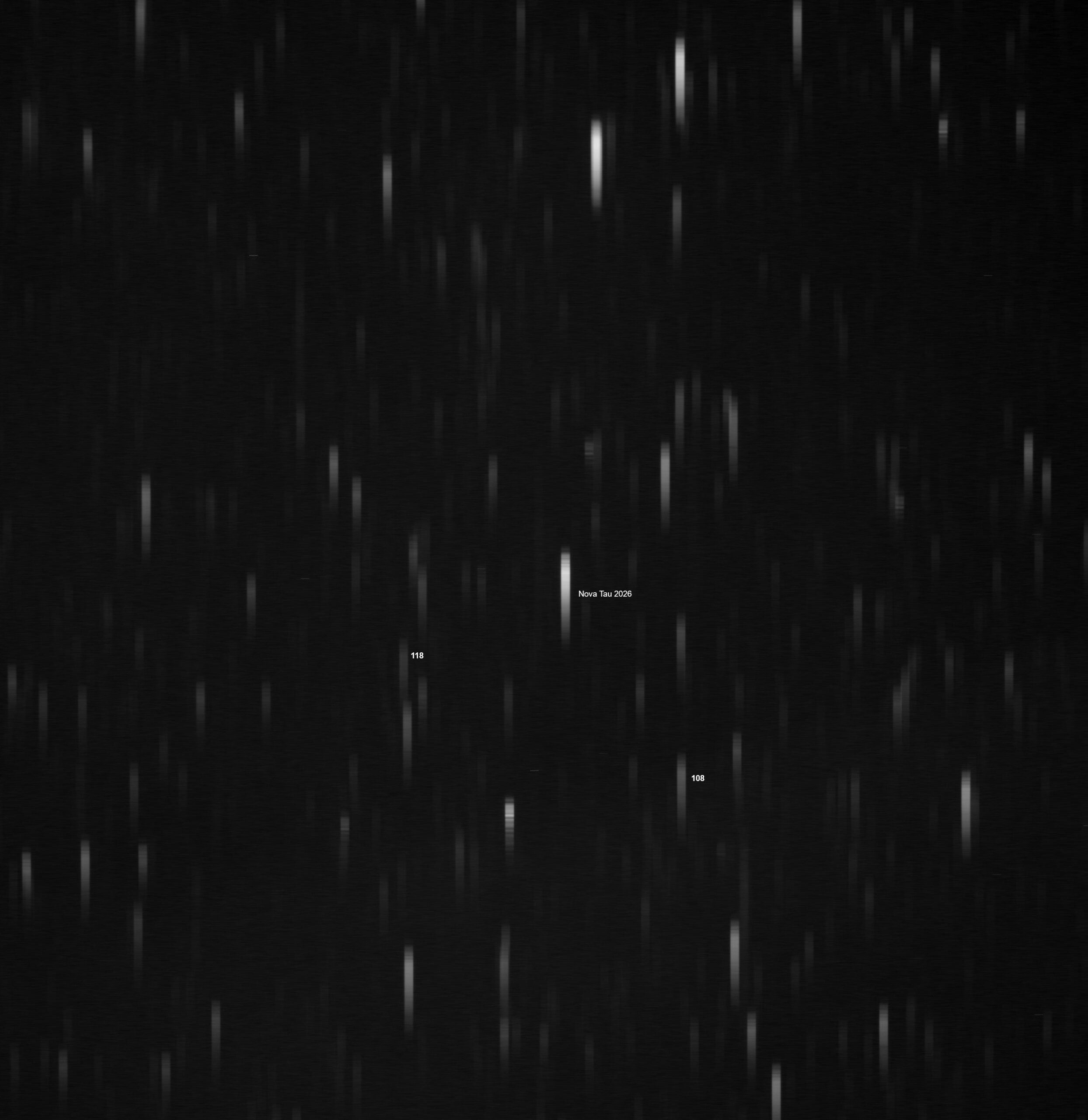
    First attempt at a spectrum of the nova this morning. The sky was starting to brighten and the telescope only just cleared the observatory wall so a very narrow window of opportunity!
    The image covers the same field as the AAVSO chart shown above with the nova near the centre. It shows a strong continuum but little sign of emission lines yet. I guess it is still in the hot, dense ‘fireball’ phase. As it expands and cools the emission lines should appear as the continuum fades in the ‘nebula’ phase…it will be fascinating to follow over the next few weeks.
    As Gary mentions above it is bright. Two comparison star magnitudes are shown on the spectral image.
    The spectrum was taken with a 26cm, 3 degree objective prism on a 12inch F/3.6 astrograph and unfiltered CMOS camera.
    Mike.

    #642404

    Thanks for this….always good to have a backup plan. Going to have a party with the neighbours fingers crossed, but have to get the telescope on the garage roof first to gain sufficient visibility.

    #642354
    Gary Poyner
    Participant

    This morning the Nova was magnitude 9.84V on Aug 09.1979 UT, using Slooh Canary 2 telescope. Bright field though, with the waning crescent Moon about 7 degrees away.

    I’ve entered the observation into the VSS database using N Tau 2026. This is the first observation in the VSS DB, so please continue to use this until an official designation is announced – which I will then announce here.

    A chart and sequence is available from the AAVSO using N Tau 2026. Mike Poxon (AAVSO chart team) very quickly added a sequence yesterday afternoon, after some nagging from me. Good bloke is Mike P.

    Gary

    • This reply was modified 2 months, 2 weeks ago by Gary Poyner.
    Alex Pratt
    Participant

    “Named after NASA’s first chief astronomer, the ‘mother of the Hubble Space Telescope,’ the Nancy Grace Roman Space Telescope will have a field of view at least 100 times larger than Hubble’s, potentially measuring light from a billion galaxies in its lifetime. This observatory will also be able to block starlight to directly see exoplanets and planet-forming disks, complete a statistical census of planetary systems in our galaxy, and settle essential questions in the areas of dark energy, exoplanets, and infrared astrophysics.

    The Roman telescope is slated to launch no earlier than 7:20 a.m. EDT Sunday, Aug. 30, aboard a SpaceX Falcon Heavy rocket from Launch Complex 39A at NASA’s Kennedy Space Center in Florida.”

    Register now by visiting:

    https://NASAsRomanLaunch.eventbrite.com

    Registration includes mission updates, curated resources, interactive opportunities, and a stamp for your NASA virtual guest passport following launch. All resources, participation, and registration are FREE. Register to let NASA know that you’re virtually participating!

    To learn more about the Roman mission, visit:

    http://www.nasa.gov/roman

    Sincerely,

    NASA Guest Operations

    Jeremy Shears
    Participant

    I was delighted to see on ArXiv today a paper that includes several BAA members as authors which has been accepted by MNRAS:

    Twin Impact Lunar Telescope network: Lunar Impact Flash observations of the 2025 Geminids

    Congratulations to Tony Cook, James Dawson, Chris Hooker, Alex Pratt & Michael O’Connell for this important work!

    #642206
    Jeremy Shears
    Participant

    Unfortunately the UKRI/ STFC continues to push its their “nothing to see here” message in its latest update: https://www.ukri.org/publications/what-stfc-is-investing-in/factsheet-jodrell-bank-e-merlin-and-ukri-funding/

    Tim Roca MP’s social media post that Denis highlighted above chimes with that.

    I do not see this as a positive message from the MP. It attempts to put a positive spin on the STFC announcements. But there is nothing new. STFC funding for e-Merlin, of which the Lovell telescope at Jodrell Bank is a critical component, will cease in April 2028.

    University of Manchester note to staff: https://www.staffnet.manchester.ac.uk/news/display/?id=34224

    #642165
    Robin Leadbeater
    Participant

    and Jodrell Bank is just the exposed tip of a large iceberg

    from the BBC

    “The UK will no longer participate in research at the James Clark Maxwell Telescope in Hawaii, which scientists are using to image supermassive black holes at the centre of galaxies.

    UKRI has also cut funding for the UK’s involvement in two instruments on the Extremely Large Telescope which is being built in Chile to search for signs of life on other Earth-like worlds.”

    An earlier piece also mentioned cutting Vera Rubin involvement

    #642164
    Bart Fried
    Participant

    One solution might be for UK universities to join forces and form a consortium to fund and operate these closures. Spread the risk and cost. That’s how many of the largest telescopes and facilities operate these days. One good example is the Hobby-Eberly telescope. Its Project Partners are The University of Texas at Austin, Pennsylvania State University, Ludwig-Maximilians-Universität München, Georg-August-Universität Göttingen. Operating Jodrell Bank would be spit in a bucket compared to the cost of Hobby-Eberly.

    The astronomers in China must be laughing their 臀部 off. They didn’t have a problem building the world’s largest radio dish. Think of that cost compared to simply continuing to operate a relatively small radio dish. The UK government is clearly shortsighted.

    Bart Fried
    President and Founder, Antique Telescope Society
    American Astronomical Society – Historical Astronomy Division
    British Astronomical Association
    Amateur Astronomers Association, Inc.
    oldscope@gmail.com
    1-646-267-4620

    #642162
    Jeremy Shears
    Participant

    The announcement also mentions that e-MERLIN – the network of radiotelescopes across England, which includes the Lovell telescope – will also stop.

    More in the Grauniad.

    #641961
    Stewart John Bean
    Participant

    I am updating the observations of ER Uma and its superoutbursts and have noticed the quite short observing season. The summer is a difficult time for ER Uma as it is only just above the horizon. The first observations in the AAVSO record are usually in mid October from their New Mexico AAVSOnet telescope. This is quite far south. Observers at high latitudes are in a slightly better position to catch it in September.

    If you are observing from the within the Artic Circle, Shetlands, Orkney or Scotland this is an early morning challenge for September and October that just might help catch a superoutburst that would otherwise be missed.

    Regards

    Stewart

    #641913
    Grant Privett
    Participant

    I just looked and they still do grinding materials.

    https://www.scientificmirrors.co.uk/telescope%20making%20supplies.html

    #641896
    Mike Harlow
    Participant

    Thanks Robert,
    That’s a very interesting web site he’s got…REAL telescope making!
    Mike.

    #640607

    In reply to: Jodrell Bank at 80

    Mike Harlow
    Participant

    Just to note that Kevin McCloud visited the Lovell Telescope as part of his ‘Listed Britain’ series. It will be on channel More4 on Thursday 11th June at 9pm.
    Mike.

    #640542

    In reply to: Unexpected astronomer

    Peter Carson
    Participant

    I think the telescope was to watch for approaching law enforcement, and the camper van was to lie low for a while!
    Peter

    #638150
    Mazin Younis
    Participant

    An excellent opportunity is available for suitably qualified members of (BAA) to teach Astronomy at secondary school level in a leading private boarding school in Jordan. The school hosts a well-equipped observatory featuring a 20-inch PlaneWave telescope.

    This is a one-year appointment, with the possibility of extension, running from 15 August 2026 to 31 May 2027. The successful candidate will be responsible for delivering astronomy course and overseeing the operation of the observatory, including leading practical observing sessions and outreach programme.
    The position includes a well-furnished on-campus apartment and full board (meals provided).

    While some familiarity with observational astronomy is desirable, there is no need to be concerned about the technical aspects of the observatory. Having worked there recently, I will be available to provide guidance, support, and, if needed, hands-on training.

    This is a fantastic opportunity to work in an outstanding educational environment with excellent facilities.

    For further information or to apply, please send your CV to: mazin@mazastro.org.uk

    #637039
    John Coffin
    Participant

    Hi, I’d like some advice on the minimum size of telescope I can use for photometry. I am thinking of piggy backing my 60 mm guide scope (225mm focal length) onto my C11 so I can measure the magnitude of a target star when performing spectroscopy. I would be using an ATIK 460 which has 4.56 micron pixels, so I imagine I would have to add a x 2 Barlow to the image chain in order to get a reasonable pixel scale.
    The targets are generally down to around mag 12.
    Is this a viable proposition? I also have a 80 mm Skywatcher Equinox ED scope with a focal length of 500mm but this is rather heavy for my setup. Thanks. John

    #636809
    Richard Severn
    Participant

    Skies cleared in Nottingham nicely and the clouds were kind at the two crucial moments. The main issues was a very strong blustery wind buffeting the telescope!

    #636801
    David C Rayment
    Participant

    thegreatcourses.com

    has just introduced Experiencing James Webb: The Invisible Universe Revealed, which I am sure will be of interest to BAA members. This comprises twelve lectures, all of which are just over thirty minutes in duration. They may be watched at any time on-line. Lecture 11 is Processing Your Own Webb Images. For further info go to the website and watch the short trailer. There is also a list of chapters with a summary of each. If you decide to purchase, go to Shop. Currently on sale at £14.99. Don’t forget to download the 100-page companion book which is in colour and includes a black and white picture of Vera Rubin examining spectra This contains a reading list for each chapter and web links for further info.

    In my opinion this is a superb piece of work excellently presented by Sarah Rugheimer, who earned her PhD in Astrophysics at Harvard University. She is Chancellor’s Fellow at Edinburgh University.

Viewing 20 results - 21 through 40 (of 1,113 total)