By using a Sky-Watcher Evoguide ED 50mm f/4,8 teleskope with a Daystar Quark, is is possible to obtain a full disk single shot Sun image on a ASI1600MM camera.
13:00 CET 22/3-2026, Svendborg, Denmark.
FPS: 6
Duration: 60s
ROI=4656×3520
90% bedste stakket.
Telescope: Sky-Watcher Evoguide ED 50 mm f/4,8
Mount: Sky-Watcher EQ6 Pro
Other hardware: Daystar Quark, ZWO tilter, ZWO ASI1600MM Pro
Software: FireCapture, Autostakkert, RegiStax, Astroart 9

Here’s a photo of my setup, piggybacking on my 10″ newtonian in the observatory.

Shortly before sunset on March 29 the magnitude 1.4 star Regulus (alpha Leonis) will be occulted by the Moon. With your back to the Sun look at the gibbous Moon in the SE sky and at around 18:15 UT Regulus will disappear at the Moon’s dark limb (DD). About an hour later it will reappear at the bright limb (RB).
The attached table gives the predicted times for various locations around the UK and IE. The diagram indicates the DD and RB positions on the lunar disc for the locations in the table. (All computed using Occult software). Slightly less accurate times can be derived from stations’ a and b coefficients (given in the table) using the method on page 37 in the 2026 BAA Handbook. Planetarium programs can also be used.
The DD event should be observable with any optical aid, despite the glare from the 89% illuminated Moon. Regulus, a blue-white subgiant, is a multiple star system and a telescope might show its mag 8 companion Regulus B, 3 arcmin distant, which will be occulted about 5 and a half minutes before Regulus A. Most lunar occultations are instantaneous; expect a very brief fade of 0.1s with Regulus. The RB event will be a more challenging observation against the surface brightness of the lunar limb.
That is shocking and very sad news. I had known Owen for many years. He was quite a character and could be controversial at times, but to his credit he spoke his mind without worrying what people thought. I remember how he was generous with both his time and sharing his expertise. One of my most memorable astronomical memories is seeing the Veil Nebula through Owen’s large Dobsonian at Kelling Heath sometime in the 2000s. Owen freely gave time to a crowd of people gather round his telescope, effortlessly moving between deep sky targets. He will be sorely missed.
Andy
Is anyone interested in the following? I will take them to the Winchester Weekend if they have not already been sold.
6 inch diameter f/8 Pyrex mirror by Henry Wildey, with matching diagonal flat in machined holder.
10 inch diameter f/7 parabolic mirror with 4 inch diameter perforation, with 5.5 inch diameter optical flat, both made by Jim Hysom for a photographic telescope.
All coatings are still in fine condition.
Any correspondence and offers to
richardmckim@btinternet.com
More info from Phillip Houston on ATS Forum
Yes, a spectrum camera seems very likely. This camera has a rather small range of tilt adjustment, perhaps 40 – 50* or less, and only in one direction, unlike ordinary view cameras. It would work with an objective prism, and perhaps a long focus singlet objective. No need for achromatism in a dedicated spectrophotography system. In fact, a singlet lens and prism of the same glass would perhaps give a more linear spectrum spacing than anything achromatic. As John pointed out, focal length of a singlet varies with wavelength, requiring a range of tilt. Quarts optics would be needed to reach very far into the ultraviolet, but other materials could be used for visible and infra-red.
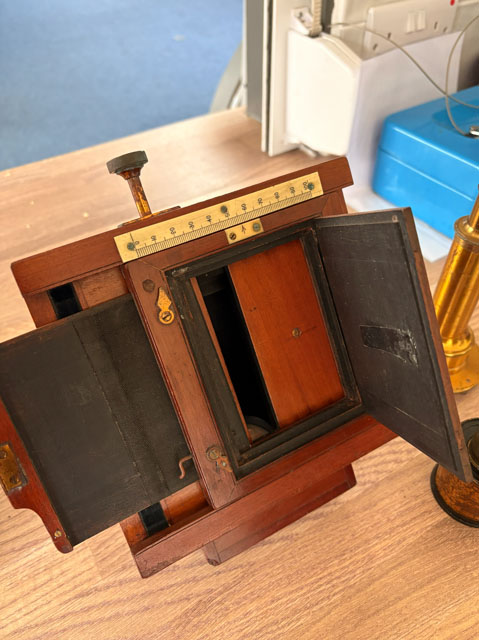
It seems likely that this plate (or film?) holder was part of a spectroscopy dedicated optical tube that attached to a larger telescope. The scale and long stem knob in the top photo appear designed for shifting the back to allow multiple images on one plate. A dark slide is pulled out at left. Typical practice for stellar spectrophotos of the day would have been to orient the prism and camera back so that the telescope drive could be shut off and the light would trail perpendicular to the dispersion spread, giving nice neat spectral lines and great stability.
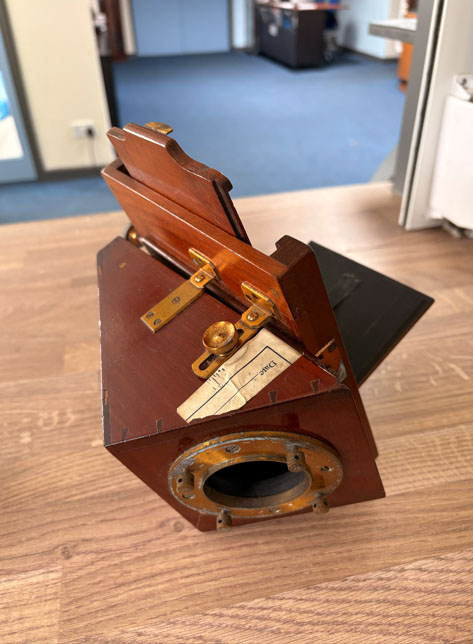
On the bottom photo, you can see some narrow dovetails. This is consistent with fine English carpentry. Looks like mahogany and very well made.
Sam
Mike, the full apertture prism is still attached to the Kensington telescope. Unfortunately this telescope is currently out of action awaiting repairs to the dome shutter. I also believe we have the objective prism for the McClean telescope in store but not aware of any others.
David
Hello all,
Here some comments from John Briggs and Richard Berry in the Antiqur Telescope Forum:
Hi Denis,
I’m pretty sure it’s a plate holder from a spectrograph. Some old instruments that I have seen had very inclined focal planes like this hardware suggests. One example is the setup used for early Raman spectroscopy. But I think some other types I have seen, but did not have time or circumstances to study, had similarly included plate holders.
All the 2×10-inch plate holders on the old Mount Wilson solar telescope Littrow spectrographs are tiltable to allow for varying focal lengths of the different wavelengths recorded in a given exposure (given that the camera used a lens with some inevitable chromatic aberration). But the maximum angle allowed was not nearly as great as what has been built into the unit you show.
I’ll see if I can find pictures of spectrographs with similar big-angle plate holders to give us a better clue!
–JWB.
And a bit more: These highly inclined plate holders were used on quartz spectrographs for violet and UV light, where the prism and the camera lens, etc., where made of quartz for good UV transmission. In this case, the camera lens might not have been more than a single element, given that the goal was transmission and focusing of UV. Only quartz was possible! Thus, the camera’s focal length was a function of wavelength. And from the appearance of how these things were made (with a big tilt), it was a strong function!
Google “Adam Hilger quartz spectrograph.”
I recently learned that Adam Hilger had been an employee of John Browning in Hilger’s youth. (I’m a big fan of all things Browning!)
–JWB.
Hi all–
I agree. There were similar plateholders on the spectrographs at C.R.E.S.S. at York University (Toronto) where I worked many years ago. The focal surface is inclined if there are refractive optics in the instrument. They would take many spectra on each plate, moving the plate down for each spectrum. If you examine it carefully, you’ll probably find what were called “deckers” that allow the spectroscopist to shoot a 6 to 10mm slice on a 3-1/4 x 4-1/4 plate, or whatever size the plateholders take. I was sometimes able to snatch boxes of out-of-date 103a-E Kodak glass plates before they chucked them out.
–Richard
Can anyone expalin the resaon behind the design of this camera? It is a beautifully made hardwood (mahogany) plate camera with precision brass fittings.
The focal plane of the camera is highly inclined and not perpendicular to the optical axis if it was attached to a telescope. There is a shutter mechanism which
allows different parts of the plate to be exposed. I realise that the blue and red end of the spectrum have different foci, but would not have thought it would be this extreme? But maybe with a long focus refractor that may be so?
David
Already mailed Paul. Albondon is relatively close to La Palma (close by UK standards anyway, though still a 2-day journey in each direction) and although shipping would not be cheap, it should not to be too expensive — especially if I rent a van and drive/ferry over there and back myself.
A vacant concrete pad at Tacande Observatory already has power and ethernet laid on. It is big enough to hold a 4m diameter dome.
Arrangements have been made. In the fullness of time a ~4m dome will be planted on that pad ready to host a 0.4m RC telescope.
Many thanks Barry, that’s a useful review. One problem we have here is that on many occasions we have to cope with cloudy skies but children always ask to look through the big telescope! They all climb the steps in turn only to look at the underside of grey clouds! Are you able to show stored images through the eyepiece of previous shots taken through the smarteye, so at least they get to see something? That would seem to be more engaging than just looking at a computer screen.
Thanks
David
Thanks, Paul. I had a tooth pulled. I struggle to believe all the possibilities attributed to it, but if you confirm it, I’ll begin to dispel my doubts.
I’m referring here to the cheapest telescope AP 50/250 Seestar S50.
I’ll tell you, it’s a little hard to imagine having Pluto within reach. It seems that on M13, M31, M42, the Pleiades, etc., it’s truly miraculous. For “beautiful” photography, I think it’s a good instrument, even if the resolution leaves something to be desired. I wonder: what does it provide on Epsilon Lyrae?
Given its light weight, I’d take it to high mountains, to the Gran Sasso, even at altitudes above 2,800 meters, to photograph lunar eclipses, which I study seriously. At F=250mm, the lunar and solar disks have a diameter of about 2.5 mm. So I wonder what the quality of lunar photography is, taken for photometric purposes? No description provides information about the actual resolution on the Moon and Sun.
I would like to see some photographs of the Moon and the photosphere, taken without any post-production or retouching with various soft-focus techniques.
My image of the Sun, one in the list given by Andy, is exactly as it came off the S50. No post-processing at all. Another image in the list shows Pluto. I can’t help with epsilon Lyrae, sorry. An image of Polarissima Borealis, aka NGC 3172, appears at https://britastro.org/observations/observation.php?id=20241121_180849_58cdbd49c5f6525c — that image took only 11 minutes to take. The galaxy is not very impressive in appearance, true, but it is magnitude 14.9 and the exposure was quite short. What really surprised me was LEDA36268 appearing — that one is 17th magnitude!
Re: Andy’s comment about access to the raw data. On the Seestar the lights frames, in FITS format, are easily available for subsequent post-processing. The calibration frames are not, as far as I know, but perhaps they may become available in subsequent versions of the firmware if enough people ask ZWO for them. The telescope firmware automatically applies dark frames. Flats can, presumably, be taken in the usual manner but I have not yet ventured there.
Paul
-
This reply was modified 8 months, 1 week ago by
 Dr Paul Leyland. Reason: Add raw data comments
The wide variety of smart telescopes are great, but as with anything you get what you pay for. Putting together a custom setup where you get a high quality 50mm apochromatic lens, a good quality mount and a good quality CCD or CMOS camera is going to give superior results but will be a lot more expensive. Smart telescopes are designed for convenience and ease of use, and that is where they will beat a custom rig. Also, some smart telescopes like the Seestars and Dwarfs are designed for portability.
You can do science with them, but look into the capabilities to understand the pros and cons. For example, they have colour chips so you can’t just add a photometric filter. Though we already have a couple of observers submitting photometry to the Variable Star Section database taken with Seestars using the green channel from the colour camera. I got myself a Dwarf for its ease of use, portability, and easy access to the fits files and calibration frames.
The resolution will be the same as any traditional telescope with that aperture, focal length and pixel size. You can find results taken with a variety of smart telescopes in the BAA image gallery. Click the images to see the details of the equipment used to find those taken with smart telescopes
https://britastro.org/observations/
You can also search for ‘Seestar’, giving these images.
The best images are obtained by people who do post-processing of the results, rather than relying entirely on the inbuilt processing.
If you want ease of use and portability then they are hard to beat. If you want to extract the maximum science potential then a custom rig is the way to go.
Andy
-
This reply was modified 8 months, 1 week ago by
 Andy Wilson.
-
This reply was modified 8 months, 1 week ago by Andy Wilson.
-
This reply was modified 8 months, 1 week ago by Andy Wilson.
-
This reply was modified 8 months, 1 week ago by Andy Wilson.
-
This reply was modified 8 months, 1 week ago by Andy Wilson.
Thanks, Paul. I had a tooth pulled. I struggle to believe all the possibilities attributed to it, but if you confirm it, I’ll begin to dispel my doubts.
I’m referring here to the cheapest telescope AP 50/250 Seestar S50.
I’ll tell you, it’s a little hard to imagine having Pluto within reach. It seems that on M13, M31, M42, the Pleiades, etc., it’s truly miraculous. For “beautiful” photography, I think it’s a good instrument, even if the resolution leaves something to be desired. I wonder: what does it provide on Epsilon Lyrae?
Given its light weight, I’d take it to high mountains, to the Gran Sasso, even at altitudes above 2,800 meters, to photograph lunar eclipses, which I study seriously. At F=250mm, the lunar and solar disks have a diameter of about 2.5 mm. So I wonder what the quality of lunar photography is, taken for photometric purposes? No description provides information about the actual resolution on the Moon and Sun.
I would like to see some photographs of the Moon and the photosphere, taken without any post-production or retouching with various soft-focus techniques.
Thank
P.S. Sorry for my poor English, I don’t know much and I have to use a translator.
Just an update on the above post regarding Reflect Orbital and the Earendil-1 prototype satellite.
Their application for launch is currently before the FCC. If you are not aware of Reflect Orbitals plans a very basic summary is that they intend to launch a satellite constellation that will provide “sunlight as a service” – basically large space mirrors that will sit in an orbital shell at 625 km. The purpose is to reflect sunlight onto the dark side of earth to provide near 24hr illumination on areas where subscriber’s to their service pay for it. These will track across the sky shining a beam of light on, for example a solar farm and its surrounding area. There is no clear method stated as to where this beam of light goes as the satellite reorientates onto its next target. This is of course a very short and simplistic overview of their project.
There are many impacts and risks to their proposal, the key ones for astronomy being the launch of intentionally bright satellites and the risk of retinal damage if you are unfortunate enough to be looking through a telescope or binoculars when one of these satellites passes directly into your FOV.
There are of course other significant impacts on ecology, and atmospheric pollution, aviation and so on, and also its worth noting the US military have seen the potential applications and have gave the project financial resources to explore ‘novel uses’ of the technology.
I would like to encourage any and all within the BAA to have a look at this project and join in lodging objections to the FCC. I am happy to provide details as to how to do this, and you do not need to be a US citizen to lodge an objection. All objections are equally valid, whether from individuals or organisations.
Clear skies,
Jim
James Verner
Director
Dark Sky UK
IAU-CPS Member
Hi All,
There is no doubt that the application by SpaceX for a 1 million satellite strong mega-constellation has the potential to be a devastating blow to astronomy at all levels. Yet, the economics of such a venture are alot less clear and some within the industry are already casting doubt on orbital data centres as both uneconomical and a significant risk to data security.
Whether or not this ever becomes a reality remains to be seen, though, as we have seen before with Musk / SpaceX never underestimate their ability to make even the improbable possible.
There is however, another potentially serious threat looming in the sidelines in the form of the Earendil-1 prototype satellite from Reflect Orbital. Their application for launch is currently before the FCC. If you are not aware of Reflect Orbitals plans a very basic summary is that they intend to launch a satellite constellation that will provide “sunlight as a service” – basically large space mirrors that will sit in an orbital shell at 625 km. The purpose is to reflect sunlight onto the dark side of earth to provide near 24hr illumination on areas where subscriber’s to their service pay for it. These will track across the sky shining a beam of light on, for example a solar farm and its surrounding area. There is no clear method stated as to where this beam of light goes as the satellite reorientates onto its next target. This is of course a very short and simplistic overview of their project.
There are many impacts and risks to their proposal, the key ones for astronomy being the launch of intentionally bright satellites and the risk of retinal damage if you are unfortunate enough to be looking through a telescope or binoculars when one of these satellites passes directly into your FOV.
There are of course other significant impacts on ecology, and atmospheric pollution, aviation and so on, and also its worth noting the US military have seen the potential applications and have gave the project financial resources to explore ‘novel uses’ of the technology.
I would like to encourage any and all within the BAA to have a look at this project and join in lodging objections to the FCC. I am happy to provide details as to how to do this, and you do not need to be a US citizen to lodge an objection. All objections are equally valid, whether from individuals or organisations.
Clear skies,
Jim
James Verner
Director
Dark Sky UK
IAU-CPS Member
Which “Smart Telescope AP 50/250”? A web search on that term shows the Vespera II (https://www.apm-telescopes.net/en/86732-smart-telescope-ap-50250-vespera-ii-x-edition) and the ZWO Seestar S50 (https://www.astroshop.eu/telescopes/zwo-smart-telescope-ap-50-250-seestar-s50-with-universe2go-/p,84933). The latter is much cheaper and I own one myself.
The S50 most certainly can be used for scientific research as well as the canonical “pretty picture” field which is where most of the marketing is targeted. Precision photometry down to around 15th magnitude is possible with reasonable exposure times. Transformation coefficients to convert from its G channel to Johnson V are available. A 15 minute exposure seems to show a detection limit (SNR ~4, so useless for photometry) of around 17th magnitude.
https://astrobackyard.com/seestar-s50-review/ gives some detail but I don’t know how much more than that you want.
Very much not a piece of junk, IMAO.
Paul
Good morning everyone,
I’m considering purchasing the much-hyped Smart Telescope AP 50/250. Despite numerous presentations, I can’t quite figure out what this device can actually achieve. It’s advertised as useful, if not absolutely indispensable, for deep-sky observations: It allows for easy imaging of nebulae, clusters, stars, and even some planets. At first glance, it seems like you could reach the sky with it; even the Moon and Sun are targets of its small F250 D50mm apochromatic telescope. It’s incredibly portable; it can send frames (even processed ones) to your phone while you’re at the table. In short, this little instrument seems to be the gateway to an astronomical revolution, following Galileo and Newton. However, upon reflection, none of the numerous presentations seem to cover all the technically necessary and essential details. Can it be used for serious amateur astronomers? Before deciding whether or not to buy it, I’d seek technical and objective advice from someone who understands optics and telescopes. Is it a gem, or is it little more than a toy—a piece of junk?
Thank
I have created a script for AstroArt 9 which picks up a target list from another text file. It creates a new directory based on the date the script is run and automatically saves all the images based on the target number and name and the Julian date (this is so that if you take another set of images on the same object on that day they are not overwritten). The target list text file does not need to have the correct RA and Dec as this is calculated during running of the script. It also automatically gets the magnitude of the object from the built in star Atlas and or the MPCOrb dat. The Object magnitude is used to control the exposure time. You can choose an area of the sky for imaging based on hours before and after the meridian and limits on altitude, along with a maximum magnitude figure, any objects that do not match all these variables are skipped, the script loops through the list as many times as you desire so during the course of a session some objects will enter and leave the observing window. It drives the telescope to the object, does a full frame autofocus then a short imnage to check position and if necessary correct it then it starts PHD2 and takes a sequence of images and saves them to your chosen directory. It also creates a log file (.csv file) with a line for each image and saves this to your chosen location. The longest continuos run I have had with it was 10 hours where it performed with no problems and even coped with intermittent cloud cover, all the targets were visible on the images. I am using it for Asteroid light curve work but it could equally well be used for variable star, exoplanet, comets (although the magnitude information would need some changes), Deep sky imaging. If this is of interest please let me know and I have attached a copy of the script and the target list file. Some of the commands in this script are yet to be released, I have been working closely with the author of AstroArt and he will send a pre release of Service Pack 4 to anyone who wishes to use the script. It may be possible to get it working with some reduction in functionality using earlier versions of AstroArt. If you would like to get involved with the Asteroid and Remote Planet Section asteroid light curve work that would be appreciated. If any one from another section would like to use it and needs help to create a target file based on their needs let me know.
Wayne Hawley
Old Orchard Observatory Z09
I immediately read this news with interest, and I was delighted by it because I glimpsed in it a sort of great new discovery, somewhat similar to what the discovery of America must have been four centuries ago. Driven by strong enthusiasm for it, I wanted to do some calculations, done, so to speak, with a child’s abacus.
Data: Satellites N=10^6, orbiting at d=1000km above the ground and R=7350km from the center of the Earth.
Here are the results: surface area of the sphere centered on S = 4 * 3.14 * R^2 = 6.8 * 10^8 km2. Each satellite would have approximately S/N = 680 km2. The area is roughly square, with side L = 26 km. The hypothetical future tourist who will be on holiday in orbit approximately 1000 km above the surface will pass near a satellite every 2.5 seconds. This is a very short interval, similar to the frequency with which a driver encounters streetlights along a route in a city like Rome.
The worst is yet to come for us amateur astronomers. The angular distance between two nearby satellites is: 26km/1000km = 0.026 rad = approximately 1.5°. That is, between one false star (satellite) and the other closest to it, there would be only 3 lunar diameters. At 50x, we will see at least two satellites in the eyepiece field at the same time. Let’s hope they are invisible to the naked eye. If only each one had a magnitude of 1, it would be like having an almost full moon every night: goodbye to nebulae, clusters, and deep sky in general. This would lead to the bankruptcy of all telescope and accessory manufacturers. Thus, humanity will definitively lose a huge cultural heritage; no one will ever again look up at the starless sky; it will be pointless. Everyone, heads down, miserable, sad, and afflicted, will crawl on the ground almost like reptiles. In this state, I see no light, but black, the symbol of the famine emerging from the underworld: I see the apocalyptic Black Knight. A famine of natural stars, a famine of beautiful things. One side of his scale leans toward artificial light pollution, toward illusions, toward the falsehood that pushes everyone into the deepest corner of a Dantean Inferno.
I wonder if that “brilliant” idea is a sign of pure madness, a carnival joke, or something truly serious.
…and paper on “Nucleus and Postperihelion Activity of Interstellar Object 3I/ATLAS Observed by Hubble Space Telescope” claims to be the first detection of the nucleus: https://arxiv.org/abs/2601.21569
It doesn’t say where submitted but one of the authors is David Jewitt.