-
Search Results
-
I would like to use an 80mm refractor for public outreach for white light solar observation.
The telescope will track the Sun, potentially for several hours. In that time hundreds of people would observe the Sun. This includes large groups of school children. It will be supervised, of course. Though excited 9 year olds are quite lively!
Note that my primary concern is safety. I am not worried about small differences in the quality of the views provided.
I have posed the question to the Solar WhatsApp group which method is safest in this use situation. Among the helpful replies, three options have arisen:
1. Using a full aperture Baader film filter. This was my initial plan. But I am concerned about it being knocked off or pinholes appearing (the device would fit over the dew cap, held in place by screws, but not rigidly attached – taping in place each day is probably not conducive to long term use).
2. Using a Herschel wedge. This strikes me as a safer option and better from an engineering perspective as the wedge can be firmly attached to the telescope. My residual concern is that after several hours, the housing might get hot, presenting a burn hazard or be damaged in some way. Does anyone know whether these concerns are borne out in reality?
3. Using a projection box. This is probably safest of all, though my experience is that the image is often too dim for casual observers. It also doesn’t give the experience of observing THROUGH a telescope (similarly, Smart Scopes or cameras on the back of the telescope are not options under consideration).
Any views based on experience? Any risks assessments that can be shared?
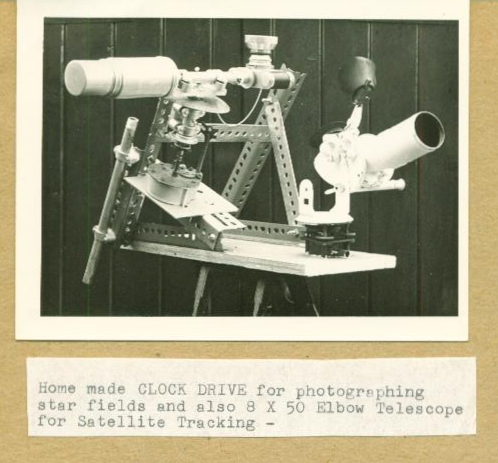
I am still sorting through some pamphlets and paperwork from Alan Heath’s house. I found this fascinating photo from about 1961 of a clock drive he had built and an 8×50 Elbow Telescope… I have to confess I’d not heard of an Elbow Telescope before.
I just thought this may be something other may be interested to see, and to save the image for prosperity.
James Dawson
NottinghamAttachments:
The Mauve space telescope with a mission to study stars in the UV has been launched
https://bssl.space/blue-skies-space-launches-satellite-to-study-the-hidden-lives-of-stars/With the falling cost of technology and launches I wonder when we will see amateur space telescopes ?
Topic: M31N 2008-12a in outburst
Anyone who would like to image and, especially, to measure a variable star in an external galaxy should pay attention to this announcement made only a few hours ago. If you follow the link you will discover that the discovery was made with a 23cm aperture telescope, something well within the range of equipment used by many BAA members.
Dear colleagues,
The 2025 eruption has been discovered. Please try to increase your observing cadence to monitor the light curve.
The nova was discovered on Nov. 30.3634 with a magnitude of 18.7 by Koichi Itagaki as reported on TOCP page below:http://www.cbat.eps.harvard.edu/unconf/followups/J00452879+4154101.html
Best regards,
Hiroyuki Naito, Nayoro ObservatoryM31N 2008-12a erupts annually and has by far the shortest period known for a recurrent nova. By comparison T CrB, for which everyone seems to be waiting, has a period at least 80 times longer.
Paul
Your chance to own this classic and beautiful telescope. I bought it in 2021 and it has barely been used and has been stored indoors for most of the time. The Takahashi 1.01x field flattener is also included.
You can see my setup here: http://www.astro-sharp.com/2021/09/29/my-new-deep-sky-imaging-setup/
Full, original packaging included.
I used it with a Pegasus Astro Motor Focus V2 and still have this – ready to be fitted. Let me know if this is additionally wanted.
I’m asking £2750.
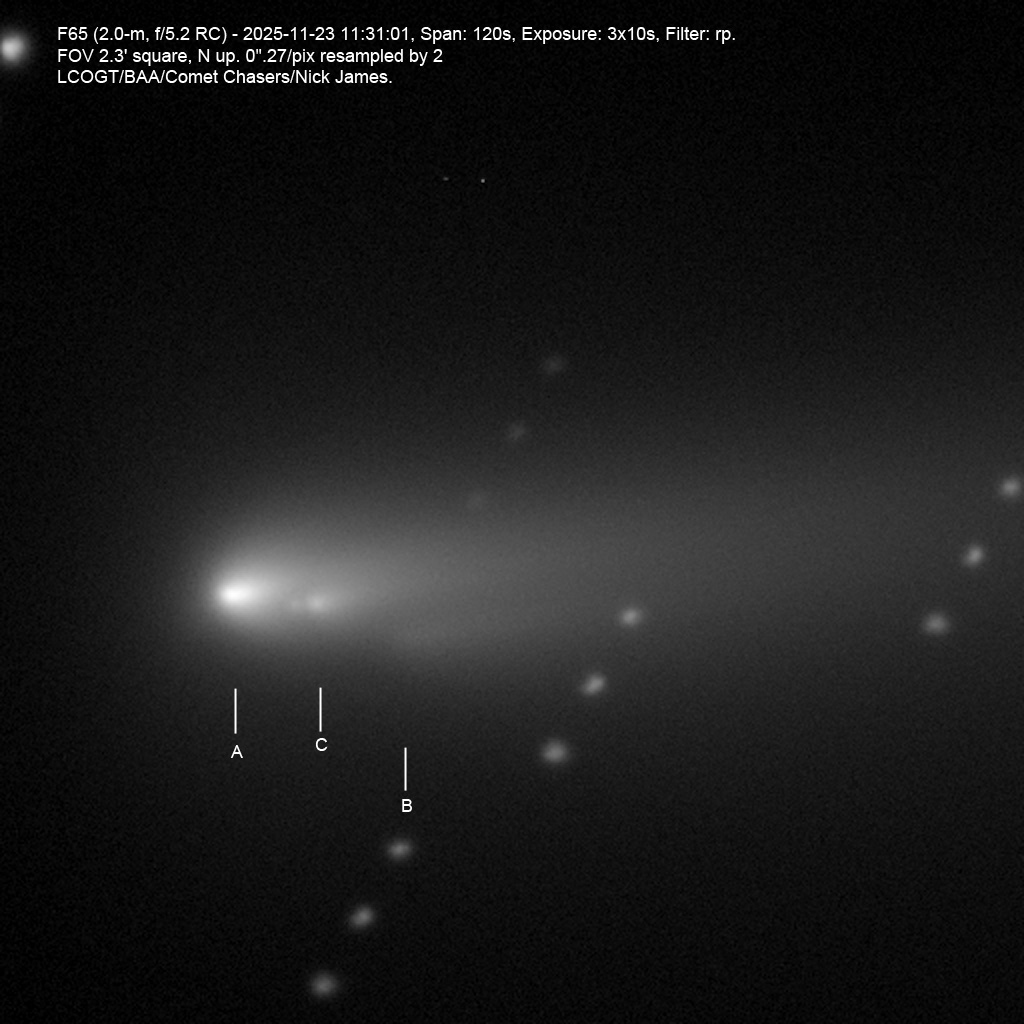
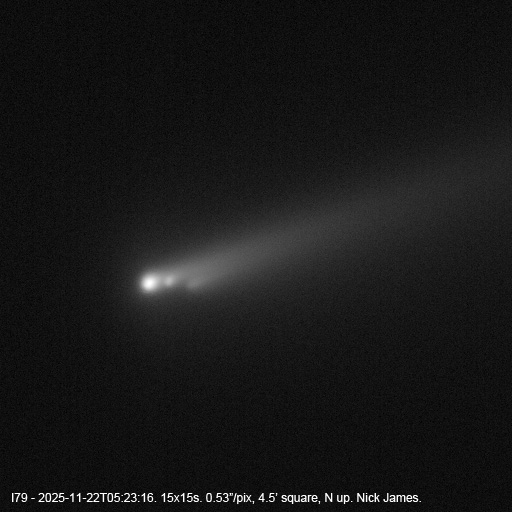
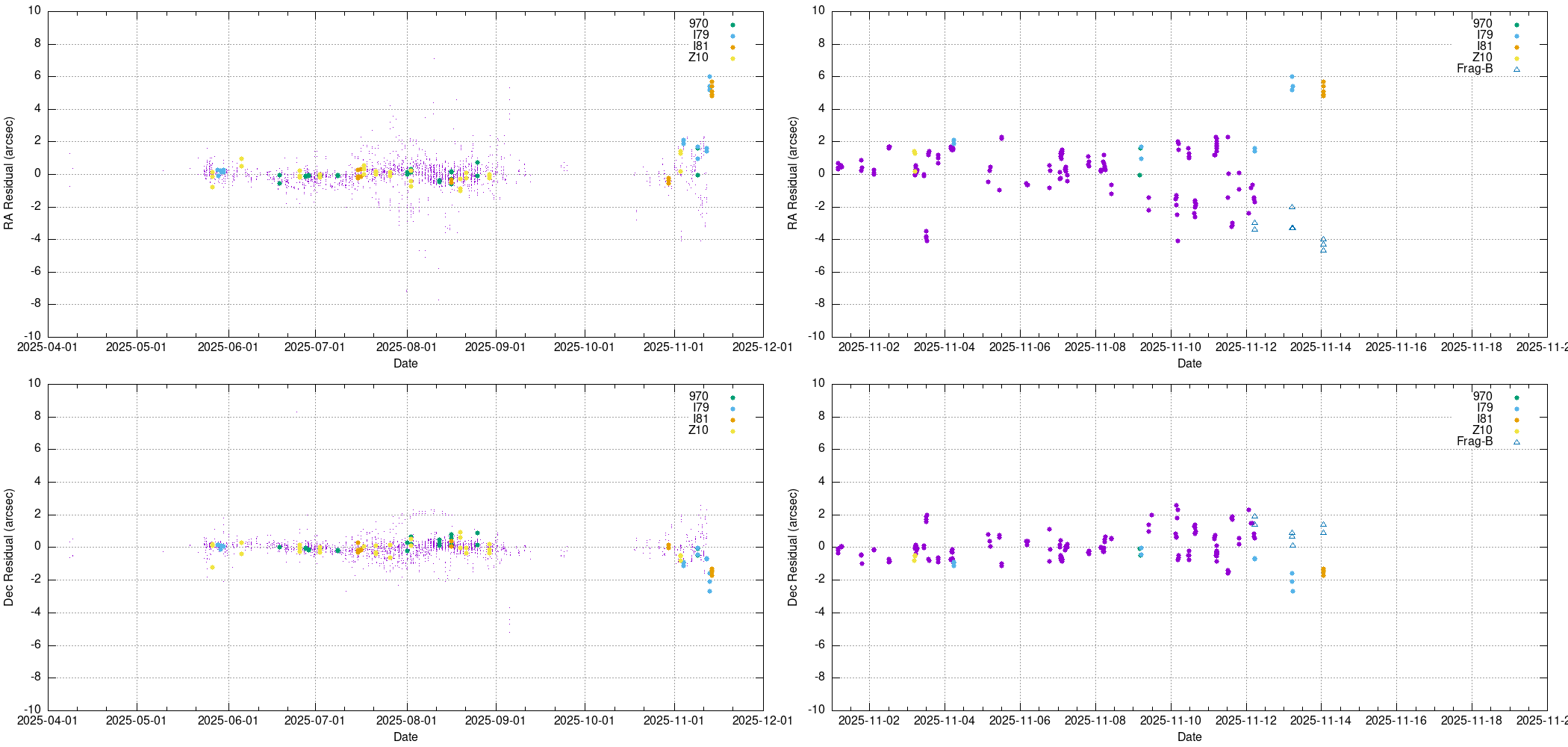
This comet was reported to have fragmented on or about November 4 (ATEL 17482, 17487, 17488). There are several fragments but the two brightest are the main component and fragment B. Recent images are in the archive here:
https://britastro.org/cometobs/2025k1/thumbnails.html
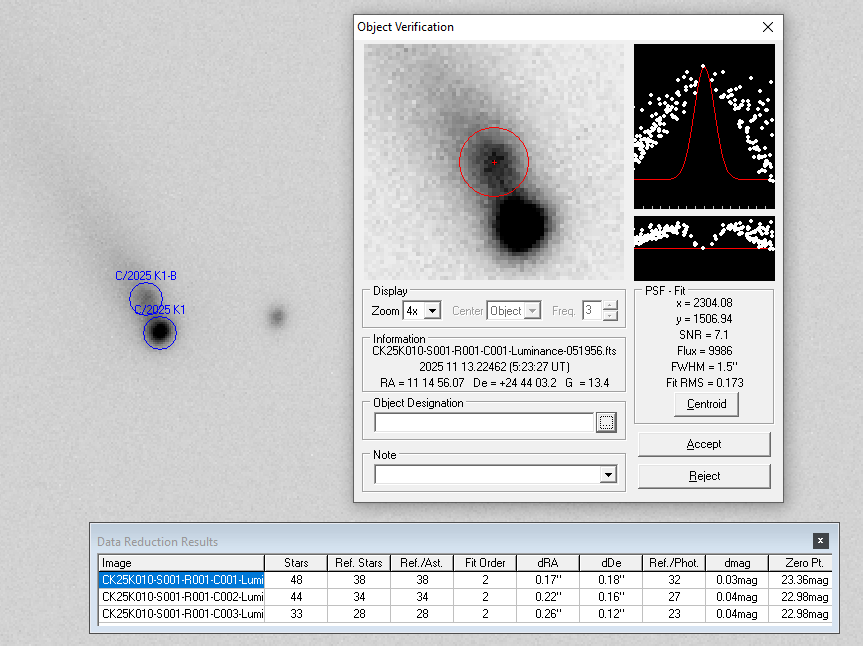
Attached is a plot of the all the astrometry that I have. The recent astrometry consists of my measures using the Alnitak telescope in Spain (I79) on Nov 12 and 13 and Denis Buczynski’s measures using his telescope in Tarbatness (I81) on Nov 14. The plot shows the residuals for the main component as filled circles and the residuals for component B as open triangles. These residuals are from the fitted orbit using all the available astrometry (from the MPC) prior to November 4.
The main component shows a large positive RA residual which is matched by a similarly large negative residual for fragment B. A simple-minded interpretation of this would be that both components have a similar mass but fragment B is much fainter so that doesn’t seem likely.
If anyone has any recent (post November 11) astrometry of this comet please forward it to me and the MPC. Astrometry of the main fragment (C/2025 K1-B) would also be very useful. It is now well separated from the main component.
I have a Double Stacked Coronado Personal Solar Telescope for sale for £1100 or best offer. The well-matched etalons allow safe observation of the features of our sun in h alpha. If you’re a beginner,then I can offer you as much support as you need to observe and/or image with it.
For more information please contact Nic Spencer at nicspencer1@gmail.com I live in York, North Yorkshire.I started the project in February of this year.
The telescope was my own design. I wanted a telescope for visual deep sky observing, so decided on a low f ratio and it had to be able to break down (by removing the truss-poles) to fit in the back of an average car.
I finished it in May and I’m pleased with the results. It’s stable, solid and the axis’ move smoothly.
The mirror took a bit longer.
5 months longer. One turned edge, two pitch-laps and three parabolising attempts later and I have what Terry Pearce of Vacuum Coatings described as an “excellent parabola”. Coming from a man of his knowledge and experience, that’s high praise indeed. In fact I measured the mirror at better than 1/10 P-V wavefront which Terry thought to be somewhere near.It was a very enjoyable project. The most challenging aspect being mirror polishing and parabolising. I learnt a lot during the process and I’m already thinking about a small table-top dobsonian as another project.
I’d like to thank Denis Buczynski for his generous donation of the mirror blank and tool. Also Terry Pearce for his evaluation of my mirror at his ATM club, and excellent aluminising service, and Mike the Ebay seller who supplied the extra Cerium Oxide I needed and some very helpful advice.
Also thanks to David Arditti for the telescope making article in the 2024 August BAA journal for giving me the initial spark.I haven’t had much luck with the skies lately, but I did get some lovely views of Saturn and the Moon in the last couple of nights.
I’m looking forward to putting it to good use during galaxy season.Clear skies to all.

British Astronomical Association
Supporting amateur astronomers since 1890