-
Search Results
-
Dear colleagues,
Good morning, everyone.
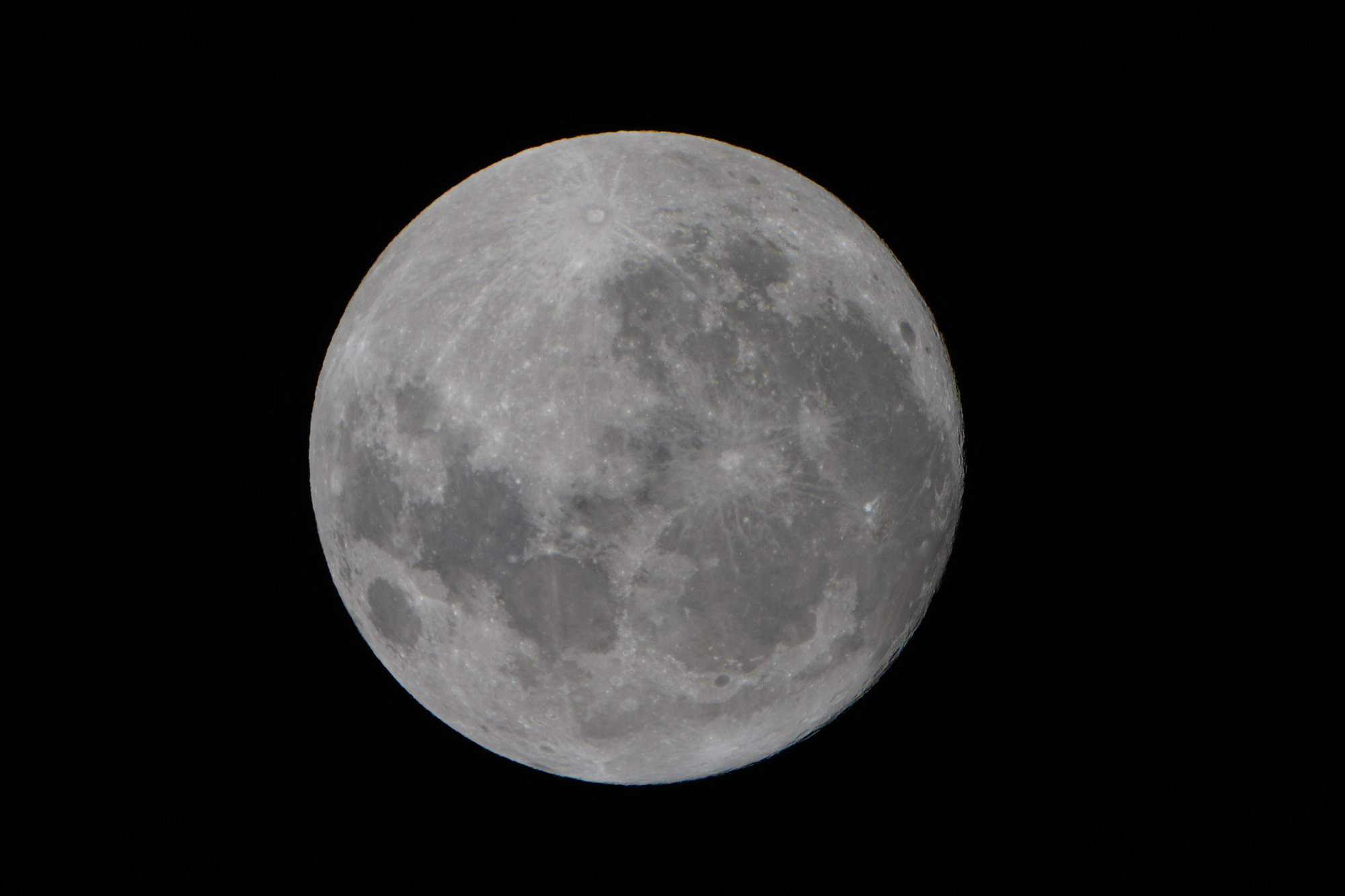
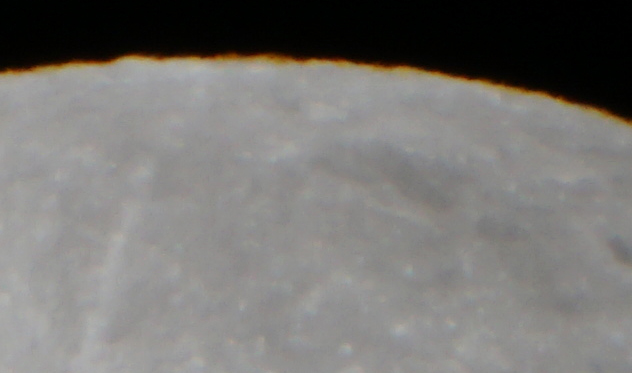
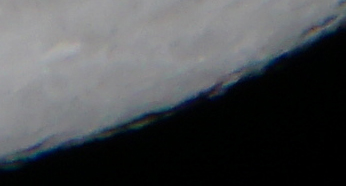
I kindly ask for your help in understanding a feature of my telescope. It is a small MAK90 f1250 catadioptric telescope, which I enjoy using to observe the brightest objects, mainly the Moon from my balcony at home. I also take some shots with my Sony Alpha 6000 mirrorless camera using direct focus. The resolution is low and the results are mediocre, but I am satisfied nonetheless. However, I am puzzled to see that chromatic aberrations always appear on the lunar disc. As can be seen in the enlarged images, one edge is outlined in red and the opposite edge is outlined in blue.
What causes this?
Thank you and best regards to all.
Translated with DeepL.com
Attachments:
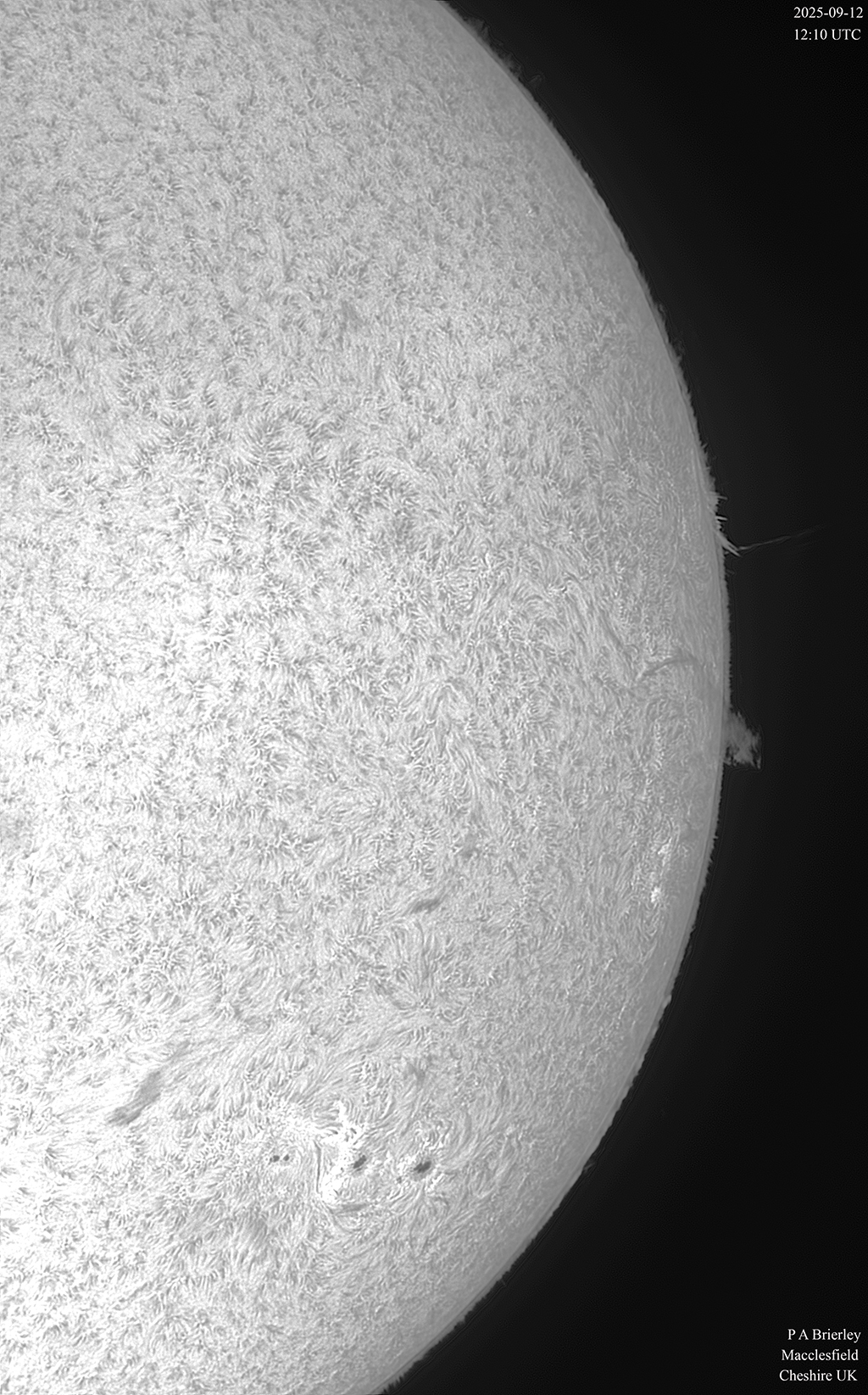
Topic: 2025-09-12@ 12:10UT
Dodging the showers, I was able to capture this image of our star shortly after local noon. The Sun is still very active, as you can see from this carefully processed image.
Equipment for those who are interested.
Telescope: William Optics Z61.
QuarkChromosphere.
ZWO ASI174MM.
SkyWatcher SolarQuest.Prof. Boris Gaensicke (U. of Warwick) has requested timeseries photometry of a white dwarf with debris transits. The period is uncertain (days to tens of days). Hence very long runs are required.
Boris says “We are currently observing the star every night with one of the 20cm NGTS telescope at Paranal, but this project would hugely benefit from multi-site data.” Longitudes of ANZ and RSA would be especially beneficial to get complete coverage.
If you think you could observe this far southerly object, please contact me and I will put you in touch with Boris.
Go well!
JeremySirius 2.3-metre diameter motorised observatory and various telescopes for sale
Joy Heyworth, daughter of Derek Harris, a recently deceased BAA member, is in the process of disposing of her father’s Astronomical equipment, in order to benefit the BAA. The main items are a 2.3-metre diameter motorised Sirius Observatory, and a 10-inch Meade LX200 telescope complete with a set of eyepieces and colour filters, anti-dew shield, heater and Kendrick dew controller. The latter instrument is mounted upon a custom-built Ambermile 1.4-metre metal pier, and the maker’s supplied tripod is also available. We believe the equipment to be in working order, but the buyer would have to inspect (and, for the Observatory, dismantle) it. (I shall go and have a look myself in a few days’ time, but have been unable to do so yet.)
There is also a 125 mm Meade ETX125 PE telescope with wedge and field tripod and solar filter, a Coronado PST solar telescope, and a ED APO 80 mm refractor with carrying case.
Offers from £1,500 upwards for the Observatory, £450 for the 10-inch Meade, £90 for the 125 mm Meade and £150 for the APO 80 mm refractor will be particularly welcome. Any offer will be considered for the Coronado PST as it is from 2006. There will be a few eyepieces with each scope.
Joy will be happy to receive enquiries and offers direct from BAA members, and has some photos available; her contact details are as follows:
Email. joy.heyworth@gmail.com
Phone. 07535 671432The Observatory is located in Holbeach, Lincs., and the equipment could be inspected by arrangement with Joy on a number of dates from early September onwards.
There are also some modern Astronomical books available, and any successful buyer going to collect their purchase may take as many of them as they wish, for free.
It is likely that other smaller items will be offered for sale at a future Winchester weekend (or other BAA) meeting.
Payments for all items will need to made be to the BAA.
Please send enquiries direct to Joy, not to me.
Richard McKim, Archivist
Topic: Materials strength question
This question relates to clamping a dovetail to a telescope and the bolts used for that…
I’ve got M4 bolts, 25mm long, made of A4-70 stainless steel.
How much mass could one bolt support before it snapped or deformed? I guess the two force options would be a weight hanging off the bolt pulling it in its long axis. The other would be the weight hanging off the bolt, and stressing it across is short axis / diameter.
I’ve read values of 600 MPa but what does that mean in terms of kg hanging off, or across, an M4 bolt?
Thanks for any answers and I appreciate I’m asking for a very complicated topic to be condensed into a single kg answer, per bolt.
James Dawson
Dear BAA Members,
My name is Dr Jack Lampkin and I am a Senior Lecturer at York St John University.
I am conducting anonymous interviews (around 20 minutes) with amateur astronomers who live or practice astronomy in northern dark sky areas (specifically, the Yorkshire Dales National Park and North York Moors National Park). I am interested in the impact, if any, that satellites and orbital debris have on amateur astronomers of all aptitudes (naked eye, binocular, telescope, astro-photography, etc.).
If you, or anyone in your network, are able to spare some time to chat with me either online, over the telephone, or in-person, then please get in touch with me at j.lampkin@yorksj.ac.uk
Thank you so much for your help!
Jack
Dr Jack Lampkin
Due to retirement from observing, BAA Solar Section member Brian Mitchell has an extensive list of astronomical equipment that he would like to dispose of. The full list can be read on the attached pdf file.
The list includes a solar observatory, Celestron 8″ SCT, Coronado Ha PST, Lunt 60mm Ha solar telescope and much more.
If you are interested, you will need to collect from Brian in Norfolk. Please contact Brian direct by telephone 01603 457555Topic: Vera Rubin Images
The first Vera Rubin telescope images have now been released….
https://www.bbc.co.uk/news/articles/cj3rmjjgx6xo
Worth a look.
Dear friends,
More than a few members of the Antique Telescope Society, as well as BAA members, own T. Cooke & Sons, or Cooke, Troughton & Simms telescopes. At times, restoring or repairing them can be challenging, and ATS member Matt Considine, FRAS, and I have been searching for the company records. The U. of York / Borthwick Institute has the vast majority of what is known to remain, but what’s been elusive is the status of actual engineering and technical material. We just received the following report from Dr. Nick Melia of Borthwick Institute. His news was not positive, so I am reaching out to see if anyone knows anything further about other possible locations that T. Cooke engineering drawings may have ended up, if not in a landfill or incinerator.
Warm regards from NYC,
Bart
Bart Fried
President and Founder, Antique Telescope Society
American Astronomical Society – Historical Astronomy Division
British Astronomical Association
Amateur Astronomers Association, Inc.
oldscope@gmail.com
1-646-267-4620On Tue, Jun 3, 2025, 10:45 AM Borthwick Institute <borthwick-institute@york.ac.uk> wrote:
Dear Matt,
Many thanks for your email.
As you will no doubt have seen in the catalogue, the T Cooke and Sons archive contains few manufacturing or design records. While we hold an index of drawings (our ref: VI/TC/4/2/2), the drawings themselves survive in neither the T Cooke and Sons archive, nor subsequent iterations of the company. Unfortunately, we don’t know there whereabouts of the drawings, or, indeed, if they survive.
I’m sorry not to be the bearer of better news; do let me know should you have any further questions, and I’ll do all I can to help.
With best wishes,
Nick
Dr. Nicholas Melia
Archives Assistant
Borthwick Institute for Archives
University of York
Heslington
York
YO10 5DD
Tel: 01904 321166
Email: borthwick-institute@york.ac.uk
Website: http://www.york.ac.uk/borthwickFind us on Facebook: http://www.facebook.com/UoYBorthwick
Follow us on Bluesky: https://bsky.app/profile/uoyborthwick.bsky.social
Read our blog: https://blogs.york.ac.uk/borthwick-institute/

British Astronomical Association
Supporting amateur astronomers since 1890