Search Results for 'espin telescope'

› Forums › Search › Search Results for 'espin telescope'

Viewing 20 results - 101 through 120 (of 1,113 total)
  • Author
    Search Results
  • #629850

    In reply to: Lunt driving me mad

    David Arditti
    Participant

    I have an old Lunt LS60T telescope (tilt-tuned) and also two 5Omm Lunt aperture filters (tilt-tuned). These come from before 2010, the early days of Lunt.

    The LS60T came with the B600 blocking filter and the 50mm filters with the B1200 filter.

    I also was very concerned about the highly uneven illumination the Lunt 60mm gave both visually and in images, and did extensive tests, including pulling the filter units apart and using the blockers separately from the diagonals, in a straight-through configuration using an adaptor I made on my lathe (invalidating all warranties obviously).

    My conclusions were:
    1) The B1200 gave very much better results than the B600, with all other components being the same. It was chalk and cheese, the B600 just seemed to be a low-quality item.
    2) The straight-through configuration was better than using a Lunt diagonal, and substituting a 2″ mirror diagonal from another manufacturer was better as well, though not as good as straight-through. When I pulled the Lunt diagonals apart I noticed how crudely and inaccurately made they were, components just glued with a rubbery substance to rough aluminium castings, the inside a total contrast to the polished outside finish!

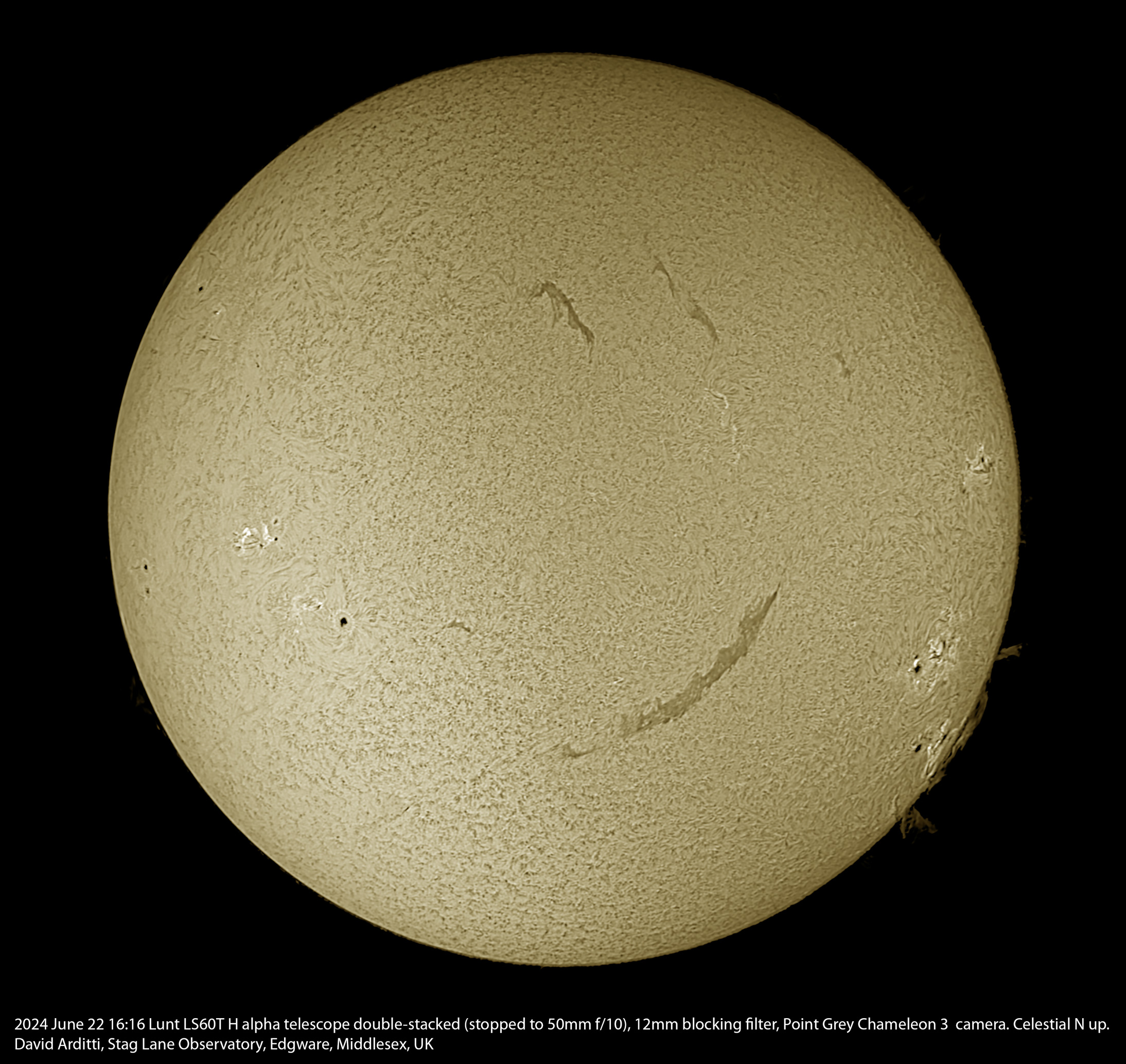
    Since then I have taken all my images with the straight-through system I made incorporating the B1200 and a replacement IR block filter (the original Lunt IR block filters all crazed over after a few years; this is likely due to the dampness in my observatory). That said there is still an unevenness in my images from the Lunt that cannot be completely removed by any adjustment of components. Here’s a typical example. Not flat frames have been used.

    Flat frames will (or should) correct Newton’s rings (which I get with certain cameras), but will not make the uneven filtration of Lunt systems even. In other words, even if you flattened the illumination, you would still see the uneven detail. The only H alpha telescopes I have experienced personally that do not suffer from such unevenness at all are the Solarscopes made in the Isle of Man (3 times the price of Lunt). However, I’ve been very impressed by images from users of the new Sky-Watcher Heliostar and Acuter scopes.

    #629706

    In reply to: Which diagonal?

    David Arditti
    Participant

    I believe so. BBC Sky at Night magazine did a comparative review of diagonals:
    https://www.skyatnightmagazine.com/advice/what-is-diagonal-telescope-used-for

    #629661

    I have now used my little tool to evaluate the brightness of T CrB in real-time with a Seestar S50 smart telescope (and sound an alarm to wake me up in case of an outburst!) for more than 20 clear nights, some with rather challenging intermittend clouds) and I’m now confident enough to recommend its use by others.

    https://github.com/Bikeman/SeestarPhotometricWatchdog

    I still need to correct many typos in the documentation files README.md and Adv_Documentation.md (which were written in a frenzy to outrun T CrB going nova…) but the scripts themselves are stable.

    I’m still looking for people who want to give this a try with the newer Seestar S30 product. If someone wants to port this to Windows, that would also be most welcome (it’s currently intended to be hosted on a Raspberry Pi or other Linux host).

    CS
    HBE

    #629631
    Nick James
    Participant

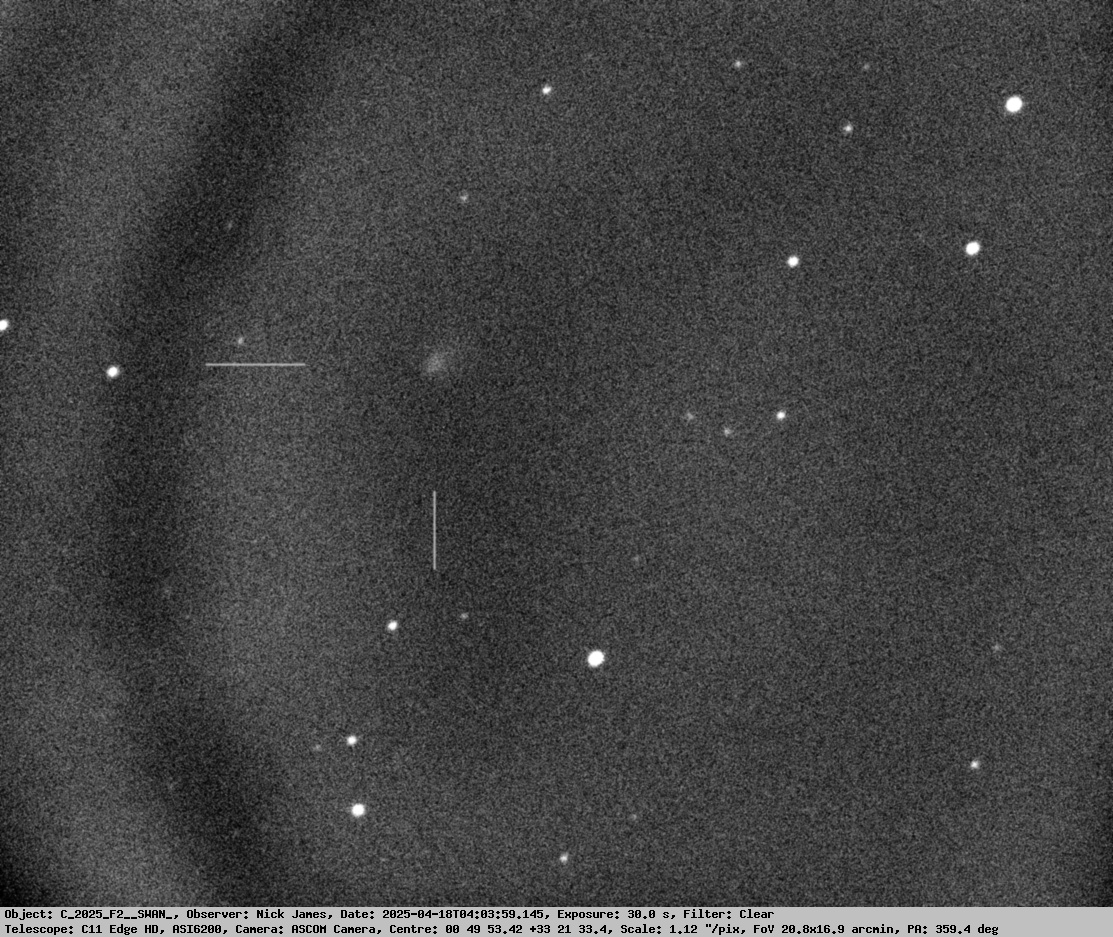
    I’m not able to get onto the comet with my main telescope until it clears my house roof, by which time the sky is very bright, but here is an image from this morning (April 18.17). There is apparently no distinct photocentre any more.

    #629272

    An update with additions. The Becvar atlases are spoken for. All offers on the rest will be considered.

    Additions…
    H.D.Howse
    Greenwich Time and the discovery of Longitude 1981
    Nice copy with dust jacket

    R.A.Proctor
    Easy star lessons 1881
    Good clean copy but little piece of titlepage missing

    G.F.Chambers
    The Story of the Comets 1909
    A classic and sought-after book in good condition

    Will Hay
    Through my telescope 1935
    Worn ex BAA library copy, no dust jacket (perhaps there never was one).

    R.s.Ball
    Ball’s Popular Guide to the Heavens
    1955 edition revised by E.A.Beet, v.g. Condition

    More to come later.

    #629093

    We have acquired various surplus books from collections of deceased members, and I am now offering the following items. A further list will be posted later. They are in very good condition unless stated otherwise. Please send me your bid for the book(s) you are interested in, and I will let you know if it is acceptable. If the bid is successful, you would then need to pay this donation to the BAA Office, and to reimburse me for the cost of postage and packaging. You could of course collect any item in person, and the two books by Becvar are too large to post. My email and home addresses are given under Archivist in the inside back cover of the Journal. The items are for sale to members only, residing within the UK. If I have given a guide price as a minimum bid, it is only because the item is quite rare. Please send a private email to ask about condition or to request photos.

    A.Becvar
    Atlas Eclipticalis 1950.0
    1962

    A.Becvar
    Atlas Borealis 1950.0
    1964

    J.F.W.Herschel
    Outlines of Astronomy
    6th edition 1859
    This one is a Prize copy with inscriptions. Plate A is badly damaged (subject, planetary perturbations), but all other plates and text are sound with minimal foxing. Spine and boards rubbed and detached. But a chance to get a cheap copy of this classic. Offers above £10.

    Allan Chapman
    The Victorian Amateur Astronomer
    1998
    Until lately, before the release of a second edition, this book was very scarce and was offered for sale at silly prices. Any offer over £20 considered.

    A.F.o’D.Alexander
    The Planet Uranus
    1965
    Much harder to find than Dr Alexander’s The Planet Saturn, this volume is in excellent condition but is missing the dust jacket. Offers above £10.

    G.F.Chambers
    A Cycle of Celestial Objects
    2nd edition 1881
    In original cloth binding. A very nice copy. Normally offered for very high prices. Offers above £50.

    R.N.& M.Mayall
    Sundials
    1973
    Fine copy with dust jacket.

    Colin Rohan
    The Skywatchers Handbook
    1985
    Fine copy.

    N.E.Howard
    Standard Handbook for Telescope Making
    1984
    Fine copy in dust jacket. Very similar to the first edition but now with the Dobsonian included.

    G.E.Satterthwaite
    Encyclopaedia of Astronomy
    1973
    The dust jacket has a few tears, otherwise very good.

    E.W.Maunder
    Astronomy without a telescope
    1904
    Lovely copy with pictorial boards.

    E.W.Maunder
    Sir William Huggins and spectroscopic astronomy
    Arcturus editions softcover reprint 1980

    Patrick Moore
    Practical amateur astronomy
    1970
    Fine copy in dust jacket

    G.Serviss
    Pleasures of the Telescope
    1909
    Ex BAA library copy with boards and spine detaching. Has been heavily used, but a complete and readable copy of thus classic.

    As already stated, a further list will follow later.

    Richard McKim (Archivist)

    #628615

    I have started to use my Seestar S50 as a robotic telescope to keep an unattended “eye” on T CrB. It will start observing at 01:00 GMT when the telescope gets a clear LOS on T CrB (from where I can keep it safe) and it will record images for ca 3 hrs atm, and then shut down again, powered by an external powerbank (so I’m not wearing out the internal batteries so much). An errupting T CrB would probably saturate the sensor soonish, but at least I could, when lucky, contribute the initial erruption and some part of the pre-erruption phase.

    As the sub-frames are accessible to other computers on my home network (as the Seestar S50 shares it’s storage in the local network as a network drive) it would in theory be possible to script something that would actually monitor T CrB in real-time, unattended, during all of this. Has anyone done this kind of scripting already?

    Clear Skies
    Heinz-Bernd Eggenstein

    #628450

    In reply to: Planetary “parade”

    David Arditti
    Participant

    Yes it was a live feed at just before 18:30, and then another one just before 22:30. These could be a first. I had it all ready to go before 18:00, then a shower of rain came across and I had to cap the telescope, but I left the run-off roof open, as to close it I would have had to park the scope, and might not have been able to get Jupiter on the chip again in time. Fortunately the cloud moved off quickly, stuff hadn’t got too wet, and it all worked at the right time.

    #628416

    In reply to: Planetary “parade”

    David Arditti
    Participant

    Yep, there’s no why that Saturn can be seen now without a telescope, low horizon and knowing precisely where to look, and obviously Neptune is totally invisible. I did a thing for the BBC news 6 & 10pm yesterday where they wanted a live image of a planet. Unfortunately they didn’t let me speak. If they had, I would have tried to inject some realism by explaining what people can really see.

    #628412
    David Arditti
    Participant

    Terry Pearce who runs the Amateur Telescope Makers of London club (see the Journal 2024 August edition) and the firm Vacuum Coatings (Scientific Mirrors) seems to be able to get these supplies. You can contact him via http://www.scientificmirrors.co.uk.

    David

    #628410
    Callum Potter
    Keymaster

    Galvoptics used to, and still do apparently https://www.galvoptics.co.uk/optical-components/telescope-products-andamp-services/

    Would be nice to hear how you get on.

    Callum

    #628406
    Martin Reeve
    Participant

    Hello all. This is my first post on the BAA forum.
    I’m interested in building my own telescope including grinding my own mirror, but I can’t find anyone selling telescope mirror blanks in the UK.
    Does anyone know of any suppliers?
    Thank you
    Martin Reeve

    Somerset, UK

    #628067
    Callum Potter
    Keymaster

    We have had this request come through – if you are interested the contact details are below.

    ======

    We are hiring astronomers and hoped we can advertise to your members?

    The Opportunity:

    Calling all astronomy students, amateur astronomers and those interested in the stars!

    Do you enjoy talking about the cosmos and would you like a chance to learn how to use a state-of-the-art digital Unistellar telescope? You will meet and work with Unistellar’s Co-Founder and Chief Science Officer, Franck Marchis.

    We’re looking for 12 people to join our staff for Piccadilly Un:plugged, an outdoor public art installation as part of the Art of London’s Art After Dark programme with artist Nelly Ben Hayoun Stépanian.

    This is a very public-facing role. You will work in pairs, situated around the West End with your telescope for 3 nights in March: Thursday 6th, Friday 7th, Saturday 8th. Your job will be to invite the public to stargaze and talk to them about what they’re seeing.

    Requirements:

    Basic astronomy knowledge is requested – the digital telescopes will provide you with information about what you are viewing on the screens but we are looking for people who may be able to answer additional questions from the public and provide engaging commentary

    No previous telescope handling is required – Unistellar will provide on the job training with their digital telescopes

    Must be able to carry approx 10kg in a backpack

    Must enjoy talking to strangers from all walks of life

    Shift details: must be available for all evenings

    Wednesday March 5th 6pm – 7:30pm (training session – paid) Thursday March 6th 6:30pm – 10pm Friday March 7th 6:30pm – 10pm Saturday March 8th 6:30pm – 10pm

    Working Location: West End (London)

    Dresscode: Please dress for the weather. We will provide a reflective jacket that should go over any warm layers

    Fee: London Living Wage £13.85/hr, invoiced at completion of the weekend and paid within 30 days

    Please contact jen@new-public.com with your CV and a paragraph about why you would like to be part of Art After Dark!

    #628033

    In reply to: Ha solar vignetting

    Dawson
    Participant

    I’ve had a useful email conversation with a technical person at Lunt. This is a summary of their suggestions which I have yet to try asI’ve not had time nor a clear day! It has a new blue filter in which I replcaed before the April 2024 total solar eclipse.

    Now, may I ask with the double stack removed, do you also experience such views? It is certainly true that a double stack can really make your image extra special but if not tuned correctly, can also consistently be at odds with the primary etalon.

    What I might recommend here, might seem like a step backwards. When I test double stack units, for the LS50THa or otherwise, I of course start with my scope in single stack mode. I tune and adjust until I am at the best point, and then I introduce the double stack. From there, I make sure my double stack is at rest (that is, no tilt introduced through the tuning wheel) and begin to tune from there. There are times when double stacks need a little something else. If I was testing your LS50THa, with this LS50c, the first thing I might do is go through the entire range on the LS50c that is attached and find my absolute best view while tuning that (after having tuned the primary without the double stack attached). If my field is much like your picture, my next thing I do, is to attempt to retune the primary etalon. At times, a little adjustment on the primary can really go a long way to making the double stack image what I would like it to be. From there, I would lastly try rotation of the double stack unit itself. This may seem the most precarious, but of course you have multiple threads securing it, and you wont need to during any more rotation than the initial 360 degrees, as anything past the first complete turn will put you at the same physical position in terms of lens tilt, but with just less thread to hold the filter onto the telescope.

    Very often, customers who are experiencing a lack in quality views with their double stacks will find some relief between these suggestions.

    Lastly, I am uncertain how old your telescope may be- but have you checked the BG (Blue glass) optic in your blocking filter as of late? This would be the blue glass element found under the nose tube that is introduced into your focuser. It should be perfectly clear, and without occlusion. Some of our older scopes have an uncoated version of the BG, while the new ones have a coated version. In either case, it should be 100% clear.

    David Nicholson
    Participant

    That is truly impressive, thanks for sharing!

    The quality of equipment and knowledge that amateurs have available to them is incredible. Once I have got back into visual variable observing I intended to start pulling together some tracking (a mount) to do some DSLR observations. I then intend to follow this with a telescope (my dob being unsuitable) and a dedicated astro camera.

    This thread has already been inspirational for one potential variable/exoplanet observer!

    All the best,
    Dave

    PS I agree that you should boast about this on other fora!

    • This reply was modified 1 year, 8 months ago by David Nicholson. Reason: Typo and added info
    #627844

    In reply to: Storm Dunlop

    Alan Dowdell
    Participant

    Sad to hear Storm has died . I knew him quite well , but haven’t seen him for some years now. I first met him in the late 60s when he joined Hampshire Astronomical Group. He got at time involved in making quite large telescope mirrors . I visited many times his home in Wittering and also met his mother who was quite a interesting person. I asked her why the name Storm, apparently she just liked the name but it was most suitable for his later writing career.
    He was very active in running our association for many years being secretary and President and keen on variable stars.
    I will certainly remember him

    Dr Paul Leyland
    Participant

    Craig: that FOV is comparable to my 400mm, which is 16.45 * 13.18 arcmin, or 0.27 x 0.22 degrees. I have not yet had any problem finding a suitable comparison star but, to be fair, stars do become much more common at fainter magnitudes.

    Once more: suck it and see is my recommended approach. Remember that you can do all this sort of experimentation at your convenience – you do not need to wait until a transit is imminent. If you do so for all the stars which you are likely to observe over the next few weeks you can choose which telescope to use as appropriate.

    #627774
    Dr Paul Leyland
    Participant

    SWarp (https://www.astromatic.net/software/swarp/) is the only stacking program I use most. It works exceedingly well.

    I believe that SWarp is available for the Mac. (I have never needed to look for it before but here it is: https://ports.macports.org/port/swarp/ )

    I use a local installation of astrometry.net to put the WCS on my images. Toddle over to https://astrometry.net/ for links to both the on-line plate solver (“use”) and how to drive the local installation (“download”). I already knew that a MacOS version of the local installation exists.

    FWIW, I use “ANSVR” to put a WCS on images taken with Maxim DL under Windoze for the purpose of a rough and ready indication of the centre of teh field for synchronizing the mount’s idea of its pointing location to the telescope position. Never tried stacking with SWarp under that OS but often use Maxim DL’s stacker to see when enough subs have been taken to give a good enough SNR for photometry. AN and SWarp are used subsequently to do a proper job.

    • This reply was modified 1 year, 9 months ago by Dr Paul Leyland. Reason: Minor clarification
    • This reply was modified 1 year, 9 months ago by Dr Paul Leyland. Reason: Fix ltyop
    #627627

    In reply to: Variable nebula update

    Jeremy Shears
    Participant

    Article on “A Predicted Great Dimming of T Tauri: Has it Begun?“ here
    https://arxiv.org/abs/2501.06378

    An AJ preprint from Tracy L. Beck (Space Telescope Science Institute).

    #627546
    Tim Haymes
    Participant

    Alex, Nick,
    It was mostly clear here. I had a view though double glazing. The telescope is not accessible atm. Temperature was touching -5.5 in North Oxfordshire.
    Alex: The Atlas step is very clear at 7/100 sec. Its been ages since a decent M45 passage.

Viewing 20 results - 101 through 120 (of 1,113 total)