Thanks for the reminder Tim. At 2am it was -3C out at the telescope but I was indoors in the warm. I got videos of the Merope and Alcyone events. From Chelmsford these were at 02:02:23.40 and 02:43:40.95. Lunar occultations of bright stars are always fun to watch.
I have got a set of Amateur Telescope Making by Ingalls for sale on ebay and a book on optics of the cassegrain telescope; there’s also a Danish book which is lovely, but illegible to me.
Amateur Telescope making:
https://www.ebay.co.uk/itm/156623785078
Optics of the Cassegrain Telescope:
https://www.ebay.co.uk/itm/156625863389
Danish book:
https://www.ebay.co.uk/itm/156618669272
Seeing as Jack has managed to sell his Burnham’s, it prompted me to have a go as I’ve been having a clear out over Christmas.
James Dawson
Society for the History of Astronomy
I have a 250mm Mewlon. To solve a problem with condensation on the main mirror, I wrap a dew heater band around the back of the scope, near the main mirror cell. During the winter months I leave it on constantly at a low level, turning it off before observing. I have found this works well at preventing any moisture from forming on the optical surfaces or within the telescope tube. It only uses a tiny amount of power.
I also have a tube heater, something like 60W or 80W, set on a timer in the winter. This gives just a little heat to the observatory, but did not stop condensation within the optical tube.
I have a wooden roll off roof observatory.
Andy
Members may be interested in supporting this initiative to rebuild this historic observatory.
—–
Penylan Observatory holds a special place in Welsh astronomical history, serving as a precursor to the Cardiff Astronomical Society (CAS), which is celebrating its 50th anniversary this year.
The observatory was originally built in 1888 and housed a 12-inch Newtonian telescope, one of the largest in Wales at the time. It was a hub for astronomical observation and education for many years before sadly falling into disrepair. Rebuilding it at St Fagans would not only preserve a vital piece of our scientific heritage but also provide a valuable resource for future generations of astronomers.
I am reaching out to astronomy clubs across Wales, including yourselves, in the hope that you will consider supporting this petition. You can find the petition and learn more about the project here: https://petitions.senedd.wales/petitions/246454
Thank you for your time and consideration.
Sincerely,
Spencer Grennan FRSA
(edited)
—–
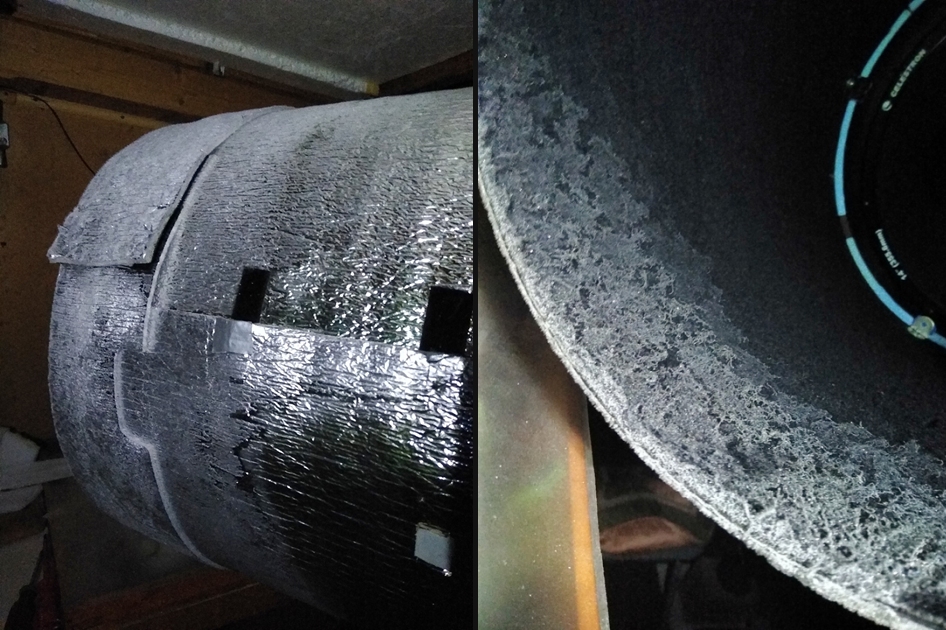
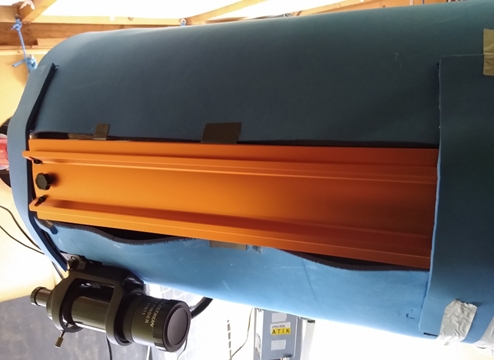
I too have been using insulating foil around a standard dewcap on my C14 for a few years now with great success (see pictures). Previously even with the dewcap and dew heater on full there was a little misting up of the corrector plate on the -4 to -5 deg. C nights when the telescope was doing long exposures at high elevations. But the insulating foil has stopped that. Frost might form on the very front end of the dewcap but it never affects the corrector. I also have a ‘jacket’ around the OTA made from exercise mat foam which helps prevent the mirror end getting too cold and with it I haven’t experienced misting up of the mirror. The telescope is in a shed observatory with a run off roof and so has plenty of draughty gaps and the resulting ventilation helps dry out the interior after a night’s frost collection!
Richard
Observing statistics for 2024
Gary Poyner (Birmingham)
Following four pretty decent years with over 120 observable nights for each one, 2024 has been a big disappointment with just 93 observable nights. The cloudiest year since 2019.
Second half of the year has been marginally better than the first, with a 45-48 split. Only 11 nights were totally clear from dusk to dawn in the whole year.
I’ve been recording clear/cloudy nights since 1978, and during those early years I classified them as Clear = less than 50% cloud, Partially Clear = more than 50% cloud. Although not a perfect method, I still use it for continuity.
2024 (2023 in parentheses)
Clear nights 11 (29)
Partially clear nights 82 (101)
Totally cloudy nights 274 (235)
Total observable nights 93 (130) with 38% of these nights having Moonlight interference.
I made VS observations on 90 nights.
Total hours at the telescope 177.5h (257h)
Best month August with 12 nights, 10 partially clear and 2 clear.
Worst month December with 3 partially clear nights.
Weather predictions from various sources gave incorrect information on cloud cover for 58 nights during 2023. Once again, my ancient ‘weather owl’ out performed the Met Office.
Total visual VS observations for 2024 is 7,466 (11,043). My worst year since 2019. CCD single measures using remote telescopes COAST, SLOOH and the AAVSO MPO-61 are 3,245 (2,996).
Happy New Year!
Gary
-
This topic was modified 1 year, 9 months ago by
 Gary Poyner.
I’m looking for a ‘complete solution’ rather than ‘just a battery’ and the only one I’ve seen so far was at Screwfix
https://www.screwfix.com/p/maypole-mp7430-400a-lithium-power-pack-type-a-usb-charger/718fy#product_additional_details_container
As far as Ah rating is concerned the sort of observing I do is limited to public outreach work where my equipment draws about 1A and the events generally don’t last longer than six hours. So a 10Ah battery should be more than sufficient.
My ulterior motive for this is that I’m already thinking about our 2025 Autumn Weekend Meeting in Orkney and was looking at a lower weight battery than my current (17Ah, I think) lead acid jump starter/leisure battery. On the evening of Sunday September 7 there is a lunar eclipse with the Moon rising in eclipse and coming out as the evening goes on which might be worth taking a telescope for.
-
This reply was modified 1 year, 10 months ago by
 Bill Barton.
Hi Bill,
I use an off-the-shelf Celestron Powertank (LiFePO4), which provides both 12V telescope output and 5V USB outputs.
It seems to work fine to power a 12V telescope. My only serious issue is that it automatically switches itself off if you don’t draw some minimum amount of current. My small Star Adventurer mount seemingly doesn’t draw enough power by itself, unless I plug something else into the other USB port.
Best wishes,
Dominic
Hi Jack and all,
I am part of a small group still working to rescue the 24-inch telescope which includes David Sinden’s daughter Caroline. If you have not already signed the petition please do so, it can be found here:
https://www.change.org/p/save-the-sinden-espin-calver-telescope-let-it-be-restored?source_location=search
Regards, John Nichol
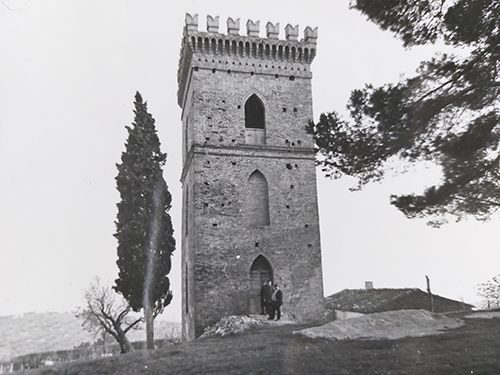
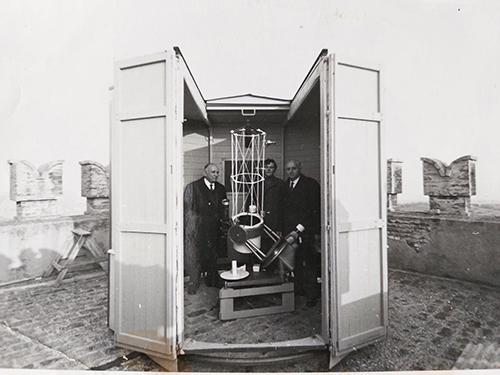
Mr Jack, it cannot be, I cannot believe such a ‘discovery’. Basically, almost, domes and telescope only need painting and lubrication. Now that’s a real treasure, other than the one in Louis Stevenson’s novel. I say this because in my association (the former Associazione Astrofili Abruzzesi) things went a little differently: we had built a Newtonian D300 mm F1500 mm. A beautiful telescope equipped with a D100 mm apo astrograph dedicated to the search for asteroids, in collaboration with the state observatory of Collurania (in the town of Teramo).
The instrument was placed on an old medieval tower, Torre De Sterlich, 10 km from our city Pescara in Central Italy. The 20-metre high tower and telescope are in the attached pictures.
One evening, we went there for an observation and found that the telescope had been catapulted from the top of the tower with all its accessories. Astrograph, push-button motors, eyepieces, blackboard and everything else lay on the ground at the foot of the tower. Everything had been destroyed by unknown vandals.
Thus ended the Association.
Any comments are yours.
In any case, congratulations on the preservation of things.
Translated with DeepL.com (free version)
I had been imaging for this object using itelescope robotic telescope in Utah, USA since the beginning of December and last night thinking the moon would be in the way I ceased the scheduling (getting expensive). Yep it happened I just knew it would. I’ll try and follow it if possible.
Eric
Denis,
Its the same telescope, the plaque is featured in the video.
Regards,
Jack
Hi Jack/ALL,
I don’t seem to be able to open the video you post about. However I assume it is the same as the 24 inch Espin Telescope that I have posted bwout on this forum and on the BAA forum at this link:
https://britastro.org/forums/search/espin+telescope
Here you can read along thread concerning the campaign to save the telescope.
Denis Buczynski
The Zeiss Telementor (63mm OG, 840mm focal length refractor) of the 1970’s is like this. If you screw the eyepiece holder directly into the telescope tube you won’t be able to achieve focus, either an extension tube or a diagonal is required. Zeiss manufactured six different extension tubes (in the range 20mm to 80mm, and usable singly or in multiple) to cover all circumstances.
‘Classic’ Newtonian reflectors of a few years ago had the opposite problem because the eyepiece tube couldn’t be too long as it would cut into the light path inside the main tube. (i.e. use of a diagonal was impossible.)
The Tomline Refractor at Orwell Park also suffers from poor prime focus image position (too far up the tube) which similarly makes the use of a diagonal impossible.
On the other hand a by-product of a ‘focal reducer’ or a ‘Barlow lens’ is a shift in the position of the focal plane image. The image is moved away from the objective with a Barlow and toward it with a focal reducer. This allows you to get the image plane nearer where you want it, but you have to accept a reduction or increase in magnification for any given eyepiece.
-
This reply was modified 1 year, 10 months ago by Bill Barton.
-
This reply was modified 1 year, 10 months ago by Bill Barton.
Giovanni,
You have understood correctly.
So, I am using spacers to achieve focus.
I was not aware this could be an issue with some telescopes!
Regards,
Jack
I wish it was an issue with my telescope!
There is insufficient back focus to use an active optics unit with the current camera, off-axis guider and filter wheel. However, I have a cunning plan …
If I understood correctly, I would say that the travel of the eyepiece holder tube, i.e. the focuser, is too short for the diverter (prism or mirror) not to be inserted. It is obvious that without a diverter, the focal plane remains very far out in relation to the extrusion of the eyepiece holder tube. I have the same problem with a Russian telescope. That is if I have not misunderstood.
Saluti
Giovanni
Oh, woe is me.
My life is a misery.
Oh, can’t you see
That I’m at the start of a pretty big downer?
This is just a self-pitying whinge, please ignore if you wish.
I am still having immense difficulties starting an imaging session with the Seestar, having just spent over an hour trying to get it set up. Part of the problem was that it took four attempts to install the latest firmware upgrade. I have no idea what I did differently this time, other than changing the firmware, for the occasion when I had a mostly successful session.
One problem, though, appears to be that the SS starts by looking at the zenith (I may be wrong) and if there is cloud around that point it fails to initialize its calibration (again I may be wrong). Although that may be an issue, waiting until the zenith is clear didn’t seem to ghelp much. Even after performing an explicit polar alignment, telling it to point to a specific object, and the telescope occasionally appears seems to be pointing in that general cloudless direction, it fails to show anything, let alone auto-focus or stack incoming images.
Perhaps I need to find a reasonably local to Cambridge and clueful SS owner whom can give me a tutorial as to how to get the damn thing working within a few minutes of taking it outside and applying power.
Dear Arditti
You are absolutely right (‘unfortunately’)!
Therefore, the mere thought of limiting this welter of lights, better orienting many stupidly pointed headlights, adjusting this skylight that seems to be emitted, diffused, flowing without any consideration from a Dantesque bedlam; limiting waste, in the dark seeing better and more but paying less would be a misleading option: his fretus! Based on this fine conclusion we will continue to have more and more poisoned air, light pollution and starless skies.
I enclose a frame of the situation of my sky to the SSE, from my current residence at an altitude of 700m. This will be named ‘Capital of Culture 2026’.
But tell me: is it worth spending money to buy a new telescope?
Nor can I. Not sure where it went.
Bottom line: Google Earth is your best bet as TheSky doesn’t (I don’t think) talk to a GPS dongle, so any location it has for you will be from an IP address or the nearest town long/lat. I could be wrong here.
Note though, that time and location are both important. You need a good position and good times. So, to get accurate pointing:
1, Set the computer system clock using its “Change date and time” setting.
2, Start TheSkyX
3, Set your location to the Google Earth value
4, Do your 100+ pointings T-Point run.
And whenever you use the telescope set the time again just before running TheSkyX – its an essential. Many laptops/PC lose multiple seconds over a week or two between observing sessions – some do better than others.
Not sure what mount you are using, but a Paramount MEII does far better at absolute pointing (after T-Point) than my regular NEQ6 which was good to 1 arc mins on the west sky last night but a lot further out on the east part of the sky. The mount quality is a big factor. If your mount is not entirely consistent even T-Point cannot make it perfect.
Yes, Google Earth is probably best. The lat/long in Google Earth is WGS84 and its georeferencing is accurate at the few metres level over much of the UK (mainly the flat bits since projection on mountains is much harder). A few years ago I checked this for my telescope using a surveying SBAS/GNSS receiver which, ultimately, is cm level accurate in WGS84 if you leave it long enough. The position it got was around 1.5m from the position I read from GE and about 6m different in height although I couldn’t work out which geoid reference it was using.
For most astronomical purposes, apart from very precise astrometry of near objects and meteor triangulation, you don’t need that kind of accuracy. In any case, at the metre level you need to be very careful what system you use. Lat/Long is generally WGS84 but height depends on the exact reference geoid and, for instance, the GMN meteor camera network uses EGM96. I think the difference between those two can be 10s of metres (height) in some places.