Currently I do not use the option in ISIS to correct the vertical gain of the flat but David’s comments in the ISIS workshop video https://britastro.org/video/17273/19252 (at 59:10) prompted me to revisit this.
On the face of it there should be no need to worry about variations in the sensitivity of the spectrograph vertically along the slit as provided the spectrum is horizontal (as it should be) this has no effect on the shape of the spectrum. When subtracting the sky background however it is important that the intensity in the regions where the background is measured represents the intensity of the background where the spectrum is. This is where having a flat which accurately represents any variations in sensitivity along the slit could be useful, particularly with faint objects in light polluted skies where the background contribution can be large.
Ideally you would use a sky flat which would take into account all the effects in the optics including the telescope but that is not possible because of the Fraunhofer lines present in such a flat. Instead many spectrographs have a built in halogen lamp used to produce the flat. The problem is these systems can be rather crude and the illumination of the slit can be quite uneven along the slit so the tool in ISIS is there to get rid of this unevenness.
The tool however assumes that, in the absence of these lamp illumination issues, the sensitivity of the system (including the telescope) is otherwise uniform along the slit. I don’t know if anyone has checked if this is the case but I plan to take some sky flats and look at the profile along the slit compared with the profile using the lamp. Based on this, it should be possible to decide if it is better to use the vertical gain tool or not. Watch this space !
Robin
Hi,Here is a link to the arXiv website posting an abstract a paper on a Saturn sized planet discovered , in part, though citizen scientists. https://arxiv.org/abs/1909.09094
The first line of the abstract is reproduced below:
We report on the discovery and validation of TOI-813b (TIC 55525572 b), a transiting exoplanet identified by citizen scientists in data from NASA’s Transiting Exoplanet Survey Satellite (TESS) and the first planet discovered by the Planet Hunters TESS project.
I am one of many volunteers, probably including other BAA members, who found the light curve dip last winter. It is interesting that for transits that are infrequent ( this planet has an orbital period of about 80 days) , the automated searches are less able to detect the dip as they depend upon reoccurring events. So transits from hot Jupiters with short periods are easily found but cold Jupiters with long orbital periods are more difficult. So there is a role for volunteers even if you do not possess a telescope.
Regards
Stewart
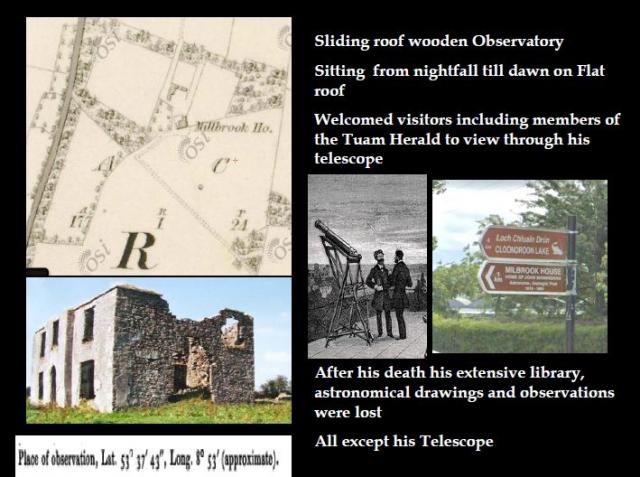
Thanks Bill, well not everything was destroyed or lost as we only recovered in the past week, most of his fine 18th century instruments were sold in an auction but in relation to his drawings and observations they were lost as mentioned in the following extract.
John left all his astronomical records and writings to Rev. Thomas Webb in Hereford, but Webb who died shortly after John handed them on to Rev. Thomas Espin. It was Espin who industriously completed John’s second edition of ‘The Red Stars’ which the Royal Irish Academy then published. When Espin, a bachelor, died in Co. Durham, angry local people set fire to the contents of his house, so all John’s material was destroyed.
Thanks
Ronan

John Birmingham (1816–1884) was an Irish Astronomer, amateur geologist, polymath and poet. In 1866 he discovered the recurrent nova T Coronae Borealis. He studied and wrote articles in various Astronomy European manuscripts at the time on Planets, Comets, Meteor showers (inc the 1866 Leonids), Aurorae, Sunspots and the 1882 Venus Transit. Some included in this summary.
The story of this astronomer is very interesting and what he achieved. There were other notable amateur astronomers in the West of Ireland at the time including Edward Cooper who owned the Markree Castle Observatory housing the largest reflector in the world, a huge 13.5 inch telescope in an open dome. Birmingham had to settle for 4.5 inch Cooke refractor and a wooden observatory which he used for his famous Red Star Catalogue with 658 of these objects included.
I have uploaded this very interesting the talk to youtube and split into three segments. The talk is presented by Paul Mohr, a now retired Professor from the Department of Geology at the National University of Ireland, Galway City.
The video is of very high quality and was recorded during the first Galway Astronomy Festival in 2004. They are here at https://www.youtube.com/user/KNOXVILLE2626/videos
Further Reading
http://articles.adsabs.harvard.edu/full/2004AntAs…1…23M
Thank you
Ronan Newman


David. Thanks for this image. It may not look that impressive but it is extraordinary that we are now able to discover and track objects like this which have come from interstellar space. I’m sure that the pros will be doing everything they can to get a spectrum of this object in the near future. I’ve not been around to image this yet but will try as soon as I get the opportunity. It is not often that you get the opportunity to image a chunk of ice from another star system with an amateur telescope.
I’ve been offered the opportunity to spend some nights at a telescope/observatory thats not often used by its owner. Its quite a large scope and is equatorially mounted using a “AWR Technology Intelligent Handset and Drive box goto, stepper motor system”. It sounds interesting but involves a substantial journey to reach.
Does anyone have a feel for what these drives were like? I’ve seen adverts before but I’ve not come across one before.
Long learning curve?
Hi Derek
Not all candidate supernovae turn out to be supernovae, for example they may turn out to be novae, Luminous Blue Variable outbursts or other cataclysmic variables in our own galaxy. A follow up spectrum is needed to establish exactly what type of object it is. (For example the redshift measurement can be used to confirm if it is extra-galactic and the width of the lines can be used to measure the velocity of the material flung out in the explosion which is much higher for supernovae.There are also different types of supernovae produced by different mechanisms, for example core collapse of massive stars or the thermo-nuclear explosion of a white dwarf following accretion of material from a companion. These different types of event have characteristic spectral features and are very different from what the spectrum would have been before the explosion.
An introductory paper on the subject is one by Filippenko here
https://ned.ipac.caltech.edu/level5/March03/Filippenko/frames.html
also brief but more up to date this blog entry
https://astrobites.org/2016/12/02/classifying-supernovae/
I have talked more about this and how I am using spectroscopy to confirm and classify supernovae spectroscopically in more detail in a few BAA meetings a couple of which were videoed
https://britastro.org/video/11250/12234
https://britastro.org/video/13862/14769
Also short more up to date piece on the Sky and Telescope website currently
https://www.skyandtelescope.com/astronomy-news/from-lunar-flashes-to-variable-stars-pro-am-astronomy-projects/
Cheers
Robin
Recently, I was reading a paper in the MNRAS and the author casually referred to pointing their telescope toward the Sun-Earth L5 point. Now, I imagine working out where that is in the sky involves offsetting from the antisolar point by a fixed (slightly varying as our orbit is elliptical) number of degrees along the ecliptic, with the L4 being on the other side of the antisolar point. I looked at The SkyX and some other bits of astronomical software I have knocking about (including AstroPy) but have found none that will tell you the RA/Dec of the L4/5 points from a given location at a given time.
Does anyone know – offhand – what that offset is for the Sun-Earth L4/5 please? Alternatively, can you point me at some software that would?
I can only imagine that finding the Earth-Moon Lagrange points must be much harder.
Well there is a telescope inside the new professionally constructed shed conversion to a roll off roof observatory.
Now I have 2 obo’s in my garden.
Obo no1 for Spectroscopy.
Obo no2 for visual observing.
From this.

To this.


A special thank you to Peter Carson for his advices and helping to set up the telescope.
Best regards and clear skies to all.
Jack
Essex UK
With considerable help from Martin Fowler I have added a guide to using the MicroObservatory Robotic Telescope Network to the Exoplanet website’s Project Page at https://britastro.org/node/18623
Have you downloaded the complete GCVS? If so a preliminary selection based on a minimum Dec, a plausible range of RA and a type of EA, EB, … will give you an initial range of candidates.
What do you consider high-cadence? Minutes, seconds or milliseconds?
My 0.4m telescope (located only about 100km from El Teide) could manage a very few millimags precision (unfiltered CCD, so approximately Gaia G band) down to mag 11.5 with a cadence of around a minute as demonstrated with an observation of an exoplanet transit.
In fact, why don’t you try for an exoplanet transit? Not only do you get your differential timing data, you also add to our knowedge of exoplanets. The minimum may be wide but the ingress and egress events are short-lived and it’s generally possible to observe both in a single session.
Would you like me to join in perhaps, weather permitting? It’s been unusually cloudy in these parts of late. I also need to get the new camera commissioned first but I hope that doesn’t take too long.
Send the query to the Antique Telescope Society at this link:
ADDRESS:
Antique Telescope Society
Walter H. Breyer, Secretary
1878 Robinson Road
Dahlonega, GA 30533
E-Mail:
whbreyer@gmail.com
or to:
Bart Fried
Hi Nick, I use Windows 10 professional which directly installed and MaxIm 6.14 and experience no difficulties in using it so far, though I may migrate to other telescope control software now.
Eric
Very good news. Sky and Tel, whose parent company is going through bankrupcy, has been bought by the AAS at auction for 1.225 million. I don’t think the outcome could have better for any of us who subscribe. Who know the AAS had a large pile of discretionary cash?
https://www.foliomag.com/fw-media-announces-winning-bidders-bankruptcy-auction/
https://www.foliomag.com/fw-media-announces-winning-bidders-bankruptcy-auction/?fbclid=IwAR3Nudvuy1hjn5G_4HGg-8S0PCViZxpFmDxFVjsSnuBWTYNjI_VcLgsUxuY

I have that book but it never occurred to me that the lunar maps were the ones under discussion. They are indeed beautiful and practical, not that I ever look at the moon through a telescope any more.
Added in edit: I forgot to mention that I have the French translation.
Hi Andrew I used a book called Moon Mars and Venus A concise guide in colourpublished by Hamlyn in 1978. It contains the Rukl map in small sections and is very easy to use at the telescope Attached is a one of the sections which I have scanned. It is available from Amazon as a used book for about £20
https://www.amazon.co.uk/Moon-Venus-Concise-Guides-Colour/dp/0600362191

Don’t know whether it is relevant, but I have a spare concrete pad in La Palma. It’s 4m square, around 20cm thick and has been used by a European university physics department as the site of a robotic telescope. Power and ethernet are laid on but there is no other infrastructure right now. A Google maps image is available at https://www.google.co.uk/maps/@28.6419037,-17.8677037,123m/data=!3m1!1e3 which shows the orange circle painted on the slab. To its left is Kevin Hills’ robotic observatory and to its right is mine.
What a great suggestion, Andrew!
The kit you describe would be very effective operating in remote telescope-mode.
The ODK 16 is a very multipurpose scope and you look to have focussing sorted out: stability of focus is an important factor in remote operation.
Am sure there are several BAA members who would be seriously interested in your proposal – I can’t speak for the Association but would be happy to discuss with you and others offline.
Clear skies,
Richard Miles
Yes. I usually use Polaris as my first alignment star as it – very obligingly – drifts only very slowly without sidereal tracking engaged. Plus, as Polaris is a double star, one can straightaway suss out the optical performance of the telescope and atmospheric conditions too before completing alignment and engaging tracking.
I obtained the following three results with the T5 telescope ( 250mm reflector) in New Mexico on 26 May. Using a 14.29 mag star as reference, AstroImageJ gives 15.55(V), 15.96(Red) and 15.48(Blue).
Stewart