-
Search Results
-
Hi everyone,
I’ve just recently joined the BAA …. Some brief personal background first, if i may … I’m 44 years of age now, and have been very interested in Astronomy since before i was 10. i’ve really wanted to be a member of the BAA for many years now, but have always held myself back from joining, just feeling that my level of expertise would not be sufficient to justify becoming a member of such a historical and eminent society …. Over the years i have been a member of the SPA a couple of times, which i have valued very much although i contributed very little towards in terms of observations. I certainly did consider renewing my SPA membership recently but have decided instead to take ‘the plunge’ and realise my dream of being a BAA member, the special introductory offer did help persuade me somewhat though, i must admit!
Now i have joined I’d really like to get involved in a section or two perhaps, and i just hoped for some helpful advice to guide me in the right direction please. My interests are fairly broad and general. I know my way around the sky with the naked eye fairly well, but i am a much less experienced telescope/binocular observer. I own a greatly underused ED80 f7.5 APO telescope, a pair of 8.5x 42 and 10x 50 binoculars, and a pair of 20x 80 binoculars also. Over the years I have lacked confidence with my ED80, but now that I’ve joined the BAA i am very determined to build this confidence! Given the equipment that i have stated above could anyone recommend appropriate sections please that I may consider joining, with a view to making (over time) reasonably serious observation contributions to? I have some very limited variable star observing expeience (many years ago, naked eye observations only), and I am certainly willing and happy to challenge myself further in that direction …. But i am very intersted to know and consider any other observing options that some of you may feel i may have with my scope and bins, and limited experience.
Looking forward to perhaps hearing from some of you at your convenience …..
All the best from Stonehaven!
Donald
Topic: filters
HI All,
i have just bought my first telescope (celestron 150) i would like to observe the eclipse in march can someone explain what filter/s i will need to do this safely
regards
stan wright (Newbee)
Attachments:
Examples of some of the brighter galaxies from Halton Arp’s “Atlas of Peculiar Galaxies” that Cherryvalley Observatory could image within its capabilities using an 8-inch SCT.
Best wishes & clear skies
Mike
David Herald of Australia has writen to the following message:
I have made a video of C/2013 A1 passing NGC362. The video is made from a series of 63 CCD images. The exposure was 3-secs for each image, with images being taken at 3-minute intervals from 13:50 to 17:00UT. The telescope was a 40cm SCT. Image size is about 12′ x 20′, with north to the top.The images show some fluctuation in brightness due to thin cirrus cloud and fog.
The brightest star in the image (at bottom left) is about mag 8. Almost all stars are fainter than magnitude 12.0, with the faintest well-defined stars being about magnitude 16.
The video may be viewed at:
http://youtu.be/LBBkgGK6-D8
Attachments:
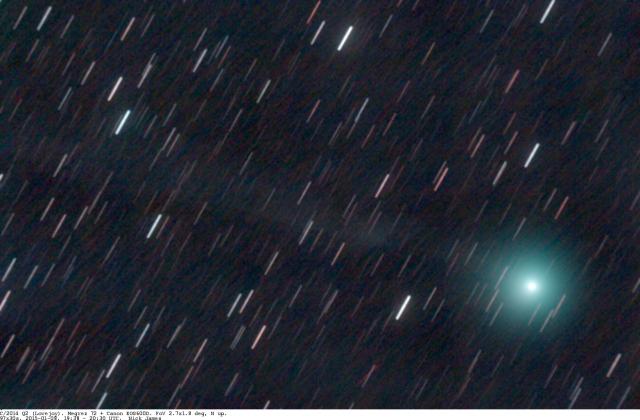
The discovery of a new comet on 2014 Aug 17.7 (designated C/2014Q2) by the Austrailian amateur astronomer Terry Lovejoy in Queensland using his own back garden equipment( C8 telescope with a f2.1 reducer, Vixen Sphinx mount and a QHY9 ccd camera)is an impressive feat. More so when considers the competion from large professional survey teams which is so intense. This discovery is not a one off lucky chance either. This is Terry’s 4th discovery in recent years. It is the result of many years of technique and computer programming development(his own software). No doubt he will discover more comets as he only 48 years old. So the days of comet discoveries by amateurs is far from over. In recent years we have seen comets discovered by Borisov,Elinen, Breunjes,Rinner, Jacques and Lovejoy.Perhaps we could also include Vitali Nevski and Artyom Novichonok who discovered C/2012S1 ISON. With the correct techniques, discoveries can still be made.However none of these recent discoveries have been made visually, perhaps(bar lucky circumstances)those days may be over.The prospect of a a visual discovery by means of a systematic nightly search is small. One other aspect of this discovery was the cooperative effort by other amateur astronomers around the world to obtain confirmatory and positional data on this new comet. When one looks at M.P.E.C. 2014-Q10 Issued 2014 Aug. 19, 19:42 UT the first positional data recorded are all by amateur stations thus: Observer details: I39 Observatorio Cruz del Sur, San Justo. Observer A. Chapman. 0.20-m f/4 reflector + CCD. Q80 Birkdale. Observer T. Lovejoy. 0.20-m f/2.1 Schmidt-Cassegrain + CCD. W95 Observatorio Panameno, San Pedro de Atacama. Observer A. Maury. Measurer J. Fabrega. W96 CAO, San Pedro de Atacama (since 2013). Observers A. Maury, J.-F. Soulier. Measurer J.-F. Soulier. 0.4-m f/8 Ritchey-Chretien + CCD. Y00 SONEAR Observatory, Oliveira. Observers C. Jacques, E. Pimentel, J. Barros. Measurer C. Jacques. 0.28-m f/2.2 astrograph + CCD. As soon as the discovery notice was placed on NEOCP these amateur stations were working hard to obtain the data which confimed the discovery and allowed an inital orbit to be computed by MPC. The drama of the night was relayed to me in an email to the BAA COmet discussion group by Tony Angel (a BAA observer in Spain) “I saw most of it the event unfold on the Comet Watch Facebook page. At about 0200 hours this morning Cristovao Jacques posted a notice from the MPC asking Terry if it was his. I checked the coordinates and noted that it would not be visible for me. A friend of mine Andres Chapman in Argentina posted that he would be able to observe the location and coordinated his observations with Terry which he did at 0835 UT, then Cristovao Jacques came through with his observations eight hours ago. Quite a nail biting experience.” So we have reason we rejoice that amateurs are still able to discover comets by their own efforts and innovation and that there is a very strong cooperative spirit amongst their compatriots abroad. well done Terry and all involved. Denis Buczynski secretary Comet Section BAA

Topic: Variable Nebula Update
This is my latest image of the variable nebula NGC6729 in Corona Australis. I used the newly installed 0.7m (27 inch) telescope at Siding Spring, Australia which is part of the iTelescope.net network (http://www.itelescope.net/) to get my most detailed image yet.
I only started to image this nebula in early 2013 when I began using remote telescopes. But even over this short time the nebula has changed appearance significantly (see links below). All my recent images of the six known variable nebulae are held on the Orwell Astronomical Society web site. Images up to the end of 2013 are at: http://www.oasi.org.uk/Obsvns/20140101_VN/20140101_VN.shtml and all those from the start of 2014 are on the web site forum: http://forum.oasi.org.uk/viewforum.php?f=6&sid=985263be0bcc7b2ed8ba05a7a8c773a5
Mike Harlow.

Attachments:

British Astronomical Association
Supporting amateur astronomers since 1890