Forum Replies Created
-
AuthorPosts
-
18 October 2026 at 10:41 am in reply to: Use of night vision devices (NVDs) for visual observing #643442
 Andy WilsonKeymaster
Hi Joel,
It is interesting to hear of your experience using a night vision device. It is not something I have been able to try, but it sounds fascinating. I can imagine the thrill of the details you can see at the scope. In my opinion there are lots of different ways to do astronomy, all of them valid.
Best wishes,
AndyAndy WilsonKeymasterThat is a great result Lars. Thank you for sharing it.
AndyAndy WilsonKeymasterTo avoid any misunderstanding, I am very pleased to hear ZWO have done this. I hope they have done it in a way that is applicable to general scientific research projects, meaning the results can be added to the BAA VSS database. If not then it still provides an excellent introduction to photometry and it will be useful as a science education tool.
ZWO may be following an existing standard, or they may be trying to do something different, we simply don’t know at this time. Several members already submit Seestar photometry to the BAA VSS database using results from the green filter pixels calibrated with V-band comparison magnitudes (either from a V-band survey or Gaia G transformed to V). This follows standards developed for DSLRs and other colour cameras. Thanks to Steve’s investigations it seems ZWO may be doing something different, possibly a kind of G-band approximation. This could be fine, but we need to know what it is to record it in the database. A new filter might need to be added to the database if they are combining all 3 filters in a ‘white light’ G approximation, something like “WG – combined tricolour RGB with Gaia G comparison magnitudes”.
There is the separate issue of whether the software checks for saturated stars and whether the stars remain within the linear range of the chip pixels. If not then that is something observers need to be aware of with an easy way for them to check this for themselves.
Best wishes,
Andy-
This reply was modified 17 hours, 19 minutes ago by
 Andy Wilson.
Andy WilsonKeymasterInteresting. This has great potential, though to understand whether the results can be used for scientific analysis and for example contribute to the VSS database, I hope they publish information about how it is doing the photometry. Things like does it check for saturation and keep the counts within the linear response region of the chip, is it using the green channel to approximate V, what comparison star magnitudes are being used and how are the comparison stars chosen. Without this it is still a fantastic innovation and could get more people into variable star observing.
Andy (BAA VSS Database Secretary)Andy WilsonKeymasterThere is a perception problem with “amateur” as it is casually used to describe someone who is not very good at a task. Whereas the distinction between amateur and professional astronomers is about whether or not you are paid. Each can be a skilled observer or theorist.
I straddle both camps as I am currently a professional astronomer, though I have been an ‘amateur’ for 40 years and I still do ‘amateur’ astronomy (things for fun that I am not paid to do). While not all professional astronomers are aware of the BAA, I know of professional astronomers who are or were members and the Association has an excellent reputation.
I would add that most professional astronomers do it because they are interested in the subject and enjoy it. You can usually earn more by going into industry rather than staying in astronomy and the work tends to be more reliable.
I agree it is rare for a professional astronomer to look through a telescope. However, to get time on a telescope detailed proposals have to be written which may be approved or rejected. Writing these proposals involves detailed knowledge of the object being studied along with the physics of how the observation will be made. While there is a real buzz when observations you have requested arrive, and occasionally you may visit the observatory, it is not quite the same as looking through an eyepiece or casually deciding what to image that night.
Andy WilsonKeymasterThank you Jeremy.
It is great to have this paper accepted for publication in the Monthly Notices of the RAS. I began work on this 10 years ago, at the start of my PhD, but I got side tracked by other project work. The skills I gained by doing photometry and spectroscopy with the BAA Variable Star Section were really useful background.
The surprising result is how spotted these young stars are, with around 30-75% of their surfaces covered in cool spots like sunspots, and maybe even higher coverages. Our result is not unique, with other researchers finding similar spot coverages. These are very young stars, around 3-4 million years old. At this age they are not yet fusing hydrogen in their cores, instead they are largely powered by gravitational collapse.
Andy
Andy WilsonKeymasterWhen I setup my observatory I did the following to align my equatorial mount on the pole.
I started with a rough alignment, which from the sounds of it you have already done. For azimuth, I found out when the Sun would be due south and then aligned the mount shadow by eye. For altitude I used the crude scale on the mount.
I then performed drift polar alignment to get the alignment more precise. This works best with an illuminated reticle eyepiece or digital camera. Depending how accurately you need the alignment, you watch how a star drifts in a couple of different locations on the sky over 1 to 5 minutes. Here are a couple of links to the technique.
https://explorescientific.com/pages/polar-alignment-using-the-drift-method
https://www.skymtn.com/mapug-astronomy/ccdastro/drift-align.htm
In my experience this simple technique works really well. One point to note, it is easy to get mixed up about which direction the mount needs shifting, so I keep a careful watch as to whether my adjustments decrease or increase the speed of the drift. I first used the technique with a portable setup, and after some practice I could get very accurate alignment within 20-30 minutes.
Andy WilsonKeymasterHi Connor,
There are also longer term changes to older nearby supernova remnants that are studied.
The best example is M1 the Crab Nebula. This was created by a supernova in our galaxy in 1054. Images taken over several decades reveal the expansion of the nebula.
There is also the more recent supernova 1987A in the Large Magellanic Cloud. A bright ring of material that was ejected prior to the supernova was illuminated by the explosion. Though professional observatories are needed to observe it.
Andy
Andy WilsonKeymasterHi Connor,
Supernova are too distant for any change in their distance or location to be measured. Though monitoring the changing brightness and spectra of brighter supernova is frequently done by members of the BAA Variable Star Section.
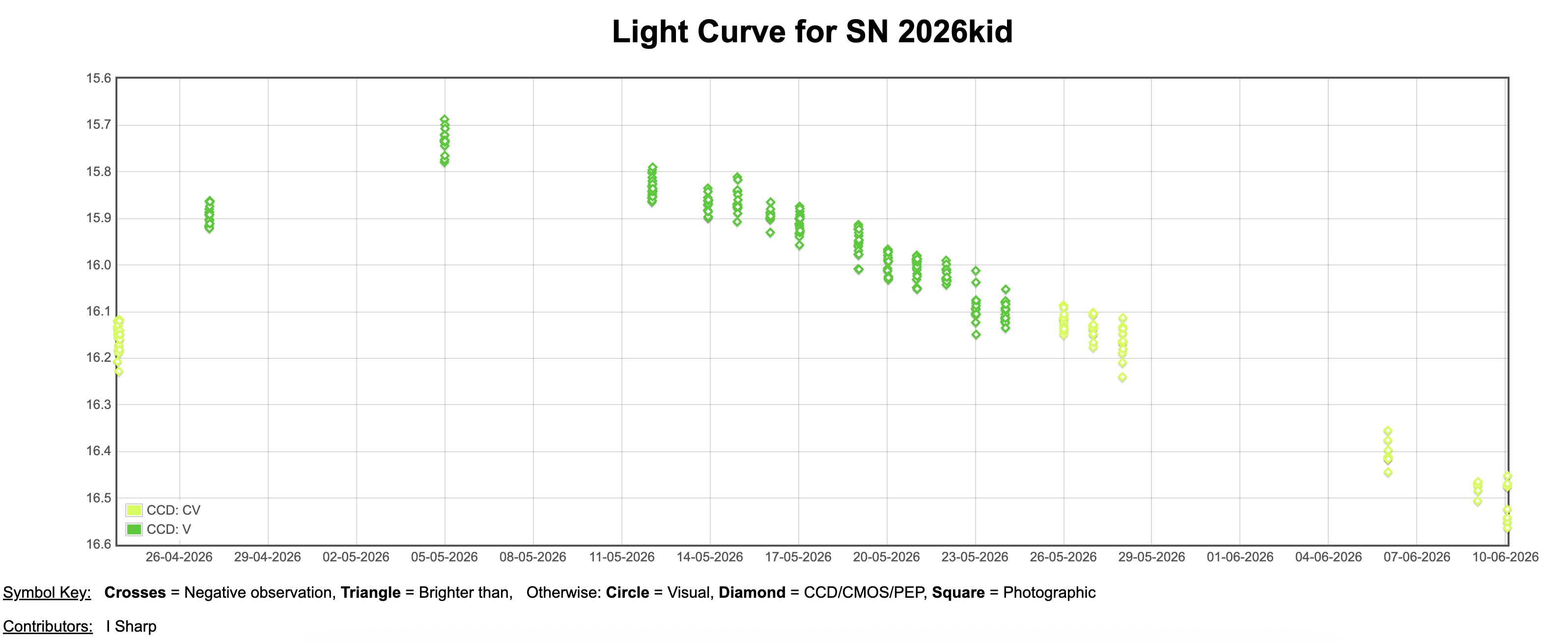
I attach a plot from the BAA Photometry Database of SN 2026kid, photometry again by Ian Sharp.
Robin Leadbeater is an expert at obtaining spectra of supernova. This is tough for amateurs as supernova are faint and typically require large telescope to obtain usable spectra. Here are a couple of spectra from the BAA Spectroscopy Database of SN 2026kid by Robin.
https://britastro.org/specdb/data_graph.php?obs_id=20917%2C20670&multi=yes&mix_flux=no&plot=Plot+up+to+20+SpectraCheers,
Andy-
This reply was modified 1 month ago by Andy Wilson.
-
This reply was modified 1 month ago by Andy Wilson.
Attachments:
Andy WilsonKeymasterHi Neil,
Great to hear you are also doing spectroscopy. I too spent about a year practicing and refining my technique before I felt confident to contribute to databases.
There aren’t any formal BAA spectroscopy campaigns. A lot of the spectroscopy is connected to the Variable Star Section, in particular where targets of opportunities such as Nova and occasionally supernova are within reach of member’s equipment and location. Other variable stars can also be interesting to follow spectroscopically. Currently there are three interesting novas, a couple of which might be within your reach depending on your setup. I give very approximate V mags at the start of September 2026.
N Sge 2026 (V488 Sge) ~10V
N Tau 2026 (V1452 Tau) ~11V
N Aql 2026 (V2104 Aql) ~16V
Variable stars are not the only targets, with bright comets another frequent target when they come along. Nebulae and galaxies are also observed.
When it comes to submitting your spectra, here is a link to the page that explains the requirements.
https://britastro.org/specdb/submission_requirements.htm
Everyone submits at least one sample spectrum in the format detailed on the page. Depending on their availability, we may have experienced spectroscopists able to assist you if any parts of the spectrum reduction process are proving problematic.
Kind regards,
Andy Wilson (BAA Spectroscopy Database Manager)-
This reply was modified 1 month, 2 weeks ago by Andy Wilson.
-
This reply was modified 1 month, 2 weeks ago by Andy Wilson.
Andy WilsonKeymastermight catch out people who don’t stay logged in all the time, like me.
You can stay logged in ?? How do you do that ? (I have never been able to stay logged in, a source of annoyance)
Cheers
RobinI only restart my MacBook every week or two and I sometimes stay logged in. I’ve not tested what happens if I shut down my Windows computer while logged in to the BAA website, but I would not be surprised if that logs me out.
Cheers,
Andy-
This reply was modified 1 month, 2 weeks ago by Andy Wilson.
Andy WilsonKeymasterWelcome to the BAA Connor!
As mentioned by Jeremy, joining one or more Observing Sections is a really great way to get more from your membership. Sections allow you to get to know people with similar interests, whether you are just starting out or very experienced.Andy WilsonKeymasterSonia,
Welcome to your role as the Section Director of the Equipment and Techniques Section.
Best wishes,
AndyAndy WilsonKeymasterHi Sonia,
That is an amazing rainbow! In case you have not found it, there is a BAA Gallery where members can share their pictures. It is a little hidden away under the Observations menu or the ‘Explore’ icon on the homepage.
https://britastro.org/observations/
Best wishes,
AndyAndy WilsonKeymasterAs posts too all the different forums appear in a single list on the front page of the BAA website, I unfortunately doubt that posting to another BAA forum would gain any extra responses.
I have not been doing active spectroscopy with my LHIRES III for a little while, though I used PHD2. I found it very easy and user friendly. It did need a little setup and tweaking, but no more than other software. I would set it up and try it out. Different people prefer different software, so I think it depends on what you find works best for you.
Best wishes,
AndyAndy WilsonKeymasterHi John,
If you are combining errors/uncertainties from individual images then you also need to divide by the square root of the number of images.
A useful check is to calculate the standard deviation on the magnitudes derived from the individual images. This won’t be identical but should not be vastly different. The standard deviation with give you a direct estimate of the random error, and large differences could indicate systematics that are over or under estimated in the formula used to calculate the individual magnitude uncertainties.
Best wishes,
Andy-
This reply was modified 4 months ago by Andy Wilson.
Andy WilsonKeymasterHi John,
In theory stacking the frames or combining the photometric measurements should give similar results as you have found.
With short exposures of 10 seconds, you need to be careful of atmospheric seeing. You might see changes due to atmospheric turbulence from frame to frame.
One option would be to slightly defocus the camera. This will spread the light over more pixels and lower the peak, so you should be able to expose for longer. Obviously you need to avoid blending the light from nearby stars, so you only want a slight defocus.
AndyAndy WilsonKeymasterHi Paul,
Welcome to the BAA!
If you are an active observer, then may I recommend joining one or more of the Observing Sections. You don’t need to be highly skilled to contribute. The Sections will help you to develop your skills and are a great way to get to know other members.
Best wishes,
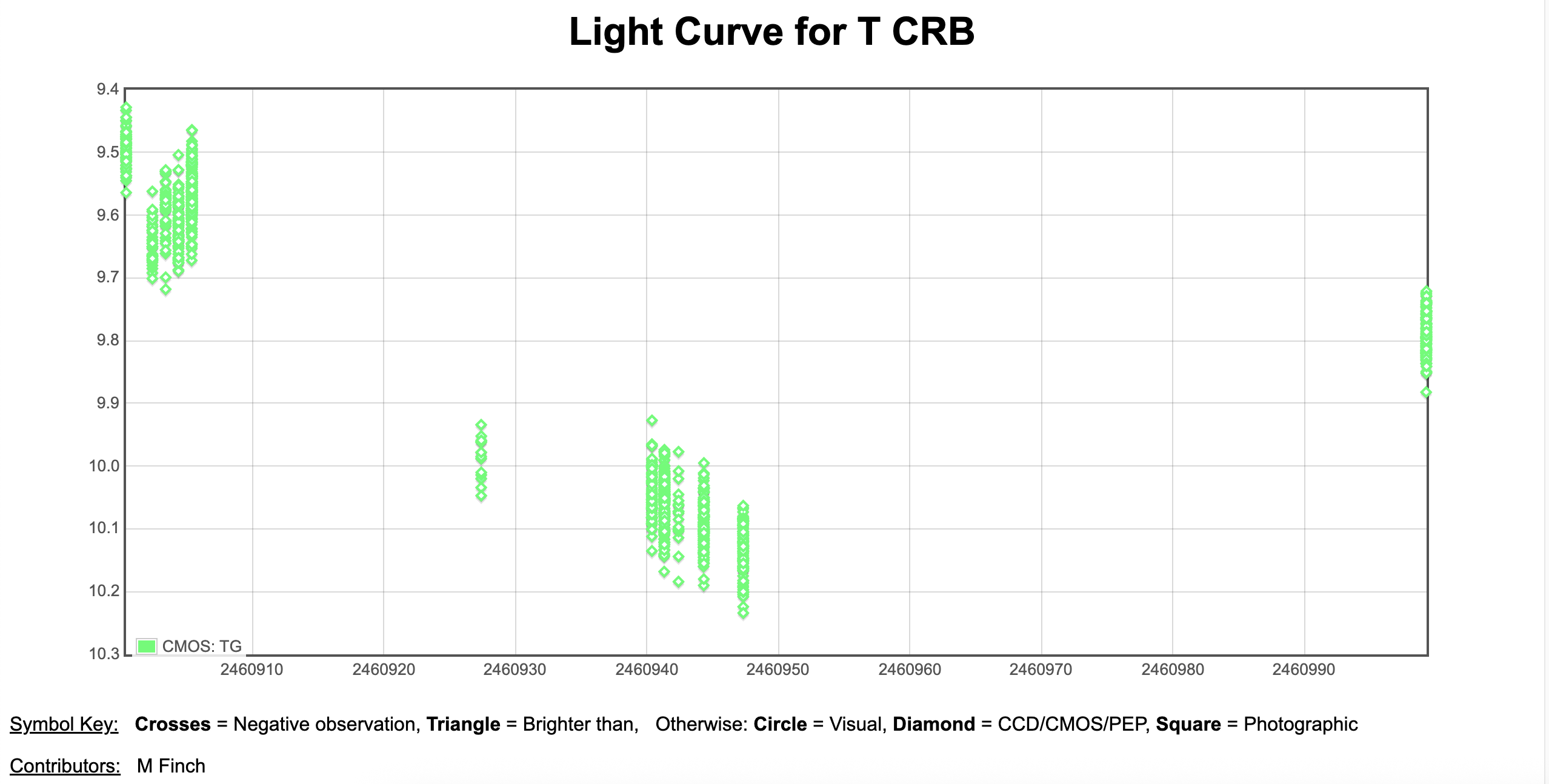
AndyAndy WilsonKeymasterI am adding to this thread after hearing from Matthew Finch, whose light curve from the BAA VSS Photometry database I showed above. Matthew has seen a significant increase in scatter of his Seestar photometry since late 2025.
Andy WilsonKeymasterHi Steve,
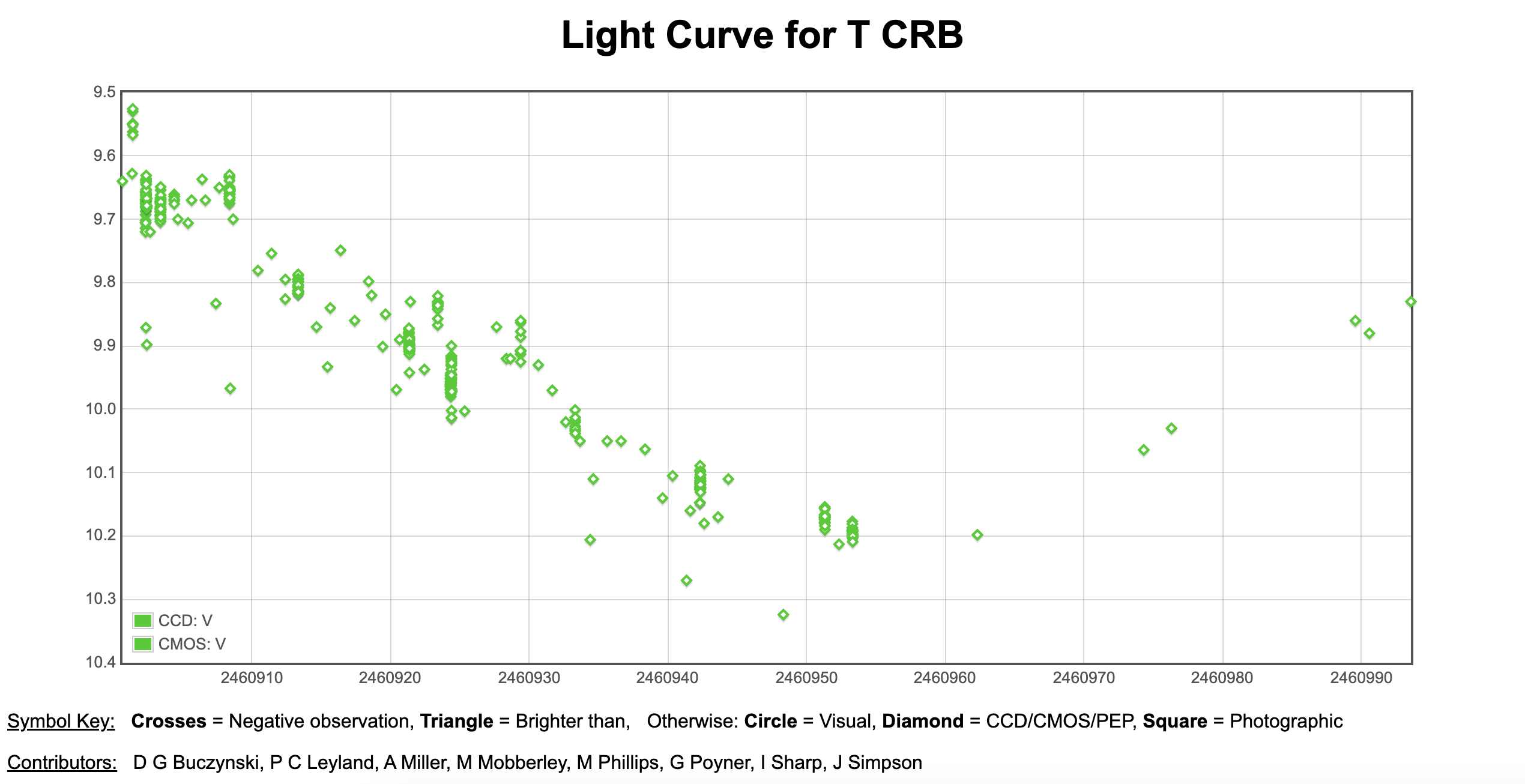
I will see if I can put you in touch with other BAA members who are using Seestars for photometry. I have taken a quick look at the VSS Photometry Database. Matthew Finch has Seestar observations of T CrB and they not showing the same large scatter as yours, though with less time coverage than your data. The attached plots for the shorter time period from August to November 2025. First showing Matthew’s Seestar data and the second with all the V data in the database as it is better at showing the trend.
Best wishes,
Andy-
This reply was modified 5 months, 1 week ago by Andy Wilson.
Attachments:
-
This reply was modified 17 hours, 19 minutes ago by
-
AuthorPosts