Hi Jack, I have not done this with a Lhires III but I did try it with a LIAS. I used a 1:1 transfer lens(two doublets) to project the exit beam from a 50 micron fibre on to the entrance of the LISA with the slit removed. It worked fine but you get a 50 micron slit.
I had an F5.4 telescope which matched the F5 LISA even if the fibre reduced the focal ratio to about F4.5
This will be the issue with the Lhires III. It is designed for F10 so if you use a 50 micron fibre you will have a large “slit”
If you feed it at F10 you will get an F5-6 exit beam and so light loss. You could match the F ratios using transfer lenses but this will increase the size of the “slit” or vice versa. You could retain the slit but then you will get more light loss.
Hope this helps.
Regards Andrew
Hi Jack – forgot to say at the telescope end I use a Shelyak fibre injection unit. I think this is the most difficult bit to make with fibre fed spectrographs and well beyond my diy capabilities.
Regards Andrew
Has anyone been able to get spectra via a fibre optic cable between the Lhires III and telescope, if so how ?
Regards,
Jack
Essex UK
Only just learnt of this very sad news. I got to know Maurice back in the 80’s, during the infancy of astronomical computing on the ‘home micro’. He was editor and contributor to APEX which had been set up primarily for the publication and exchange of computer programs of an astronomical nature, including ephemerides, telescope optics, and astronomical photography. I believe he was also co-founder of the group too. Many of you might remember his paperback, ZX Spectrum Astronomy, of which I still have my copy, and signed by him too. For one reason and another, it was during this period, the second half of the eighties, that I got to know Maurice. There after we would often have a good chat at various astronomical meetings if we both happened to attend. Sadly, in recent years, I lost touch with Maurice, and despite attending more BAA meetings, I didn’t have the good fortune of seeing him. So this news come with great sadness for me. Maurice was a genuinely nice chap, and always willing to help the beginner. He will be very much missed. R I P Maurice
The discovery of the ‘victory star’ as it was called at the time was credited to Warren Curdworth of Norwood, Mass USA. Not because he was the first to see it, but because he was the first to report it (to Harvard).
Apart from Bower, Michelle Luizet of Lyon observatory France observed it at 08.40 GMAT on June 8.
There is also a story of a Cornish fisherman seeing the Nova a whole day before anyone else, but upon reporting it to Greenwich his account was dismissed as he was a non astronomer (who might know the night sky better than a fisherman?) I remember reading the account in I think Philosophical Transactions many years ago, but despite re-checking can no longer find it. Perhaps I am mistaken with the publication I first encountered this story, but if anyone knows about it I would very interested in where it was published!
The Nova attracted the imagination of the public, and the attached satirical cartoon appeared in ‘Punch’ on June 19, 1918.

Some of us still observe the Nova, myself included. It can be seen varying slightly between magnitudes 11 and 12, but doesn’t do anything spectacular these days. It is interesting though to consider the turbulant times in which the Nova first appeared when ‘looking’ at it through a telescope!
Gary
It’s certainly been a very grim 12 months indeed for the BAA, with the loss of so many fine observers, telescope makers and others. If I recall correctly Maurice was the first UK observer (around 1989/1990) to seriously use SBIG’s tiny ST4 autoguider CCD for imaging, despite its microscopic dimensions. This was in the era when a hard disk stored 30 Megabytes! How Maurice positioned the target onto the chip was a mystery! Pic attached of Tom, Guy, Nick H., me and Maurice at the Winchester Weekend on April 3rd 2004. Taken with my camera. Button pressed by Pete Seiden.
Martin
Hello Bill
Thank you for your answer.
I guess the lava flooding in Imbrium would have been a great sight, seen ”live” in a telescope from the Earth.
Lars
Hello Lars,
Thank you for your careful and very thoughtful reading of my book. You raise some very good questions! Of course, contemporary lunar science cannot yet produce definitive answers for everything, but the case for how the lunar maria were formed is pretty convincing. This is probably not the place to go into lengthy detail, but I can certainly try to address some of your questions.
We should bear in mind that the recent Hawaiian eruptions and lava flows were on a microscopic scale compared with the events that created the lunar maria. The enormous energies released in the impacts that created the huge basins at the sites of subsequent mare development would have compressed, shattered, melted and fractured the lunar crust at the impact site. Such a compromised site would have provided a preferential route for the subsequent eruption and flow of magma on to the surface, magma that had been kept molten by the effects of churning in the interior magma ocean and the decay of radioactive elements.
As Wood says, once vented onto the surface the lavas would indeed have flowed relative easily over great distances, being much less viscous than lavas on Earth (the Moon as a whole is made up of less dense material). Also the larger maria at least would have been formed not in one go, but by successive lava flows. This is obvious in the Mare Serenitatis, where the flows of different lavas are obvious even to the eye at the telescope and appear as different colours and shades.
This would all have gone on until the Moon had cooled sufficiently to prevent the eruption of lavas on such a huge scale, (although smaller forms of volcanic activity continued long afterwards).
Thank you again for your interest!
Bill
Hello,
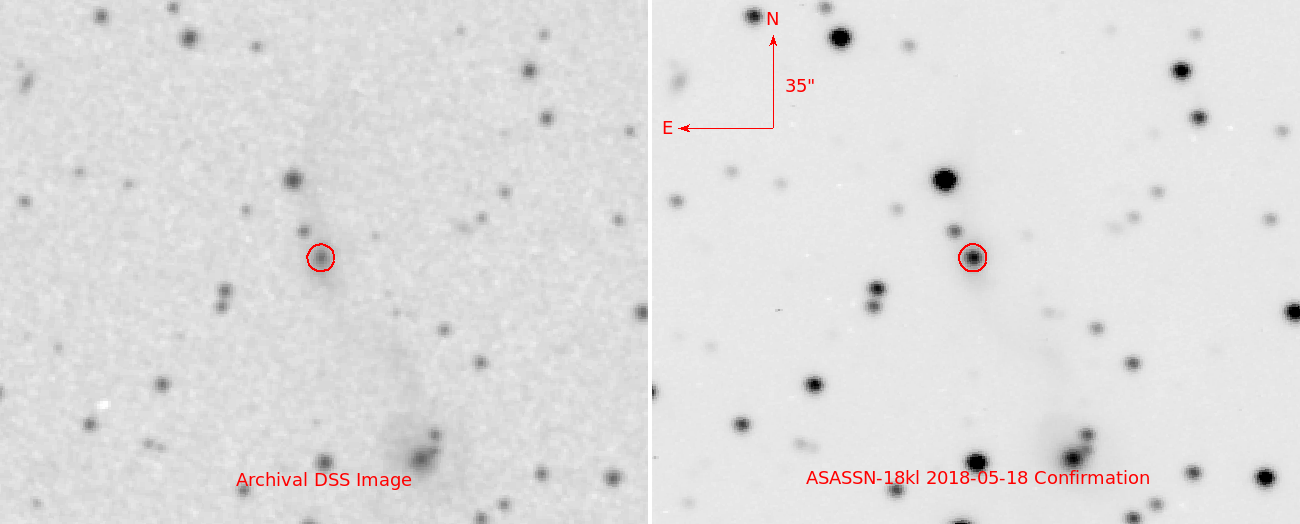
Occasionally I download and filter a list of recent transients taken from tns-weizmann – to find something interesting to look at.
I imaged 2018bsr last night – perhaps a type IA SN a week to two weeks before maximum (spectrum with Liverpool telescope) – and don’t see any brightening of the galactic host (it is not a significant distance from the centre). I note the discovery mag is low.
Can anyone make sense of all the available information – and put forward a likely identity?
https://wis-tns.weizmann.ac.il/object/2018bsr
http://www.astronomy.ohio-state.edu/~assassin/followup/asassn-18kl.png
Vmag of host 16.3 UCAC4 via Vizier.
My FITS: https://1drv.ms/u/s!Agvxu8wNOxpAc6vj_rFUjsIKm-E
David
Ian,
Welcome.
Yes, there is a lot to get your head around.
I would advise finding a local society to get involved with. They probably hold regular meetings and star gazing events. If you email me your nearest city I can have a look online and see what groups are near by.
I wouldn’t rush to make any decisions about buying equipment or deciding what sort of amateur astronomer you are. Go with the flow as they say.
There are plenty of books to read and magazines and forums [fora].
Learning your way around your own night sky is a great place to start with practical astronomy. The major constellations, and any visible planets. A bog standard pair of binoculars are useful for looking at some of the brighter targets in the sky, such as globular clusters and open clusters and the Andromeda Galaxy. Binoculars are also useful for getting a closer look at the Moon.
If there is a meteor shower coming up, that is always fun to observe, ideally on a sun lounger in a sleeping bag or two!
If you are hands on and like tinkering with either mechanical things or electronics there is so much tinkering to be done with equipment and the like, and again lots of fascinating stuff to read. Or maybe you are so hands on you’d like to build your own telescope.
I enjoy reading. I don’t enjoy getting cold. I have various telescopes but I don’t have a permanent set up, so I don’t use them as often as I should. Many believe an observatory isn’t a luxury for an amateur astronomer, it is an essential tool. I like imaging the planets and the Moon, and showing non-astronomers things through the telescope like planetary nebula or globular clusters. I’m also interested in the history of astronomy, and like reading about the goings on several hundred years ago, as well as from the 19th and 20th centuries.
The BAA Journal has some fascinating content and as a BAA member you can look through past copies of the BAA Journal on the website. The Journal also contains sky notes to help you learn more about the night sky. The members pages are great for looking at things others are up to, and if there are things you want to know more about you can either leave a note on peoples observations, or start a thread on the forum.
It will be very exciting for you.
Welcome and enjoy.
James
Finally, a clear sky. And a nova.
I saw V392 visually using a 24mm Panoptic in my Celestron C9.25. FOV 0.69, magnification x97. From Teggs Nose Country Park
The Nova was very easy to see next to 93 Per. I thought N392 looked reddish to my eye’s.
To confirm I had indeed found it. I compared the eyepiece view with a picture on the Sky and Telescope website.
Macclesfield AS held a public star party last night. And we were fortunate to have this nova on view. A lot of people asked the same question. What is a nova?
I was able to explain to the best of my knowledge what it was.
Thats interesting. As my previous problem had been using a USB sound sampler on a shared port, I thought I should check again.
So, I was out last night using a USB GPS dongle and NMEATIME2 to set my system clock to <0.005s accuracy, controlling a telescope from TheSkyX (which uses a USB to Serial converter to talk to a Paramount) and a Starlight camera via a USB socket.
The laptop I used was a Dell E4310 (Intel i5 at 2.4GHz with 4GB memory) which only has 2 USB sockets.
I noticed that when anything was sharing a socket with the dongle, the NMEATIME2 correction timings became erratic – it assumes GPS fixes from the receiver are evenly spaced I think. So, when I connected the telescope or when sharing with the CCD my timing precision was potentially off as the attached image demonstrates (the sharp change in the trace is when I connected the telescope). Not surprising I suppose, but the timesharing aspect clearly does have some an effect on other bus users. I imagine the impact will depend upon the nature of whats sharing the port and what laptop manufacturer/model you choose.
I will try again tonight if (wonder of wonders) we get two clear nights in a row using a Dell D630 which has 4 USB ports and post the results here. Alas, I only have Dell laptops and so cannot say how this pans out with other machines.
I now have a permanent site in southern Spain (near Albox) with an excellent view to the south and clear, dark skies together with plenty of equipment. My problem is the lack of an observatory. I want a roll-off roof shed but I do not want to build it myself. Ideally I want an automated roof.
(I have spent some years renting properties down there using telescope covers. The last time I was there I had 3 telescopes under cover and there was a terrific storm. I went out to check and all three covers had disappeared – the wind had snapped 3 bungee cords holding down each cover! I managed to find two covers – the third was never seen again!)
I know of one UK company that does supply observatory sheds to Europe but the cost can be very high.
Does anyone know of a Spanish source for observatory sheds?
Thank you in advance for any comments/suggestions.
Len Adam
On Monday morning of 16th, April,2018. I happened to watch on the BBC an edition of “Heir Hunters” for which one of the subjects was the late BAA member Roy Panther, comet discoverer. There was, by his neighbour, some mention of his interest in astronomy and that he had built his own telescope. However, sadly, there was no mention what-so-ever of his discovery of a comet.
Eric
Thank you gentlemen,,,, you both make a good point. I will not dispute my son’s decision to buy the Celestron. I need portability because I /we plan on travelling to locations on the other side of the mountains to areas where the skies are amazing and very dark. I live in Washington Sate in the US, And there are some really good observing sites.
I will admit to being skeptical due to the decisions I have made in the past. I didn’t want to admit that the telescope was NOT really good quality… I was being cheap and miserly lol. This time I plan on being more careful about quality. I am referring to the eyepieces I will purchase as accessories. My son plans on buying the Celestron and I must try and bury my past skepticism, as well as lack of knowledge and patience.
Ian
Hello Ian,
An 8-inch aperture will certainly outperform a 5-inch, on the planets or anything else. However, aperture is only one consideration. When I first started observing I could not see much fine detail on the planets, even with 8.5-inch and larger apertures. When I moved up to a 14-inch I still could not see the kind of details sketched by Paul Doherty et. al. So, I switched to photography. After a few more years experience I realised that the eye and brain become trained to see finer detail the more you observe. Then I realised how crucial accurate
collimation was. I also realised that the planets rarely look really good unless you observe a lot and catch the good seeing. Observing planets on a laptop screen, when imaging, is a revelation. The details distort every sixtieth of a second with the limb jittering by arcseconds! Then, on maybe 1 night in 20, planets look like a Damian Peach image, when the jetstream is absent and the weather is misty, or even foggy! However, unless the telescope has cooled to the night air and is precisely collimated you still won’t get great views. Moving up from a 5-inch to an 8-inch will not automatically give you good planetary views. So much depends on the state of our atmosphere and how often you observe. On this latter point some sort of user-friendly observatory, that can be set up in minutes, will make you observe 10 times more often, because you can just ‘nip out’ and check the seeing. For planets you do not need a computer control. Despite the hype, low-cost computer controlled telescopes can be more hassle than you need. Planets are easy to find, so a low-hassle Dobsonian is all that is needed… No need for star-alignment, cables and pressing buttons…just push the Dob and look through the finder….
Deep Sky objects are obviously easier to find with ‘Go To’, but star-hopping is simple for the brightest objects.
So, to summarise, moving up to an 8-inch will not give you spectacular planetary views unless you observe a lot, train your eyes and brain, and keep the telescope collimated and cooled to the night air. The bigger the better though, so it may be worth thinking about a Dob. You can get a 12-inch Skywatcher Go To Dob for the same price as a Celestron 8SE, but you’d want to build a small run-off shed to house it, or put it on wheels. Deep Sky objects would look far brighter in a 12-inch! One final thought….Mars, Jupiter and Saturn are horribly low down at the moment so whatever telescope you get you have a long wait until they are nice and high again.
And the best views are usually obtained when planets are high up.
Martin
Hey everyone,
Until a year ago I was using a 5″ refractor, and it was OLD school. Nothing wrong with that but I had to give up on it because I just could NOT understand RA and declination.
However one of the main disappointments was that I bought the telescope thinking that I could a really clear view of the planets… particularly Mars Jupiter and Saturn. However the refractor turned out to be a major disappointment in that area as well. To look at the moon with my a 21mm wide field eyepiece… yes it was astonishing. But it does not take much more than a 20×80 pair of binoculars to get a really good look at the detail of our amazing celestial neighbor.
MY point now.. is that for a retirement present my son wants to buy for me, the Celestron Nexstar SE8…. the famous classic Schmidt Cass telescope, introduced with the well known orange optical tube.
Now I am nervous! As much as I am stunned by his generosity, I have reservations about him wasting his money with once again very mediocre and generally disappointing images of my favorite subjects.
I know that aperture equals light gathering power, but I need some assurance that this telescope will outperform the 5 inch refractor… not only for viewing the planets, but in viewing deep sky. I would like to resolve double stars as well. These areas of astronomy have also caught my attention in the year before my retirement and particularly now that I am retired.
The telescope is computer controlled, but that does not intimidate me at all. What DOES concern me is what I mentioned before. I don’t want my boy to waste money if this telescope cannot meet my expectations. In my mind and heart I know that this would be an excellent decision, but in the light of constant disappointment with past experiences, I would appreciate some input from anyone of you folks who can assure me that this decision will be the productive experience I am hoping that it will be.
Ian
Ian – I see the manual states:
Using the included NexRemote software you can control your NexStar telescope with a computer via the RS-232 port located on the computerized hand control and using the RS-232 cable . For information about using NexRemote to control your telescope, refer to the help files located on the disk. In addition to NexRemote, the telescope can be controlled using other popular astronomy software programs.
And Megastar is compatible with the following scopes:
- Meade LX2000, AstroPhysics GTO, Celestron NexStar 5/8/GT/GPS, Sky Commander, NGC-MAX, Sky Wizard, Sky Vector, Advanced AstroMaster, BBox, MicroGuider III, Mel Bartels and RXDesign ServoCAT.
So it should definitely work. Make sure you use the correct driver for the scope and it looks like it all works via ASCOM.
Hello folks,
Just a quick question.
My son has VERY generously indicated he is buying me a retirement present… that being the classic Celestron 8 SE in the Nexstar series of telescopes.
My question is…. I have Megastar V5 on my laptop. Can you tell me if that software will communicate, AKA control the telescope? Do I have to get an accessory to attach to the scope???
I appreciate any suggestions/help in advance
Ian
Very good paper ;). The authors state that the very high apparent magnitude of the host star (-27) precluded further studies of the host star and planet with their telescope. I aim to follow up the authors’ work with my own observations of this mystery planet as it comes to opposition, even though its southerly declination will be a problem.