Search Results for 'espin telescope'

› Forums › Search › Search Results for 'espin telescope'

Viewing 20 results - 741 through 760 (of 1,113 total)
  • Author
    Search Results
  • #579991

    In reply to: Transient location

    David Swan
    Participant

    I have re-stacked with more stringent quality criteria (FWHM and roundness). The noise is higher, but the stars look more round. Problem sorted I think! I’ve looked back at my determinations of transient locations, and the difference from the survey telescope position in this case isn’t unusual. Experimenting with the fit order doesn’t really change the measured position either.

    #579938
    Martin Mobberley
    Participant

    Hello James,

    >If anyone can recommend another telescope <

    A Sky-Watcher Explorer 130P-DS OTA might be worth considering. They get good reviews and at £169 (FLO price) it’s not a financial disaster if things don’t work out…..

    Regards,

    Martin

    #579931
    James Screech
    Participant

    If anyone can recommend another telescope for photometry with an ASI1600MM-C camera (3.8um pixels) ideally with all the required accessories (excluding mount) totaling less than £1000, though I might be able to go up a little more. I would prefer something with a focal length of 800mm or less to give me a wide field for selecting comparison stars. It will also need to get to fainter stars than my current 70mm f6 scope without needing longer exposures. Also it needs to be light enough for an AVX mount.

    I’m considering the C6 + Hyperstar, Bresser AR102XS/460, StarTravel 120 (with upgraded focuser) & 150mm f5 Newtonian.

    James

    #579911
    Callum Potter
    Keymaster

    Hi Xiaoli,

    M64 sits in the constellation Coma Berenices, which is a bit low in the sky setting in the west at sunset, so is pretty much un-observable at the moment, and I think that remote robotic telescopes in the northern hemisphere won’t allow you to observe that low.

    Really it is a Spring constellation, though might come into view for imaging Feb onwards, depending on the telescope location.

    If you are at school, you could try to get them to get you access to the Faulkes Telescopes, which have some nice big robotic telescopes.

    There are a lot of galaxies available at the moment, so you might need to pick a different one depending on your project needs.

    Best regards,
    Callum

    #579905

    In reply to: Will I ever get there?

    << And  that would  be focusing on the  history of  astronomy….

    Nothing wrong with the history of astronomy!

    I own a telescope, but I tend to use binoculars, simply for convenience and ease of use. I have a small pair for general use and sky browsing, and some “big buggers” which get wheeled out for total eclipses (totality only!) and other short-duration events. I’m not a dedicated observer and binoculars work for me.

    I hope you’ll be able to come along to some historical section meetings (usually held late spring). Are you on our historical section mailing list? If not, send me your email address and we’ll send the section newsletter twice a year. 

    Mike Frost, Historical Section Director

    #579900

    In reply to: Will I ever get there?

    Ian Kahler
    Participant

    Well guys, I have given my commentary/opinion a great deal of  thought the  last 2 days. I have  decided to give my telescopes to the  physics  & astronomy dept. at the  local university. I am going to remain focused  on what I like  doing best. And  that would  be focusing on the  history of  astronomy…. the  people behind  the  discoveries, the  geology of  the  solar system and  so on. I know  now, that without any doubt than continuing to try an master  the  use  of  a  telescope, EQ or  Alt-Az would  continue to frustrate and  eventually destroy any joy I experience with astronomy.

    As  for  spending time  outside  under  the stars, I have binoculars 25×100, and  a tripod to hold  them. And  so I will wander  randomly without needing to know  what I am seeing. Rather  I will focus on enjoying the  absolute magnificence of  the  view.

    Thank you for  your opinions and  ideas, but the  reality of  it for  me  is  to understand that telescope  operation has always  ended  badly for  me, and  it will not change; so I have  to change  my priorities and  my reality.

    #579898

    In reply to: Will I ever get there?

    Dawson
    Participant

    Ian, you certainly don’t need a college education or an in-depth understanding of maths to use a computerised telescope. It is something which is much easier to learn from someone else, hands-on, than trying to read a manual though. If you have access to a local club or society I would strongly encourage you to get acquainted with them and get some help. Understanding some basic maths is useful for some aspects of astronomy, for celestial coordinates, working out magnification etc, but you’ll get by fine without it. Having an open mind, patience and a willingness to learn something new is far more important, as some computerised telescopes are not always as intuitive as they could be.

    Good luck.

    James

    #579896

    In reply to: Will I ever get there?

    Andy Wilson
    Keymaster

    Hi Ian,

    I think you are part of a silent majority who have trouble setting up telescope mounts. It is good that you raise these points as I am sure there are others who will read this post having the same experience as you. Over the years I have comes across a good number of people with an interest in astronomy who bought a telescope but never successfully got it working and gave up.

    I do think things are easier now than 10 or 20 years ago. To track stars you used to need an equatorial mount, but now there are many cheap computerized altazimuth mounts that will track and locate objects from a 2 or 3 star alignment. This does of course mean knowing how to locate the bright stars used for alignment, and this is where I know some people fall down. It is also true that you get what you pay for, but an easy to setup mount is often not the most expensive one.

    While I am one of those who does some fairly advanced astronomy, I still remember learning about equatorial mounts and being confused. Each step has taken me time to learn and then master. I also enjoy casual astronomy where I just look at the Moon, the planets, or a deep sky object without going to the lengths of making a recorded observation. It is important to get the balance right, to ensure you enjoy astronomy and it does not become a burden.

    Apologies if I am stating things you already know, but I would advise that you start simple. A low power eyepiece with a wide field of view, so that accurate mount setup is not as important. Though it is easy to find the Moon and planets without a goto mount, start off by using your mount to find those easy objects which you already know where they are. That way you will spot when something is wrong, and when it is working right. With fainter objects it can be difficult to know whether your telescope is pointing at the wrong bit of sky, or if the object is too faint for your telescope and sky conditions.

    If you still have your telescope(s), then you could try posting specific questions on the mount you use. There may be others on the forum who know that mount and can offer advice. Otherwise someone may be able to post advice on relatively cheap, easy to use mountings from their personal experience.

    Best wishes,

    Andy

    #574113
    Ian Kahler
    Participant

    So, I have  been a  member  for  a   a  short while  now. I have  not said  much or  contributed  much at all, but I HAVE done a  lot of  reading.
    Why haven’t I contributed  much at all??
    Because I am one  of  those  members  who is  at the  “bottom of  the  totem pole.”
    When I was in my last year of  school I was  looking at careers and  I actually went to the  University to ask about a  career  in astronomy. The  dept. head was  very gracious but I knew  that he must have  sat there in his  office  after  I left, and  laughed  at what a  waste  of  time  it was  for  me  to even ask for  an appointment. I suck at math. Math is  logic… and  I cant even build a wooden box straight and  square.
    But that has  not stopped  me  from enjoying astronomy. I DO read  very well. I can understand  so many aspects  of  astronomy but when it comes  to math; when it comes  to actually using a telescope to find  ANYTHING other  than the  moon and  planets… well let’s just forget that! I have  had  three telescopes in my lifetime  with EQ  mounts. Now  let’s just step aside  for  a  second  and  consider those school experiences where many of  us where the  victim of the  annoying and  sometimes  terrifying bully in the  school. Well, my “bully” has  ALWAYS been an EQ mount. His worshipping followers who were  always  there with him… adding insults and  humiliation, where setting circles, RA and  sidereal time.
    Now  it seems  the  bully has grown to become  an all enveloping cloud of  judgmental humiliation. I look at/study the  other  folks and  your equipment. I read  about your  achievements, and  how  easy it is  for  you to accomplish the  one, yes  the  ONE  process that has tormented  me like a chronic  cough, a painful lower  back.
    The  one fulfilling engagement that I would  so very much want to accomplish before  I go to the  next life, the  next etheral plane, is  to be  able  to operate a  computerized telescope. Also to understand all the  available attributes of  such programs as Software Bisque’s The  Sky, Megastar, C2A,  Stellarium, just to name a  few.
    At this  time, when I look at the  achievements of  so many folks who are able  to see  the amazing and  beautiful universe, to photograph it, to plan useful and  productive  observations, and  finally to write about it, I realize  that I am not even on your  planet!
    IS it true??  Does  one  need  to have a  higher  understanding and  education to be  able  to operate  these  amazing precision machines? Does one really need  to have college  education in computer sciences, digital photography, and  math to be  able  to achieve even somewhat mundane  tasks when operating the  of  scientific software and equipment available today?
    I feel that it is, but I would  not be  opposed  to anyone  telling me  I am wrong and  explaining why. I feel that this  combination of  computer  software, cameras  and  machines are the  domain of  the  bullying hoard, the  “plastics” the nemesis that delights  in denying me my ultimate joy?
    Now before anyone  gets  all in an uproar and  wants  to shout out that I am trashing the  honorable institution of  astronomy, let me  add that I extract a number  of  satisfying goals from such sources as  planetary geology, celestial cartography and  historical atlases to name a  few attributes of  this science. But the  one  goal that eludes  me  with such unwavering consistency is  the concept of  computerized celestial mechanics. I feel that it is  very unlikely that I will ever  master this concept in this  lifetime, and  that I must be  satisfied to live vicariously in the  shadow of  those who excel in this branch of  this science.

    Ian

    #579881
    Michael O’Connell
    Participant

    Thanks Bill.

    I’ve used Vega for calibration in RSpec previously when I used a Star Analyser in my telescope so I’ll stick with that method.

    Thanks,

    Michael.

    #579830
    Robin Leadbeater
    Participant

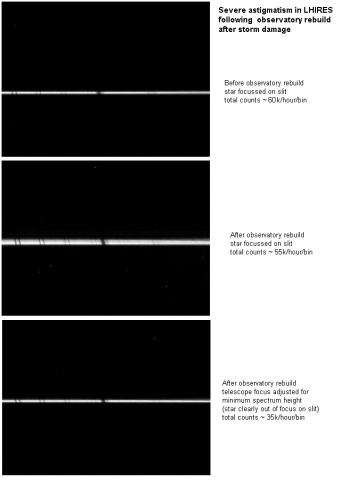
    Attached are examples of before and after spectra when the grating was overtightened after a rebuild, though unfortunately I did not do the zero order test before I cured it which would have conclusively proved astigmatism.  With the spectrum at its narrowest, the star was out of focus on the slit and the throughput was low. Adjusting the telescope so the star was in focus on the slit gave  good throughput but a  wide spectrum. Once the grating clamps were slackened off. Everything returned to normal (The star was in focus on the slit, the spectrum was narrow and the throughput was good)

    Robin

    #579825
    Robin Leadbeater
    Participant

    >Do you mean the star disc spreads beyong the slit? For the stars I am looking at this is certainly the case. In this respect (star >diameter vs slit width)  my guide images look liek the one Andy posted above.

    Images of the star on the slit can be deceiving if the star is  over exposed as the overspill looks worse than it is. Best to measure the typical FWHM of the point spread function of the star when correctly exposed and in focus. Matching the slit width to this  is a good compromise as most of the light will pass through the slit and you will optimise the resolution. With your setup 23um corresponds to 2.4 arcsec and 35um is 3.6 arcsec.  I would not go any  wider as you lose too much resolution. You cannot reduce the star size using a focal reducer either as that produces more vignetting in the spectrograph.  When you do these sorts of calculations you begin to see how the telescope, local seeing and spectrograph design are intimately linked. The LHIRES is optimised for an 8 inch f10 with 2.5arcsec seeing.

    Robin

    EDIT:  Found the calculator I was looking for.  For a gaussian shaped star profile, 76% of the light will pass through a FWHM wide slit. 

    https://spectroscopy.wordpress.com/2009/05/22/slitpinhole-flux-calculator/

    #579822
    Robin Leadbeater
    Participant

    Here I am talking about the light beam after the slit. It has to fit through the collimator in both directions. The collimator is f8 but there is an angle between the beam in each direction and the return beam is also dispersed by the grating so is wider. This means an f8 beam will overspill the collimator hence the f10 design specification for the LHIRES. Running at f8 does not affect the spectrum quality appreciably though, you just lose a bit of light. In spectrograph design there is a trade off between slit width, focal ratio and resolution. The upshot is though for a given resolution, the size of  spectrograph optics scales with telescope aperture. 

    Robin

    #579811
    Andy Wilson
    Keymaster

    Hi Kevin,

    I will reply to your points ii and iv, and perhaps a bit on i, as I think they may be related. I have the same setup as you, an LHIRES III and a GSO 10″ RC.

    When I first started with my LHIRES III, I concentrated on trying to get perfect guide stars and a perfectly narrow spectrum. I was getting some very nice results. Then after a few months I tried tweaking things to get the maximum throughput. I found I was getting my best results by going for a compromise setup. By that I mean that the spectrum is not perfectly narrow, and neither is the guide image perfect. It is possibly I gave up too early, but from conversations with Shelyak and other users, I think the sweet spot is genuinely a compromise setup.

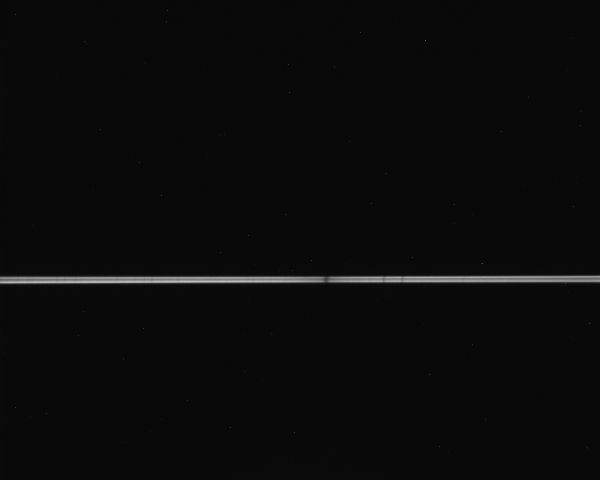
    My main learning was not to concentrate on getting the narrowest possible spectrum. I realised this when I started using MaximDL to examine spectra on the fly. Not looking to maximise the counts in the centre of the spectrum, or trying to get the narrowest possible spectrum, but instead to get the largest combined counts across the height of the spectrum. Hopefully you understand what I mean, which is basically you want as many photons to pass through the slit and spectrograph, reaching the detector. I found this might not be when the star appears perfectly focused on the slit, or the spectrum image as narrow as possible. This seemed a bit crazy at the time, and maybe I am still missing something, but I kind of assume it is something to do with the slit being a half-silvered glass plate. It is worth noting I don’t mean a horrible guide image or spectrum, just not absolutely perfect.

    Here are a couple of images to try to illustrate what I mean. First an image of the spectrum of gamma Peg at high spectral resolution.

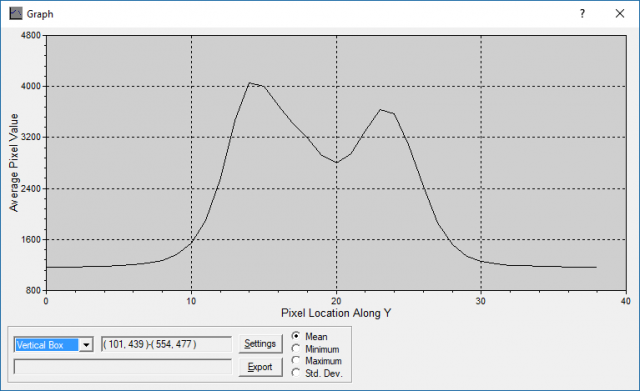
    You can see the image is not perfectly focused as the central obstruction shows in the middle. However, if I examine the vertical profile using a box area in MaximDL I see the following.

    So the dark centre is far from being black, but contains a lot of signal. I tried various ways to improve the look of the spectrum, to make it look more ‘Gaussian’ in cross-section and I did achieve this. However, when I did thorough checking of the results, I was always getting less photons.

    So when I focus, I aim to maximise the cross-sectional area of the spectrum, not the star on the slit. Just to be clear these are small changes, so the stars still look reasonable in the guide camera. To use this method of focusing (this is focusing the telescope), you need a star that is bright enough to give a decent spectrum in 10-20 seconds but not so bright that the spectrum starts to saturate. With shorter exposures you will be chasing seeing affects rather than true focus, and longer exposures will take a long time to try out different focus positions to reach the sweet spot.

    I find there is very little image shift in the GSO 10″ RC unless the temperature really varies a lot during the night. So I can spend a decent time getting good focus, and then often leave it for weeks.

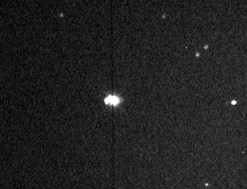
    With regard to the guide image, here is an example from my setup for comparison.

    I hope some of this helps. It would be interesting to hear if other LHIRES III users found similar results to me, or get their best results with the narrowest spectrum.

    Cheers,

    Andy

    #579781
    Dr Andrew Smith
    Participant

    Yes Robin is right. I use a Shelyak guide head and it is a fine bit of kit. They can customise it’s focal ratio and hole size to better suit your telescope within a certain range. 

    Regards Andrew 

    #579750
    Alex Pratt
    Participant

    That’s a great idea for an exhibition, Denis. Let’s hope comet 21P puts on a good show in late August / September for young (and old) astronomers alike. If it brightens sufficiently they might not need a special yellow telescope to see it.

    Clear skies,

         Alex.

    #579725
    David Swan
    Participant

    Last year – I forget precisely when – I had the telescope out on some land jutting into the sea, a great dark spot if winds are light. A curious member of the public came over and we had a good talk and I showed him some bright DSOs. He then proceeded to tell me that he was the person primarily responsible for installing the LEDs all over Tynemouth, and wasn’t it just wonderful ….

    #579686
    Andy Wilson
    Keymaster

    At the risk of triggering a major debate, my experience of Windows 10 running my astronomy software and my telescope in my observatory has actually been pretty good. The only software I use that does not simply run is AIP4Win.

    Though Windows 10 has the very annoying habit of wanting to run updates every few months without giving the option to postpone or disable updates. I am sure that alone is enough to put many off using it on an observatory computer.

    Cheers,

    Andy

    #579676
    Dr Paul Leyland
    Participant

    Let me stick my head above the parapet and apologize for not contributing earlier.  Fortunately (!) I have been very busy of late.

    The reason I was busy last week is that I purchased a house and observatory on La Palma on Wednesday.  It has a 0.4m Cassegrain, of excellent optical camera, tip/filt adaptive optics which keeps a star image on a single pixel (the plate scale is 0.75 arcsec/pixel) and a SBIG-8 CCD.  I’ve not had chance to use it seriously yet but the previous owner managed 2 millimag photometry.  La Palma is famous for having clear skies and superb seeing.  Incidentally, Kevin Hills has comparable equipment on the same site and I have been working with him and Phil Charles performing ~2mmag photometry on the optical counterpart of an X-ray black-hole transient.

    I’ve been busy all day today attending the Exoplanet-II conference in Cambridge — https://www.exoplanetscience2.org/programme .  After only 1 day of presentations (out of 4.5) several indicated that amateurs can do bleeding-edge research on exoplanets.  Although most spectroscopy is done with 2-10 metre-class telescopes, professionals often use 0.4 — 0.6m scopes for photometry because it is so much easier to get time on them.  One speaker presented results from a 0.2m telescope.

    I very much intend to work on exoplanets, whether or not a section is created.  Needless to say,  I strongly recommend an exoplanet section be created.

    #574069
    David Swan
    Participant

    Hello,

    Many of you, I suspect, are already aware of this – but I thought I’d flag it nonetheless.

    The Royal Observatory Greenwich has been kitted out with some modern equipment – at the very least there’s a C14 and piggy-backed refractors on a Paramount going on the photo – and the operators of the scopes are keen for public involvement.

    I am sure the BAA would want to make its presence known, if it has not already done so.

    It is a pity the gas giants will be at a southerly declination for some time yet, as I bet the public will be most keen to get a look at them through big scopes. But of course they will offer fantastic views of the moon, double stars and star clusters, for example.

    David

    https://www.theguardian.com/science/2018/jun/25/star-attraction-royal-observatory-seeks-volunteers-to-use-new-telescope

Viewing 20 results - 741 through 760 (of 1,113 total)