Does anyone have a GSO 16″ Ritchey-Chretien telescope possibly re-badged by various UK suppliers and be prepared to supply me with the following dimensions?
A) The tube balance point taken from the front of the tube.
B) The dimension across the flats of the tube octagons.
I want to be able to determine if the telescope can be housed in my planned observatory with a LISA spectrograph attached.
I would also be interested in owners views of these telescopes.
Replies can be private if preferred.
ronarbour@swonston.demon.co.uk
Thanks for the suggestions. Guiding was doing well as I was watching it, seeing was good when I imaged these two and Im sure they were the right stars as I used sync before moving on to next target. I did wonder about trees so checked height and tree tops but they appeared clear.
i use an Atik camera controlled by Artemis, the telescope runs with Cartes du ciel with a costar for guiding in phd2.
if we get clear skies I’ll try again tonight
kate
If you are thinking of changing your guide camera, a mono version will be better than colour as it will be that much more sensitive without the Bayer Matrix. Just been scouring the pre-owned pages of Telescope House website and have come across a secondhand Starlight Xpress Lodestar if you are interested,works well with the Alpy.
https://www.telescopehouse.com/offers/preowned/preowned-starlight-xpress-lodestar.html
Regards
Alun
Hi John,
I’ve also had this problem. I found that not only the mounting, but also the focuser and mirror flop caused problems. I’m not sure whether you have an extra focuser for fine focusing your C8. I used a Crayford focuser on a 14″ Meade for fine focus without moving the mirror. The weight of the spectrograph and 2 cameras caused the focus tube to shift as I slewed, making it nearly impossible to point accurately.
I am using a different setup now (10″ F8 RC) but I found several points that could help you, 2 already mentioned by Andrew and David.
– If you can afford to setup an electronic finder scope then that can be a big help. Otherwise just a good finder so you can easily and accurately point your telescope to bright stars.
– Star hopping from nearby bright stars. Start off with an obvious bright star on which to sync your telescope. Then jump to bright but progressively fainter stars nearer your target, re-syncing your telescope on each star, until you reach your target.
– I used a flip mirror between the spectrograph and telescope so I could use an eyepiece to check where the telescope was pointing. I found this was a big help but not without its difficulties. I could just about get it so the spectrograph and eyepiece were in focus at the same time. A couple of things to bare in mind. First, this moves the spectrograph and cameras further from the back of the telescope, increasing the moment arm on the telescope and mounting. Second, if you use a Crayford or Rack and Pinion focuser for fine focus then this increases the strain on the focuser.
I would expect finding objects to be much easier with your 80mm refractor as the field of view will be larger. As long as the focuser and mounting are up to the job.
Cheers,
Andy
Hi John,
This is a common problem unless you happen to have a mount capable of very accurate pointing. You can either use your finder scope visually, or more conveniently, attach a small CCD or CMOS camera fitted with a normal camera lens on top of your scope so you can see the wide angle field to which the telescope is pointing on the computer screen. Within this you should be able to see your intended target. By working out where the small field you see in the Alpy guide camera is within the wider field from the piggy-back camera, you can work out how to adjust your mount’s pointing to bring the target into the Alpy guider field.
David
Grant,
I use a standard dew heater band on my C11, near the corrector plate. I used to have a dew shield as well, but it was a pain as I kept dislodging it as I moved around the obsy. Moreover, if I needed to cap the telescope during breaks in observing, or to produce CCD dark frames, I had to take the shield off, put the cap on and then reverse the operation to start observing again. Too much of a hassle!
I look forward to seeing your results with the RASA.
Jeremy
Hi,
Although the document is referencing solar observing have a look at this: http://www.spectrohelioscope.org/net/spectro.pdf
It’s essentially the same design as Cristian Buils work (a Littrow is a Littrow….) but using very basic components. I built this out of thin plywood and other scrap. I even used the objective from and old pair of binoculars, just like the spec and the only thing I bought was a “b” grade grating from Edmund Optics. It worked brilliantly! I even used it in demos about spectroscopy. You could beef up the design for telescope mounting without too much difficulty but without a way to view the slit it’s akward to use for stellar astronomy ( I tried and gave up…).
Anyway, it’s a very basic and cheap way to start.
cheers,
Bill.
Good day,
I have a mirror (8in. f/8) that I started 40(ground and polished) years ago.
What I’m wondering does anyone have any experience building a solar telescope using a uncoated primary and either a uncoated secondary or a Herschel wedge?
Thanks,
David
Thanks Andy and Robin for your kind words. I enjoy tinkering as much as using which is just as well given the near perma-cloud here. One advantage of the fiber feed is I can play with new bits without disturbing the telescope and it’s pointing.
Sorry Tony, I don’t have any plans as such I basically read all I could find and then pinched the ideas. I then drew a layout on paper and transferred it to ceramic base, drilled holes, and fiddled about until it worked. The optical layout it is similar to the Shelyak Instruments eShel but on its side. I went for high thermal mass so it is in a large plywood box covered in 2″ back insulation. It has an air to air peltier cooler controlled by a Laird Tehnologies PID controller. Once stabilised it is better than +/- 0.02 degrees so the calibration remains stable during a nights observing.
Happy to answer any specific question or help anyone trying to do similar things.
Regards Andrew
How common are microlensing events of this brightness? I had no idea such things could be observed visually with a small-ish telescope (I hope to follow it down using my 10″ telescope). Thanks all for sharing – ditto BAAVSS notices.
We are having our Autumn Conference in Birmingham tomorrow (28th October), open to SHA members and non-members. The programme can be found here though has changed slightly:
https://societyforthehistoryofastronomy.files.wordpress.com/2017/07/2017-autumn-conf-flyer.pdf
Talks include:
· Roger Salt – “The Antikythera Mechanism”
· Eddie Carpenter – “An Astronomical Slide Show – lantern slides”
· Dr Lee Macdonald – ”From Cracked Mirror to Nobel Prize: Fifty years of the Issac Newton Telescope”
· Professor Donald Kurtz – “It’s About Time”
· Dr Allan Chapman – “The Civil Servant and the Sunbeam, Sir Joseph Norman Lockyer, pioneer of solar physics’.
Should be an educational day. I’ve just been setting stuff up and putting out a vast number of books to sell. If you are turning up on the day, the first talk by Roger Salt is now starting at 10:45am. Even if you are not coming tomorrow to the Birmingham and Midland Institute, hopefully you’ll be coming to the BAA Historical Section Meeting here on the 25th November 2017 (https://britastro.org/node/8445).
James
Society for the History of Astronomy Librarian
If you are within travelling distance of Keele University, you may be interested in the following event on Wednesday, 1st November.
Foden’s Band, one of the country’s top brass bands, will be playing Holst’s The Planets Suite and two other pieces with astronomical connections. These will be accompanied by a short talk by Dr John Taylor, Lecturer in Astrophysics at Keele University, illustrated with Hubble Space Telescope images of the planets.
Keele Observatory will be open after the concert and, weather permitting, the audience will be able to view planets and other night-sky objects using the Observatory’s historic Grubb refractor.
https://www.keele.ac.uk/artskeele/whatson/music/keeleconcertsocietyevents/title,175744,en.php
Posted on behalf of John Taylor
Hi Peter,
The neon bulb would have to be placed in front of the slit.
Typically you either have the neon lamp inside the spectrograph in front of the slit, or outside of the telescope so the light goes through the telescope optics and then the spectrograph. The advantage of having it shine down the telescope is you do not have to worry about the lamp position too much. If it is inside the spectrograph, then as I understand it the neon lamp must be carefully positioned so that the light follows the same path as the light coming from the telescope. Otherwise a shift in position of the lamp would cause an apparent but unreal shift in wavelength.
Though there were no light leaks, was the room completely dark or was there an opportunity for other light to pass into the spectrograph optics? Alternatively someone may have a spectrum of a similar lamp, in which case they may know if it also has a broad spectrum component.
Best wishes,
Andy
I have had a request from a professional team for spectra to classify possible supernova AT2017haf
which was discovered 2017-09-30 on the rise at mag 16
They are intensively following up all nearby type 1a supernova and if it is found to be 1a before Wednesday they have telescope time available. The weather forecast is not good here though so is there anyone else who would like to try for it? If you get a spectrum I can assist in the classification.
The same team are also following up my recent type 1a classifications SN2017gxq and SN2017gjn
Cheers
Robin
The SWIFT observation is a really nice addition to this, and confirms yet again the increasing importance of small telescope / fast response amateur spectroscopy. With your permission I’d like to use this example in an up and coming presentation that I’m giving on the subject at UWA.
Paul
The Liverpool telescope has confirmed that the object is a classical nova and a member of the FeII spectroscopic class.
http://www.astronomerstelegram.org/?read=10754
I am glad they got this done – the nova is fading fast and is almost beyond my detection.

Using a remote telescope in Spain I got 6×120 seconds of fairly reasonable images.
Magnitude estimate 16.66
Thanks Robin. I am amazed that the skyglow, pollution etc has such a huge component. I would have thought with a 2m mirror there would be bags of data from the nova. The Matt Darnley of the Liverpool telescope indicated that they would have a go at the nova as well. We wait and see…
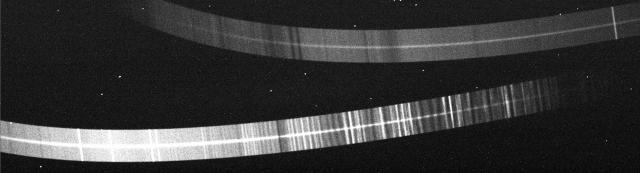
Richard Miles tells me that the 2.0m FTN has acquired a spectrum using the FLOYDS spectrograph. The raw data will be processed after the telescope closes for the night. Richard sent me the attached image showing the raw spectrum which doesn’t mean a lot to me at the moment but presumably will make more sense once it is rectified and calibrated. Many thanks to Richard for arranging this.
There’s an interesting article on spectral confirmation of novae here. Any comments from the spectroscopists on this forum would be very useful.
Hi Alex,
Observed via video cam on telescope from about a minute and a half before predicted time to 3 minutes after but no occultation seen.
Regards,
Richard