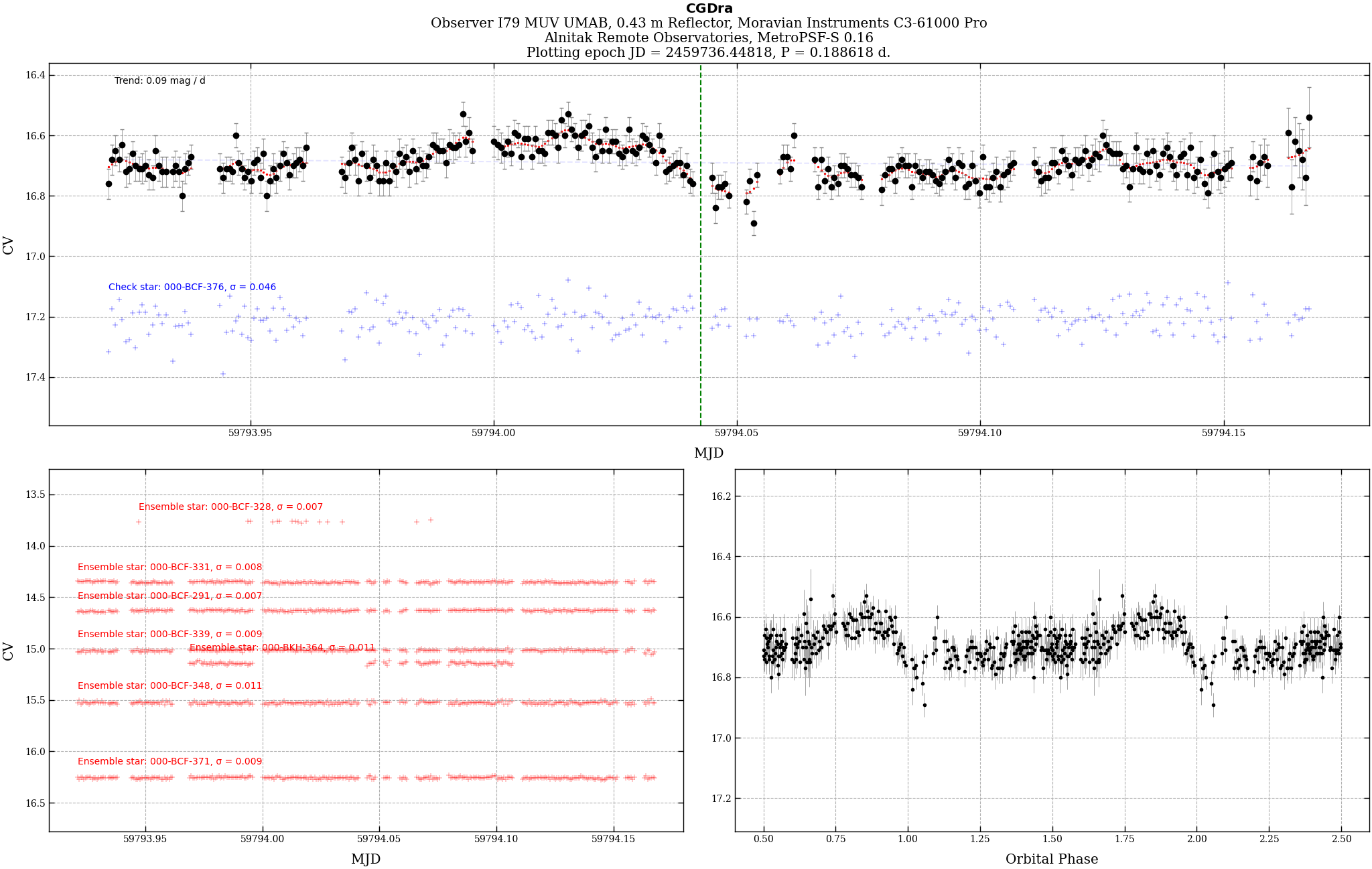
Eclipses No(s): 59
State: Quiescence
CG Dra back to quiescent state with a typical U/N/A eclipse, normal ~ 0.1 mag orbital hump amplitude indicating a mix of accretion disk and bright spot components. Mediocre data quality due to the clouds. Roof was closed 9 times this night, so this was a good test of automatic telescope wake-up routines.
Max
I posted a message yesterday but I received an ‘awaiting moderation’ message and the post still has not appeared!!
Anyway, I was trying to alert historians and archivists to the new BBCrewind website.
This contains thousands of videos from old BBCTV footage. By typing ‘telescope’ into the search window I found
some fascinating clips, especially H.P. Wilkins and John Wall at Crayford in 1959, plus Wilkins in his garden in
1953, talking about the controversial O’Neill’s bridge on the Moon. There are some other fascinating clips too,
such as the 16″ AE Cross-Axis Cassegrain at Armagh, described by Terence Murtagh, and a big 18-inch telescope,
also at Crayford.
I’m avoiding posting web links as maybe that was why my last post was censored?!
Just Google BBCrewind and then type telescope into the search field.
Regards,
Martin
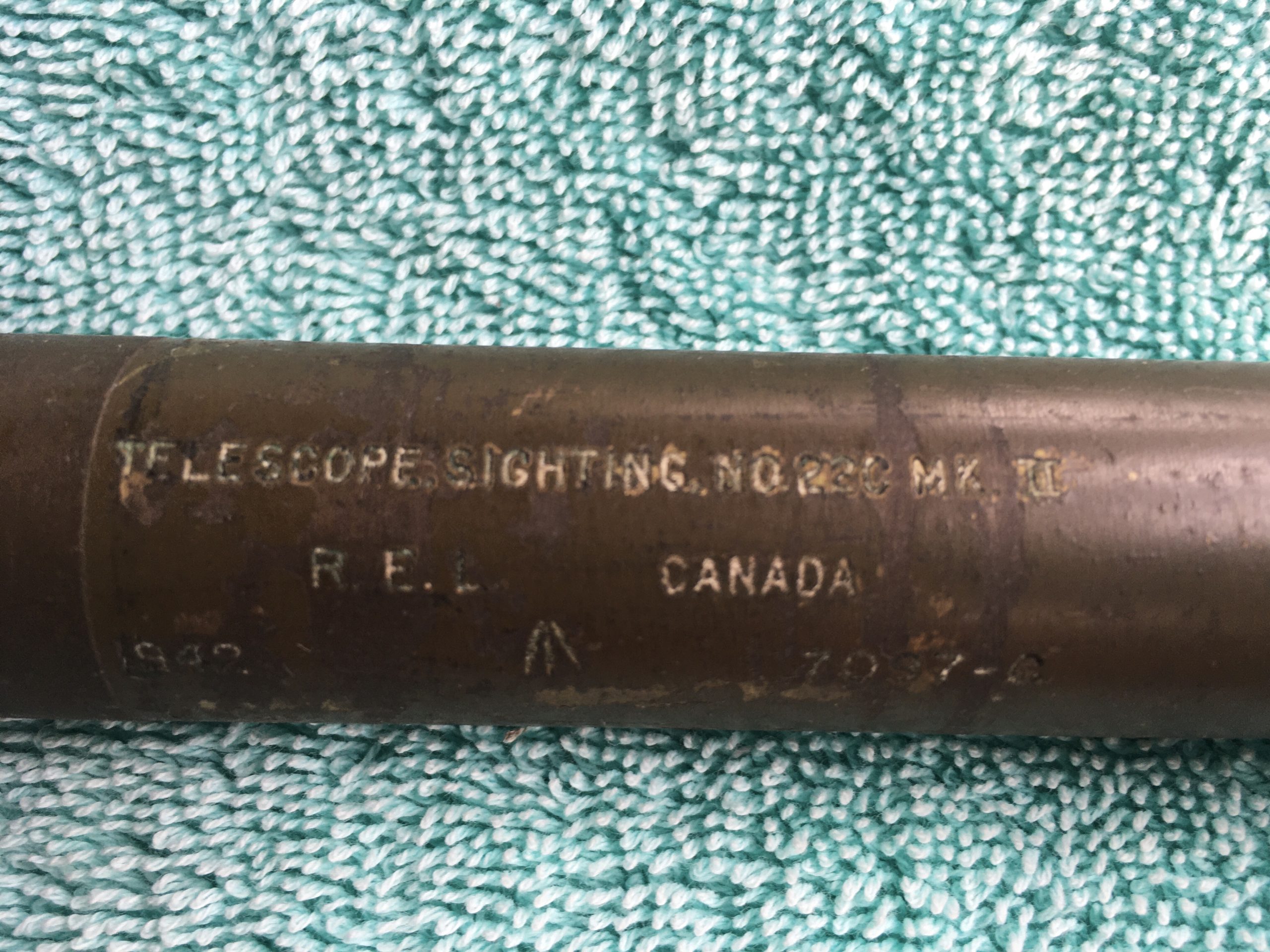
Here’s pictures of the military sighting gadgets I have here. The shorter one is a black-painted brass tube with both a helical focus and a moveable rack-and-pinion adjusted objective, for some reason. Gives an inverted image. No maker name. The other is by REL, Canada, dated 1942. It is a unity power telescope with an extendable objective shield and reticle, gives an erect image, and is a bit lighter than the other one. It looks exactly like a brass bicycle pump.
These gadgets always tend to be too heavy for their optical power to be of any use for astronomy.
I wonder if there is any link here with A A Common, famous astronomer of Ealing and early member of the BAA. He was involved with the Ottway company and patented devices for sighting naval guns around 1900. Here is a partial listing of patents in his name; they are mostly around this subject. Note the patent numbers are nothing like that quoted, and are much longer. This doesn’t look like a correct patent number.
In the obituary of Common by F W Dyson in MNRAS (1903) it is stated that according to a Captain Percy Scott, RN, ‘The great strides made by the British Navy [in gunnery] lately was entirely due to Dr Common…. He had produced a telescopic gun sight that would, when properly used, quadruple the fighting efficiency of our battle-ships.’
I also have a similar gun sight in my collection. Ottways must have made a great many of them. I got mine from the workshop of telescope maker Irvings (Teddington) when they closed down.
David
This event will be broadcast on NASA TV from 14:45 BST on Tuesday afternoon
https://blogs.nasa.gov/webb/2022/07/01/how-to-see-webbs-first-images/
We all look forward to seeing the first data from this 21st century space telescope.
Alex.
Now to track down the Patent number …
I have not yet found the patent in the WIPO database but this link turned up
https://www.grelly.uk/itm/genuine-27-inch-antique-w-ottway-1917-gunsighting-ships-navy-marine-telescope-142854086185
Looks like my telescope may well be from the Royal Navy. If so, it would be nice to find out which ship to which it was fitted.
Last autumn, at a family gathering in Somerset, I picked up an antique brass refractor. Just the OTA, no mounting to speak of. I thought folk here might find it at least slightly interesting. It has been in a cupboard until today when I started renovating it.
It has a 50mm (or, more likely) a 2 inch objective and a low power eyepiece which contains a cross-hair graticule, of unknown focal length, giving an erect image. The telescope appears to be about f/12 or f/13. The exterior lenses are a bit grubby but the optical train appears completely clear. Not yet had chance to perform a star test but have no reason to believe it won’t perform well.
The brass tube has a century of patina which polishes off nicely. It is also extremely heavy, at 6.1kg, because it is made of 5mm (1/4 inch) brass. This is mil-spec construction! Not surprising, perhaps, as it was built as a gun sight for a First World War artillery piece.
Far too heavy for a finder but it will be fun mounting it and putting it to use. A couple of pictures follow.
Eclipses No(s): 27, 28
State: Quiescent
Data Quality: Good (check star sigma = 0.045)
Holy cow. What’s going on here? I thought there was something wrong with my telescope.
How do you measure the bright spot here? I assume the quiescence is somewhere in the middle of the chart, at 16.89 mag, and the bright spot before the second eclipse pushes it all the way up to 16.75 mag – an amplitude of 0.14 mag. Note two-step increase in brightness in the orbital hump – first to 16.85 mag, then the second one to 16.89 mag.
The profile is a new type, U/H/A, never seen before. It is similar to U/L/S, except that here we see a very prominent bright spot.
Lots of flickering – at the bright spot apperance, orbital hump, at the minimum, and the egress. Note the post-egress 0.05 mag dip, then sudden rise of 0.1 mag, then ~ 0.5 mag dip. Flickering? I don’t think so. Exactly the same structure is visible in both eclipses tonight. Is this the second bright spot or, perhaps, stream overflow? Could the second bright spot/stream explain the 2-step rise, and the post-egress hump?
LOTS of questions.
Max
I have been following this thread with interest and the quoted post, expressing a degree of incomprehension over the star’s behaviour, prompted me to contact an old friend, Phil Charles. Phil is a notionally retired but still very active professional astronomer who has specialized in the study of CVs of various types. He has given me permission to pass on his response.
Have to confess I’m not familiar with CG Dra, but that’s a very good light-curve for an almost 17th mag star (as expected for a 0.4m telescope in presumably a good site). It’s an eclipsing U Gem-type dwarf nova, here in quiescence, but I just looked at the AAVSO long-term light-curve and you can see that it outbursts quite frequently. That means it will be undergoing continuous mass transfer from the donor into the disc, and that displays itself as enhanced light when viewing either side of eclipse by the donor. In fact the hump here is quite broad, so it’s definitely an active system, and it’s clearly growing the disc in preparation for its next outburst.
Given the obvious data noise that is also visible in the comparison star, my reaction is that there’s nothing that unusual here. Let me know if you think I’ve missed anything.
-
This reply was modified 4 years, 3 months ago by
 Dr Paul Leyland. Reason: Fix typpo
Eclipses No(s): 27, 28
State: Quiescent
Data Quality: Good (check star sigma = 0.045)
Holy cow. What’s going on here? I thought there was something wrong with my telescope.
How do you measure the bright spot here? I assume the quiescence is somewhere in the middle of the chart, at 16.89 mag, and the bright spot before the second eclipse pushes it all the way up to 16.75 mag – an amplitude of 0.14 mag. Note two-step increase in brightness in the orbital hump – first to 16.85 mag, then the second one to 16.89 mag.
The profile is a new type, U/H/A, never seen before. It is similar to U/L/S, except that here we see a very prominent bright spot.
Lots of flickering – at the bright spot apperance, orbital hump, at the minimum, and the egress. Note the post-egress 0.05 mag dip, then sudden rise of 0.1 mag, then ~ 0.5 mag dip. Flickering? I don’t think so. Exactly the same structure is visible in both eclipses tonight. Is this the second bright spot or, perhaps, stream overflow? Could the second bright spot/stream explain the 2-step rise, and the post-egress hump?
LOTS of questions.
Max
-
This reply was modified 4 years, 3 months ago by
 Maxim Usatov.
Not sure whether this somewhat elderly thread is still current or whether I should start a new one.
Over on SGL members were asked about their smallest telescope. Ever the pedant and firm believer that one should never ask for anything unless you are prepared to receive it, I pointed to an image taken with a 2.2mm f/1.8 refractor. This one to be precise: https://britastro.org/observations/observation.php?id=20191209_191900_36b00eba365581f4
Now I am pretty sure when it was uploaded originally to the old gallery it was displayed upright and not sideways. Can it be fixed, please?
No idea whether other images have been similarly rotated.
Back to monitoring. Severe turbulence at the beginning of the session as the telescope was still cooling down, but I thought I’d remain this in the dataset as it appears to capture the ingress hump (hot spot?) I think that it’s another eclipse near the end of the session in the morning when SNR began to decrease. Period precision keeps improving.
Max
-
This reply was modified 4 years, 4 months ago by Maxim Usatov.
Hi Daryl,
I had thoughts along similar lines.
I have already pointed out to them it appears you can zoom in on individual houses. They responded to say the postcodes cover many houses and they don’t think anyone looking at the map would assume everyone taking part has a telescope. None the less I wonder if it might discourage those with expensive equipment from contributing.
I have not seen evidence their conclusions are rigorous. I do think it is encouraging those recording severe light pollution has fallen, though my concern is whether this might be due to differences in participation. It would take quite a detailed analysis of their results, looking at individual locations. In particular comparing locations where results are reported from the same or nearby locations over several years.
Best wishes,
Andy
-
This reply was modified 4 years, 5 months ago by
 Andy Wilson.
Thanks, Jeremy!
Today’s data – really interesting. Note the eclipse profile is asymmetric with what appears to be a gentler egress on the first event. The second dip is ~ 0.1898 d from the first one, so looks like I was lucky and that is the second eclipse this night, also with a gentle egress. Could be something going on with the accretion disk?
Seeing conditions improved later into the night, with better precision on the second eclipse. Periodic interruptions in the light curve are refocusing events at 30-minute intervals. The telescope decided it wants to autofocus near both minima. I’ll increase the period to 60 minutes to minimize this effect.
If I combine this data with the previous night’s run (with polynomial fit to remove the trend) I get 0.189617 +/- 0.07808 d period reported using the ANOVA algorithm, which appears to be in good agreement with the 0.1893 +/- 0.0006 d period used by Bruch et al. (1997).
All the data is in AAVSO and BAAVSS databases.
Max
-
This reply was modified 4 years, 5 months ago by Maxim Usatov.
These have now found a good home.
Going as a job lot (if you want one, you have to have the lot), and MUST be collected from Nottingham, an incomplete set of the Irish Astronomical Journal, loose, not bound. List of copies, to the best of my knowledge are listed below:
1 (1) Mar 1950
2 (2, 6, 7,8) 1952-3
3 (1-8) 1954-55
4 (1, 3-4) 1956
5 (1, 2-3, 5,6,7,8) 1958-9
6 (1-8) 1963-64
7 (1-8) 1965-66
8 (1-8) 1967-68
9 (1-8) 1969-70
10 (4) 1971
Special issue 1972 (dedicated to EJ Opik)
11 (5,6) 1974
12 (3,4) 1975
13 (7,8) 1976
14 (1-8) 1979-80
15 (1,2) 1981
16 (1-4) 1983-84
17 (1-4) 1985-86
18 (1-4) 1987-88
19 (2×2, 3-4) 1989-90
20 (1,2, 3*, 4) 1991-92
21 (1*,2*, , 3* & 4*) 1993-94
22 (1*, 2) 1995
23 ( 1*, 2*) 1996
24 (1,2) 1997
25 (1*, 2) 1998
26 (1, 2) 1999
27 (1*, 2*) 2000; Ceased publication
* contain Cyclopedia of Telescope Makers
A memorial service for Prof Roger Griffin will be held this Saturday, 14 May at noon, in the chapel of St John’s College, Cambridge. All are welcome to attend, and I’m sure Roger’s family would be delighted to meet any astronomers who knew him or worked with him.
Roger was an active amateur observer as a teenager in the 1950s, and whilst at boarding school he was given special permission to travel to London to attend BAA meetings. In later decades he worked almost exclusively with the 36-inch telescope in Cambridge, making observations of the spectra and radial velocities of stars.
Despite turning professional Roger remained in touch with the BAA and was always willing to share his thoughts, especially on matters relating to spectroscopy.
More information can be found on the St John’s College website:
https://www.joh.cam.ac.uk/memorial-service-be-held-professor-roger-griffin
and on Richard Griffin’s memorial page:
https://www.squarewheels.org.uk/rfg/
An update on IX Dra recent behaviour. Observations are been made by the AAVSOnet telescope in New Mexico, by BAA-VSS, and by AAVSO members.
The most recent superoutburst was well recorded by AAVSOnet telescopes with a start around JD 2459688.
TESS contributed a detailed record of the superoutburst at JD 2459633.
The previous superoutburst was well recorded at JD 2459577.
The next previous superoutburst was well recorded on JD 2459520.
Graphing the most recent data gives the data in the attachment. This shows a declining trend from a peak around 60 days. The data point at JD 2459106 is almost certainly too high owing to limited observations. Observations were available only once the outburst had started so the start must be uncertain by a few days.
It seems that for IX Dra the trend towards longer superoutburst periods has paused. It may be reversing.
Thanks to all who have, and continue to, contribute to following this star.
The nearest star, alpha Centauri, is 1.3 parsecs away and although it is a multiple system the separations are many AU and the orbital periods are much more than a decade.
Thinking about it, if you are prepared to use a robotic telescope and/or travel to the southern hemisphere and are willing to relax your orbital period requirement to 80 years, alpha Cen is also a possibility.
It could indeed be Arthur Ransome, but in that book Dick’s telescope is more of a device for reading semaphore signals sent by another group of children. There is the stars book owned by Dick, and a few constellations are mentioned at the start. But the book is more about ice skating on the frozen lake. But yes, a brother and sister……. I find the question intriguing and at first I thought I knew the answer. But it was not so simple. On my shelf I still have an early 60s book from my childhood, Timothy’s Book of Space, but herein Timothy is the only one to receive instruction from his Dad. Although I cannot solve the riddle, instruction in the form of a series of long conversations between brother and sister is the theme of another book in my library by James Ferguson, An easy introduction to astronomy, for young gentlemen and ladies…. London MDCCLXXII. I will keep looking, but one certainly turns up interesting things along the way.
Good to have this update on that particular aspect of remote telescope time.
Another possibility that Grant is well aware of (he has used this for variable nebulae studies) is the Europlanet Telescope Network.
Early last month I had an online meeting with several interested parties closely involved in the ETN, and I am planning on progressing the BAA’s further involvement after several weeks delay on my part – That will be an offline discussion once I’ve submitted a report to Council on the subject.
Richard Miles
I didn’t know Ron but he was kind enough to ‘like’ one or two of my images. An honour indeed.
The video of his appeareance on the Sky at Night with Patrick is fascinating. How on earth did he manage to move that telescope from one end of his garden and back again? Clearly he was one of the greats of amateur astronomy.