-
Search Results
-
Mine’s a 60mm ED doublet (Altair 60EDF). I never cease to be amazed at just how much I can see with this little telescope. I’ve seen shadow transits on Jupiter. I can see Titan (Saturn) and often Rhea. I can also see the Ring Nebula with a bit of averted vision.
Attachments:
Telescopes: One Newtonian, three Maksutov Cassegrains, seven refractors, and a large SCT.
Topic: Observation Frequency
I’ve observed Mercury seven times in total this year (January, February) with a telescope. I don’t think I’ve ever seen it more than twice in one year with a telescope. Unfortunately it’s a bit low for me at the moment.
Telescopes: One Newtonian, three Maksutov Cassegrains, seven refractors, and a large SCT.
Hello everyone,
my name is Andrea and I’m from Italy.
This is my first post on this forum since I’ve joined the BAA this spring. I hope my message finds you well.
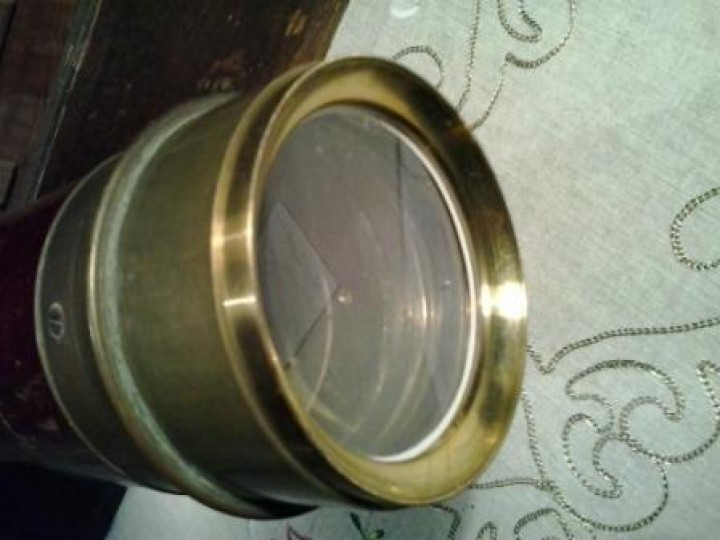
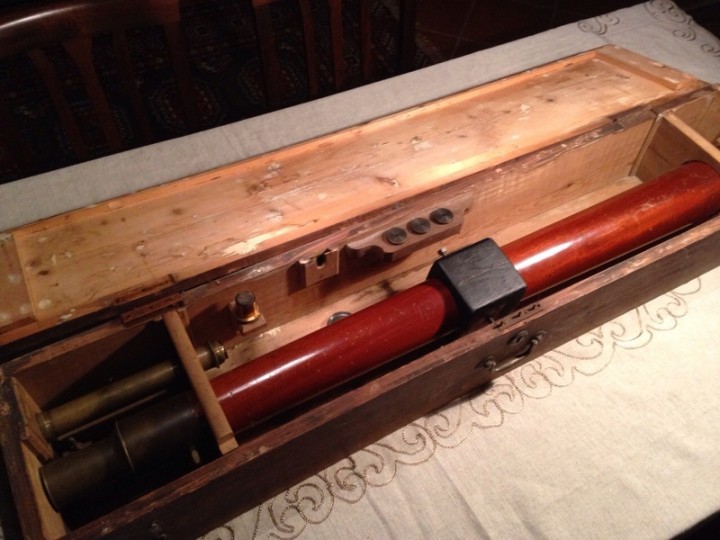
I’m not really sure if this is the best section to make a post about this topic or if it would have been better to put it on the “History” forum. Anyways I’ll give it a go here.I’d like to know more about an antique Steinheil Muenchen refractor telescope that I’ve recently found on a local website for buying and selling astro-gear. I’m really interested in buying it, as I’m quite fascinated by its history, but I have to admit that I’m not an expert in ancient telescopes (this would be my first one) and so I hope that some of you can help me!
Under this message you’ll find attached some photos that the seller has shared.The instrument is 70mm in aperture and bears the serial (I think) number 8915. We don’t know in which year it was made. It comes with several accessories and in particular three eyepieces of different (and unknown) focal lengths. The telescope is complete with a lens cap and a removable black mounting block has been added to allow its use with some modern mount, since the original one is absent. The seller has told me that the instrument is usable, but probaly in need of some cleaning and restoration. I haven’t personally seen it yet, because it’s a two and a half hours drive from my hometown to the seller location.
The seller doesn’t know how much he should ask me for it (he has received wildy different quotes) and I don’t know how much to offer. Can you guys give me a quote?
Thank you for your time and I hope to hear from you!
Kind regards,Andrea
3056 x 3056 pixels, 36.7 X 36.7mm chip. Suitable for all wide field applications. The reason I am selling it is that it’s too heavy to mount on my 20inch newtonian (f3.5), but would be perfect for an SCT or Astrograph on a fork or German equatorial mount with counterweights.
I bought it 2 months ago from Crni Vrh Observatory (MPC observatory code 106) who used it for their asteroid survey. It is in perfect working order and they gave it a full check up before shipping. The chamber was purged and refilled 2 years ago, so you won’t have problems with condensation or ice crystals. Apogee offer this as a lifetime free service anyway. You ship it to Andor in Belfast, they refill the chamber with argon gas, and send it back to you for free. I am asking £1480 which is what I paid for it 2 months ago.
The £20 shipping is for standard post which can take 3 weeks, but faster methods are available. The camera comes with power supply, USB cable, mounting plate, mounting adapter, and 3 spare fans. If you are not familiar with Apogee cameras, I posted the link to the S&T revue below. I have used them for 20 years and apart from replacing a fan occasionally, have never had a problem.Please contact me on mgedawson@gmail.com, phone +352 621 291849
Sky & Telescope review by Denis de Cicco: https://www.thefreelibrary.com/Apogee%27s+Alta+U9000+CCD+camera%3A+the+first+astronomical+camera+with+…-a0169309135
Apogee U9000 specs: https://www.observatorij.org/News/U9000.pdfAttachments:
Topic: Globular Cluster Marathon
Many of you know that I have been imaging small planetary satellites of the gas and ice giants. My stamp collection is now almost full in that the remaining ones are below magnitude 22.0 at best. Some of you may be aware of https://britastro.org/section_information_/deep-sky-section-overview/observing-programmes/globular-clusters/the-gc-marathons-part-i-galactic-globular-clusters which I wrote a couple of years back. Unfortunately, a couple of links there were broken when the BAA site was updated but http://www.astropalma.com/Projects/GC_Marathon.html still works.
Accordingly, I have now started imaging GCs and will eventually put them in the BAA gallery and my personal web pages. I have only managed 14 out of 158 so far but hope to pick up a few more in the next week while Sgr et al. are still visible. At least twenty are too far south for a telescope in La Palma and a few more are visible only in the IR. To summarize: only 10% have so far been done.
I urge others to join in this escapade.
I have just issued this BAA Alert via email.
John Toone (BAA VSS, Shropshire) has reported RY Sgr fainter than normal, at visual magnitude 8.0 on Aug 29 (compared to 6.2 on Jul 8) and has suggested that it might be at the start of a fading episode. Several other observers have also reported the star as being fainter of late. Further observations are urgently requested to determine whether this is the beginning of a deep fade or just a deep pulsation minimum.
RY Sgr is a yellow supergiant of the R Coronae Borealis class. As is typical for the class, its light curve is characterised by a sudden drop in brightness from 6th mag to mag 12 to 14 over a few weeks before gradually brightening over the following several months. The interval between these fading episodes is irregular. The fading is due to the presence of dust clouds of carbon obscuring the star.
RY Sgr is also a pulsating variable, with a semiregular period of 38 days, mag ca 6.5 – 7.5. Observations over the next few days will confirm if the current fainter state is due to one of these pulsations being faint, or the start of a genuine fade. Contributions by observers will help to resolve this question.
The southerly declination of RY Sgr is a challenge for UK-based observers (RA 19h 16m 33s, DEC −33° 31′ 20″), but not impossible for those in the southern part of the country with a good southerly horizon. Observations could be made with binoculars or a small telescope. Observers from countries further south are naturally encouraged to observe the star too.
Finer charts are available at the AAVSO VSP: https://app.aavso.org/vsp/chart/?star=RY+Sgr&scale=A&orientation=visual&type=chart&fov=900.0&maglimit=9.0&resolution=150&north=down&east=right
These can be scaled as desired.Jeremy Shears
Director, VSSAttached is a link to a Utube video of the abandoned observatory that was once operated by Newcastle University in the NE of England (home of Grubb-Parsons). The three domes are ina poor state (I visited in the 1980’s) with David Sinden. The tragic shame is that the most famous of the telescopes a 24 inch Calver reflector used by T.E.Espin is still in there. It was restored by David Sinden (once chief optician at Grubbs) and placed in the that observatory after restoration. The telescope was used by Espin to compile his catalogue of red stars, valuable double star measures and estimates of variable stars, amongst other ground breaking observations. The University should hang their head in shame at leaving this historic telescope to deteriorate in the way it has.In 2007 they proudly announced that the 24 inch was once one of the lasrgest telescopes in England.They could have at least dismantled it and stored it .It would only take a day to dismantle and take away. I wish I was 30 years younger, I would tackle the problem.
Denis Buczynski
https://www.youtube.com/watch?v=-_FRY1XAmSk
https://shasurvey.files.wordpress.com/2019/12/espin-observatory.pdf
Attachments:

British Astronomical Association
Supporting amateur astronomers since 1890