-
Search Results
-
Topic: Piazzi’s transit telescope.
On a trip to Sicily I got to look through the actual transit telescope at Palermo National Observatory that Piazzi used to discover dwarf planet Ceres on 1st Jan 1801. An experience I wont forget!
Back in September, various news outlets reported that this year’s opposition of Jupiter was the closest since 1963 – including EarthSky [1], Scientific American [2], Sky & Telescope, CNN, etc. Last week, John Rogers asked my thoughts on this – specifically whether this was purely down to chance or due to periodic oscillations in Jupiter’s orbit. This piqued my interest to do some calculations, and I hope John won’t mind if I post my conclusions here for all to see.
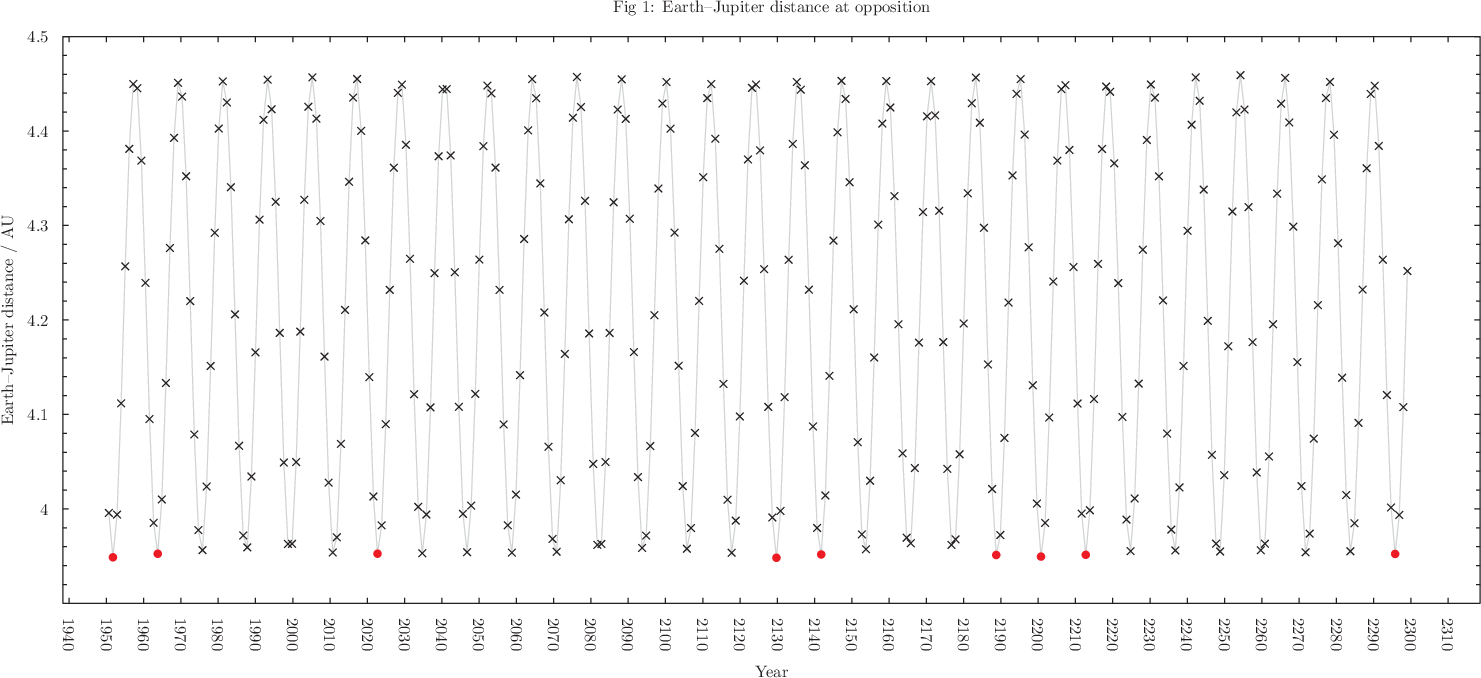
In Figure 1 (attached below), I’ve plotted the Earth-Jupiter distance at every opposition between 1950 and 2300. The red points are oppositions that are closer than the 2022 opposition. By far the dominant effect is a 12-year oscillation, brought about by Jupiter’s orbit carrying it between perihelion (4.95 AU) and aphelion (5.46 AU). As you’ll see, the reports of the “closest opposition for 70 years”, whilst mathematically true, were somewhat over-hyped. There have been five other oppositions in those 70 years which were only fractionally less close.
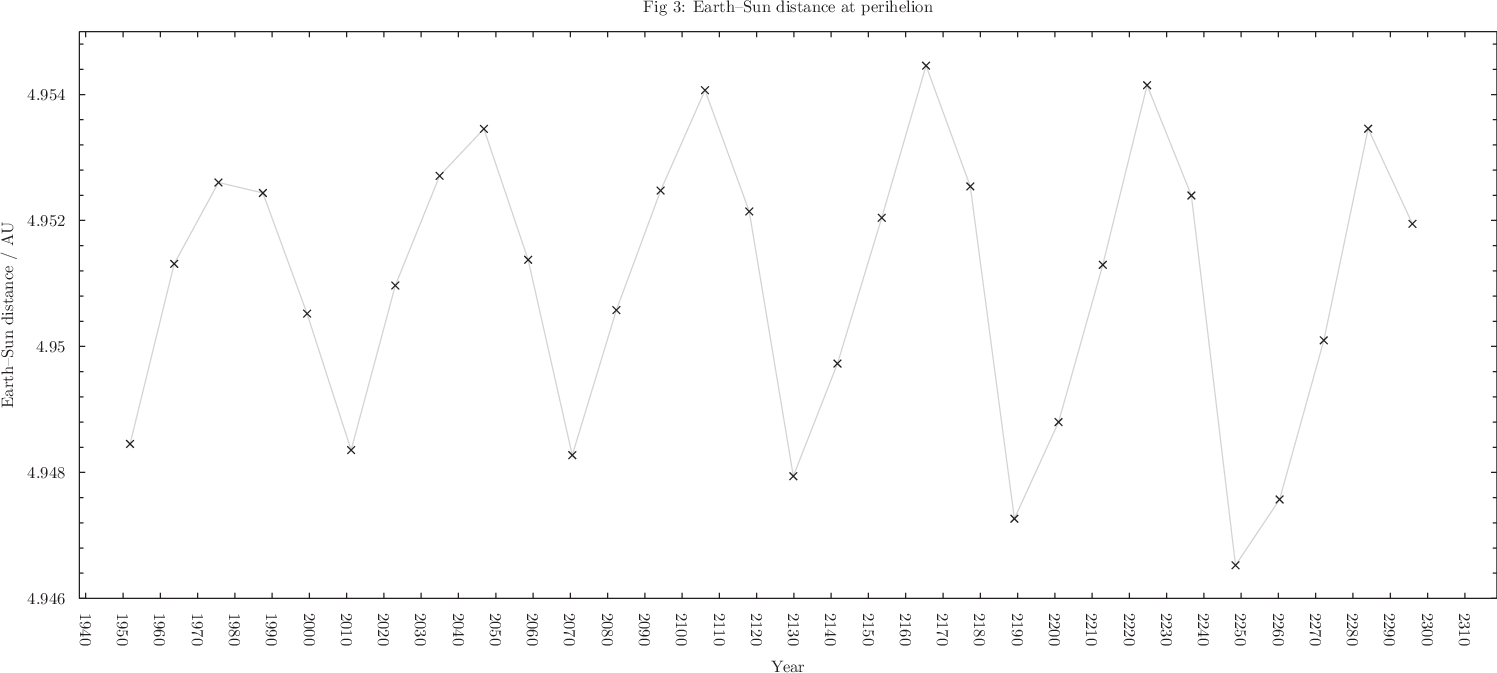
John was curious about the impact of periodic oscillations in Jupiter’s orbit – for example, the 60-year cyclic perturbations induced by Saturn. In Figure 3, I’ve plotted Jupiter’s distance from the Sun at each perihelion between 1950 and 2300. The 60-year oscillation induced by Saturn is very apparent here, but it’s an absolutely tiny effect compared to difference between Jupiter’s perihelion and aphelion distances (0.5 AU).
So, in short, I think the closeness of the 2022 opposition is simply down to the close alignment between Jupiter’s opposition (26 Sept 2022) and perihelion (22 Jan 2023). Of course, the four-month separation is hardly a particularly close alignment. But since Jovian perihelions only come around once every 12 years, it’s quite possible to go for 70 years without getting a closer alignment than that.
The EarthSky article (link below) included this curious paragraph… “Jupiter isn’t always exactly closest to Earth on the day of its opposition. But in 2022, Jupiter’s opposition to the sun and closest approach to Earth fell on the same day. That’s because opposition took place so near in time to Jupiter’s perihelion – on January 21, 2023 – its closest point to the sun in its 12-year orbit. If it’s nearly closest to the sun, and we go between it and the sun … voilà, it’s a close opposition for us!”.
This claim was also repeated by other news outlets, and I think it’s broadly wrong.
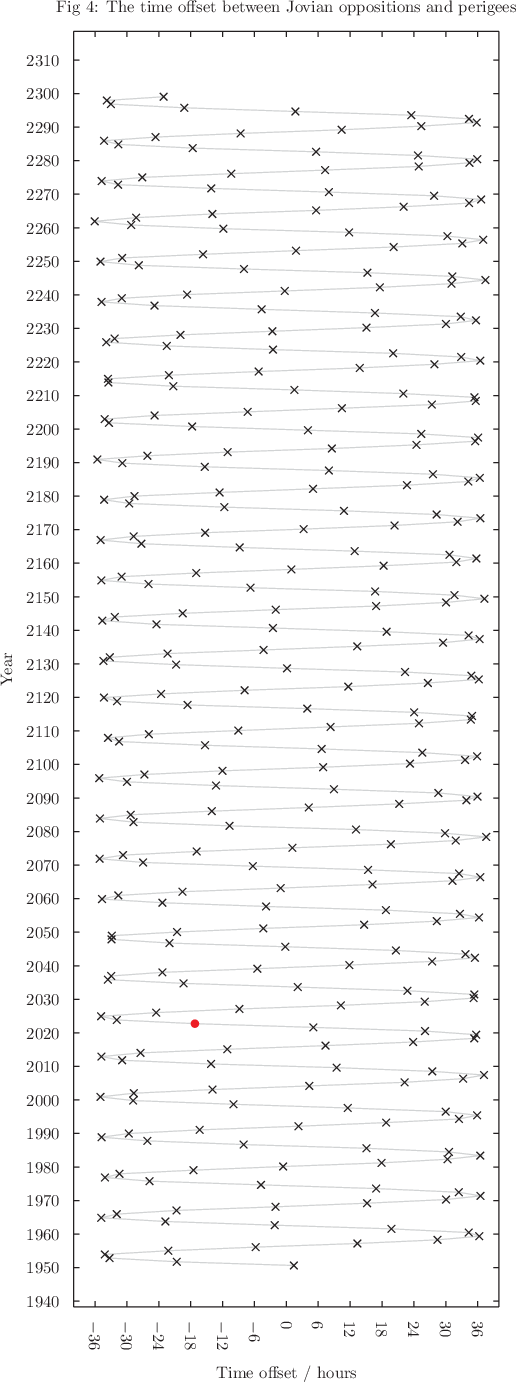
To demonstrate this, in Figure 4 I have plotted the time interval between Jupiter reaching perigee and the moment of opposition. As you’ll see, the maximum offset is +/- 36 hours. So, Jupiter is always closest to the Earth on (or very nearly) the day of its opposition. Moreover, the offset in 2022 (shown by the red dot) – around 18 hours – is actually rather large.
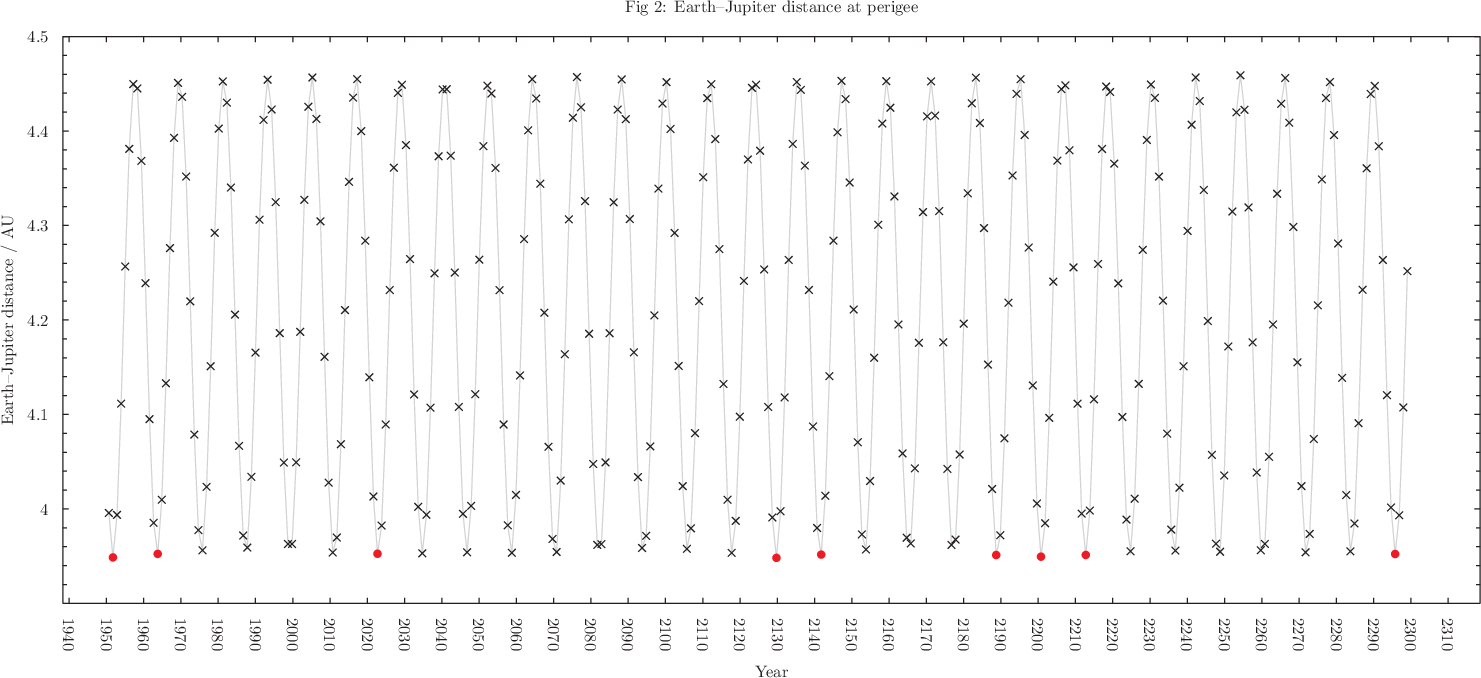
To reinforce this point, in Figure 2, I’ve plotted the Earth-Jupiter distance at every *perigee* between 1950 and 2300 (equivalent to Figure 1, but for perigees rather than oppositions). If you think it looks very similar to Figure 1, you’re right. The two plots are basically identical.
So, what were EarthSky thinking? Well… if you don’t do the calculations, I think you might expect Jupiter’s perigee to be displaced some time before opposition when it is receding from the Sun, and displaced after opposition when Jupiter is moving closer to the Sun. In practice, though, the Earth’s orbital velocity is much higher than Jupiter’s, and this is rather significant in determining the displacement of perigee vs opposition. Even though, in terms of the absolute Jupiter-Earth distance, the non-circular shape of the Earth’s orbit is totally negligible, since the difference between the Earth being at perihelion vs aphelion is only 0.03 AU.
—–
[1] – https://earthsky.org/astronomy-essentials/jupiter-at-opposition-closest-brightest-best/
[2] – https://www.scientificamerican.com/article/see-jupiter-shine-during-its-closest-approach-to-earth-since-1963/Topic: BAA Annual General Meeting
I enjoyed attending yesterday’s meeting via YouTube and listening to David’s interesting talk on the History of the Telescope.
Thanks to all involved in running the Association for another year of good work.
AlanThe latest Rubin Observatory newsletter advertises a colloquium for Monday 3rd October entitled: “Trailblazer: An Open Data Repository for Satellite-Streaked Images”
By Meredith Rawls and Dino Bektesevic.I am not sure whether it would be appropriate for me to post the Zoom link but the abstract reads:
An increasing population of commercial satellites is significantly impacting ground-based astronomical observations. To address this, we have built a new Trailblazer web portal, which aims to enable quantitative studies of streaks from satellites in images as the satellite population changes. Trailblazer is written in Python and Django, and allows users to upload and retrieve images affected by satellite streaks. Trailblazer stores uploaded FITS images in the cloud and saves key header information in a metadata database. Users can run queries to find satellite-streaked images by date and time, observer location, sky position, telescope, instrument, and band or filter. Images and metadata may be accessed through a RESTful API or a web query interface. To better disseminate the impact of satellite streaks on astronomy, each image also appears in a gallery for users to browse. Trailblazer is designed to be accessible to astronomers and other stakeholders to collaborate on mitigating the impact of satellite streaks, and is a cornerstone of SatHub at the new International Astronomical Union (IAU) Centre for the Protection of the Dark and Quiet Sky for Satellite Constellation Interference (CPS). Trailblazer launched in June 2022 thanks to funding from the LSSTC Kickstarter Grant Program, which enabled us to pay undergrads for software development. Check it out and upload your satellite photobombs: https://trailblazer.dirac.dev.
I’ve taken a quick look at https://trailblazer.dirac.dev/about/ and it looks as if it should become a valuable resource.
Good morning, everyone,
I would like to share with you some observations of the planets I made last night.
My observing commenced shortly after 22:30hrs and ended at 00:06hrs BST. The morning of the Autumn Equinox.
I own a Celestron C9.25 and decided that it was about time I brought it out hibernation. This is a fine telescope, as Damion Peach will testify in his review of it on his website.
I have this mounted onto a Losmandy G11 with Gemini 2. And I am currently using a Stellar Lyra 1.25-inch Star Diagonal, the optics are collimated and very clean.All observations were made at the C9.25 native F10 at 2,350mm focal length and I used a 13mm Baader Hyperion eyepiece giving a magnification of x180.
Seeing at times was ANT-II occasionally ANT-I my skies were hazy.
Jupiter.
It has been too long since I last had a look at this giant. Tonight, I was delighted to see the planet again. Through my C9.25. Jupiter was pleasing to see. The seeing was steady. But the planet was visible through a hazy sky. I think this helped to settle the seeing. On the planet. Jupiter’s two main belts were clearly visible. I thought the NEB looked brownish to my eye. Maybe someone on here can confirm this? I was able to see other features including Festoons and barges. IO was Orange in colour whilst the other three were white dots. One of the moons Ganymede was very close to the planet, and I thought it might have just come out of transit. But wasn’t certain of that.I spent a long time studying the planet and trying to familiarise myself with all the belts and zones. I must read up on observations of Jupiter before next time.
My next targets were Uranus and Neptune. I am happy to say both planets were clearly visible. Uranus appeared as a tiny orb at x180. But I wasn’t able to see anything else. Neptune again, appeared as a small disk. I wasn’t able to see any colour in Uranus or Neptune.
It made a pleasant change to use the Mk1 EB again. And the SCT.

British Astronomical Association
Supporting amateur astronomers since 1890