Although dewing and the desiccant sounded the potential problem, it turned out to be something else.
As I dismantled the camera off my telescope to prepare to dry the desiccant, I noticed the fiield flattener I was using on my refractor looked a little dirty. However, when I tried to clean it it seems the dirt is caught between layers of the flattener I cannot reach. See image.
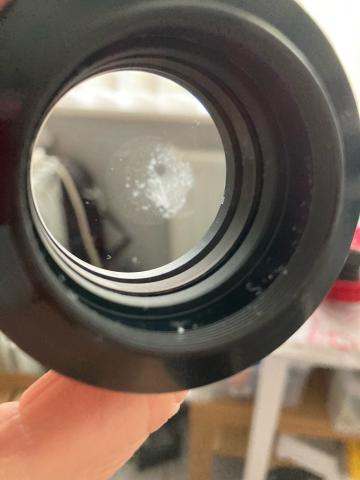
Oddly the appearance of this dirt varies and a stable room temperature looks like it completely disappears. Must be at its worst when its super cooled ?
So I redid my flats with the field flattener removed and the images are all fine and do not change over time. So no need to dry the desiccant.
However I have had to send the field flattener back to the company I bought it from to be professional cleaned.
Still very grateful to you for your advice though.
Living near the wettest place in England, dewing is ever present hazard for me but with this specific ATIK camera model which I have been running for many years the only time I have had a dewing problem has been when water got into an SCT when it got rained on making the air inside the telescope particularly humid. The dew then was on the outside of the camera window and drying out the telescope solved the problem. If this is a reoccurring problem (eg with an open tube telescope) this is where a specific dew heater for the camera could help. The other possibility though is dewing internal to the camera, either on the inside of the camera window or on the sensor cover glass (this can actually be frost if the sensor is cooled,as here). In the ATIK cameras, this is prevented by making the chamber in front of the sensor hermetically sealed and the air kept dry by a desiccant tablet. If the dewing is on the inside it is because the air in the chamber has become wet (either over time or because the seal has failed) In this case opening the chamber in a warm dry environment, introducing dry air and recharging the desiccant as ATIK recommend will solve the problem, though the solution may be temporary if the chamber is leaky.
Cheers
Robin
A special case of “short focal length refractor” is a lens specifically designed for the camera in question. Telephoto lenses are especially flexible in what they can be used for. I’ve taken snapshots with a 80-300mm telephoto of star fields which look quite nice. Never had the skill or patience to do it properly though. Those who do learn the technique have produced some amazingly good work. You may like to try this approach to cut your teeth before spending serious money on a telescope. Invest in a good mount first.
It doesn’t seem to matter much whether you use a Newtonian or a Cassegrain. That from personal experience and from reading the metadata attached to many images on the web.
What is by far the most important is that the telescope tracks the sky properly. Getting everything mechanically balanced makes the mount’s job much simpler!
Having an autoguider is not essential but certainly makes life immensely easier. Without it you need to have a very well set up and high quality mount and/or take lots of short exposure subs then throw away any which show unacceptable trailing.
Grant,
As you say, Skywatcher and Orion Optics are probably the first choice people. I’m very happy with my 12″ f/5.3 Orion Optics Newt and the 12″ f/4 Skywatcher Quattro, though heavy, looks like an absolute bargain! Have you looked at the Teleskop Service pages? They show a few 12″ and 14″ tubed models. Their ONTC models have 3 mirror positions for moving the focus in and out if required. Focusers and other bits are customisable. Of course, given Brexit looming who knows how that might affect prices/delivery from Germany?! On the same page (at the bottom) they have the Boren-Simon PowerNewts (up to 12″) which are f/4 in length but have a 0.7x reducer to give f/2.8 across a 25mm diameter field. The TS page is here:
Teleskop-Express: Newtonian Telescope and Bundles with Corrector for Astrophotography (teleskop-express.de)
Martin
Hi Grant,
I have used David Lukehurst (UK) to make me a well made Truss OTA for a 16″ F:6 Newtonian which is mounted on a Paramount ME. He is associated with Dobsonians usually, but was able to make up this for me. It will see first light any day now. He’s a lovely chap to deal with.
Regards,
Eric
Hi Alan,
Analogue video cameras, such as the Watec 902H2 Ultimate and the more sensitive Watec 910, give 8-bit output, a brightness range of 256 values. They can measure accuracies to 0.1 mag., such as this light curve of a minimum of the eclipsing binary, RZ Cas

obtained using a Watec 910 camera and an old 50mm f/2 SLR lens. Thin cloud caused the large amount of scatter at minimum. Of course, using a telescope would reach fainter targets.
Video dark frame and flat field recordings can be made and used to calibrate the data.
Members of the Variable Star Section use CCD and CMOS cameras for photometry and produce estimates accurate to 0.01 mag. This is because they are using 12-, 14- or 16-bit sensors, with much larger well depths, supporting a significantly greater range in brightness, giving better accuracy. Exoplanet observers take photometry to an even higher level.
It depends what you want to do. Video photometry is useful for transient events with large magnitude drops and for estimating times of minima of eclipsing binaries, but I suggest looking at the VSS webpages and its Members’ Pages if you wish to do good quality UBVRI photometry.
Cheers,
Alex.
Poor conditions last night with thickening fog and a bright Moon but managed to get an image and (very) low resolution spectrum. Shows the main features of a nova in its early stages…bright continuum with hydrogen emission lines. Results on my members page.
Regarding photometry…you could try a small aperture mask on you main telescope to cut the brightness. I sometimes use a 4 inch or even 2 inch on my 12inch scope for spectroscopy of bright stars for example.
Mike.
You need a smaller telescope, Nick! I was using 5 sec exposures on the C11.
Good target for visual observers even with relatively small instruments.
Super to have another northerly nova.
I am interested in starting video astronomy using a Watec video camera and I am wondering how useful it will be for photometry and magnitude measurements using a reasonable telescope (12 inch). I can see the meteor astronomy use after the excellent tutorial recently but I would like to expand its use by making magnitude estimates and exploring objects with UBVRI filters. There is nothing like corroborating results in catalogues! And what sort of accuracy should I expect.
http://www.astronomerstelegram.org/?read=14224
The confirming spectrum was taken with an ALPY600 and 10 inch telescope
(Here it was clear earlier last night but the arrival of the alert in my in box coincided with that of the clouds)
Robin
SRO telescope , Arizona gave 15.3 at 1:33:8.35 UT on November 16, 2020.
Those recorded by TESS were about 10 days in duration from when the first superhumps appeared to getting back to quiescence at mag 17.
Stewart
A few years ago I attended a local Classic Cars Show. On display for the first time were examples of Elon Musk’s Tesla cars. They looked impressive and I thought: ‘Expensive, but that won’t last – I have seen the future of the motor car!’
Yesterday I came across an article about the Veonis Stellina (Sky News, Nov/Dec 2020 pp.21-23), one of a new generation of Electronically Assisted telescopes combining optics with digital enhancement technology. I had the same thought as when I saw the Tesla car – ‘Expensive, but that won’t last – I have seen the future of amateur astronomy!’
Those catalogue pages of OTAs, EQ mounts, tripods, camera attachments, controls, drives, etc. all suddenly looked like the past, antiquated relics of a former age soon to be consigned to the museum of Astronomy. Now we have an integrated unit – optics, mount, controls, computer, etc – and not before time to my mind. And they can only get bigger, better, more sophisticated and cheaper.
Is this the future?
Alan
(Note: I do not own an EA instrument and have no connection with Veonis, Unistellar, etc!)
Paul is right that there will be lots of opinions. Here is mine based on many years of imaging work.
My calibration steps involve having a library of dark frames of different exposures so that I never have to scale darks. Since I don’t scale my darks I don’t need bias frames. I generate the darks when it is cloudy and generally average 30 – 100 raw dark frames at each exposure to get my library dark (I do 5, 10, 15, 30, 60, 120, 300s darks). My camera has good temperature regulation and so I can use dark frames from 6 months ago and they are fine. If you have a CMOS camera you probably will find that scaling darks is not always successful so, again, it is a good reason to keep a library of darks at different exposures rather than trying to scale them.
I have always used sky flats, again taking 30 – 100 raw flats, subtracting the flat dark and then normalizing and averaging them to get the master flat. Since the right conditions for making twilight flats don’t come along very often I tend to re-use flats for a month or so. I’m lucky, I have a permanent observatory and the camera never comes off the telescope but new dust spots appear with monotonous regularity. You can see an example of that in the lower right of this image.
When you do the averaging is best if you can use floating point format output FITS files rather than 16-bit integers. This applies both for the calibration frames (flats, darks) and for your final stacked images. Certainly don’t using summing with integer files since you will end up saturating brighter stars as their summed pixels hit 2^16.
IX Dra has been interesting for a newcomer like myself. It changes every five days or so and puts in a bright superoutburst fairly regularly. Following IX Dra might be a good New Years resolution.
I am going to follow ( from my desk as I do not have my own telescope) other UGER stars that are high in the morning sky: ER Uma, RZ Lmi, and DI Uma and are starting their observing season. These are also evolving fast enough to be rewarding. Gary Poyner recommended RZ Lmi as it is a good winter target and it has a superoutburst every ~20 days so there really is something happening every few days.
Stewart
ASAS-SN reports IX Dra at magnitude 15.6 in its green channel for 2459162.6 : so back to a high state. When in superoutburst ASAS-SN has recorded magnitudes in the 14.5 to 15 range.
The UK weather forecast seems a bit Novemberish with cloud on all days this week for Cambridgeshire. Fortunately, there is good weather forecast for the AAVSOnet SRO, Arizona telescope for the week ahead.
I’ll keep you posted.
Stewart
The AAVSOnet SRO telescope in Arizona suggested a V mag of 17.7 last night – so a low state.
One week to 10 days to go before the super outburst.
Regards
Stewart
Hi,
As promised, here is the full announcement by the Antique Telescope Society for the meeting:
The ATS is very pleased to present an outstanding lineup of presenters and presentations for our first Virtual meeting. In addition, we have a substantial number of virtual observatory tours being offered. You can see the list here:
Up to Date List of Presentations The list of presentations will continue to be updated as more abstracts are submitted, so save the link.
For the up to date Daily Schedule of Events, please go here: Up to Date Daily Schedule This schedule will be updated with the Presentations in their time slots as the program is finalized.
Registration is now available here: FREE REGISTRATION FOR THE CONVENTION When registering, we request you use your real name so that ATS members and guests who’ve never met can get to know one another. Thank you for your cooperation.
The fast moving near Earth Object that I mentioned in Sky Notes tonight has been named 2020 UQ6. Details are in this MPEC. My timelapse from last night is here. It is quite unusual for such a large object to be discovered this close to the Earth. There is no prospect of any impact though!
I’ve just imaged it again tonight and it is now around 16th mag moving at around 20 arcsec/min. Possibly a visual target if you have a large enough telescope.