Search Results for 'espin telescope'

› Forums › Search › Search Results for 'espin telescope'

Viewing 20 results - 501 through 520 (of 1,113 total)
  • Author
    Search Results
  • #574773
    Alan A.
    Participant

    Hi,

    I am member of the Antique Telescope Society (ATS), and wanted to notify everyone at the BAA about an event we are having.

    The ATS is an international society which is now 30 years old. It is a diverse group with many accomplished members, including for example several who have worked on professional ground and space based telescopes.  The ATS is holding it’s annual meeting virtually this year on November 13-14 and 20-21.  The schedule and full details yet to be announced – I will post here on the BAA forum when they are available.

    The meeting will be free and open to all, and we anticipate having several hundred attendees from all over the world. I hope many from the BAA will have interest and time to participate.  In addition to scheduled talks, the ATS board would like to have pre-recorded virtual observatory tours of 5-20 minutes each available for attendees.  Each year our society tours both historic and modern observatories, and this year’s focus is to include observatories from around the world, and in particular those which might be less accessible for a regular in person meeting.

    If you are someone who works at an observatory or has a relationship with an observatory, and would be able to arrange a virtual observatory tour, please send me an email through the BAA site.  If a tour is pre-recorded and 20 minutes or less, I am hoping it would not be too time consumptive for any who choose to participate.


    Best

    Alan


    #583287
    George Sallit
    Participant

    Rodger,

    Basically you are correct.. CMOS cameras allow you to change the gain of the amplifier used in the camera. As you increase the gain you will increase the signal you get in the image but you will also increase the noise. So setting the gain is a balance between getting a good signal and minimising noise. For the Panasonic chip used in your camera I have found a Gain of 2 works well for LRGB images. Because narrow band filters darken the background you can use a higher Gain for narrow band filters.

    Having assumed that then you need to optimise the exposure length. The aim here is to expose the image long enough that the image signal overwhelms the camera noise. For a gain of 2, with your sky conditions, you have found that an exposure of 20 secs is optimum. The camera adds 2 electrons of noise from the readout of the image so the exposure needs to be long enough to overwhelm that noise. However, I suspect the sky noise from the light pollution in your skies will dominate. Although 20 secs would be optimum, exposing for 40 secs would do no harm so I would use that. Such short exposures may allow you to do unguided exposures.

    For darks, a set of  40 sec dark frames at a gain of 2 would be ideal. Unlike CCD cameras CMOS need darks of the same exposures as the lights but at 40 secs that should not be a chore. You observations on the dark frames are confusing because you have changed the gain and that increases the noise.

    The reason Gain 1 is not used so much is that it can suffer from digitisation noise and to avoid hat people use a gain of 2. This gives a bonus in that the readout noise is reduced.

    For dark frame combination I prefer median as it will reduce cosmic rays but averaging will work.

    The teashirt over the i-pad works but may not give a totally uniform illumination across the whole screen. You could try sky flats where you put the teeshirt over the telescope objective and ‘look’ at an illuminated white screen or the sky. Or you could buy a flat frame accessory. Try the ipad first. 

    Hopefully that helps but the important things to do is try out these settings and then change them to see what impact they have. If you want to calculate the exact, ideal settings for your personal conditions then Sharpcap can measure them for you.The software costs £10 a year and it is a great help in using these cameras although there are many other packages out there and a few are free.     

    #574771
    Rodger King
    Participant

    Just purchased my second dedicated camera for imaging.  My first was the ATIK 314L+ CCD camera and I have had some good results with that.  I never bothered with darks and never really got any good flats so most of my images were as they came off the camera. 

    My newest camera is the ATIK Horizon II CMOS camera.  This is different in many ways and I want to get the best start using it by doing proper darks and flats at the beginning.  However I am struggling to get to grips with both theory and practice.

    LIGHTS

    My reading says that the optimum sub-exposure for my home site with a Bortle rating of 5 and camera which is rated to have a read noise of ~ 3.5 electrons at gain 1 is about 40 seconds.  But as I up the gain from a setting of 1 the read noise should decrease,  at gain setting 2 it shoulld be ~ 2 electrons and at gain 5 ~ 1.2 electrons.  This then changes the optimum sub-exposure length to ~ 20 seconds at gain setting 2 and just 10 seconds at gain setting 5.   

    Is this correct ???

    DARKS

    I am not sure what gain setting I will settle on so I am trying to create darks for gain setting 1,2 and 5 setting.  However, the theory of darks says I must do dark exposures for the same time as I do my lights.  So I do my darks at gain setting 1 for 40 seconds, for 20 seconds at gain setting 2 and just 10 seconds for gain setting 5.    However when I tests the noise of these exposures, the ones at gain 1 and 40 seconds are less noisy than the ones at gain 2 and 20 seconds which are less noisy than the ones at gain 5 and 10 seconds.  Which is the opposite to what I was expecting ??? 

    Is this right ??? 

    According to my results gain1 wins out for both lowest noise and highest well depth.  Why would I choose any other gain ?

    Also how should I create my master dark image Do I median the individual exposures or average them ?

    FLATS

    Trying to create flats inside my observatory using a teashirt over the telescope and pointing at a light source (my Ipad on low intensity with an even illumination. 

    Any better ideas ?

    Also how should I create my master flat image Do I median the individual exposures or average them ?

    #574768
    Robin Leadbeater
    Participant

    There is a report from the MASTER robotic telescope of a bright (mag 13.9 transient in the centre of UGC 2730

    https://wis-tns.weizmann.ac.il/object/2020ydk

     If confirmed,  this would make it about -20.3 absolute magnitude at this distance,  brighter than a typical type Ia supernova at maximum so could be worth a look. 

    Robin

    #574761

    Topic: The SkyX issue

    in forum Computing
    Mr Jack Martin
    Participant

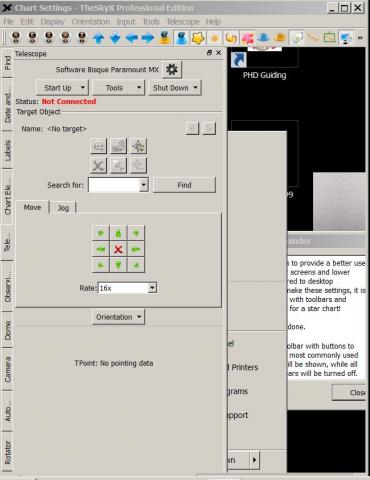
    The main obo computer motherboard malfunctioned. I took it in for repair, the shop recommended transferring the hard drive with all data and programs from my Dell Optiflex 760 duocore to a Dell Latitude 755 quadcore, same operating system Windows 7.

    All good apart from The SkyX Professional edition 2013 which won’t open properly, close other popup windows all of which freeze in the background, also lost the sky map on the right, but it connects to the Paramount MX and guides the telescope.

    So, I reinstalled the program from the disc, but it still shows the same symptoms, it does not want to open/run properly.   

    How do I fix this ?

    Regards,

    Jack
    Attachments:
    #583233

    In reply to: Dome Control

    Tim Haymes
    Participant

    This is a very interesting conversation. In the example of the Pulsar Dome and Rigel controller, i would be interested to learn if anyone has used the LesveDome software and POTH, as described in Sky at Night Magazine 2018 Sept 5
    It can searched in Google.

    I am reluctant to use an advanced application such as SkyX or MaximDL, as this is not my approach to imaging or telescope control, but i would like to control the dome via goto from CdC or similar with appropriate software to control the dome through the Rigel setup.  (I use SkyMapPro and EQMOD).  As you may be wondering, im completely new to the idea of dome control, but i am learning and interested in anyone’s experiences. I don’t currently have a dome.

    The Sky at Night article was written by Steve Richards.

    Thanks – Tim  (a future dome owner)

    #583218
    Dr Paul Leyland
    Participant

    Steer a (virtual) radio telescope around the sky.  Listen to whistlers from Jupiter, the repetitive pock-pock-pock from a pulsar, the loud noise from the sun and the constant faint hiss from the CMB no matter where the receiver is pointed.

    Many years ago I observed the sun with a small dish controlled from the visitor centre at Jodrell Bank.

    #583206
    David Strange
    Participant

    Probably the best person to contact would be Nic Bonne who runs the Tactile Universe https://tactileuniverse.org/  Nic is a  visually impaired professional astronomer who has made a series of 3D printed tactile objects of planets, moons, galaxies etc. Last year at the NLO we ran a one day Tactile Astronomy Day for our local charity Moor Vision https://www.moorvision.org/  We were able to offer NASA braille constellation charts, lunar craters made out of plaster of paris, planets on a string to show scale of solar system and letting students feel a telescope, lens and eyepiece. It was as a rewarding experience for those helping as it was for the visually impaired.

    David

    #583205
    Martin Mobberley
    Participant

    Hi David,

    As you say, without more detail on the severity of the visual impairment, it’s impossible to know what might work, but clearly the more light the better…so, a large aperture telescope pointed at the Moon would surely stand the greatest chance of success….Alternatively >Are there any other facilities that a near-blind child might use to get a sense of the planets?<  There is this chap, Nic Bonne at Portsmouth Uni, who may (Covid restrictions permitting) be able to offer advice…..

    https://www.bbc.co.uk/news/av/uk-england-hampshire-51559823

    https://researchportal.port.ac.uk/portal/en/persons/nicolas-bonne(b0bffcb1-1efe-4853-9678-139071bdcea0).html

    Martin

    #574750
    David Arditti
    Participant

    In my capacity of Director if the Equipment & Techniques Section, I receive a lot of questions from the public.

    I have received one that it is not within my knowledge or experience to answer very well, so I wonder if any colleagues on here have any good ideas about this.

    This is a question about astronomy for a visually-impaired child, but as there is a lack of detail in the query about how great the visual impairment is, it may not be not possible to answer very well.

    Subject: [Contact the BAA] Possible aids for partially-sighted children?

    My friend has a little boy who is fascinated by the concept of the solar system and would love a telescope.  Unfortunately his vision is extremely limited.  His parents are wary of encouraging his interest by buying him a telescope because he would be so disappointed if he couldn’t see anything.
    Have you any suggestions for aids they might use.  Are there any other facilities that a near-blind child might use to get a sense of the planets?
    I realise this is a real conundrum when so much of astronomy relies on sight, but I thought you would be the best people to ask.
    Thank you for your time,
    Etc.

    #583203

    In reply to: Dome Control

    William Bristow
    Participant

    Nick.

    The SkyX dome setup is fairly well described in the manual (with one exception, see below) but here are a few tips from my experience using the smaller 2.2m Pulsar dome, the current Rigel dome controller and ACP/MaxIm with The SkyX and a Paramount.

    Firstly, the dome driver (ASCOM or X2) does very little other than drive to a commanded AZ angle and open/close the shutter, the actual calculations for the position of the slot relative to the OTA are all handled by the observatory control program, in your case TheSkyX.

    While the ASCOM driver for the Rigel dome controller works well in both ACP and MaxIm I found that it was unreliable and rather erratic when used with TheSkyX. I think this is a SkyX issue and nothing to do with the Rigel ASCOM driver and you will find TheSkyX X2 plugin for the Rigel dome controller works more reliably. I use the X2 driver when operating the dome via TheSkyX, for instance when building a T-Point or PEC model for the Paramount, but when running the dome normally under ACP/MaxIm I use the Rigel ASCOM driver where it performs well (in this configuration the dome is controlled by ACP and not TheSkyX).

    You can download the X2 driver for the Rigel dome controller via the RTI-Zone website here.

    Install the X2 driver as described in TheSkyX manual and select it in the dome setup tab, the geometry settings you already have remain intact.

    Measuring accurately when configuring the dome geometry is vital for good OTA-slot alignment. You have to measure to within +/-5mm the mount and optical axis offsets and be sure to set the offset value signing correctly. Beside the mount and optical axis offsets the dome home-sensor offset setting must produce a real AZ value for the slot centre line that is within a degree of the displayed AZ value. To determine an accurate north reference I found using a compass bearing with lots of buried rebar in the dome concrete pad was useless with at least a 7 degree declination from true north at my location. For both pier and dome I used the local noon solar transit shadow method to determine true north, marked that on the dome wall and based my measurements for the dome home-sensor offset from that.

    In TheSkyX dome setup there is one poorly explained setting that is critical for alignment between the OTA and the dome slot. In Dome Setup, Preferences, you will find the setting “Minimum angle from slit edge to telescope position” and it is not explained in the documentation how to determine the angle.

    The starting point for calculating that setting is the formula: Arctan((L-D)/(2R)) where L = Width of slit in mm, D = Effective diameter of the OTA in mm (including guide scope if applicable) and R = radius of the dome in mm. Enter your calculated value in the box for “Minimum angle from slit edge to telescope position” and that should be a good starting value to ensure that the OTA optical axis always remains close to the centre on the slot. If you find any remaining overlap between OTA and slot then increase that value a degree at a time until the overlap is no longer present. For my current 100mm OTA = the calculated value was 8.58 deg and the actual value required was 12 deg to ensure that OTA and separate guide scope always remained aligned with the slot on both sides of the meridian. If that angle value is set too high or too low then the OTA will overlap either edge of the slot on both sides of the meridian.

    Lastly, when driving the dome from TheSkyX the Rigel controller should be set to 0.00 sidereal rate on the control panel otherwise TheSkyX and the Rigel controller will argue over who is in control and the dome will oscillate continually. When driven from TheSkyX the dome does not continually track at sidereal speed but it moves in a series of incremental updates, the larger the diameter of the OTA relative to the size of the dome slot then the incremental updates occur more frequently. For my current 100mm OTA and 560mm width slot the dome increments about every three minutes, when I use a 350mm diameter OTA the dome increments every thirty seconds.

    When setup correctly TheSkyX and the Rigel dome controller work well (using the X2 driver rather than the ASCOM driver) and I do not experience the overlap issues that you are reporting.

    Hopefully there is something above that helps.

    William.

    #574747

    I have a Pulsar 2.7m Dome fitted with The Pulsar Dome Drive for the Azimuth and Shutter for the altitude the later linked by Bluetooth. My 6″ F7 refractor is using ring mounted on my faithful Astro Physics 900 mount. Recent upgrades incluse replacing the optical sensor with a magnetic activator and installing an AP GTO 4 box with Astro Physics Command Software (APCC). APCC has its specific ASCOM driver with SKY X linked by APCC virtual port.

    Rather than using Pulsar on software, the idea of using SKY X Dome to slave the dome to the telescope appeared attractive. Using Pulsar Rigel Software for the Azimuth worked well until the telescope was close to the meridian when tracking moved too fast when set at sideral rate.

    No issues arose when installing SYX dome control I did my best to work out the factors necessary to measure the radius plus the various offsets, shutter dimensions etc. Slaving the dome worked well until pointing to the meridian was reached on either side. Now the telescope is 50% obscurred. I tried various changes to the offsets withoout any improvement.

    It maybe this issue I common to other domes on the market. The mathematics are quite complex.

    Has anyone been more successful?

    #583187
    Nick James
    Participant

    If you really want to put delta-T in a program then there are polynomial approximations such as the ones here. As has been said though you are unlikely to require this for lunar phases. It is important for high precision ephemerides of relatively close objects (including satellites)  since it does affect the parallax correction and, as Dominic says, it is crucial for calculating total eclipse paths. It is probably worth including in telescope pointing algorithms too. Should anyone ever decide to remove leap seconds from UTC it will become important for the general public in a few thousand years!

    #574741
    Tim Haymes
    Participant

    Ade, Thanks for the alert.  I observed the occultation through thin cloud with a telescope (C11). It was at a convenient time after supper, and the Moon was “rising” over the house.   The event was recorded by video, and the passing cloud illuminated by the Moon was quite bright to the camera.  I would say without hesitation that the eye is a better device, but having a recording allows some benefit from the timing perspective or further analysis.   I do enjoy a good naked eye or binocular event.

    I waited for kappa, but the altitude was too low for me and the cloud thicker – 

    #583181

    In reply to: Chocolate telescope

    Alan Thomas
    Participant

    A brilliant idea! Spend hours waiting (unsuccessfully)  for clear skies and then cheer yourself up by eating your telescope. I like it!

    Jeremy Shears
    Participant

    The tile of this paper on ArXiv today caught my eye. It mainly focuses on the effect of climate change (in last 30 years and projecting into the future) on obs made at the VLT site in Chile. You can also read the full paper in Nature Astronomy.

    Essentially, the authors investigate the effect on seeing of local temp rises (also effect on telescope operation), the increase in the surface layer turbulence, and increase in southern subtropical jet stream activity (affecting the adaptive optics and hence on quality of exoplanet obs).

    All-in-all an interesting read. But to be honest I’m more worried about the affect of climate change (and local weather) in south Cheshire. This is insignificant compared to the problems that our colleagues in California are having to deal with regarding forest fires….

    #583167
    Daryl Dobbs
    Participant

    One way to go about it is to find a comfortable position to sit or stand and measure your eyelevel from the ground. Subtract from this the height of the mount from where it would join the pier to the position of the eyepiece when your telescope is at the lowest practical observing position and also when the telescope is at it’s highest practical observing position. That should give you an idea of the pier height. depending on your interests and location you might find there’s a certain ‘band’ of altitude your favorite objects reside in I’m thinking of planets or the Moon which will make choosing the pier height a bit easier.

    Another method may seem a bit odd. But if you get a pole higher than the top of the sides of your observatory you wedge it in the vertical position. This simulates the pier. Next take another pole which will simulate the telescope and tie it with string to what you think is a suitable height to the vertical pole. You then can pivot the pole simulating the telescope up and down to find out if the observing height is practical. If not just untie the ‘telescope pole’ and move it up or down the vertical pole until you are happy with the range of heights from the viewing end where an eyepiece would be. Measure on the vertical pole the point where the ‘telescope pole’ is to the ground and subtract from this the height of the mount and you will arrive at your desired pier height.

    If you change your telescope you might have to put an extension piece on top of the pier or use steps. 

    I hope this helps

    #583165

    In reply to: Chocolate telescope

    David Arditti
    Participant

    Thanks Jack, I’ll put it in the next E&T News. But I’ll keep it separate from the cats, as it would poison them.

    #583159

    In reply to: Chocolate telescope

    Pauline Phillips
    Participant

    Now make a real one…

    #574737
    Mr Jack Martin
    Participant
Viewing 20 results - 501 through 520 (of 1,113 total)