-
Search Results
-
An excellent talk from the Northumberland Dark Sky Festival Week:
From Gateshead to Galaxies: The peculiar history of a Geordie Telescope by Dave Newton
https://www.youtube.com/watch?v=wwBSUVLtSJo
An excellent talk about the RS Newall’s 25-inch refractor at Gateshead. Reputedly, the largest telescope in the world at that time. It appears that Norman Lockyer was a great fan of this instrument and made several 7hr rail journeys up to Gateshead to use it. RS Newall was a wealthy industrialist who had made his money producing wire ropes and undersea telegraph cables.
Following this talk and checking the Nature references I came across these articles all appearing in the 1874 edition of Nature describing the appearance of this Great Comet and some of Lockyer’s observations of it.
Discovered April 17th 1874 by H. Coggia in Marseilles. It developed a tail 43.5 degrees in length 25,000,000 miles in length. Period 10,445 years.
From The Bright Comet Chronicles by John Bortle: COMET C/1874 H1 (COGGIA; O.S. 1874 III). Visible to the naked eye from the beginning of June until the end of Aug.; T = 1874 July 9. For many weeks following discovery almost stationary in Camelopardalis. In mid-June, about fifth magnitude. By the end of the month, third magnitude. In July, began to move rapidly southward. At that time, the comet was in conjunction with the sun but far north of it in Lynx and visible all night On July 6th, of second magnitude with a 10-degree tail. On the 13th, brighter than nearby Capella and displaying a 20- to 30-degree tail. By July 18, comet’s head was lost in twilight, but a 48-degree tail observed. Two nights later, tail up to 63 degrees long. Comet passed between the earth and sun on July 20. Thereafter, visible only from the Southern Hemisphere. Passed near Procyon on July 23 — head similar in magnitude. At the end of July, a second-magnitude object to the southeast of Sirius. In mid-August, situated not far from Canopus and of fourth or fifth magnitude.
Lockyer’s drawing of Comet Coggia on July 12th 1874:
https://www.dropbox.com/s/fyy7poqeb04fbm3/Lockyer_coggia_3.jpg?dl=0
Lockyer’s article to the Times, describing “his poor and tiresome description of the magnificent and truly wonderful sight presented to me…” through the 25” Newall refractor:
https://www.dropbox.com/s/r4iue16jrel4eam/Lockyer_coggia_1.jpg?dl=0
Second part:
https://www.dropbox.com/s/kc096msx44ksrqd/Lockyer_coggia_2.jpg?dl=0
His observations through his own 6.25” refractor on June 25th 1874:
https://www.dropbox.com/s/sbwpfpadmvzyqt6/Lockyer_coggia_4.jpg?dl=0
It would appear that Comet Coggia reached about magnitude 1-2. It showed much structure in the nuclear region similar to our own views of Hale Bopp. It would certainly have received as much public attention as Neowise did for us this past summer.
Even though it was that bright you do feel sorry for those old Victorian astronomers. When trying to photograph the comet through the 25″ Lockyer writes: “A photograph exposed for ten minutes gave no results!”
Cheers,
David
Topic: Mars Landing in Real Time
Great fun watching the Mars Perseverance lander in real time while observing Mars in real time. On the monitor is NASA TV, on the laptop is Mars through the C11 telescope and a processed image.

Wonderful to know that somewhere in these pixels are several orbiters from several nations with rovers (and soon a helicopter) exploring the surface.
Looking closely at the image, at centre stage is Sinus Sabeaus – the Opportunity rover’s playground.

Perseverance’s landing site on Syrtis Major and Jezero crater (with evidence of flowing water) are over the limb on the right hand side. Hence, NASA were using the Mars orbiters as a radio relay to bring the telemetry back to Earth.
With some careful averted imagination, you can see the probe under its parachutes and the glint from the heatshield 🙂
Topic: Theodorus Blethyn
Does anyone have information about this 17th century telescope maker based in London. Blethyn is a Welsh name.
Jack
Topic: CMOS for Photometry
I am starting to take images of asteroids and have obtained my observatory code. I use an ATIK Horizon Series 1 CMOS camera on a LX200 Classic 10 inch telescope.
Software is AstroArt 7 for imaging and Astrometrica is used to process the images.
The ATIK Horizon has a facility to change the gain setting which I believe is supposed to enable a higher SNR if the gain is increased.
Does anyone have experience of the use of this camera or the ZWO ASI1600 which uses the same chip and also has variable gain.Wayne
A new initiative to include amateurs in the professional organization is being launched at the 237th Meeting, 10-13 January 2021. In 2016, Amateur status was added to the membership categories. Now, the AAS is extending its initiatives for inclusion by actively seeking engagement at the conferences. Ahead of that, an ad hoc committee of correspondence was launched by several AAS members. We held our first meeting online on 16 December.
Speaking to the group, AAS publicist Rick Fienberg underscored the fact that when the AAS was founded in 1899 a significant fraction were amateurs. However, the birth of astro-physics with spectroscopy meant that by the early 20th century the communities already were diverging. Amateurs fell away. Then, by the 1990s, amateurs were equipped with CCD cameras, spectrographs, and now are doing good science in collaboration with professionals. It made sense for the AAS to open its arms to the amateurs in 2016. Now we have 300 Amateur Affiliates. Also, the AAS recently purchased Sky & Telescope magazine. That being as it may the AAS opened the membership to amateurs ahead of a defined rationale. So, in the summer of 2019, the Board of Directors created a task force to develop a coherent set of programs and benefits.
An 8 August 2018 press release said: As long as amateurs do not depend on the field of astronomy as a primary source of income or support, they are now welcome to join the AAS as Amateur Affiliates.
Applicants are required to be a member of an affiliated organization, such as an astronomy club that belongs to the Astronomical League; the Association of Lunar and Planetary Observers (ALPO); the Astronomical Society of the Pacific (ASP); the American Association of Variable Star Observers (AAVSO); the Society for Astronomical Sciences (SAS); the International Meteor Organization (IMO); the International Occultation Timing Association (IOTA); the Society of Amateur Radio Astronomers (SARA); or the Citizen Science Association, to name a few.
Dues for Amateur Affiliates will be $52 for 2019. Inaugural benefits include reduced registration fees to AAS meetings, access to the AAS family of journals, and the annual AAS Wall Calendar. Additional programs and opportunities are expected for this group once a critical mass is established for survey and feedback purposes.
The Session Notes from the Convention Schedule – Jan 14 2021 6:50PM – Amateur Astronomers Meet & Greet
“Recognizing the increasingly important role of backyard stargazers in astronomical research, science advocacy, and public outreach, the AAS recently created a new membership class: Amateur Affiliate. Subsequently the Society became the owner/publisher of Sky & Telescope after the magazine’s former owner went out of business. As 2021 begins, the AAS has about 300 Amateur Affiliate members. Many of them, as well as many S&T readers and other amateur astronomers who haven’t yet joined the Society, have registered to attend AAS 237. If you’re among them, please join us for this virtual get-together. (Others interested in meeting an engaged group of astronomy enthusiasts are welcome too!) In addition to getting to know each other, we’ll hear from Rick Fienberg, AAS Press Officer and former S&T Editor in Chief, about how the AAS plans to bring professional and amateur astronomers closer together for our mutual benefit. You’ll also have an opportunity to offer your own ideas about how the AAS can be more supportive and encouraging to amateur astronomers.”
According to Denis Denisenko there is a conjunction between ASASSN-20pv, a cataclysmic variable receiving some attention at the moment, and a “likely new comet NEOWISE”. He notes:
QUOTE
….there is a rare opportunity to observe two very
interesting 15m objects in one CCD field of view. For the next 48 hours the
newly discovered NEOCP object N00ht7m (likely new comet NEOWISE) will be
located less than 45 arcmin from ASASSN-20pv. The close approach to within
13′ takes place around 16h UT on Jan. 07th.Geocentric ephemeris with one-hour step is below. The last column gives the
distance between two objects in arcminutes. The position of ASASSN-20pv
itself is 10 40 19.5 -49 51 30. Depending on the FOV of your telescope, you
may need to adjust the pointing to fit both objects. N00ht7m is moving in
position angle about 292 (towards west-north-west) at 2.0 arcseconds per
minute (2 arcmin per hour). Obviously this opportunity is for southern
hemisphere observers only.If you have the observatory code at MPC, please report the observations of
N00ht7m to Minor Planet Center in MPC format with the keyword “NEOCP” in
the Subject line.NEOCP
——————————————–
Year MM DD UT R.A. (J2000.0) Decl. Dist
——————————————–
2021 01 06 11 10 46 12.6 -50 00 04 57.5
2021 01 06 12 10 46 01.7 -49 59 24 55.6
2021 01 06 13 10 45 50.8 -49 58 44 53.8
2021 01 06 14 10 45 39.9 -49 58 04 52.0
2021 01 06 15 10 45 29.0 -49 57 23 50.2
2021 01 06 16 10 45 18.0 -49 56 43 48.4
2021 01 06 17 10 45 07.0 -49 56 02 46.5
2021 01 06 18 10 44 56.0 -49 55 21 44.7
2021 01 06 19 10 44 45.0 -49 54 40 42.9
2021 01 06 20 10 44 33.9 -49 53 58 41.1
2021 01 06 21 10 44 22.8 -49 53 17 39.2
2021 01 06 22 10 44 11.7 -49 52 35 37.4
2021 01 06 23 10 44 00.6 -49 51 53 35.6
2021 01 07 00 10 43 49.4 -49 51 11 33.8
2021 01 07 01 10 43 38.2 -49 50 28 32.0
2021 01 07 02 10 43 27.0 -49 49 45 30.3
2021 01 07 03 10 43 15.8 -49 49 03 28.5
2021 01 07 04 10 43 04.5 -49 48 19 26.8
2021 01 07 05 10 42 53.2 -49 47 36 25.1
2021 01 07 06 10 42 41.9 -49 46 53 23.4
2021 01 07 07 10 42 30.6 -49 46 09 21.8
2021 01 07 08 10 42 19.2 -49 45 25 20.2
2021 01 07 09 10 42 07.9 -49 44 41 18.8
2021 01 07 10 10 41 56.4 -49 43 56 17.4
2021 01 07 11 10 41 45.0 -49 43 12 16.1
2021 01 07 12 10 41 33.6 -49 42 27 15.0
2021 01 07 13 10 41 22.1 -49 41 42 14.1
2021 01 07 14 10 41 10.6 -49 40 57 13.4
2021 01 07 15 10 40 59.0 -49 40 11 13.0
2021 01 07 16 10 40 47.5 -49 39 25 12.9
2021 01 07 17 10 40 35.9 -49 38 40 13.1
2021 01 07 18 10 40 24.3 -49 37 53 13.6
2021 01 07 19 10 40 12.7 -49 37 07 14.4
2021 01 07 20 10 40 01.0 -49 36 20 15.4
2021 01 07 21 10 39 49.3 -49 35 33 16.7
2021 01 07 22 10 39 37.6 -49 34 46 18.0
2021 01 07 23 10 39 25.9 -49 33 59 19.5
2021 01 08 00 10 39 14.2 -49 33 12 21.1
2021 01 08 01 10 39 02.4 -49 32 24 22.8
2021 01 08 02 10 38 50.6 -49 31 36 24.5
2021 01 08 03 10 38 38.7 -49 30 48 26.3
2021 01 08 04 10 38 26.9 -49 29 59 28.2
2021 01 08 05 10 38 15.0 -49 29 10 30.1
2021 01 08 06 10 38 03.1 -49 28 21 32.0
2021 01 08 07 10 37 51.2 -49 27 32 33.9
2021 01 08 08 10 37 39.2 -49 26 43 35.9
2021 01 08 09 10 37 27.2 -49 25 53 37.9
2021 01 08 10 10 37 15.2 -49 25 03 39.9
2021 01 08 11 10 37 03.2 -49 24 13 41.9UNQUOTE
Angular resolution in radians = 1.22 times the quotient (wavelength / aperture)
Make sure to keep the units the same, wavelength may be in angstroms; aperture may in inches. So, do the conversions first.
For example, a telescope with a 10-inch lens is assumed to be observing in the visible spectrum. Assume the middle range. The last step is to convert radians to arc seconds.
Answer: 0.54 arc seconds.
My telescope has an aperture of 102 mm.
Answer ranges 0.98″ (violet) to 1.72″ (red)

Attachments:
Topic: Hirshfeld’s Parallax
Parallax: The Race to Measure the Cosmos by Alan W. Hirshfeld, W. H. Freeman & Co., 2001.
The title of the book could be a metaphor for the history of astronomy. We tend to view the history of astronomy as if through one eye: the arrangement of the universe, from the geocentric to the heliocentric model, to the understanding that our own Milky Way is not the universe, but just one of billions of galaxies. Viewing the history of astronomy through the other narrative eye of discovering the size and scale of the universe reveals the depth of the problem and of the geniuses who attempted to solve it. Hirshfeld traverses the history of astronomy by following the track of parallax. The writing is direct, intended for the interested and educated general reader.
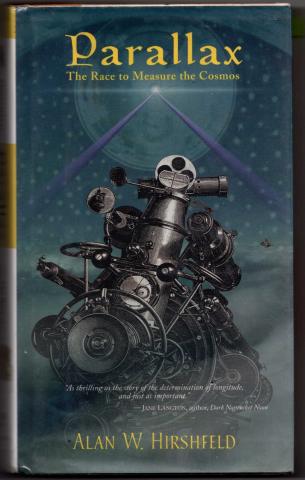
If the Earth orbits the Sun, then the planets and the nearest stars would seem to shift in position relative to the farthest background. Archimedes tried to measure it. Galileo tried. It was not until 1838-1839 in close succession and working independently that Friedrich Bessel, Thomas Henderson, and Wilhelm Struve were successful.
Of necessity, our macroscopic sense of place paralleled the discovery of the microscopic. The same lenses served both purposes. It is telling that Joseph Fraunhofer’s 1829 heliometer, the most exacting measuring telescope created up to that time, included a microscope for reading its extremely precise scale.
Science is an integration. Internally consistent theories explain observable facts. It is how we know anything. More to the point, facts and theories do not exist in isolation. Seeming contradictions must be resolved or eliminated. That speaks to the problem of parallax. Herschel’s case, in particular, exemplified the exacting standards to which all scientists adhere. It can be hard to know when your very correct theory only awaits the predicted facts and when the discovered facts demand a new theory.
“Photography of the heavens is one area of astronomy in which amateurs have made, and continue to make, significant contributions.” (page 273)
Like Galileo and the savants who followed, Herschel expected that all of the stars are more or less arrayed at random, that the universe is uniform. Thus, stars that appear to be close to each other are not physical companions. This led astronomers to seek pairs of stars, one much brighter than the other in the expectation that the brighter was the nearer of the two and thus a good candidate for measuring parallax. After years of searching with a behemoth reflector, Herschel announced on July 1, 1802, that many double stars are indeed gravitationally locked.
Also integral to the scientific method, established truths are validated by new discoveries. Following the successful measurement of parallax ten new uses were developed for it.
Alan W. Hirshfeld is currently Professor of Physics, and Director of the Observatory at the University of Massachusetts at Dartmouth, and an Associate of the Harvard College Observatory. He serves as the chair of the History of Astronomy Division of the American Astronomical Society.
Attachments:

British Astronomical Association
Supporting amateur astronomers since 1890


