
-
AuthorSearch Results
-
2 April 2019 at 7:30 pm #580924
In reply to: The Repair Shop
 David ArdittiParticipant
Of course Mark also collected and restored a large collection of instruments manufactured by the Hysom brothers’ firm AE between the 1960s and 80s. This included a 10″ Relay-lens Dall-Kirkham Cassegrain that I used to use (I described this instrument in JBAA 2007 April) that was also reputedly part-made by Dall. I don’t know if he still has this curious collection.
2 April 2019 at 6:58 pm #574299Topic: Observatory computer setup
in forum General Discussion Eric WatkinsParticipant
My observatory computer has died after several years, and I now need to sort out a “new” reconditioned one for the domed observatory with de-humidifier.
It will control a Paramount MEII mount using MaxIm DL via The Sky X + PhD2.
No doubt I will now be using a Windows 10 machine. I have heard stories regarding Windows 10, particularly now that one can not stop Windows 10 updates, of the telescope/camera side of things failing the following day after a perfectly run night.
Does anybody have any experiences similar to the set up proposed with Windows 10.
I had thought of running the above software with a Linux OS machine, but using a Windows 10 emulator to run the software.
Any suggestions?
Eric
1 April 2019 at 5:27 pm #580919In reply to: I would use my telescope more if easier
Michael John White
ParticipantThank you to everyone for their comments. I have a lot to learn and am grateful for all that advice. I am under light polluted Walsall (UK) skies and have to consider reaching a balance between affordability and reality in what can be achieved. I really do have a lot to learn, so thank you all for your comments.
29 March 2019 at 5:33 pm #580914In reply to: I would use my telescope more if easier
 Alan ThomasParticipant
Hello Mike
I have had a variety of telescopes over the years. Never having been able to justify to myself (and my wife!) establishing a permanent observatory, all have had to be set-up anew for each observing session. Some have had robust EQ mounts that almost brought on a back problem moving them! Others had GOTO systems which took even more time to operate than the basic setting up.
These telescopes spent a lot of time doing nothing (a familiar problem). In the end, I reverted to simplicity and bought a 200mm Dobsonian. Setting-up takes me a couple of minutes, the OTA is relatively light and manoeuvrable and is stored in a nearby shed. I have spent more time at the eyepiece with this telescope than all my previous instruments put together, mainly because it is so quick and easy to set up..
This will not necessarily prove an ideal choice for imaging. But if you want something easier than your current set-up, something that will increase your observing time and that will not endanger your health, you may like to consider it.
Good luck!
27 March 2019 at 7:52 pm #580907In reply to: I would use my telescope more if easier
Hi John.
For many years before I bought a Pulsar Dome I had my telescope mounted on a pier and used the TeleGizmos Telescope Cover which meant there was no need to lug it in and out of the house every clear night. The only thing then required was a)_ Polar alignment and b) to attach the cables.
With regard to a) this was easier as I had a polar alignment scope.
Hope this helps
Nick
26 March 2019 at 9:18 pm #580904In reply to: Sky & Telescope in trouble
 Nick JamesParticipant
This is an interesting read.
26 March 2019 at 5:28 pm #580902In reply to: I would use my telescope more if easier
David ArdittiParticipantThere seem to be two issues here: weight (back problem) and setup time.
These are common problems. I deal with them in my book ‘Setting-up a Small Observatory’ (Springer), and we’ll deal with them again at the Equipment & Techniques Section meeting on 17 November.
I think you have 6 general choices, which address, or not, the two issues, in different ways:
- Leave the tripod and wedge outside, polar aligned, cover it with some sort of cover, and just move the telescope and other equipment in and out each night (may not address weight problem)
- Leave the telescope and tripod outside and cover it with some sort of cover or box, either flexible or rigid, that is completely removed when you observe (might address both problems)
- Build a proper observatory (addresses all problems in the long term, but may be difficult or expensive)
- Get a system that breaks down better into lighter components, maybe tripod, German equatorial mount with dovetail fitting, and optical tube (may not solve setup time problem)
- Get a smaller telescope (solves most problems, but not good for planets)
- Get a tracking alt-az or Dobsonian system (may not solve weight problem)
Damian Peach seems to leave his C-14 outside most of the time, just covering it over with a fabric cover, and it survives. In my experience this method results in corrosion, however, and of course you’ve got a big security problem. You still need to disconnect and take in all the camera etc. More of a proper shelter or box, such the one Richard Miles built, is better. This kind of solution, if well done, allows you to leave everything outside, including cameras, power supplies and wiring, and this saves an immense amount of time.
Nothing really beats an observatory for time-saving and back-saving convenience, and at the meeting on 17 Nov I’ll be describing a ‘An observatory from a £100 shed’.
But going back a stage, without building anything, you do mention polar alignment taking ‘impossibly longer’. Imaging planets does not require very accurate polar alignment, so I wonder if you are making too much of a meal of this. Increasingly also people are using the new CMOS-based cameras from companies like ZWO and Altair to do deep sky imaging in a more ‘planetary’ manner, using stacks of short exposures (1-10s). Then they really don’t need accurate polar alignment at all. In fact planetary imaging, and this sort of short-exposure imaging of brighter deep-sky objects, is possible with the tracking alt-az or Dobsonian system I mention as option 6.
There’s a lot to consider, and in the end only you can tell what your best convenience/performance/expenditure compromise is.
David
Director, Equipment & Techniques Section
26 March 2019 at 2:27 pm #580899In reply to: I would use my telescope more if easier
 Martin MobberleyParticipant
Hello Mike,
It’s tricky to give precise advice without knowing a bit more about your observing ‘site’. Any kind of fixed pillar in a lawn, or backyard, can be a huge advantage, even if a crude observatory is not possible. Setting up each night is a huge hassle, even for someone without a bad back! Before the planets sank so low I used to do quite a bit of planetary imaging with a 12-inch Newt. on wheels.
See: http://martinmobberley.co.uk/images/Orion12inch_f5p3_mpm.JPGThe entire telescope just rolls out on a carpet from a wooden shelter attached to the house wall. After the telescope was polar aligned for the first time I knew by looking at the angle the base/wheels made with the lawn/paving slabs when the base was correctly aligned. In fact, under the carpet I made crude marks on the slabs indicating where the wheels should sit. This only guarantees polar alignment within a few degrees, but for 2 minute imaging runs on, say, Jupiter, it is more than good enough. Yes, you will get declination drift and a small amount of field rotation, BUT, compared to the problems of atmospheric seeing it will be negligible when the images are stacked with, say, AutoStackert! Deep Sky imaging is more of a problem (especially if you want to use accurate Go To) but, as Grant says, even with Alt-Az systems you can do very short exposures before field rotation trails the stars.
On a few occasions I used a small, fast, system on wheels to image big Deep Sky objects or comets like 17P/Holmes. This was a160mm f/3.6 Takahashi E160 on a Vixen Sphinx mount. See attached image…..
Occasionally this wheeled out on plastic rails, but on other occasions I just wheeled it around the lawn and literally ‘guessed’ the polar alignment by aiming the tube along the polar axis and getting Polaris centred. This was more than good enough for multiple 30 second exposures! If I was planning several sessions over a week I’d just leave the system outdoors covered with a tarpaulin!
Martin
25 March 2019 at 8:00 pm #574293Topic: I would use my telescope more if easier
in forum ImagingParticipantHi folks,
I am a new member of the BAA. I have a MeadeLX90 8” and a few basic cameras such as the Meade DSI colour and the Meade DSI pro. I have been limited in what I can do because of a back problem. Setting up takes forever, and polar alignment makes it even longer, impossibly longer. I would dearly love some advice on how I can make it easier to have a way of going outside and drop the telescope onto something and be up and running In a matter of a few minutes.
I have the field tripod the LX90 came with, I have since bought a wedge (not the superwedge), and I know I need to upgrade the setup, but am not sure how. I would be prepared to upgrade to a more expensive scope, but I realise its important that the mount has to come first. My primary interest is in DSO and planets.
I would dearly welcome advice.
Thank you,
Mike White.
21 March 2019 at 8:16 pm #580884In reply to: Opportunities for amateurs
Dr Mark Salisbury
ParticipantI’m of the opinion that single small telescope, weather limited transit searches such as those that can be run from the UK will struggle to make headway. In part this is because the large scale survey projects, especially space based ones like TESS, are quickly hoovering up all the low hanging fruit that is likely detectable with amateur equipment but also because there are already so many transiting Exoplanets now that the professional observatories have a hard time following them up and undertaking long term monitoring, creating an ideal niche for amateurs to fill. There is a lot of good science to be had from observations of already known systems.
All that said, there are many viable alternative approaches for getting involved in new Exoplanet discoveries, all of which stand the best chance when working as part of a widely (global) dispersed pro-am team. The first is candidate winnowing where you increase your chance of success by observing targets already suspected to host transiting Exoplanets. Another is by observing known transiting systems on the basis that if there is one transiting planet already then you know the system is preferentially aligned, increasing the chance of discovering additional planets. A third approach is via transit timing variations (TTV’s) when the transit times are measured precisely enough to detect the effect of (unseen) companions as they interact gravitationally with the transiting planet. This is one of the most powerful techniques in Exoplanet observing, used extensively in the Kepler data set and which has already led to discoveries from small telescope observations e.g. https://arxiv.org/abs/1806.03503. There is one final approach which is to undertake searches using publicly available survey data, which doesn’t even require a telescope.
I guess what I’m trying to say is that there’s many ways to get involved in one of the fastest moving and most exciting areas of astronomy (in my unashamedly biased view).
18 March 2019 at 10:24 pm #580872Nick JamesParticipantIf anyone wants to have a play I attach a couple of undriven images of the pole. One was taken when I was polar aligning my mount in Jan 2018, the other was taken tonight. They are both 600s exposures with the same camera/telescope and the FoV is 36×24 arcmin. The original FITS files are here.
18 March 2019 at 12:11 pm #580868In reply to: Sky & Telescope in trouble
Alan ThomasParticipantIt looks as if the publishing company has gone under, but the title may survive. It would be a pity to see this venerable name consigned to history. It raises the question of how many astronomy magazines the market can support . . .
17 March 2019 at 5:42 pm #580864In reply to: Sky & Telescope in trouble
 Mr Robert Jonathan MarshallParticipant
Sad sad news, but no surprise. I stopped subscribing to S&T about 6 years ago, as there became less and less material on observational astronomy, and, more to the point, the telescope and equipment side of amateur astronomy. S&T survived in an era when many amateur’s still built their own telescopes. Those days seem to be gone, sadly, and this venerable publication has lost it’s way in the modern astronomical age.
13 March 2019 at 7:25 am #580856In reply to: Sky & Telescope in trouble
 John ChuterSpectator
I belong to another forum which has discussed this disappointing news. I stopped subscribing a while ago for many of the reasons already stated.
Some posts on the other forum have been giving links that may be of interest to those of us who find digital content useful, as I do.
This one goes to archive.org which are the PDFs of 1625 past copies of S&T
This one is to an index as a spreadsheet which is quite good if not in complete detail
https://s22380.pcdn.co/wp-content/uploads/stindex-thru-December-2018.xls
Still available on the S&T website are DVDs of ‘The Sky’ and ‘The Telescope’ which were two separate publications prior to their merging in the early 1940s into S&T.
https://www.shopatsky.com/sale-clearance
The link above shows the two mentioned along with many other items, one of which, interestingly, is the BAA sky chart prepared by Wil Tirion some years ago now!
It appears that the DVDs that were once on sale with many old S&Ts are not now available.
Hopefully this is of interest to some members.
As mentioned,I find digital content very useful as it can be readily searched in this computer age, for items of interest, but I also enjoy collecting the ‘old fashioned‘ paper versions as well, mainly books, but that is for another thread.
12 March 2019 at 5:57 pm #580853In reply to: Sky & Telescope in trouble
 Denis BuczynskiParticipant
I have collected S@T from 1950 to 2012 and stopped taking it when it became so much poorer than it used to be. The highlight of my postal month used to be when S@T dropped through the letterbox. Then it became a huge disapointment as I looked at the reduced number of pages and the loss of serious observing advice by experts such asthat given in John Bortle’s Comet Digest. The relegation of the ATM telescope making pages to a single page was a big loss. The editorials seems to be concentrated on what the editorial team was doing rather than highlighting the latest developments in astronomy. Can S@T survive and become a popular magazine for amateurs and regain some of the prominence it once held. I hope so, but I am not holding my breath!
11 March 2019 at 8:05 pm #574281Topic: Sky & Telescope in trouble
in forum General Discussion Lars LindhardParticipant
This is bad news, I’m afraid…
 10 March 2019 at 2:07 pm #580834
In reply to: DSLR mounted red dot finder
 Roy HughesParticipant
Someone has beaten you to it.
Just found a 3D printed adaptor on ebay!
“Telescope red dot finder to Camera Hotshoe mount New 3D printed”
Roy
7 March 2019 at 6:00 pm #580812In reply to: Hubble Constant.
 Tim HaymesParticipant
I didnt see the program, but a quick search of the internet indicate you are not alone thinking this:
https://www.space.com/25179-hubble-constant.html
“As of January 2018, measurements from multiple telescopes showed that the rate of expansion of the universe is different depending on where you look. The nearby universe (measured by the Hubble Space Telescope and Gaia space telescope) has a rate of expansion of 45.6 miles per second (73.5 kilometers per second) per megaparsec, while the more distant background universe (measured by the Planck telescope) is a bit slower, expanding at 41.6 miles per second (67 km per second) per megaparsec”
This could be a significant observation.
4 March 2019 at 8:40 pm #580798 Robin LeadbeaterParticipant
Hi Kevin,
With the manual dispersion function in ISIS you double click either side of each line in the uncalibrated (combo) spectrum and ISIS calculates the exact pixel position of the centroid of the line and enters the value in the table. You have to tell it to look for either an emission or absorption line within the two clicked positions though (buttons at the top of the window) so you would need to click “absorption” before measuring the water line positions and “emission” before measuring a lamp line.
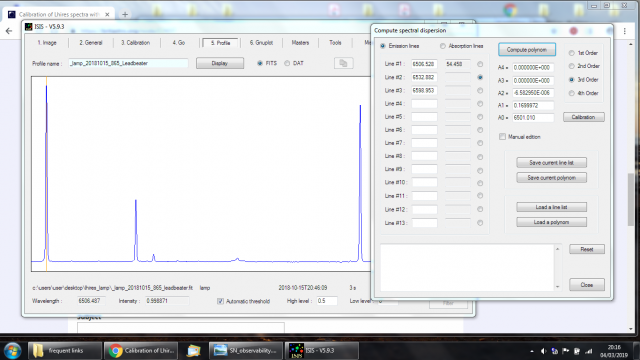
Yes, if you set the reference line to 0,0 it just uses the predefined dispersion equation but if your dispersion was measured on a reference star with the telescope pointing in a different direction to the target, this can be out by a constant shift due to flexure so adding a reference point using a lamp spectrum corresponding to the target will correct for this. (correcting the constant in the polynomial)
Robin
4 March 2019 at 5:06 pm #580796In reply to: Bresser Telescopes
Mr Robert Jonathan MarshallParticipantHi all,
I’m back on the hunt for a decent telescope setup. Having read through all the very helpful replies, particularly from Peter and David, I am still considering a refractor, but ditching the idea of a Bresser, mainly because of unknown quality. However, although it’s much more costly, I think the latest Starwave Ascent 102 ED/F11 on a Skywatcher HEQ 5 mount might be a worthwhile combination? The previous Starwave 102/F11, non ED (and much less expensive) is now sadly discontinued, but reviews of this one are good. So, does anybody have any experience of the ED version, is it worth the extra dosh, or would It be better to seek out a 2nd hand earlier non ED version? Also, is the HEQ5 mount overkill, and would a EQ 5 be adequate? I realise that one can never spend too much on a good mount, but I don’t need to go silly with the hard earned funds. Also, there are still my stairs to consider, as mentioned previously, so that has to be taken into consideration.
Sorry to bend everybody’s ears on this one again, but I really don’t want to get something that is rubbish. I have banished the thoughts of Vixen and Takahashi…..over the top for me!
-
AuthorSearch Results
Search Results for 'espin telescope'
-
Search Results
-
Topic: Observatory computer setup
My observatory computer has died after several years, and I now need to sort out a “new” reconditioned one for the domed observatory with de-humidifier.
It will control a Paramount MEII mount using MaxIm DL via The Sky X + PhD2.
No doubt I will now be using a Windows 10 machine. I have heard stories regarding Windows 10, particularly now that one can not stop Windows 10 updates, of the telescope/camera side of things failing the following day after a perfectly run night.
Does anybody have any experiences similar to the set up proposed with Windows 10.
I had thought of running the above software with a Linux OS machine, but using a Windows 10 emulator to run the software.
Any suggestions?
Eric
Hi folks,
I am a new member of the BAA. I have a MeadeLX90 8” and a few basic cameras such as the Meade DSI colour and the Meade DSI pro. I have been limited in what I can do because of a back problem. Setting up takes forever, and polar alignment makes it even longer, impossibly longer. I would dearly love some advice on how I can make it easier to have a way of going outside and drop the telescope onto something and be up and running In a matter of a few minutes.
I have the field tripod the LX90 came with, I have since bought a wedge (not the superwedge), and I know I need to upgrade the setup, but am not sure how. I would be prepared to upgrade to a more expensive scope, but I realise its important that the mount has to come first. My primary interest is in DSO and planets.
I would dearly welcome advice.
Thank you,
Mike White.
Topic: Sky & Telescope in trouble
This is bad news, I’m afraid…

