I’ve not seen any recent imaging or photometry, which I think is why Tom Killestein is calling for observations.
It is located 15″.8 west and 0″.3 south of the center of NGC 6004.
This is a pretty faint SN (mag 17.4 at discovery), so you will need a fairly large telescope and long exposures (minutes). The London skies won’t help, but give it a try – you never know what you might turn up.
Very interesting. This is a very small galaxy (obviously) less than 2 arc minutes. Do you have an ideal focal length/size of telescope to image it, it is still relatively low in the sky in the London area.
This is just a bit of light-hearted idiocy, so please don’t take it too seriously.
On Xitter today I saw that the Moon lies close to the Pleiades at the moment. My telescope doesn’t have absolute positioning but I can see the Moon through the finder and I can determine its position with MaximDL. Why not, I thought …
A quick snapshot (only 0.05s) through a Sloan i’ filter (to darken the sky as best I can) showed craters very nicely. Syncing the mount with the lunar position told the telescope where it was pointing to within 10 arcmin or so. I then slewed to Alcyone, and saw nothing. The field of view is only about 13 arcmin so it was not too surprising that no stars were visible.
Lots of slewing around pretty much at random produced a number of images which show stars. Unfortunately I have not yet been able to identify any of them but I am sure that they are members of Messier 45. Local solar time was between 13:30 and 14:00.
Encouraged by this success I may try to do a better job some time. It will require cleaner optics and a less hazy sky, presumably. The sky isn’t bad today but I have certainly seen it better. Another possibility might be to use the Moon, Jupiter or Venus (all of which are readily visible through the finder) for an initial position and then search for something as bright as Sirius or Rigel or Betelgeuse to refine the mount’s co-ordinates. A few half-hearted attempts at image processing also made the stellar images more readily visible.
If any more progress is made, I may try for other bright Messier objects by daylight. Only star clusters may be feasible, I guess. If anyone else would like to have a go, please report your success or lack thereof.
Hello all,
I would like to participate in the 2024 asteroid observation campaign. The Asteroids & Remote Planets page lists the asteroids 2240 Tsai and 5099 Iainbanks as a possible targets for 2024.
At the moment I have started with the 2240 Tsai in series of images to determine the variations in magnitude. I’ve never done this kind of measurement on asteroids before, so any help from the BAA would be very welcome. Could you please tell me to whom I should send my observations and comments?
Thank you.
The equipment used is as follows:
RC 406mm f/8 telescope + V Johnson photometric filter + Moravian G4-16000 CCD camera
Pixel scale: 1.14″/pixel
Star catalog: CMC15
Software: Astrometrica and Tycho
Joan Genebriera
Astropriorat Observatory, Catalonia, Spain MPC code M02
http://www.astropriorat.blogspot.com
Very sad news, have always been a pleasure to deal with David, he was a skilled telescope maker.
My condolences to his family and friends.
Simon Briggs
I was recently contacted by Mark Murray who is involved with the restoration of the Great Melbourne Telescope made by Thomas Grubb in Dublin. He is looking for the original plans for the telescope. I suggested he try the Tyne and Wear archives but these probably relate to Grubb Parsons activities in Newcastle. If anyone can help Mark can be contact by his email: mark@artinconstruction.com.au
Thanks,
John Nichol
I have only just learnt that David Lukehurst of Nottingham, a prominent maker of Dobsonian telescopes, passed away unexpectedly on 4th January, 2024.
David made a wooden optical tube assembly for an 16″ F:6 mirror I had and mounted onto a Paramount MA gem. The system works well and is used for photometry of comets and asteroids.
David was a quiet, soft spoken gentleman who’s work and word could be relied upon. I had hoped to have had further dealings with him, but alas yet another British telescope maker passes over.
My condolences to his wife, family and friends.
Eric Watkins
-
This topic was modified 2 years, 9 months ago by
 Eric Watkins.
Hello Giovanni. That is sad to hear about the light pollution around your home. 15 years ago I had the opportunity to stay with relations in Agerola, above the coast of Amalfi. I was so excited and just had to pack a telescope to take with me. On arrival I realized I should have left it at home. It was impossible to find anywhere to escape the glare of a light. They were coming at me from every conceivable direction. I have been back many times to spend time with family but no telescope is needed.
Paul, it’s an object discovered in WISE data. It is an elliptical ring, visible faintly in W1, but mainly in W2.
The team have taken a J band image from the Palomar 200-inch telescope, but could only get a faint detection of the nebula that overlaps the star inside the ring. They weren’t been able to detect the ring itself. While the ring is only detected in the infrared so far, the inner nebula does have an HSC (an instrument on the Subaru telescope) r-band detection from an archival PI large area survey, so we know that there is some visible light stuff going on too. R band on subaru coincides with the 656nm Halpha line, so we think that’s the best shot at getting a detection from the ground. While we don’t see a sign of a white dwarf at the centre of the ring, it is theoretically possible that this is some sort of strange planetary nebula or supernova remnant.
The coordinates of the approx centre of the ring are 04:27:05.688 +34:15:00.00
Peter
I found Mark Stuart’s “Exploring the cosmic tapestry” very entertaining. Chris Lee’s talk on Electronically Assisted Astronomy wetted my appetite for giving this a go. I like the idea of a telescope that can be quickly and easily setup and controlled from indoors.
Andy
I have an account at iTelescope with about 800 points I am not using – they have accumulated throughout a few years. I am thinking about canceling my subscription there, but this means I’ll loose all the points in 12 months. I would be glad to donate the account for something useful, so if you need telescope time, please let me know.
Max
Good evening Peter,
I hope you don’t mind. But I have just posted a link to your advert on our Macclesfield AS message board. Our society are affiliated members. And I thought this might be of interest. It is an excellent telescope. I have one.
The first four months were good and then disaster struck. On sliding open my heavy observatory roof my wet shoes slipped on the floor when the roof jammed. Came down on the telescope pier with my back, shoulder and elbow. Cracked bones and tore ligaments. Still cannot open and close roof on my own. Working on a solution to the problem. Hope to be back in action very soon.
I also did not keep accurate records in 2023 (a new years resolution for 2024 again – sure to fail though 😉
But I photographed aurora on 13 nights.
Had 6 nights clear and dark enough for wide field imaging (including comets)
Just 6 visual deep sky observing sessions (limited by dark of Moon periods, and telescope issues)
39 solar observing sessions in h-alpha
Night time observing is severely restricted from May to July due to the light nights at 59 degrees north.
Callum
TS Optics Imaging Star71 … 71mm f/4.9 Imaging Apo for big sensors
5 elements – FPL-53 optical system for color free apochromatic performance covers 45mm full frame imaging circle.
The TS Optics Imaging Star71 imaging APO telescope provides pinpoint stars at the very edge of a 45mm imaging circle.
The 347mm focal length and the big well corrected field offers great rich field images. The new 2.5″ dual speed R&P focuser holds also very heavy cameras. The 5-element optical system (3 groups) works more effective than a conventional objective/flattener/reducer design.
As new apart from minor paint marks.
Available in original packaging.
Can be collected from Chiswick, West London
(Retail price: £1300)
Observing statistics for 2023.
Gary Poyner (Birmingham)
Didn’t beat my record year of clear skies of 2022, but having said that, not too bad from North Birmingham. The year was pretty evenly spread, with 54% of observable skies occuring in the first half of the year. The last three months of 2023 were pretty disappointing though, with December being awful.
2023 (2022 in parentheses)
Clear nights (less than 50% cloud) 29 (41)
Partially clear nights (50% or more cloud) 101 (103)
Totally cloudy nights 235 (221)
Total observable nights 130 (144) with 57 (74) of these nights having Moonlight interference. I made observations
on 123 nights.
Total hours at the telescope 257h (303)
Best month May with 17 nights, 5 clear and 12 partially clear (August – 17)
Worst month December with 3 partially clear nights (November – 8)
Weather predictions from various sources gave incorrect information on cloud cover for 71 nights during 2023 (77).
Total visual VS observations for 2023 is 11,043 (12,005). CCD single measures using remote telescopes COAST, SLOOH and the AAVSO MPO-61 are 3,301 (2,996).
Happy New Year
Gary
Roger,
You may already know this….
Patrick and a Swedish amateur astronomer, Ulf Johansson, wrote a letter to Sky & Telescope magazine in May 1966 proposing an amateur IAU (IUAA). The idea gained ground at the IAU meeting in Prague in 1967. Very quickly Patrick organised the IUAA with a few friends, including Leif J. Robinson, Vin Barocas and others. Patrick found 19 coordinators in 17 countries (USA and USSR had 2 coordinators). There were successful meetings at Bologna (1969), Malmo (1972), Hamilton (1975), Dublin (1978) and Brussels (1981). After that interest waned and the IUAA disappeared.
Martin
While a Committee member of a local society I well recall a keen amateur I knew who fell on hard times and had to sell his telescope and give up luxuries, including membership of our society, to help make ends meet. Its a common thing – jobs are insecure these days.
I always thought it odd that we insisted on 50 continuous years rather than 50years in total – but there I must declare an interest, as astronomy did drop out of my priorities when prog rock, girls and beer entered my life in the mid 70s. I cannot say I regret it though…
As an aside, given the resources consumed and the mailing costs, should we not be encouraging members to move to a Digital model?
It really is a great little book! Thank you Sir Patrick. Your story is fascinating too! I was also school chums with Cdr. Henry Hatfield’s kids, and I remember the telescope he built out of biscuit tins. I dont know if its the one he used for the ‘Hatfield Lunar Atlas’ but it was a sight to behold!
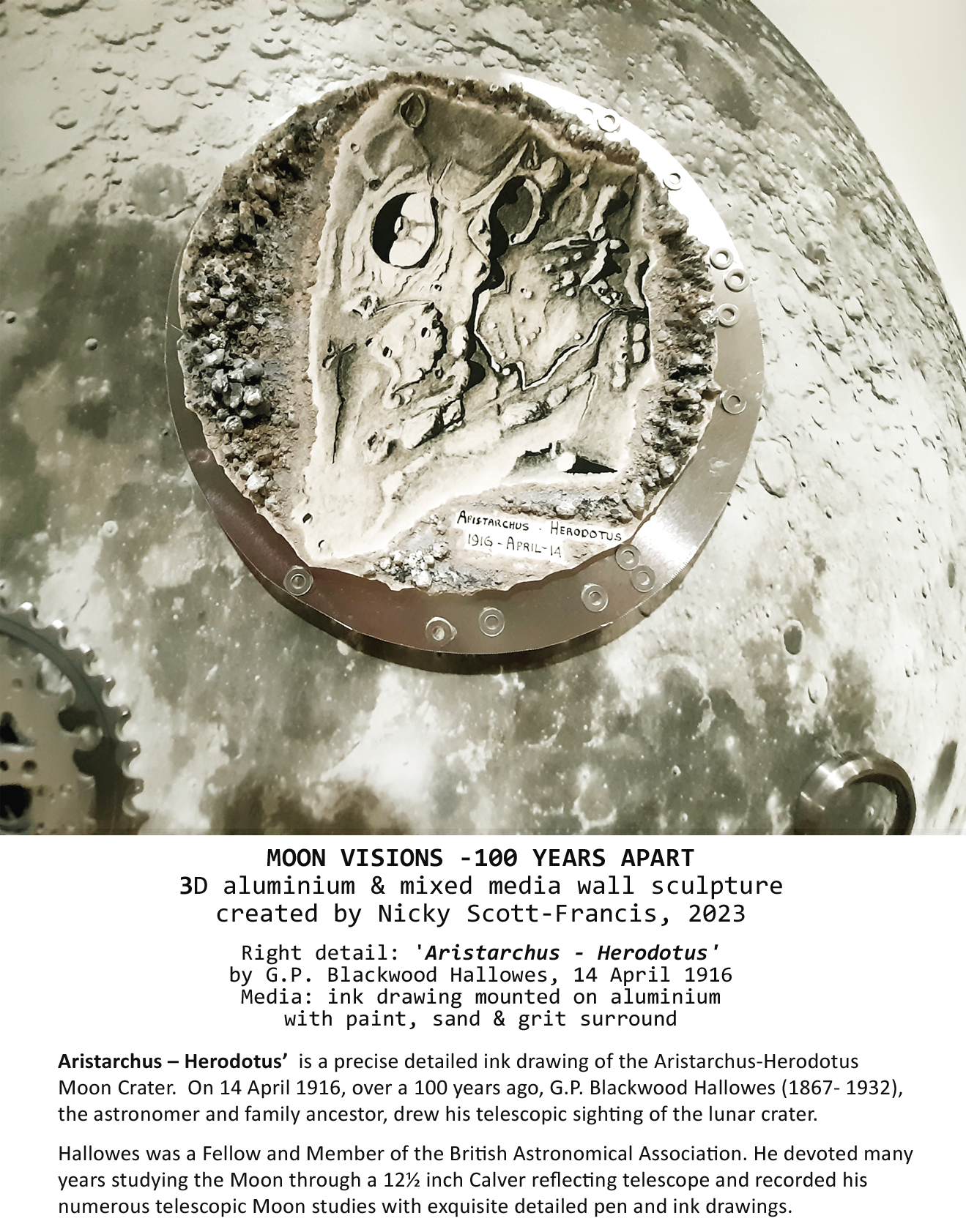
The BAA Office has been contacted to let our members know about the 11 Camden Voices exhibition. One of the exhibits is ‘Moon Visions – A 100 Years Apart’ a 3D wall sculpture by Nicky Scott-Francis, including a telescopic ink drawing by former BAA member George P Blackwood Hallowes (1867-1932).
His telescopic drawing is of the Moon Crater, Aristarchus-Herodotus, dated 14 April 1916. Hallowes devoted many years studying the Moon through his 12½ inch Calver reflecting telescope, recording a substantial amount of his moon studies in ink drawings.
You can find more details about the exhibition here: https://www.candi.nhs.uk/news/camden-talent-showcased-our-new-art-exhibition
Andy
-
This topic was modified 2 years, 10 months ago by
 Andy Wilson.
-
This topic was modified 2 years, 10 months ago by Andy Wilson.