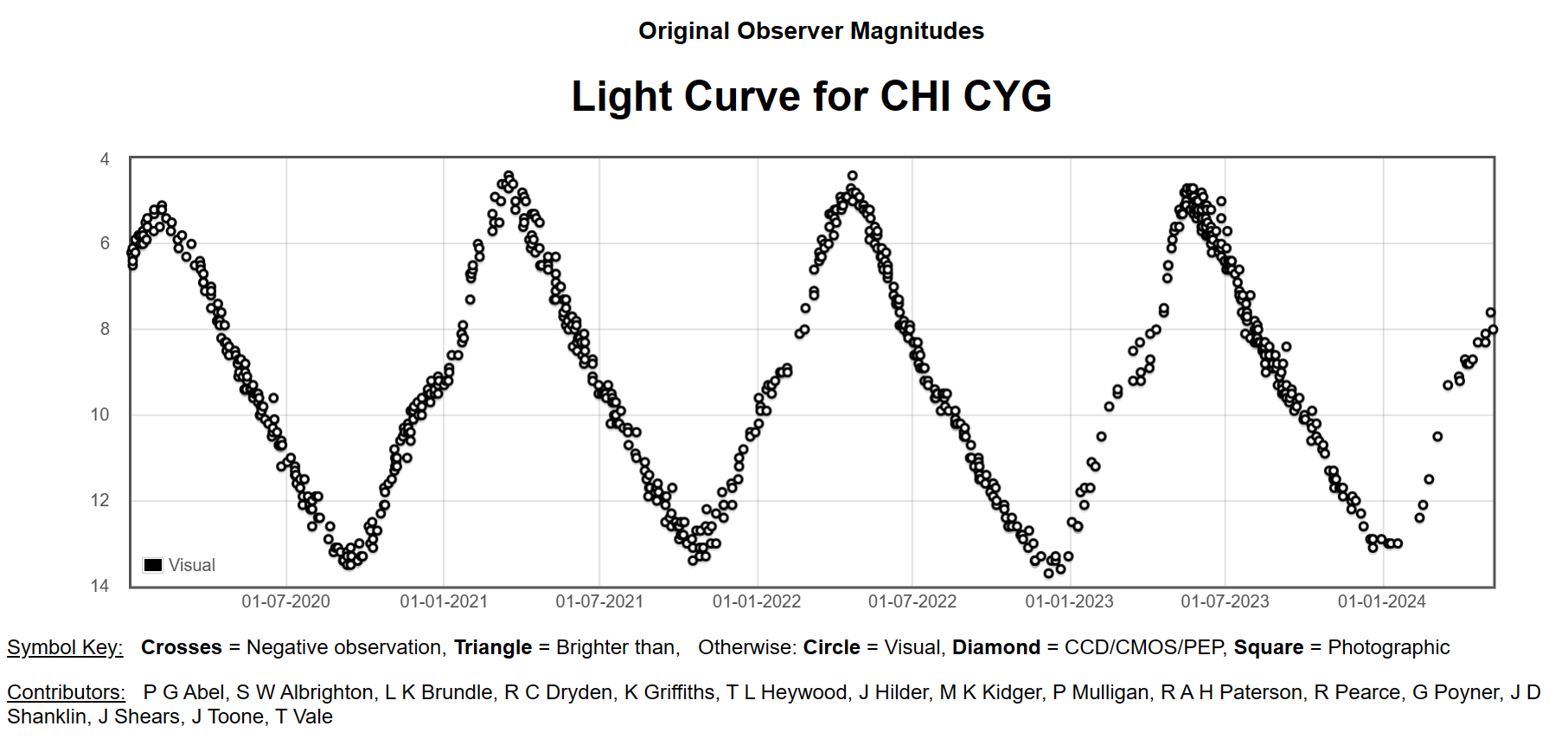
At the excellent BAA meeting in Greenock, Clara Brasseur gave a fascinating talk on “Hearing the Light: Astronomy Data Sonification”. She introduced us to “Astronify – A Python package for sonifying astronomical data – turning telescope observations into sound!”
It takes a table of observations containing their date and observed flux, and converts what would usually be visualised as a lightcurve into sound, where the datapoints are represented by notes across the audio range. It’s another way for science presentations to be all-inclusive. See this link for details:
https://astronify.readthedocs.io/en/latest/
There’s various settings to change the duration of the notes and the mean frequency, etc.
As a first look, I downloaded the visual observations of chi Cygni for 2020-2024 from the BAA VSS database (see the attached plot) and ran them through Astronify code to sonify the data, creating the attached wav file. Some variable stars sound harmonic and pleasing, others sound discordant.
Chatting with the speaker and Lyn Smith we envisioned a ‘solar symphony’ from sunspot MDF data, also a sonified ‘meteor year’, with low frequency Taurids and high frequency Leonids.
Sonification is a nice option for presenters, although please use it sparingly and where appropriate.
Alex.
Alan
Dreadful weather here in Warrington for most of the year so far, so you are definitely not alone. I have compensated by making more use of robotic telescopes, specifically the COAST (COmpletely Autonomous Survey Telescope) at the Observatorio del Teide, Tenerife. At least this has enabled me to keep making observations,
even though my own instruments are gathering dust and cobwebs.
I would like to relocate to Arizona, but I don’t think the family would appreciate it. So I await better weather with a stiff upper lip!
Don’t let the clouds grind you down.
Alan
Hi Jack,
Open the Tpoint module from the Telescope tab on the top line of the SkyX window. (the telescope mount needs to be connected). Go to the Calibration tab in the TPoint window. In the top right, you’ll see a drop-down menu from the Pointing data button. Select Export and save the file in a safe place. If you need to use the saved file you go the same route but click on Import in the pointing data drop-down menu. See attached screenshot.
Peter
Hi, I guess this is a question for Robin Leadbeater. I’m interested in spectroscopy of faint objects with the Alpy 200 which is now available commercially. I know Robin has a 11 inch SCT, mine is a 8 inch and it’s a Celestron Edge for which only a 0.7 x reducer is available.
Would my telescope be suitable for identifying new supernovae?
Thanks. John
-
This topic was modified 2 years, 5 months ago by
 John Coffin.
Now given to a good home, the Amateur Telescope Makers of London group, led by Terry Pearce.
Very nice captures !
How did you capture them ? Telescope or camera and did you use a computer to automate the sequence during the eclipse.
I have only seen 1 TSE in Cornwall through thick cloud and did not see the corona in August 1999.
Kwong
Thanks Pauline for making these pictures of the 2016 50th WW available.
I attended that particular extravaganza on that occasion.
Downloaded a few choice photos: one of Bob Mizon, Alan and John Mason wearing what??, group photo, that one of you, telescope and George Sallit, etc.
Yep – a few memories indeed!
If anyone coming to the E&T Section meeting at Winchester next week is interested in the “grittier” aspect of telescope making, I have a supply of various carborundum grid sizes plus rouge, pitch and laps needed to grind and polish mirrors. This is free to a good home but I need to know if someone is interested in having these, otherwise I won’t bother bringing them and will probably throw it all away. Please let me know.
David
Capturing nebulosity requires low focal ratio. To get optimal correction of chromatic aberration and coma at low focal ratios requires more lens elements. Yes you can use an ED (or similar) doublet with a coma corrector, but that’s 4 lens elements in total, and in most cases it won’t be as optimal as it could be, and there’s likely to be spacing errors, so better really, if you know the telescope will be used for imaging at this focal ratio, to build it all into one optimised, correctly measured-up tube assembly. Many people wish to use the dual-band, tri-band and quad-band filters for one-shot imaging, so chromatic aberration will still be a moot point.
Nogami-san just posted this on VSNET:
Dear colleagues,
We would like to call for dense monitoring of SS Cyg for coming tens of days.
X-ray observations by the new X-ray telescope XRISM (PI: Manabu Ishida) will
be scheduled based on optical detection of the next outburst. The SS Cyg
observation window with XRISM will open on April 14. We would be
thankful, if the VSNET observers would monitor SS Cyg more than usual and
timely report outburst detection, say brighter than V=11.0.
Best regards,
Daisaku Nogami
Reading the JAMA link Nick gave, it looks like they think that you might be somehow taken by surprise by the Sun reappearing and instantly damaged.
Which is kind of weird as the end of totality is always easy to see coming and I must admit I have yet to hear of the Diamond Ring damaging anyone’s eyesight.
I could only imagine a problem for people whose eyes remained fully dilated (for some medical or pharmaceutically induced reasons) or who were using a telescope/binoculars during the Ring or forced themselves to keep staring after the Ring was over. Other than that, it sounds tosh to me. But, as Nick wisely says, your experience may differ*.
*Its a bit frustrating that everyone now needs to protect themselves from the wrath (legal or otherwise) of people not thinking about the potential consequences of their own actions.
Indeed Steve, that is total BS written by someone who has clearly never seen a total eclipse so I think “reputable author” is rather kind. The surface brightness of the inner (K) corona is about 1 millionth of the surface brightness of the photosphere so similar to the surface brightness of the Full Moon. There is lots of very bad advice out there about looking at the totally eclipsed Sun. This is particularly awful:
https://jamanetwork.com/journals/jamaophthalmology/fullarticle/2816113
To quote: “It is not safe to view a total eclipse without added eye protection, even during the 90 seconds when an eclipse is total”. If people follow that advice on April 8 they won’t see much!
To be clear, during totality it is perfectly safe to view the eclipse with any optical aid you wish to use and no filters. I have always watched the 2nd contact diamond ring with the naked eye then switched to binoculars/telescope for totality and then gone back to naked eye as soon as the chromosphere appears just ahead of 3rd contact. For photography/video I’ve taken the filter off a minute or so before second contact and put the filter back after third contact. I have never had any sensor damage from doing that (although your experience may be different and I take no responsibility etc. etc.). My video from last April is here:
https://www.youtube.com/watch?v=QmoSTGQ6hpE
and it shows prominences and the inner corona for around a minute before and after totality.
Hi James,
I’ll try and answer your questions:
1. Yes a Ha telescope will only let light through centered on around 656nm with a bandwidth of < 10 nm (1 Angstrom).
2. Yes whiter areas are emitting more Ha and the darker areas less. So solar flares appear bright when they occur and filaments appear dark. Your image is very nice, showing plenty of detail in AR 3590 from last month.
3. Not sure what the blue filter is for but is likely to be a UV/IR blocking filter so care is required not to damage it (the visual colour of a filter does not necessary indicate what wavelengths it transmits or blocks).
And researching this topic led me to this fascinating lecture on the use of optical instruments by renaissance painters, very relevant to my talks (Presidential addresses) on the history of the telescope.
https://youtu.be/450pvHhH3Zg?si=gM4ST0742SVELLcz
Interesting. I’m with James. I think it is a glass object that has been painted, and the painting has been finished, but I doubt it is a telescope. There are various geometrical, navigational and surveying instruments scattered round the room. I think the object in question could be a spirit level, with metal end sections and a short central glass section containing the liquid, through which we see the monkey’s arm. Such a level would be an important tool for a painter drawing horizons and buildings. Unlike a builders’ level, you might not make it with a flat base, as there would be no reason to do so.
It has been purposefully painted to look like a glass cylinder; the white paint strategically placed to show it reflecting light coming from the left, and to give the appearance of glass. So I don’t think this represents an unfinished telescope. I would be skeptical that it is a telescope as I’m not aware of glass refractors, or why you’d want one. The end cap of the glass tube is different to the ends of the telescope near it on a mount.
We need an expert in glass artefacts of the C17th to indicate what a glass cylinder might have been used for. I was wondering what other material it could be; plastics weren’t known, rock crystal seems unlikely, ice again seems unlikely. So I would have thought it does represent glass.
Interesting story.
At first, I too could not spot the telescope in question. Then I realised there are two monkeys in the picture, near to one another. The one holding the telescope like object is near to the monkey holding the spectacles, hidden mostly behind the painting of ships.
As a fan of the Flemish masters, I was intrigued by a paper out today on the painting “the Allegory of Sight” by Jan Brueghel the Elder and Peter Paul Rubens. Painted in 1617, it discusses two telescopes depicted in the painting. One, held by a monkey, appears to have transparent tube. The author, Paolo Del Santo (Museo Galileo, Florence) goes on to claim it is made of glass: https://arxiv.org/abs/2403.02857
I’m no art historian, but I wonder whether there is a more prosaic explanation. Perhaps the painter(s) hadn’t actually completed this part of the painting, though given their known attention to detail this would be surprising. Did they paint the monkey’s hand in place to ensure it was rendered correctly, with the intention of painting over the tube later? Or perhaps the painters simply chose to depict it as transparent.
Taking it at face value, it is intriguing. I suppose wealthy people might have chosen to use unusual materials for telescopes (rather like the other, highly ornate, telescope in the painting. The author ends:
“Apparently, this is the only known example of the use of this material to make the tube of a telescope, but, now that we know that such an instrument existed, some glass tube lying forgotten in the warehouse of some museum, without anyone having ever understood the use to which it was intended, could be identified as the tube of a telescope in future”.
Might anyone know of another glass tubed telescope?
I also used ASTAP to platesolve some files and align them. I then ran them through AIJ. I think I got some NaN columns. What is NaN stand for ? I tried submitting a AIJ data via the BAA spreadsheet.xlsm but it mentioned there was an error (?NaN) and it did load some AIJ data in a sheet but did not create more graphs and the old WASP-1b data stayed in most of the sheets.
Did you solve via this problem by the CCD DP tool and enable FITS header and the coordinate converter tool set up for the target and obsy location – is the obsy location the location of the telescope where it was imaged ?
Thanks.
Kwong
I was lucky to get an image of NGC 6004 using the COAST facility at telescope.org last night. It looks around mag 15 if I’m looking in the correct location and not being seduced by a nearby star