So how do you handle the blue end with the LHIRES then?
I don’t have a solution so run without a flat, making sure I put the reference star in the same position along the slit and try to include any flat effects in the response. (I don’t use the LHIRES at low resolution and 90% of the time I am working at the red end so it is not a problem there)
I have not investigated it fully but it may be mainly light from the built in lamp leaking round the slit holder. Running a flat lamp ahead of the telescope aperture might be a better solution as the beam will be more tightly controlled. The calibration setup in the LHIRES is rather crude with the lamps just swung in over the slit. The setup in the ALPY calibrator is much better designed.
Thanks, Gary!
Well, I did not handle the companion 🙁 But checking it in Phoranso, that I use for measurement, it is clearly outside of the aperture. So should not be confounding the measurement.
I can not go deeper from my back yard, but if it is of interest, I could try capture a series with our remote telescope in Spain..?
Magnus
Hi Magnus,
I am not saying that this is necessarily the problem here but with the technique generally used by amateurs for flux calibration using reference stars nearby in the sky to the target it is important to do some investigations into the stars used as a reference. This is different to photometry where others (eg AAVSO/BAAVSS) have done the hard work and prepared nice sets of reference stars, checking that they are non variable and accurately measuring their brightness. As spectrcoscopists we are not so fortunate so we work with what we can find . A rule of thumb for example is to use main sequence stars as giants are more likely to be variable. Also look to see how they are described in SIMBAD and if they appear as variables in AAVSO VSX.
HD207673 raised a number of red flags for me. SIMBAD defines it as A2ib a hypergiant star so likely to be variable. Its MILES spectrum does not look like it should for the given spectral classification possibly due to reddening, even though the data in the spreadsheet suggests E(B-V) =0. This is likely to be wrong as the SIMBAD data suggests E(B-V) = 0.4 which would confirm some reddening. Perhaps the MILES spectrum is ok, perhaps not.
Professionals take a different approach, using a small set of reliable standards which might be far from the target at a different air mass and correcting for the atmospheric extinction separately. Christian Buil advocates this method for his StarEx/SpecInti project and it might work for you. If it does it is perhaps a better method but it does not work for me as my atmospheric conditions are not stable enough and my telescope has achromatic lenses (a focal reducer) so the instrument response is not constant but highly dependent on the focus on the night.
If you were getting good results with your previous camera but not now and suspect this is a new problem perhaps the best thing to do is to try to reproduce some of your previous measurements using the same stars. This would then narrow the area down that you need to investigate.
Cheers
Robin
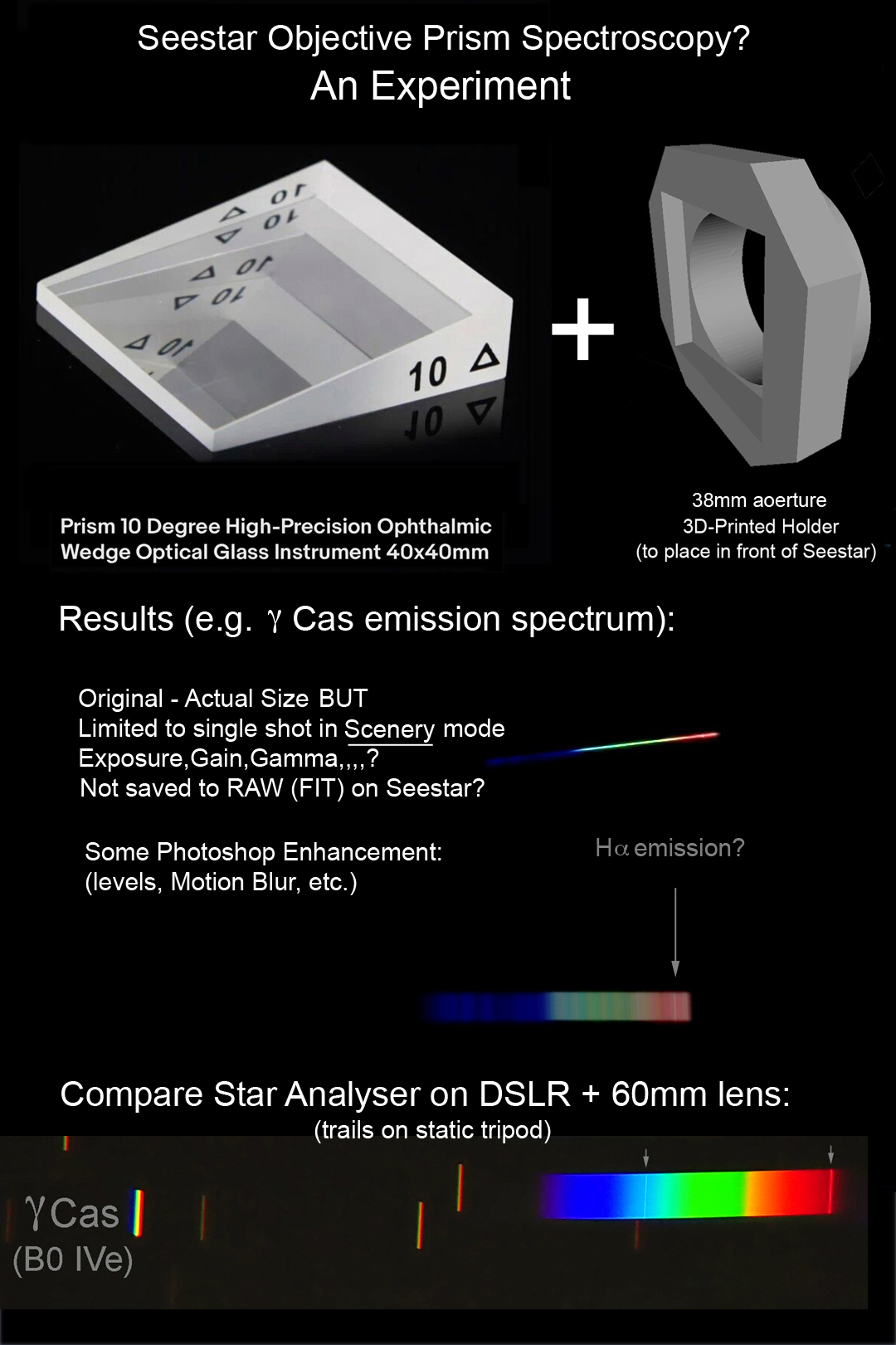
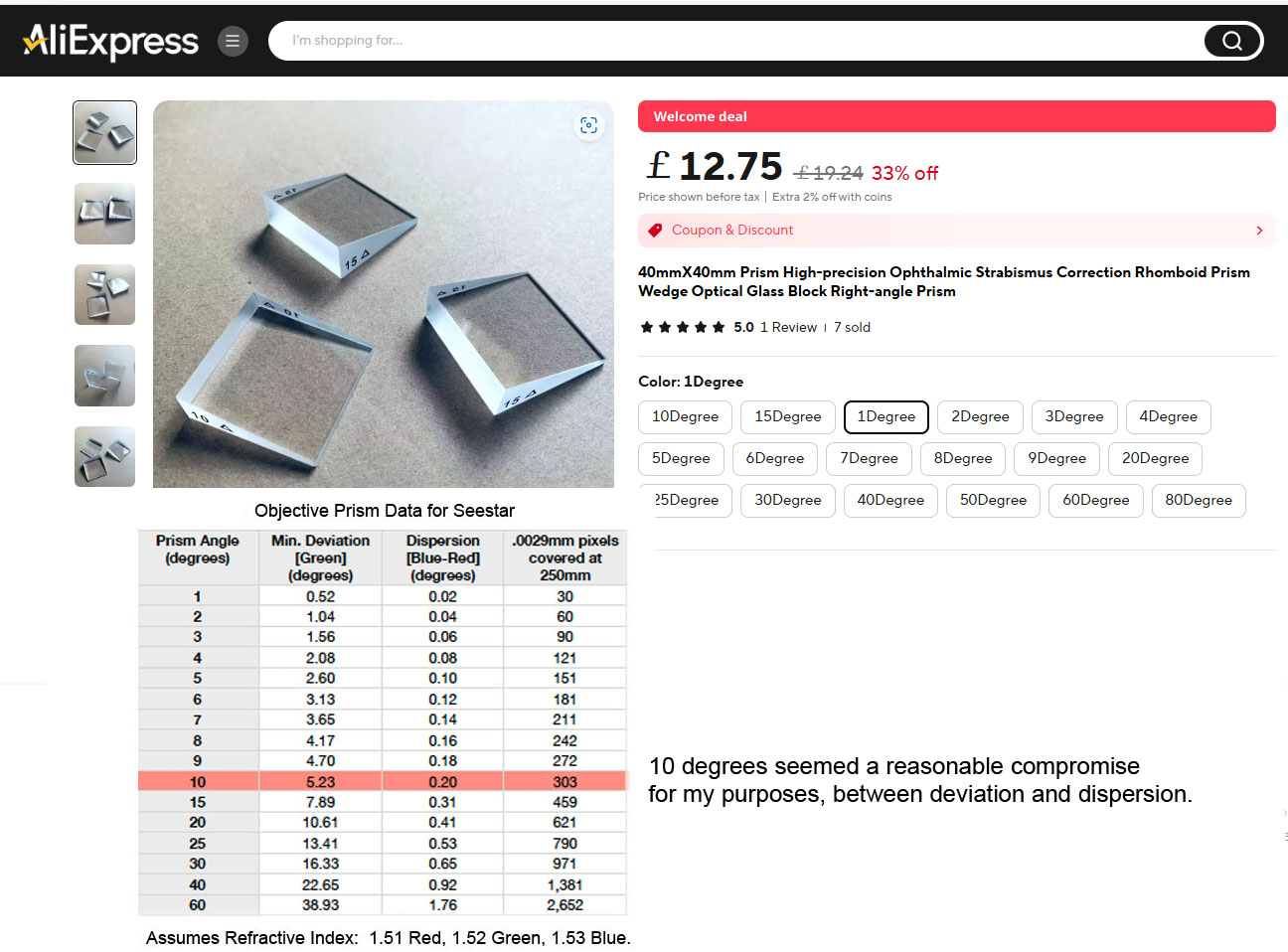
I have recently succumbed to acquiring a Seestar smart telescope which is good fun to use. I have recently tried to use it for elementary spectroscopy. To this end I recently bought a 10 degree wedge prism (source: see attached) and placed in front of telescope. Results and methodology (see further attached) So near and yet so far! Shows promise but restricted by lack of flexibility of software. I would be interested to know if anyone has tried some thing similar with better success. I avoided using grating as its dispersion far to wide to be contained in single frame, a prism hopefully showing many bright single spectra.
Thanks Gary,
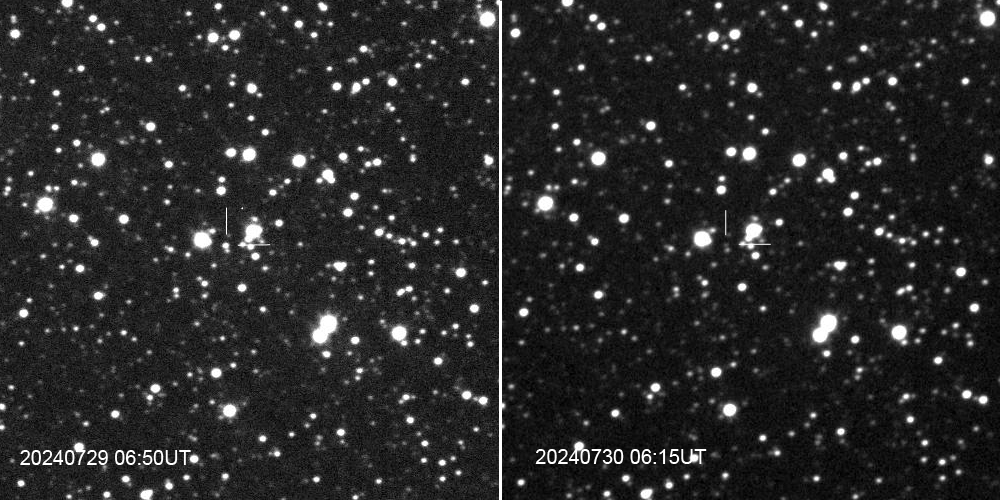
I imaged it again this morning and as you say it is fading very rapidly. Comparison image attached. Each field is 14 x 14 arc minutes, north up, through a red filter using iTelescope T5
-
This reply was modified 2 years, 2 months ago by
 Mike Harlow.
I learn this news with heartfelt regret. Meade has allowed me to do many things at reasonable prices.
The market for amateur telescopes and their accessories appears to be out of date. Telescope companies are suffocating themselves, especially as the stars have disappeared from the sky. The various online marketplaces as they are filled with gear (everything has become ballast) of all kinds still new put up for sale because they are superfluous. A few days ago, I took a Celestron D90mm refractor to one of the flea markets in my town. The manager didn’t want it, he said it wasn’t for sale. He only agreed to try because we have known each other for years.
In my country they say: only after you have bought it do you realise that you don’t need it.
Translated with DeepL.com (free version)
The fact that it is Orion Telescope & Binocular as well is bad. These names disappearing would mean a significant contraction in choice in the amateur equipment market. But Meade has gone bankrupt before and then been rescued. We’ll have to see.
I was very sorry to hear of the passing of Wil Tirion. I still own his wonderful Sky Atlas 2000.0 and Uranometria 2000.0. These were both beautifully presented and very practical. I would look over fields in the day, then take them out to the telescope at night.
Even today with modern planetarium software, I regularly use his Cambridge Star Atlas.
A great loss.
Andy
I cannot answer the question how long the silver coating will last from my own practical experience, as I am new to this. Time will tell.
The short answer must be “it all depends.” Having purchased a decent quantity of all the chemicals required, the cost of each re-coating is small.
I have found this informative article on the Sheffield Assay Office website:
https://www.assayoffice.co.uk/news/ever-wondered-why-does-silver-tarnish
They surely know what they are talking about. Clearly their advice is not specific to telescope mirrors but the priciples will be the same.
Presumably anti-tarnish paper could used to line mirror covers. The paper is available on Ebay in small quantities. The jeweller in a local town can order in bulk, by the ream. My dictionary tells me a ream is 516 sheets! I don’t yet know at what cost.
I have a recollection of reading in an old book that alum paper will delay tarnishing. The item included a recipe for making alum paper.
Chris Lloyd and Maxim Usatov report a likely new dwarf nova of the SU UMa class in an Astronomer’s Telegram just published online: https://www.astronomerstelegram.org/?read=16676
Max used his remote Alnitak telescope located in Spain for follow up observations.
Further observations of this outburst are urgently encouraged, especially time resolved photometry.
I’ve been following this visually and remotely for a while now.
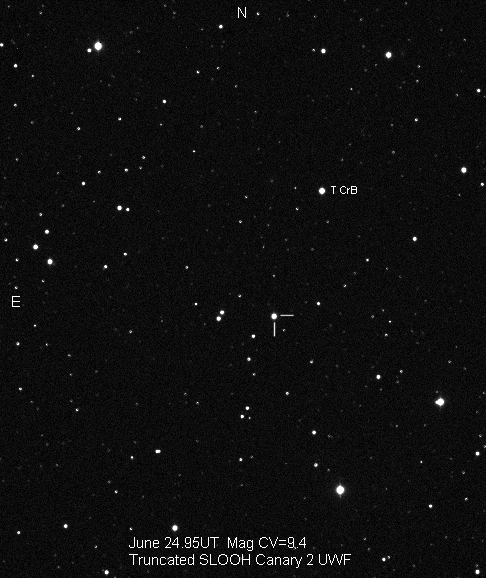
Image below is from last night (June 24.95 UT), and is a truncated image taken with SLOOH Canary 2 Ultra Wide field 85mm Teleview riding on the main telescope.
Unfiltered magnitude 9.4CV using the BAA T CrB sequence.
Gary
I have old copies of the JBAA on the BAA DVDs. A search shows Mary Ashley is mentioned in Vol 13-4: “A special mention was made of a gift by Miss Ashley of valuable astronomical books and diagrams together with two telescope stands”. She also bequeathed items to the BAA. See especially Vol 13-10, p376. Books were duplicates to the BAA library, and so were offered to members. Yes, with hindsight, the BAA should have kept it. Her name is also mentioned in later journals as a person who bequeathed certain items listed in the inventory stated in those journals.
Nick: sure.
It is easy, in my experience, to see 2nd magnitude stars through a telescope in daylight. Some decades ago Venus occulted Nunki, or sigma Sgr. From central Oxford the critical moments were clouded out but 20 minutes or so later the star was very easily visible in a 27.5cm Mak-Cas. I guess the limiting visual magnitude on that occasion was around 4 to 4.5.
I’ve been having fun* writing some code to model the performance of my telescope and am getting reasonably accurate signal to noise ratios for night time imaging.
I would like to extend this to daytime imaging but realise I have no magnitudes per arc second brightness value for a cloud free daytime sky. Obviously, this will vary from day to day and location, but does anyone have a representative measured figure? Its a while since we had a clear blue sky here.
Assuming the full Moon is 0.5 degrees across and of magnitude -12.6 I get a sky brightness estimate of 3.4 mags per arc sec but rather suspect 4.4 might be nearer as the full Moon is very obvious in the sky
Has anyone a better figure?
Thanks.
*Yes, I know I’m sad.
We used to silver the 14-inch mirror of the school telescope back in the 70s under the supervision of Commander Hatfield. This was followed by careful burnishing, a critical step, as Richard pointed out. It was a useful demonstration of chemistry in action. And more impressive than carrying out Tollen’s test for reducing sugars in a tiny test tube that we performed in the biology labs.
Giovanni, you are right, silvering was a thing of the past. As early as 1961 J.B. Sidgwick wrote that vacuum coated aluminium had taken over, noting also that the silvering chemicals were difficult to obtain by members of the public. I remember trying to obtain potassium nitrate for a different purpose and thought they were going to call the cops. Now almost anything is available mail order. I suggest the cost/benefit is perhaps shifting back to silvering. It is not just the cost of aluminising. There is no way I am trusting my mirror set to a courier, when a master optician said in 2016 that to make it then would cost between £6k-£10k. So I’d have drive it there myself and collect it afterwards.
If you can, read Jerry Oltion’s short article, pages 74 & 75 in Sky & Telescope January 2020,
Good morning everyone. I am a bit surprised to find this topic, I didn’t think the problem of silvering the telescope mirror still existed. And even more I didn’t know about that silvering kit. The first mirror silvering I commissioned from a well-equipped glassmaker, who did a very good job. The only major problem was the minimal durability of the Ag deposit, which began to oxidise and yellow. After a few months (max 6-8 months) it had to be removed and re-done. Then I tried to work on it myself by buying Ag nitrate, ammonia, H2O and more. Very bad result! Longer life (up to a year) but silvering with dark spots, uneven deposit, minimal adhesion so cleaning impossible, and other defects. Everything has made me prefer mirror aluminisation. However, here in Italy, aluminisation is made by very few companies and costs a lot. So I gave up the resolution power of a 200 mm and opted for a smaller (90 mm) catadioptric that is very handy and inexpensive. Nevertheless, the D200mm dream still haunts me. I would kindly ask for your opinion on what I have reported. I am a self-made astrophile, and as a basis I have the manual: Procedures in Experimental Physics by John Strong.
Thank you and greetings to you all
Translated with DeepL.com (free version)
*** Serious bidders only ***
Observatory grade 16 inch F/4.5 driven Newtonian reflector on a substantial bespoke fork mount. OTA and mount only. For further details and photos contact barry_merrikin@yahoo.co.uk (on behalf of Hampshire Astronomical Group)
My enthusiasm for astronomy is ebbing away.
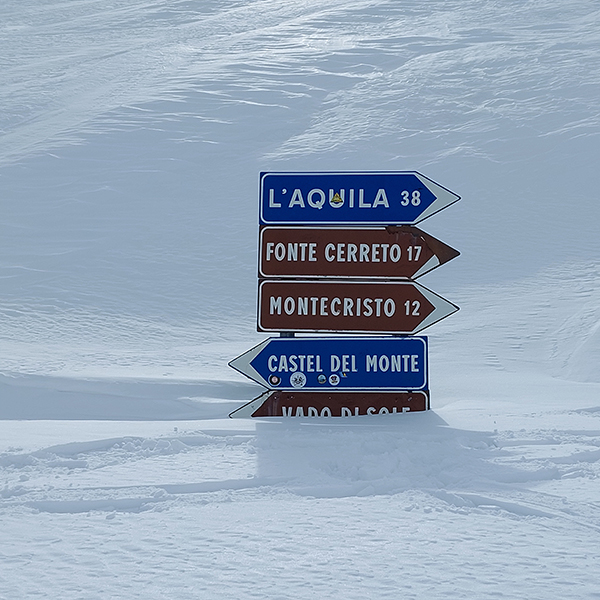
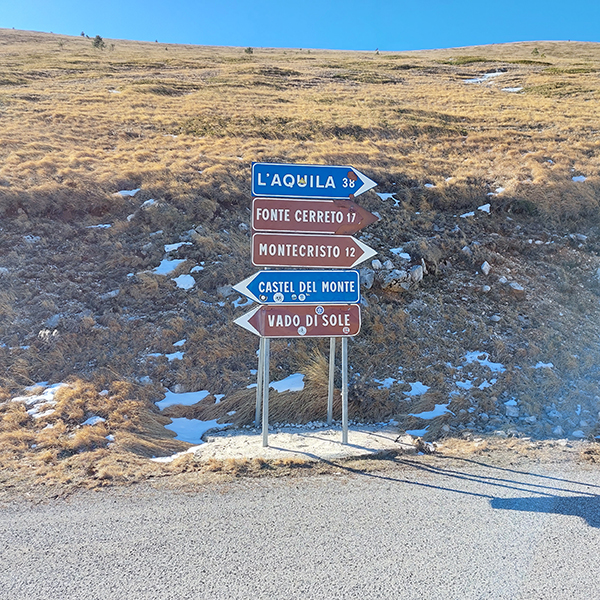
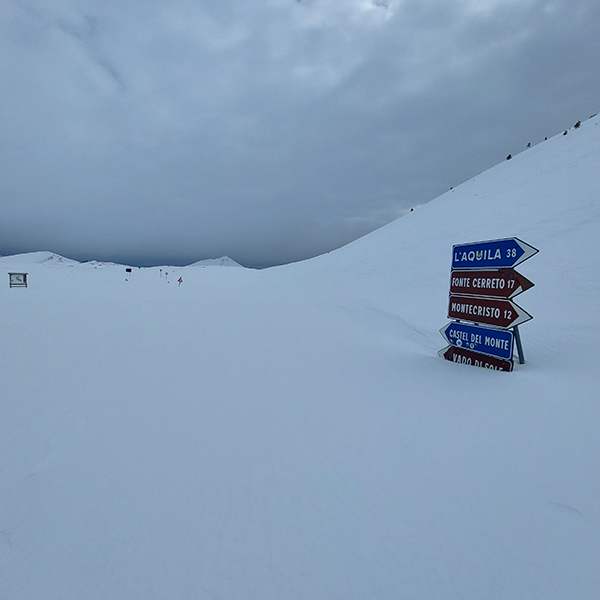
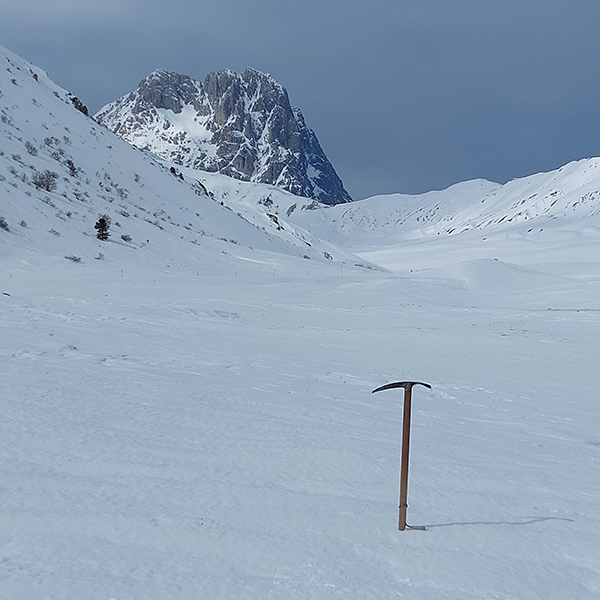
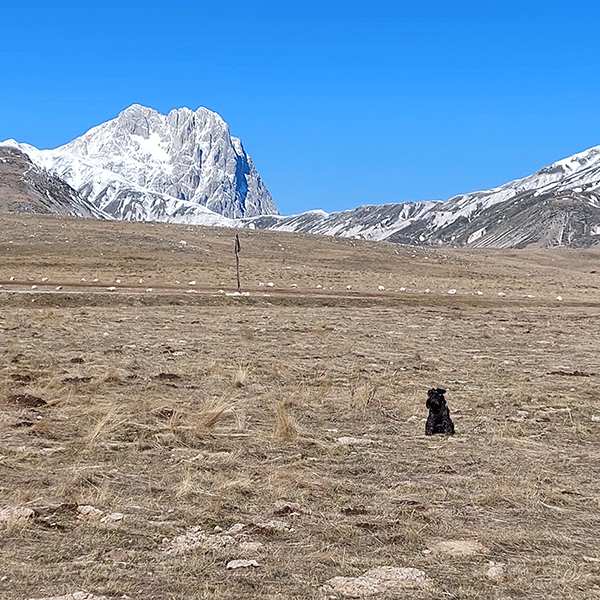
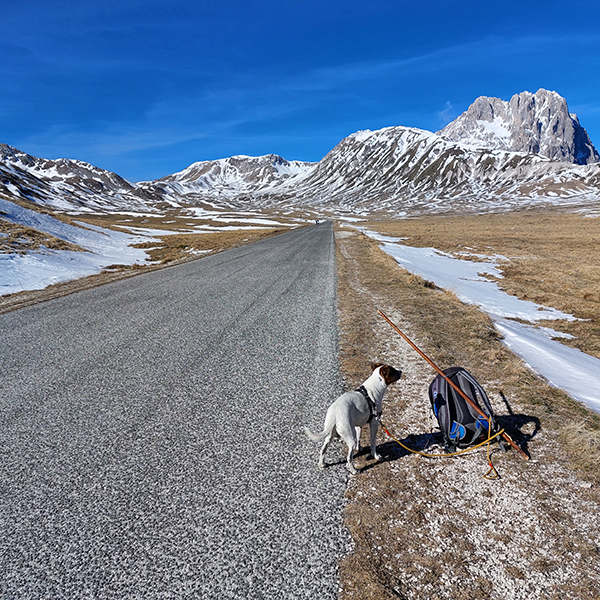
Concerning the weather, I think something is happening perhaps beyond what the researchers are reporting. Here, in central Italy, we have had a winter very different from previous ones. In my mountains (Gran Sasso d’Italia), snow was always abundant from the end of November to the end of April. On the Campo Imperatore plateau, at an altitude of 2100 m, where the astronomical observatory is located, at least 1 m of snow. By contrast, last winter was disastrous for skiers and for all tourist activity. The attached photographs are a comparison between the normal winter situation on the plateau and that of winter 2024. All taken in the first week of February. During the winters of the past years, we have always had frequent very clear and cold nights down to -10 C. Using the telescope on the moon and planets was a delight. This year, on the other hand, cloud cover was more frequent than usual and the sky was less transparent, so there were very few night frosts that we did not have to use antifreeze spray on our car windows. The month of May allowed only a few observations. This morning I went out with my two dogs and wore a padded jacket because of the black sky and cold air. Summer had already broken out in the past. All this together with light pollution (from my terrace you can read the newspaper in the middle of the night) is dampening my passion for observational astronomy. No more shopping for telescopes, ccd cameras, go to’s, eyepieces, mounts, filters, mechanical work and as many other accessories as we want.
Alan, I agree with you.
I can’t take it any more! I have decided two things:
1) I will devote myself only to the study of Astronomy;
2) better enjoy that money by inviting a beautiful woman to dinner. Just tell me I’m wrong.
Paving the Way: Next-generation Developments in Very Long Baseline Interferometry
Dr Jack Radcliffe – UK SKA Regional Centre (UKSRC) research scientist at the University of Manchester and senior lecturer at the University of Pretoria
The Zoom room will be open from 19:15 BST (18:15 UTC). Zoom link will be sent out Friday 7th June
In the past few decades, surveys using radio telescopes have provided us with unique insights into many areas of astrophysics such as star formation, supernovae, active galactic nuclei, pulsars, cosmology and much more. A key aspect of these surveys is the technique of Very Long Baseline Interferometry (VLBI) which can provide some of the highest resolutions possible in astronomy. This method has made crucial discoveries in many areas of astrophysics and geodesy including cosmology, galaxy formation and evolution, the innermost regions of active galactic nuclei, explosive phenomena and transients, stars and stellar masers in the Milky Way, celestial reference frames and space applications. In this talk, I shall review some of the discoveries made using VLBI, and highlight the exciting developments coming from existing and new instruments such as the ngVLA, next-generation Event Horizon Telescope and the Square Kilometre Array.
If you want to be added to the Zoom Distribution list please let me know.
Paul Hearn [paul@hearn.org.uk]