David: The Vera Rubin telescope has both an enormous aperture (8.4m) and a very low focal ratio ( f/1.23). Its field of view exceeds my 0.4m f/6.5 scope about 20-fold and its collecting area about 200-fold (call it a limiting magnitude about 5 magnitudes fainter than mine).
But this is an exceptional case and your post applies to almost all telescopes and certainly all amateur telescopes.
Once more: the question comes back to: what is your budget?
Until we get sensible answers to this question, and to the one about intended use, the original question is indeed unanswerable.
Karl: what is your budget and what do you want to image?
-
This reply was modified 3 years, 2 months ago by
 Dr Paul Leyland. Reason: Correct the numbers
Indeed the question as posed is unanswerable.
Telescopes are used to take images in two basic ways (not counting spectroscopy):
1. To image faint objects
2. To image fine detail
(3. Some combination of these)
Aperture allows you to resolve detail, but focal length allows you to image the resolved detail with a detector. Aperture also allows you to image faint stars, but the imaging of faint extended objects depends inversely on focal ratio. Width of field, with a given detector, depends inversely on focal length. If you wish to image the combination of faint stars, faint extended objects, and detail, you require a large aperture at a low focal ratio. If you wish to image wide fields you need a short focal length, but unless you have a large aperture and hence a low focal ratio as well, your detection of faint objects and your resolution will be limited. But there is a limit to how low focal ratio can go without optical problems, so for the widest fields, very small telescopes are needed, which are limited in both resolution and limiting magnitude.
This is all before one gets into considerations of mounts and drives.
So what is ‘a good telescope for astrophotography’ depends on what exactly you are trying to achieve.
Apologies if this isn’t the best place to ask but I can’t see anywhere more appropriate. Essentially, I’m wondering if anyone else is having difficulties with receiving the magazine on subscription, direct from the US.
I’ve been a subscriber to S&T for almost as long as I’ve been a member of the BAA (last time p/Halley was passing through, which makes me feel ancient) but ever since the pandemic, delivery of the magazine has been inconsistent to say the least. On many occasions during Covid I had to ask for it to be resent. Then, for a while, the situation improved and started to be delivered again, but the past couple of issues have not appeared even after I phoned and spoke to an actual person who promised a replacement would be sent out.
I realise I could go digital, but it’s a bit hard to lug a PC with a 27 inch monitor out to a dark sky site to read on location.
Chris
It is difficult to choose an ideal telescope as it depends on so many factors. I think you may be considering Deep Sky imaging, which has similar requirements to variable star photometry and comet imaging. While planetary imaging has different needs.
I would say good quality optics of a variety of designs can produce excellent deep sky images. If you want top quality results, then put quality before aperture within your budget.
A key point is ensuring you have a good quality mount that can robustly support the telescope and track well, or receive guider commands to correct for tracking errors. With smaller telescopes, such as small short focus refractors, you can get away with a much smaller and cheaper mount. As you go to larger telescopes and longer focal lengths, the cost of the mount will go up dramatically.
It is also important to have a focuser that can support the camera, as well as any filters or an off-axis guide camera if used.
For starting out with imaging I would recomend a short focus refractor. However, something like an 8-inch SCT on a sturdy mount is a great all round telescope. With available accessories that can be used for both deep sky and planetary imaging.
-
This reply was modified 3 years, 2 months ago by
 Andy Wilson.
It is difficult to know where to start. The website is riddled with misleading nonsense. For example here
https://astroimagery.com/equipment/telescopes/best-telescope-for-astrophotography/#research-what-telescope-would-you-recommend-for-astrophotography
in positions 2 and 7 here you have a Dobsonian mounted scopes which are not suitable for astrophotography and the description does not match the scope.
I apologise if I am wrong but the main purpose of this website appears to make money not to inform.
Robin
It does OK but I wonder if a much bigger scope (how big is best?)
How much do you want to spend?
A fully kitted out 4-metre telescope will produce some very fine images but is likely beyond your budget.
Your question as phrased is essentially unanswerable.
I am interested to know what your idea of a good telescope for astrophotography might be. I’ve been writing about this topic and wanted to get some additional thoughts from those on this forum who have experience in astrophotography. This could start a nice conversation about what to look for when upgrading.
Here are my own thoughts about a good telescope for astrophotography:
https://astroimagery.com/equipment/telescopes/best-telescope-for-astrophotography/
Do you agree with what I have written? Any additional points I have missed?
One thing in my mind is how important is the size of the aperture for astrophotography. I use a 5-inch Celestron SLT at the moment and have done it for three years. It does OK but I wonder if a much bigger scope (how big is best?) would cut down the imaging time or the fine details I can get. I realize there are so many factors involved here such as the Bortle level (mine is 5), the camera (ZWO 533MCPRO), the Telescope focal length of 650mm, F5 focal ratio, and so on…
Look forward to your replies and if useful I will add them to my post.
Karl Perera
Astrophotographer, Teacher and Author
https://astroimagery.com
Many will have heard that the Mond Equatorial was very kindly bequeathed by Dr Glyn Marsh to the Norman Lockyer Observatory several years ago. This telescope was originally installed at NLO in 1933 and consisted of 4 ex-RFC aerial reconnaiscence lenses mounted on a huge equatorial for taking wide field images of the night sky. It was modelled on the Yerkes Bruce Equatorial 10″ lens which Barnard used to image wide swathes of the Milky Way for his research into dark nebulae. Jim Lockyer and Frank McClean had visited Barnard in 1909 and had presumably decided that they wanted one too! However it was not until 1933 when Sir Robert Mond (wealthy industrial chemist and founder of ICI) provided funds for a new dome and telescope henceforth named the Mond Equatorial. After a productive life of 30 years this telescope was sold in the mid 1980’s to the late Glyn Marsh who refurbished it and had it set up on the Isle of Man. Sadly the original base of the equatorial was smashed by builders when it was being dismantled. We are now installing the Mond as a museum exhibit at NLO and are making steady progress. The main OTA has been shot blasted and repainted and the whole assembly of 4 cameras is nearing completion. We are hoping to finish the exhibit in the next few months.
David Strange
Chairman
Norman Lockyer Observatory
I would not rule out the possibility that your 1.25″ Lunt solar wedge is sub-par. I don’t have experience with this unit, but I do have experience with the Lunt 1.25″ diagonal blocking filter units for H alpha telescopes. I tried two, the B600 6mm one and the B1200 12mm one. On the same telescope, the 12mm one was clearly better. However, and this is where I get to my point, I tried a home-brew experiment (that I do not recommend to anyone who does not know what they are doing) where I pulled the 12mm blocking filter out of the 1.25″ diagonal (it was glued in) and made (on a lathe) a straight tube unit of 2″ outer diameter to house it, and a 1.25″ eyepiece tube. I was then able to use my H alpha system with a 2″ diagonal. The result was clearly better. There was therefore definitely a quality difference between the 2″ diagonal I had substituted and both Lunt 1.25″ diagonals, that was perceptible even in typical poor daytime seeing conditions. The Lunt diagonals did not seem good when one pulled them apart – well-finished outside, weighty, but just crudely glued together inside, unlikely to be precise. One experience.
ESA’s Euclid Observatory is currently scheduled for launch at 1511 UTC on 2023 July 1. The spacecraft will take around 30 days to get to its operating orbit so this is another opportunity to image a spacecraft on its way to L2. Unfortunately, at this time of year, L2 is low down since it is opposite the Sun in the sky and I don’t have any details of the transfer orbit so I can’t currently provide an ephemeris. The last time I looked it is not on JPL Horizons. I’m hoping that this information will become available shortly after launch. The final Lissajous orbit around L2 has a radius of a million km so, from Earth, that corresponds to maximum apparent separation of 40 degrees from the anti-solar point.
Launch is on a SpaceX Falcon 9 from Cape Canaveral. It was originally planned to be on a Russian Soyuz. Unlike JWST there is only one deployable structure (the high-gain antenna) so the magnitude evolution should be relatively smooth. I would expect it to have a similar brightness to Gaia, so around mag 12 immediately after launch fading to 19 or so on station.
Euclid’s main payload is a 1.2-m aperture telescope with a 600 megapixel focal-plane array consisting of 36 CCD273-84 4Kx4K sensors made by Te2V here in Chelmsford. It will be in contact with a ground station once per day for a period of 4 hours with a downlink which supports a data rate of 75 Mbps over the 1.5 million km range. That will allow it to download around 120 GB of image data per day via ESA’s 35-m aperture deep space antennas.
More info:
https://www.euclid-ec.org/
https://arxiv.org/ftp/arxiv/papers/1610/1610.05508.pdf
https://arxiv.org/abs/2108.01201
-
This topic was modified 3 years, 3 months ago by
 Nick James.
The telescope aperture could also be stopped down i.e. 4″ with all the other safety measures suggested above.
Eric
I would like to observe the Sun through my 7″ f/9 refractor.
Advice is to use a 2″ Herschel wedge, as the 1.25″ makes to small an image, but is my telescope to big for this kind of observation?
2″ wedges are made by Baader, Lunt and Lacerta (maybe others too) Lunt says: “The 2″ model performs best on refractors with apertures of 6” or less”,
Is there a limit? Will the heat be too much for larger telescopes?
Hi Ian,
Yes, I manage the BAA Photometry Database. You can contact me here and also at my email address.
When I created the online database I did not foresee a single observer submitting observations of the same star in the same filter made at the same time from different locations or telescopes. The previous offline database had a problem with duplicated and even multiple sets of the same observations, so it seemed a good idea to prevent duplicates being added. I have heard of this doing the job correctly in the past but this is the first time for this scenario where it creates a problem.
I will need to give this a little bit of thought and remind myself of the precise details of the database and the code that performs the checks. The location and telescope were not historically populated for all data. They were designed as descriptive fields and are not built into the checks to prevent duplicates. It may be possible to make a tweak, so one or both of these are included in future checks but I need to spend a little time checking into this before implementing any changes.
There is a simple fix, which is to provide you with two observer codes and logins. The observer logins are tied to a single observer code, and the observer code is one of the key fields used by the duplicate check. This would not be as neat a solution, as it would split your observations into two observers. So it is probably worth giving this a few days as I may be able to easily make a change to the duplicate check.
Best wishes,
Andy
Paul, PixelSkies is a telescope hosting facility in Castillejar Spain. Its web site is here https://www.pixelskiesastro.com/ .
You can see my kit in some of the photos. It has been developed with more “sheds” since these photos were taken.
It is run by two of the most helpful people you could wish to meet. I have nothing but good to say about the facility.
Regards Andrew
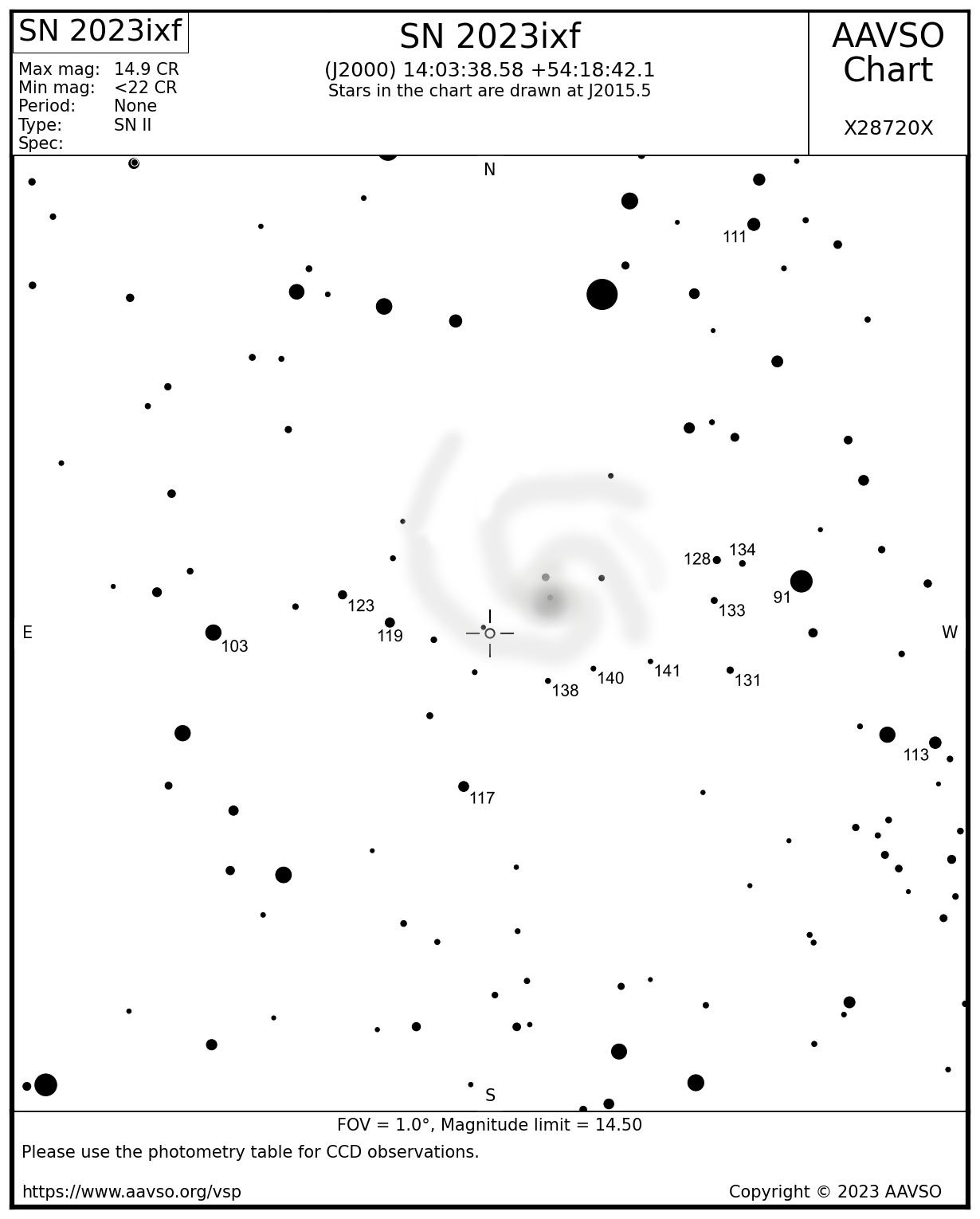
Sky & Telescope’s Bob King has provided a simple overlay of M101 and the supernova onto the AAVSO chart, if it helps visual observers
https://skyandtelescope.org/wp-content/uploads/SN-2023ixf-chart-AAVSO.jpg
Alex.
What is the V filter I read on earlier?
I want to do photometry on this. Do you need a really high focal length telescope e.g. C11 or can you do it with smaller lower focal length refractors?
Can you use a h-alpha filter 7nm bandwidth and do useful photometry ? as I am in a light pollution area.
You can use smaller telescopes – I regularly use a 100mm refractor to measure stars down to 13th magnitude.
The V filter is a Johnson/Cousins V Filter. These are standard photometric filters. You can still work unfiltered or use a colour R, G or B filter as long as you specify which was used.
I don’t believe you would have much success with a narrowband filter.
Hope that helps
Ian
Hi,
What is the V filter I read on earlier?
I want to do photometry on this. Do you need a really high focal length telescope e.g. C11 or can you do it with smaller lower focal length refractors?
Can you use a h-alpha filter 7nm bandwidth and do useful photometry ? as I am in a light pollution area.
Thanks.
Kwong
I think clouds have moved in, just as I’ve changed to a V filter for some photometry. A fresh S/N is a bonus for tonight I was trying out Astroart8 for telescope control, particularly for focusing. If it doesn’t improve shortly I’ll lock up for the night.
Eric
-
This reply was modified 3 years, 5 months ago by
 Eric Watkins.
-
This reply was modified 3 years, 5 months ago by Eric Watkins.
I use it to get the B-V of the target star. I couldn’t find that in the AAVSO data.
Ah.
When I add a new star to my program, I go to https://app.aavso.org/vsp/ and fill in the appropriate fields (Star, FOV, orientation, limiting magnitude, and more) and first get a finder chart, which I print for use at the telescope.
Next the photometry for the sequence in the filters required is downloaded. The B-V values and their errors are provided whether you want them or not, in line with the bottom of the VSP page where we find the words: “V and (B-V) magnitudes are always displayed. Select any other bands you wish displayed below.” A Perl script subsequent mungs the photometry data into a format useful for my current processing pipeline.
I never take a given B-V of the target star as gospel because it can itself vary as the brightness changes. If I want to know a colour index of a VS at a particular epoch I measure it for myself.
Just testing the water here, and you’re opinion’s are very much appreciated.
I have a William Optics Z61 that I was using for Astro imaging. It is a fine telescope for that purpose. But I now want to go back to my roots. And use the MK1 eyeball again. I have been using the telescope visually this afternoon in between rain, and was very impressed at the optical quality. So I know that I can use it for birding as well as night-time observing.
But I really wanted to combine this telescope with my Quark Chromosphere and a UV-IR filter. But I am a little nervous to point the telescope at the Sun, in case the heat does any damage.
Are there any Solar Observers out there using a telescope such as this?
 .